






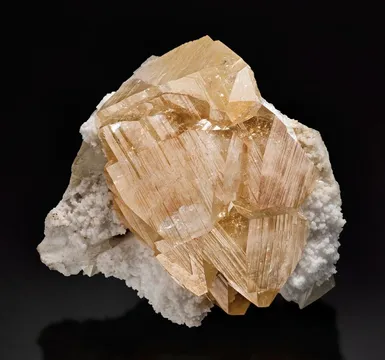
Powellite (CaMoO4) - sharp tetragonal crystals colorless to honey amber, famed for yellow-green fluorescence under shortwave UV; prized by collectors.
Key facts
Powellite (CaMoO4) is the molybdate endmember of the scheelite group and a favorite among fluorescence enthusiasts. Typically occurring as sharp, tetragonal dipyramids and blocky crystals, it ranges in color from colorless to straw-yellow, honey, and amber, sometimes with smoky or brown tones from inclusions. Its signature trait is a vivid yellow‑green fluorescence under shortwave UV, which makes even modest crystals leap to life in a display case. In hand, powellite shows high luster and, in the best examples, excellent transparency; larger crystals can be glassy to slightly resinous.
Collectors encounter powellite in a few distinct geological settings:
Individual crystals are typically a few millimeters to a few centimeters, though larger examples are known. Owing to its lower hardness (about 3.5–4) and brittle nature, pristine terminations and high gloss are prized. The species also forms complete solid solutions with scheelite (CaWO4), and composition can subtly influence both color and fluorescence.
Powellite’s appeal lies at the crossroads of aesthetics and science. Its sharp tetragonal crystals, attractive honey to amber hues, and electric UV response make it a natural for modern mixed-light displays. For decades, collectors sought the Russian “calcite-with-powellite” specimens for their gemmy crystals and dramatic contrasts; in parallel, Indian Deccan Trap pieces offered charming presentations with bright, perfectly positioned crystals on snow-white zeolites—very display-friendly, often affordable, and irresistible under UV.
More advanced collectors chase unusual matrix associations (e.g., on fluorite from Northern China or with classic skarn phases from Crestmore and Långban) and larger, limpid crystals from Dalnegorsk pockets. While powellite is not as rare as some molybdates, top-quality crystals with pristine terminations and strong transparency are uncommon. The finest cabinet specimens can be competitive in price, whereas smaller Indian matrix examples and good thumbnails offer a welcoming entry point. The species’ solid UV performance keeps it relevant in contemporary exhibits and home cabinets alike.
Below are notable sources known for producing powellite specimens that collectors actively pursue. Each offers a distinctive style or association that helps define the species’ range.
From the Deccan Trap basalts, Pandulena Hills produced elegant powellite perched in vugs alongside apophyllite, stilbite, and heulandite. These crystals are typically bright lemon to honey in color, with glassy luster and excellent contrast on white zeolitic matrix. While usually smaller than Russian crystals, their placement is often superb—perfect “cabinet jewelry” that performs brilliantly under SW UV.
Collectors prize clean, undamaged tips and balanced compositions—think a primary powellite crystal perfectly positioned amidst pristine apophyllite blades. Such pieces have become modern classics of Indian basalt mineralogy.
Color and Transparency:
Crystal Form and Luster:
Size and Composition:
Matrix and Associations:
Condition:
Fluorescence:
Repairs:
Cleaning and Alterations:
Treatments:
Powellite is stable but not rugged. With modest hardness and brittle tenacity, it needs gentle handling.
Handling:
Cleaning:
Light and Heat:
Storage:
Transport:
Follow these guidelines and powellite will reward you with superb daytime aesthetics and unforgettable UV performances—an ideal species for collections that celebrate both beauty and mineralogical science.