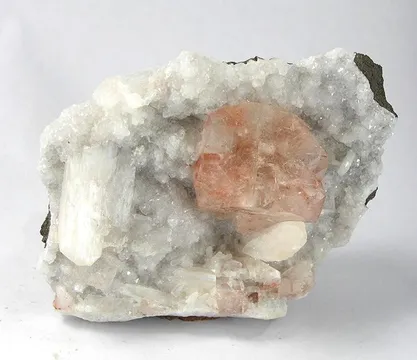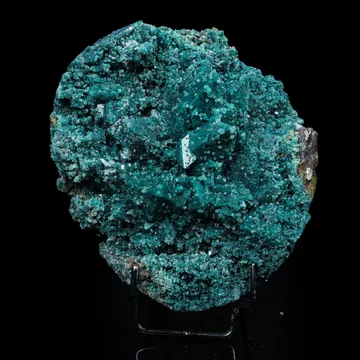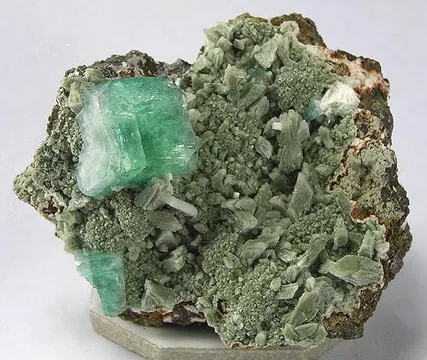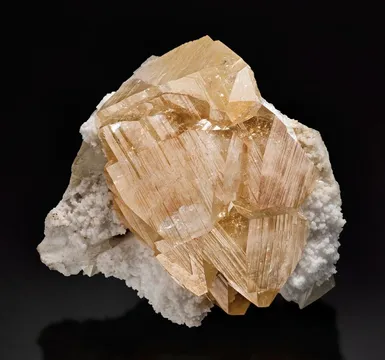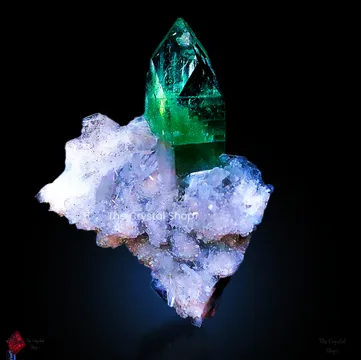
Apophyllite from Nashik, India - glassy, square crystals in pale green to colorless hues; basalt cavity mineral with pristine terminations and striking form.
Key facts
Nashik District is one of the great Indian names for apophyllite: a basalt-quarry district in Maharashtra where glassy, sharp tetragonal crystals occur in the classic Deccan Trap style, commonly perched with stilbite, heulandite, scolecite, quartz/chalcedony, calcite, and other late cavity minerals. In collector usage the name “apophyllite” on Nashik labels most often refers to fluorapophyllite-(K), KCa4(Si8O20)(F,OH)·8H2O, though older labels may still read “apophyllite-(KF)” or simply “apophyllite.” The essential Nashik look is brilliant and architectural: square to blocky crystals, pyramidal terminations, colorless to pale green bodies, and plates that sparkle strongly under ordinary cabinet lighting.
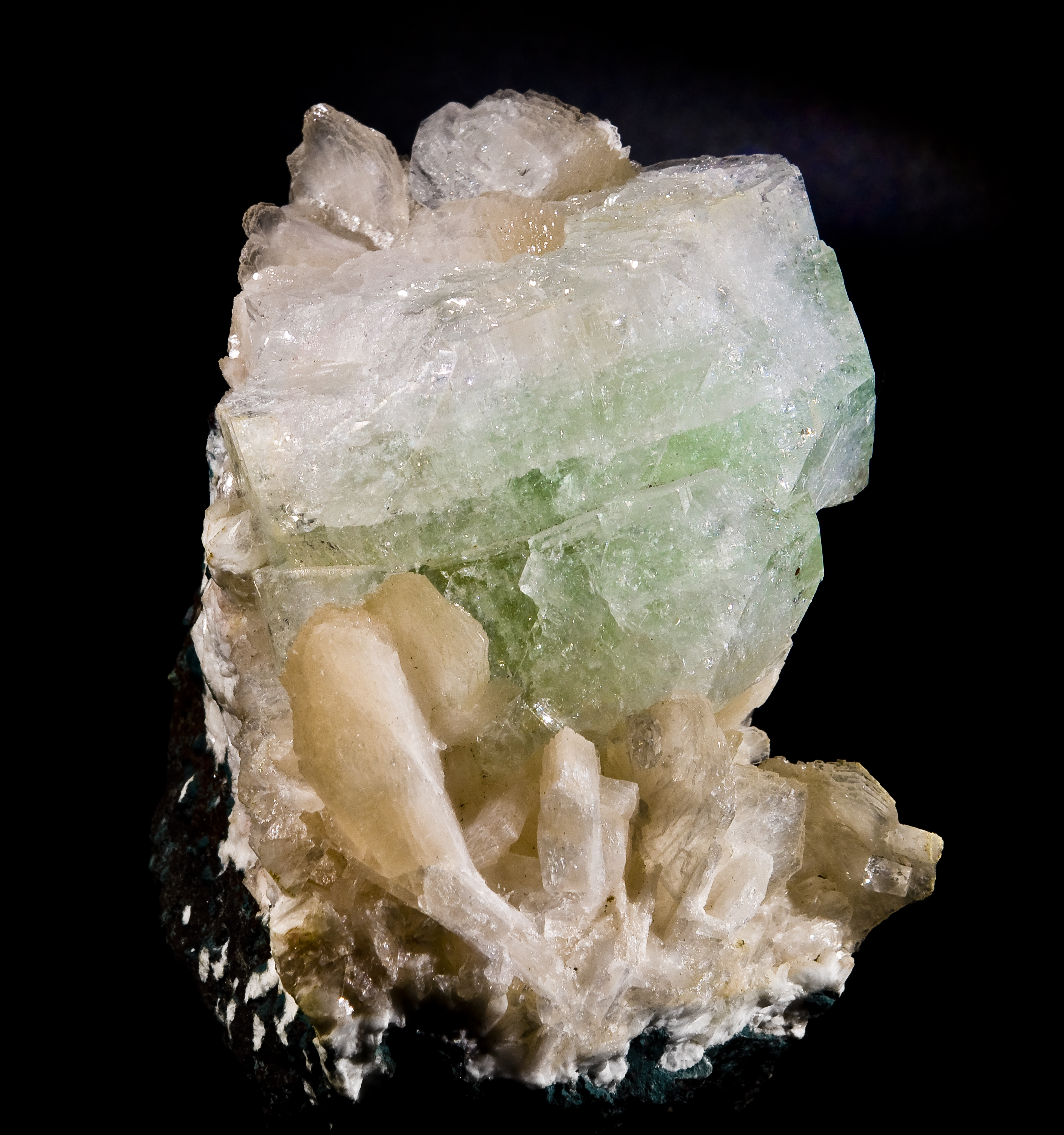
Photo: Wikimedia Commons
The host is not a pegmatite, vein, or skarn, but the cavernous interior of Deccan flood basalts. Gas cavities and larger open voids in tholeiitic basalt flows were repeatedly lined and overgrown by secondary minerals as fluids moved through the cooling and later-altered lava pile. In the best open spaces, the sequence produced smooth chalcedony, sprays and sheaves of zeolites, calcite generations, and late apophyllite with the luster that makes Indian specimens so immediately recognizable. The Nashik material is therefore best understood as a cavity mineral from basalt: apophyllite is not itself a zeolite, but in this district it is inseparable from the zeolite associations that frame it visually.
Nashik differs from the most saturated green Jalgaon and Wagholi material by often emphasizing brilliance, coverage, and form over deep color. Fine Nashik pieces may be nearly water-clear or only faintly green, but the faces can be mirror-bright and the crystals crisply stepped, blocky, or pseudo-cubic. Collectors look for undamaged terminations, clean glassy faces, natural contrast against white to peach stilbite, and strong sculptural composition rather than just color. A pale specimen with superb luster and no bruising will usually outclass a greener one with chipped tips or a crowded, repaired appearance.
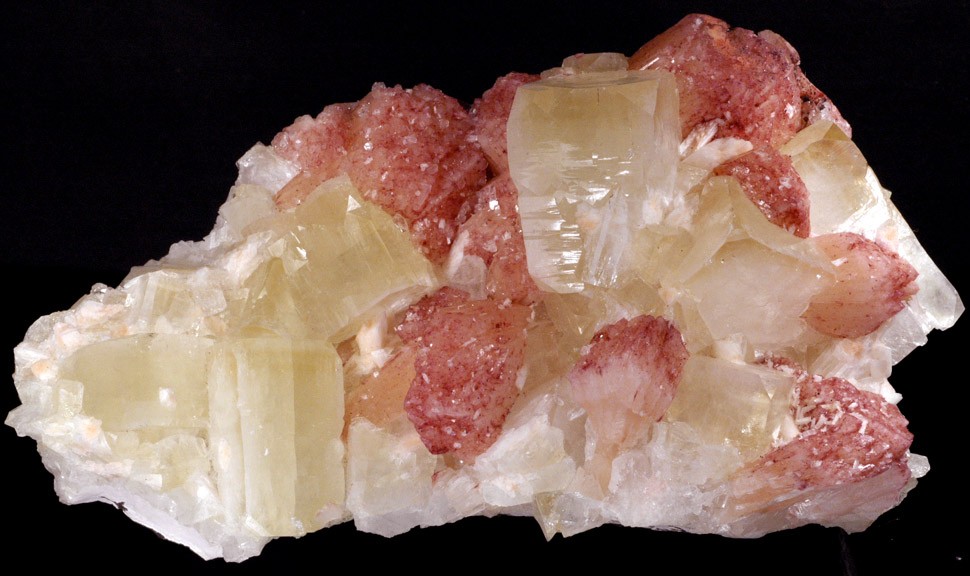
Photo: Wikimedia Commons
Historically, the district’s mineral specimens came as by-products of quarrying and construction work, not from purpose-built specimen mines. Names such as Nashik quarries, Nasik quarry, Mahodari quarry, Odha quarry, Eklara quarries, and local labels around Panduleni, Dindori, Mohu, and Sinnar appear in specimen and literature records. Labels should be read carefully: many older “Nasik quarry” pieces were labeled broadly for the district and may not preserve the exact quarry of origin. That broad-label habit is part of the locality’s collecting history, and it explains why the best provenance often reads “Nashik District” rather than a pinpointed bench or quarry face.
Search for specimens: View all apophyllite specimens from Nashik District, India
Nashik District lies within the western Deccan Volcanic Province of Maharashtra, a vast flood-basalt province built of stacked lava flows. The collectible apophyllite occurs in cavities, amygdales, and larger open spaces within basalt, especially where later fluids were able to move through vesicular zones and fractures. The quarries are hard-rock aggregate quarries; minerals are recovered from cavities opened during extraction rather than from a conventional ore deposit.
In a typical productive flow, the upper and lower parts contain smaller vesicles, while larger cavities may occur in a denser core zone. These cavities can be lined with clay minerals, celadonite or smectite, chalcedony, zeolites, calcite, and later apophyllite. Studies of Deccan cavity mineralization describe multistage precipitation: early clay and silica-related fabrics, later zeolite and calcite episodes, and late hydrothermal crystallization including apophyllite and, in some places, powellite. Nashik-area apophyllite dated by Rb-Sr methods falls into two distinct age clusters, roughly 55–58 Ma and 21–23 Ma, showing that these crystals did not all form immediately after the lava erupted; some grew during much later hydrothermal episodes.
The district’s better-known specimen localities include the general Nashik quarries group, Mahodari quarry near Sinnar, Odha quarry, Eklara quarries, Makhmalabad quarry, and other Nashik-area quarry labels. Scientific samples have also been documented from Panduleni, Dindori, Mohu, and Mahodari. In specimen commerce, however, exact locality precision varies widely. “Nashik,” “Nasik,” “Nasik quarry,” and “Nashik District” are all seen, and older labels may not distinguish between the district, a specific quarry, or a dealer’s locality convention.
The mining history is tied to basalt quarrying and infrastructure rather than precious-metal or gemstone extraction. Mineral specimens from the western Deccan Traps became increasingly visible to collectors from the 1970s onward as quarrying and construction expanded and dealers learned to recognize, trim, and export the cavity pieces. A Mindat locality photograph records Odha quarry in 1974, while modern scientific observations on Deccan secondary minerals include field and specimen observations spanning 1996–2016. Many of the district’s finest pieces moved through dealer networks rather than formal mine records, so individual pocket histories are often preserved only in specimen labels, old dealer descriptions, or collection pedigrees.
Collecting access should be treated as restricted. These are working or former aggregate quarries, not public dig sites. Safe access requires permission from the landowner, quarry operator, and any relevant mineral-rights holder, plus appropriate quarry safety precautions. Unstable faces, blasting areas, heavy machinery, and freshly broken basalt make casual collecting unsafe and often illegal. Most collectors will encounter Nashik apophyllite through established dealers, old collections, and museum or online specimen records rather than by field collecting.
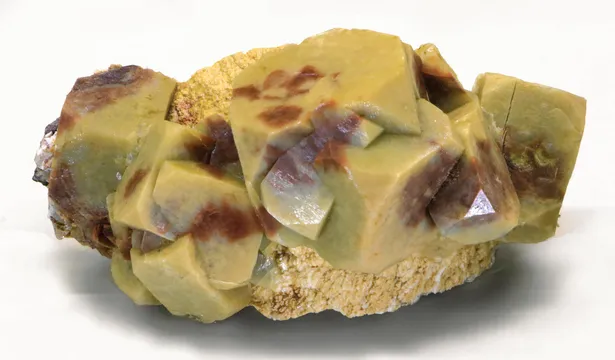
Notable finds include large sparkling plates of clear to green apophyllite on stilbite, unusual blocky “marshy apophyllite” floaters with yellow-brown clay or chlorite inclusions, and sharply crystallized green to blue-green pieces influenced by celadonite. The most desirable Nashik specimens combine a crisp apophyllite focal crystal or cluster with contrasting zeolite matrix and minimal edge bruising.
Nashik apophyllite is most familiar in blocky tetragonal crystals with square cross-sections and pyramidal terminations. Many crystals look “cubic” at first glance, but the symmetry and termination geometry identify the apophyllite habit. Common forms include stout prisms, pseudo-cubic crystals, stepped blocky crystals, small sparkling carpets, and less common complex twins or floater-like groups. Older descriptions also refer to “fish-tail” forms in Indian apophyllite more broadly; for Nashik, well-defined twins are collectible when the terminations remain sharp.
Colors range from colorless and white to pale green, yellowish green, blue-green, and, rarely, unusual yellow-brown or umber included material. The green may be subtle and watery, concentrated as zones or phantoms, or influenced visually by celadonite in the matrix or as inclusions. Some specimens show clay-rich or chloritic inclusions that give a mossy, smoky, yellow-brown, or “marshy” appearance. These included pieces are not the classic jewel-green Jalgaon style, but advanced collectors may prize them because they are distinctive to particular Nashik finds and show unusual internal texture.
Typical crystals on commercial cabinet specimens range from a few millimeters to several centimeters. Documented examples include apophyllite crystals around 1 cm on quartz stalactitic growths, lustrous greenish blocky crystals to over 4 cm on cabinet specimens, and exceptional included or blocky crystals of roughly 4.5 cm on edge. Scientific sample material from the broader Deccan study included apophyllite crystals as large as 4 × 4 × 1 cm from Savda and Nashik-area hand specimens containing stilbite and apophyllite. For Nashik, the most attractive cabinet pieces are often plates rather than isolated singles: a basalt or chalcedony base carrying many bright crystals with stilbite sheaves for contrast.
The principal associates at Nashik are stilbite-Ca and the stilbite subgroup, heulandite subgroup minerals, scolecite, quartz varieties including chalcedony and rock crystal, calcite, okenite, gyrolite, goosecreekite, epistilbite, laumontite, powellite, celadonite, and, at Mahodari especially, minerals such as fluorite, hematite, gypsum/selenite, and yugawaralite have also been recorded. Apophyllite with peach, cream, or white stilbite is the standard collector combination. Apophyllite on chalcedony gives a crisper, brighter look; apophyllite with scolecite adds delicate radial sprays; apophyllite with celadonite can show the sought-after blue-green tone.
Quality depends first on condition and luster. The best Nashik crystals have glassy, reflective faces, crisp edges, and undamaged pyramidal tips. Transparency matters, but a translucent specimen with exceptional form and color can still be very desirable. Green color adds value when natural-looking, evenly distributed, and paired with strong luster; however, a pale green or colorless specimen with superb brilliance may be more collectible than a darker but cloudy cluster. Matrix trimming also matters. A neatly reduced back is acceptable, but over-sawn bases, awkward cuts through the mineralized pocket, or visible saw marks can reduce the sense of natural cavity context.
The first authenticity issue with Nashik apophyllite is locality precision. “Nasik quarry” on an old label may mean a specific quarry, the Nashik quarry group, or simply Nashik District. Broad locality labels are common and not automatically suspicious, but they should be treated differently from a documented quarry name such as Mahodari, Odha, or Eklara. Specimens with old dealer labels, collection numbers, or matching photographic records deserve a premium when the exact locality matters.
Routine dyeing is not a documented norm for Nashik apophyllite. Green coloration in Indian apophyllite is generally accepted as natural, and green material in or on the matrix may be celadonite or other clay minerals. A collector concern sometimes arises when washing releases greenish water; in a Deccan basalt specimen, loose celadonite-rich clay in the matrix is a more likely explanation than dyed apophyllite. Still, very saturated, unnaturally uniform color sitting in cracks, glue lines, or porous matrix should be inspected under magnification.
Repair and assembly are more realistic concerns than dye. Apophyllite has perfect basal cleavage and brittle edges, so large crystals can detach cleanly along planar surfaces. Look for straight seams, misaligned crystal faces, glossy adhesive lines, unnatural piles of crushed zeolite between crystals, and matrix rubble placed to conceal joins. A longwave UV light and 10× loupe can help reveal some epoxies, though not all adhesives fluoresce. Repairs are not automatically disqualifying on important specimens, but they must be disclosed and priced accordingly.
Condition issues are common. The most vulnerable points are the pyramidal tips, sharp square edges, and projecting crystals at the edge of a plate. Bruising appears as dull white chips or frosted spots interrupting otherwise glassy faces. Basal cleavages may look like internal cracks or flat reflective planes. Scolecite, okenite, and delicate zeolite associates can be more fragile than the apophyllite itself, so cleaning should be conservative. Avoid ultrasonic cleaners, acids, boiling, steam, and heat. Use gentle dusting, careful rinsing only when the associations tolerate water, and always support the matrix rather than the crystals.
Rarity is tiered. Ordinary small pale apophyllite-and-stilbite pieces from Maharashtra are abundant, and Nashik-labeled examples remain available on the market. Fine Nashik pieces with large undamaged crystals, old provenance, dramatic green or blue-green color, unusual inclusion texture, or exceptional composition are much less common. The unusual “marshy apophyllite” style, in which blocky crystals contain yellow-brown clay/chlorite-like inclusions, is a niche but legitimate collector subcategory. It does not have the universal appeal of gemmy green apophyllite on white stilbite, but it is visually distinctive and worth recognizing.
Current market availability is good for cabinet and large-cabinet pieces. Recent marketplace listings show Nashik apophyllite with stilbite, heulandite, and chalcedony in sizes from roughly 10 cm cabinet pieces to 25 cm large-cabinet plates, with asking prices ranging from modest cabinet-level figures to several thousand dollars for large, colorful display specimens. At the upper end, pay for crystal integrity, luster, composition, and credible locality information—not simply the word “rare” in a sales title.
One of the most memorable Nashik side stories belongs to the material that dealers called “marshy apophyllite.” It was not the clean, mint-green, backlit apophyllite that many collectors expect from India. It was stranger: blocky, complete floater-like crystals in an umber-yellow tone, with included clay or chloritic material giving the crystals a swampy, internal cast. A Rob Lavinsky description of one 6.8 × 6.3 × 6.2 cm specimen records the first reaction honestly: at first the pieces seemed ugly, then, in hand, their sharp tetragonal geometry and unusual color became the appeal. Another specimen description from a 2018 auction described the find as coming from small Nashik finds roughly 10 to 15 years earlier, with a large 4.5 cm crystal on edge and iron-oxide red inclusions adding to the odd palette. The inclusions were at one time suspected to be mozartite, a rare calcium manganese silicate, but that interpretation did not hold for the locality; clay or chlorite became the more credible explanation.
Another pocket story survives in the caption of a Nasik District stilbite-apophyllite specimen photographed by Rob Lavinsky. The piece measured 18.5 × 10.3 × 7.5 cm and carried red-pink stilbite blades to 3.0 cm intermixed with glassy yellowish-green apophyllite crystals to 4.2 cm. The note is valuable because it catches a real market moment: the pocket had been found about three years before the photo record, and when the pieces arrived in Tucson, collectors and dealers “grabbed them as fast as possible.” That is the kind of detail that explains why some Nashik pieces in old collections seem to have vanished quickly into private hands rather than lingering in dealer stock.
A quieter but important field note comes from the scientific sampling of Nashik-area specimens. Four Nashik-area hand specimens were selected for Rb-Sr age work: stilbite and apophyllite from Panduleni, Dindori, Mohu, and Mahodari. Their calculated Rb-Sr ages did not form one simple number. Instead, Nashik apophyllites clustered in two widely separated intervals, about 55–58 Ma and 21–23 Ma. For collectors, that means the pocket lining is not merely a frozen bubble from the instant the basalt cooled. A Nashik specimen may carry the record of fluid pathways reopening or remaining active across tens of millions of years, long after the lava itself had become rock.