






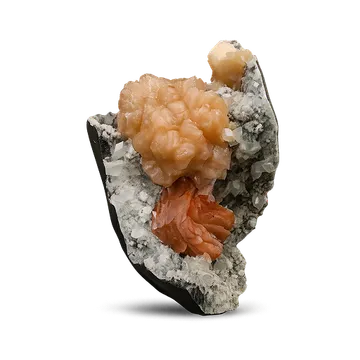
Heulandite — lustrous bladed to tabular crystals with pearly sheen in peach, pink, or green-included colors; forms in Deccan Traps vesicles, Nashik District.
Key facts
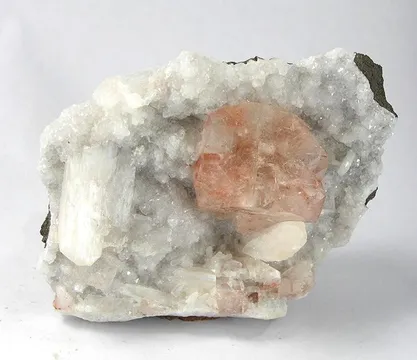
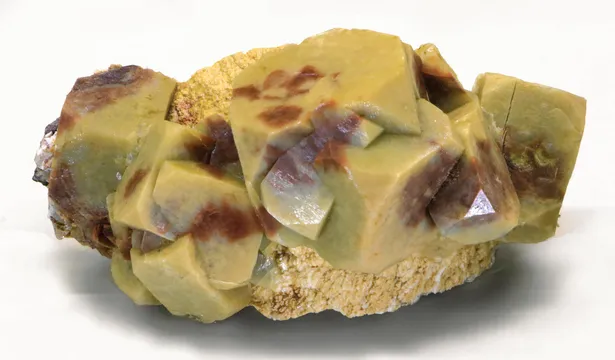
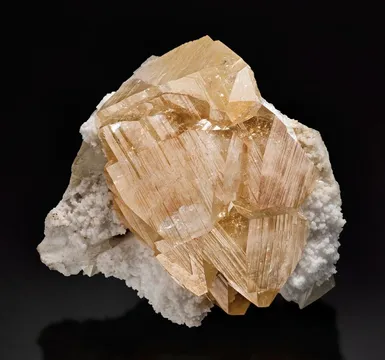
Nashik District heulandite is one of the classic Indian zeolite appearances: lustrous, bladed to thick-tabular crystals with a pearly sheen, usually peach, salmon, pink, cream, colorless, or — in the most coveted pieces — green from microscopic celadonite or aluminoceladonite inclusions. The best specimens have a buoyant, sculptural quality: curved plates that flare into bow-ties, sheaves, butterflies, fans, and complete floater groups, often set against snowy mordenite, quartz, stilbite, scolecite, apophyllite, or dark basalt.

Photo: Wikimedia Commons
The locality belongs to the great zeolite province of the Deccan Volcanic Province, where secondary minerals crystallized in vesicles, amygdales, and larger open cavities in basaltic lava flows. Nashik is not a single “mine” in the hard-rock ore sense; it is a district-scale collecting and quarrying region, with named places such as Mahodari, Panduleni, Dindori, Mohu, Eklara, Odha, Sinnar-area quarries, and the broader Nashik quarry group appearing in mineralogical records and specimen labels. These cavities were mineralized in pulses: early clay minerals and silica, then zeolites and carbonates, followed in some settings by apophyllite and other late minerals.

Photo: Wikimedia Commons
For collectors, Nashik heulandite sits in an attractive middle ground. It is abundant enough that good cabinet specimens still circulate, yet the finest pieces — clean floaters, saturated green celadonite-included crystals, large undamaged fans, and richly associated pieces with scolecite, mordenite, stilbite, quartz, or apophyllite — are much more selective. A modest Nashik heulandite can be pretty; a great one has the unmistakable architecture of the Deccan Traps: curving pearly blades grown in a basalt cavity like frozen movement.
Search for specimens: View all heulandite specimens from Nashik District, India
Nashik District lies within the western Deccan Traps, a vast flood-basalt province whose collector specimens come principally from cavities in basalt rather than from ore veins. In the Nashik quarry fields, heulandite occurs as a secondary cavity mineral in lava flows, together with other zeolites, silica minerals, carbonates, and clay minerals. The setting is exactly the kind that made Maharashtra famous among mineral collectors: hard black basalt broken open by road-metal and building-stone quarrying, revealing cavities lined with crystals.
The most useful way to understand the deposit is as a quarry-hosted zeolite occurrence. Vesicles and amygdales may be completely filled by clay minerals, chalcedony, epistilbite, and heulandite, while larger cavities in denser basalt can preserve free-standing crystals of heulandite, stilbite, calcite, apophyllite, and quartz or chalcedony. In the Nashik area, heulandite is not an accessory curiosity; it is one of the recurrent cavity minerals, recorded repeatedly from named localities and from the district as a whole.
Named Nashik District localities and collecting labels include the Nashik quarries; Mahodari quarry near Sinnar; Nashik 1 and Nashik 2 in the mineralogical literature; Eklara and Odha quarries; and specimen-label localities around Panduleni, Dindori, Mohu, and Mahodari. Older specimen labels often use “Nasik,” the former spelling commonly seen on classic labels, dealer stock, and museum records.
The mining history is tied to commercial basalt quarrying rather than a dedicated heulandite mine. Collectors and dealers obtained material when construction quarries exposed fresh cavities. Production was therefore episodic: a quarry wall might yield nothing of interest for weeks, then a blast or extraction bench could expose a pocket of heulandite, stilbite, scolecite, quartz, or apophyllite. Many specimens in circulation date from the late twentieth and early twenty-first century collecting boom for Indian zeolites, with documented Nashik pieces appearing in collections by the early 2000s and earlier.
Access is controlled by quarry ownership and active industrial work. These are not casual public collecting sites. The correct assumption is that permission is required, working faces are dangerous, and freshly blasted cavities may be unstable. Much of the collector supply has historically come through local quarry workers, Indian dealers, and established mineral dealers rather than through open recreational collecting.
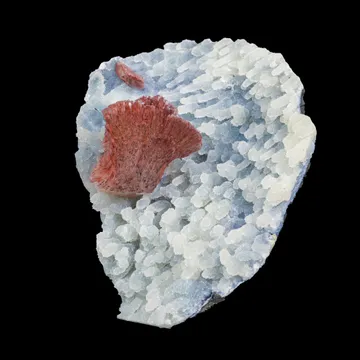
Notable finds include green heulandite crystals colored by celadonite or aluminoceladonite inclusions, salmon to red-orange fan groups, heulandite with mordenite from Mahodari, heulandite on quartz, heulandite associated with scolecite balls, and heulandite-rich matrices carrying later apophyllite or rarer species such as powellite. The district’s best heulandite is prized less for sheer rarity than for form, color, luster, completeness, and association.
Nashik heulandite is typically heulandite-Ca or heulandite subgroup material in collector labeling, with the heulandite-Ca formula commonly written as (Ca,Na)5(Si27Al9)O72·26H2O. Many labels and older descriptions simply say “heulandite,” especially when the exact cation-dominant species has not been analytically confirmed.
The classic crystal habit is tabular to bladed, often with curved faces and a pearly luster on broad cleavage surfaces. Good specimens may show single blades, radiating sprays, bow-ties, butterflies, fan-shaped groups, sheaf-like clusters, rosettes, or intergrown plate groups. Complete floater crystals and doubly terminated curved blades are especially desirable because heulandite’s cleavage and tabular habit make damage easy to spot.
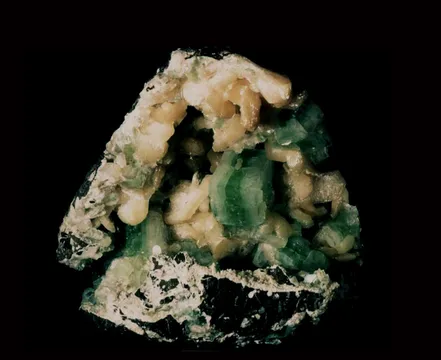
Color is one of Nashik’s strongest selling points. The common palette ranges from cream and colorless through peach, salmon, pink, orange-pink, and reddish tones. Green specimens are the connoisseur category: the color is produced by tiny inclusions of celadonite or aluminoceladonite rather than by the heulandite structure alone. The best green crystals have an internal mossy or bluish-green tone combined with pearly, sharply defined crystal faces.
Typical specimen sizes range from thumbnails and miniatures to small-cabinet and cabinet pieces. Individual heulandite crystals around 1–4 cm are common enough in better specimens; larger bladed groups and fans are more selective. Literature on comparable Deccan Trap cavities records well-developed heulandite crystals up to 10 cm in exceptional settings, while dealer and photo records from Nashik District document large display pieces with heulandite groups, quartz, mordenite, calcite, stilbite, and apophyllite associations.
Important associated minerals from Nashik District include stilbite-Ca, stilbite subgroup minerals, stellerite, scolecite, natrolite, mordenite, quartz, chalcedony, fluorapophyllite-(K), calcite, celadonite, aluminoceladonite, hematite, goosecreekite, laumontite, powellite, prehnite, okenite, gyrolite, and epistilbite. Not every association is equally common at every quarry. Mahodari labels are especially familiar for heulandite with mordenite or quartz-rich associations, while district-wide labels may include heulandite with stilbite, scolecite, apophyllite, celadonite, or chalcedony.
Quality is judged first by form: sharp, three-dimensional, undamaged fan or floater groups outrank flat drusy coverage. Luster is next; the best Nashik heulandite has a pearly glow rather than dull, chalky surfaces. Color matters greatly: clean salmon-pink and saturated green pieces are more valuable than pale tan or bruised crystals. Association can elevate a specimen when the composition is balanced — for example, a peach heulandite fan perched on white mordenite, a green heulandite floater, or heulandite framing a transparent apophyllite crystal.
The main authenticity issue is labeling, not treatment. “Nashik” may mean Nashik District, the city-area quarry group, an older “Nasik” dealer label, or occasionally a broader commercial label applied to zeolites from the Nashik Division or neighboring Maharashtra districts. Serious collectors should distinguish Nashik District from Jalgaon District, Pune District, Aurangabad/Chhatrapati Sambhajinagar area material, and Sakur/Shakur labels that may be marketed broadly as “Nashik area” but are not necessarily Nashik District in the strict modern administrative sense.
Green heulandite deserves a second look. Natural Nashik green crystals owe their color to included celadonite or aluminoceladonite, and the green is normally internal, uneven, mossy, or inclusion-like rather than a flat surface stain. A good hand lens should show the color belonging to the crystal mass or inclusions, not sitting as paint in cracks. Strong artificial color, suspiciously uniform green staining on matrix, or green concentrated only along broken edges should be treated cautiously.
Condition is a major factor. Heulandite has perfect cleavage, so broken blades, bruised fan edges, and cleaved terminations are common. Damage may be hidden among overlapping plates, especially in bow-tie and sheaf groups. Scolecite associations add another risk: acicular sprays can be excellent visually but are fragile and easily crushed. Mordenite and other fibrous white zeolites can also trap dust and look dull if handled poorly.
Matrix stability varies. Basalt matrix is usually robust, but cavity linings of mordenite, clay minerals, chalcedony crusts, or delicate secondary zeolites can be friable. Avoid soaking fine Nashik zeolite specimens unless you know exactly what is present; some associated zeolites and clay-rich linings do not tolerate aggressive cleaning, ultrasonic treatment, or repeated wetting and drying.
Market availability remains good for ordinary Nashik and Maharashtra heulandite, but the best district-attributed examples are selective. Common small specimens with peach heulandite and stilbite are affordable. Fine green celadonite-included floaters, large cabinet plates, sharply crystallized salmon fans, and clean multi-species pieces with apophyllite, scolecite, quartz, mordenite, or powellite command stronger prices. Documentation matters: an old label, a precise quarry name, a known collection history, or an analytical note for green aluminoceladonite-included material can make a substantial difference.
One of the most evocative Nashik heulandite stories is a small green floater collected in the summer of 2001. The specimen is only 6 cm across, but its description captures what collectors love about this district: a fine, sharp, slightly curved single heulandite crystal, free enough to stand as an object rather than a patch of crystals on basalt. Celadonite inclusions colored it in several shades of green, giving a layered, living quality to the crystal instead of a simple surface tint. The piece passed into the Mario Pauwels collection and was photographed by Joaquim Callén — exactly the kind of documented early-2000s Indian zeolite that now carries its own period charm.
Another famous collector description turns a 5 x 3 x 2.2 cm heulandite-Ca with celadonite into a miniature portrait. The specimen was praised for its forest-green color, excellent luster, and the fact that it was terminated on all four sides. The detail that makes the description memorable is its thickness: at 3 cm, unusually stout for this style of heulandite, it was said to have the look of “a luxurious, curved pillow.” It also carried an ex-Charlie Key provenance, linking a very specific Nashik habit — thick, green, lustrous, included heulandite — to the older collector network through which many top Indian zeolites circulated.
There is also the collector’s problem of the perfect nickname. A later heulandite-Ca with celadonite inclusions from the broader Nashik collecting world formed a circular arrangement of sharp, pearly, curved doubly terminated crystals. Jack Halpern called it “The Ring.” The name was apt: the heulandite did not simply sit there as a mineral species; it made a shape a collector could remember. Halpern’s eye was famous for color, proportion, and style, and the piece came from a collection built around beauty as much as rarity. For Indian zeolites, that is often the decisive quality — not merely what species is present, but whether the cavity gave the crystals room to become sculpture.
A different kind of Nashik field note comes from the science of the Deccan basalt cavities. In published work on secondary minerals of the Deccan Volcanic Province, Nashik samples were taken from places such as Panduleni, Dindori, Mohu, and Mahodari. These are not romantic pocket names; they are coordinates, sample numbers, and hand specimens: stilbite and apophyllite from Panduleni, stilbite and apophyllite from Dindori, heulandite with stilbite and apophyllite from Mohu, quartz with stilbite and apophyllite from Mahodari. In collector language those are attractive zeolite associations. In geological language they are clues to a long, pulsed history of fluids moving through basalt after eruption.

,_mord%C3%A9nite_1.JPG)