Monte Cristo mine, USA — iconic Rush Creek zinc locality in Arkansas, producing yellow to orange smithsonite botryoids and saddle-like dolomite replacements.
Key facts
Monte Cristo is one of the essential American smithsonite localities: a compact, deeply Ozarkian zinc mine in the Rush Creek district of Marion County, Arkansas, where Ordovician carbonate beds, faulting, brecciation, cave-like openings, and later weathering combined to make specimens with a look unlike the blue-green smithsonites of New Mexico or the pastel material of the European classics. Its fame rests on cadmium-rich, yellow to orange “turkey fat” smithsonite, commonly as botryoidal crusts and sparkling replacements after curved saddle-shaped dolomite crystals. The mine is also important geologically, because its bedded and breccia-hosted zinc ores became a case study in Mississippi Valley–type mineralization, with sphalerite and sparry dolomite in prepared ground later overprinted by supergene zinc carbonates. Historically, Monte Cristo belongs to the Rush mining landscape, a once-busy zinc camp along the Buffalo River whose boom years were tied to the high zinc demand of World War I and whose mine openings are now part of a protected cultural landscape.
Regional View
Country View
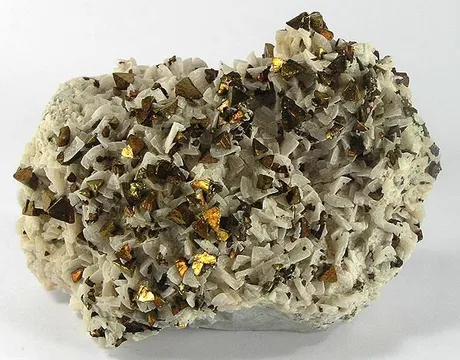
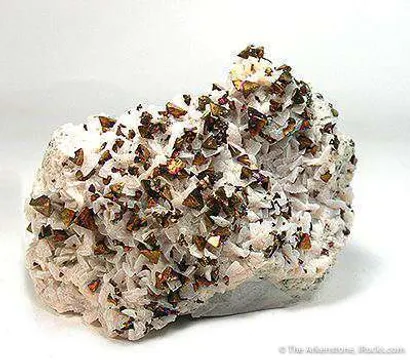
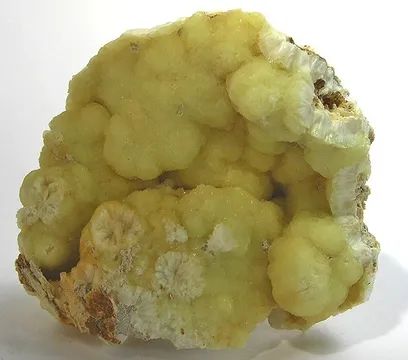
The best Monte Cristo specimens are immediately recognizable: lemon-yellow, mustard, burnt-orange, tan, gray, or chocolate-brown smithsonite with a satin to pearly luster, often preserving the looping, saddle-like geometry of dolomite beneath. Fine pieces show clean three-dimensional relief, individual replaced dolomite forms standing proud from a silicified or dolomitic matrix, and strong color contrast with drusy quartz, dark sphalerite, white calcite, or gray zinc oxide. The finest combination specimens can be surprisingly sculptural for an Ozark zinc mine, especially those with sharp calcite rhombs scattered across orange smithsonite or greenockite-rich yellow botryoids set over quartz.

Photo: Wikimedia Commons

Photo: Wikimedia Commons
Search for specimens: View all specimens from Monte Cristo mine, USA
Monte Cristo mine is in the Rush Creek Mining District near the former mining town of Rush, Marion County, Arkansas, on the south flank of the Ozark uplift and within what is now the Buffalo National River historic landscape. The mine is recorded at about 36° 7' 59" N, 92° 33' 16" W, and older labels may spell the name “Monte Christo,” a spelling now generally treated as a misnomer. The deposit is a zinc mine in fractured Everton Dolomite, part of the Ordovician carbonate-sandstone succession that hosts the classic Rush district zinc ores.
The Rush district ores are Mississippi Valley–type in character: sphalerite-bearing replacement and cavity-fill mineralization in carbonate rocks, localized by faulting, brecciation, dissolution, and favorable bedding horizons. The important ore runs of the restricted Rush district are related to the Rush Creek, Monte Cristo, and Silver Hollow faults, but the productive ore bodies were not simply vein fillings on fault planes. They developed in prepared ground near those structures, especially in certain dolomitized limestone and dolomite horizons of the Everton Formation. Regional studies describe bedded ores along contacts involving sandstone above and carbonate below, plus breccia ores in which sphalerite and sparry dolomite occupy porosity and replace favorable carbonate rock. Fluid-inclusion and stable-isotope work on Monte Cristo material indicates hot, saline brines, consistent with a deep-burial MVT system, followed by cooler meteoric waters that helped generate the oxidized zinc-carbonate assemblage collectors prize today.
In mining terms, Monte Cristo produced zinc rather than precious metal. The primary ore mineral was sphalerite, the “jack” of local miners, accompanied by dolomite, quartz, calcite, and lesser sulfides. Weathering of the sulfide ore generated smithsonite, hydrozincite, and other secondary zinc minerals in openings, vugs, and fractures. This supergene stage is what made the mine famous to collectors: not mass ore, but colorful zinc carbonate crusts and pseudomorphs in the old cavities. At Monte Cristo the collector specimens commonly show yellow cadmian smithsonite after dolomite, smithsonite on sphalerite, smithsonite on quartz, and smithsonite with calcite; some pieces carry greenockite as powdery yellow coatings or inclusions that intensify the “turkey fat” color.
Monte Cristo was part of the Rush boom rather than an isolated mine. Zinc had been recognized in the Rush area in the 1880s, and Morning Star became the district’s great early operation. By the World War I years, when zinc was needed for brass, galvanized products, and war industries, Rush grew into a vigorous mining camp. Contemporary accounts put thousands of people in the district at peak, with mills, tramways, boarding houses, stores, and hillside mine openings spread across the steep valleys of Rush Creek, Clabber Creek, and the Buffalo River. Monte Cristo itself was worked during the war years and was later reopened or promoted in the 1930s; newspaper accounts mention a long tunnel, renewed development, Milwaukee investors, J. H. Hand of Yellville as a local manager, and plans for a 100-ton concentrating plant. The broader Rush district produced far more zinc than any other northern Arkansas district, though production figures are incomplete and much of the historical record is scattered among government reports, newspapers, and later local histories.
The last mining at Monte Cristo is generally given as 1962, making it the final operating mine in the old Rush district. After the creation of Buffalo National River in 1972, the area became a protected cultural landscape rather than a collecting ground. The National Park Service has described the Rush district as containing numerous abandoned prospects, adits, and shafts; many mine openings are unstable and have been gated both for visitor safety and for protection of cultural, mineral, and bat habitat resources. Monte Cristo entrances were among the first gated by the park in the 1990s. Modern collecting inside the protected park mine workings is not an option; specimens on the market come from old collections, historic collecting before closure and gating, and material already dispersed through dealer and collector networks.
The notable specimen-producing pockets appear to have been small, discontinuous, and strongly controlled by local cavity conditions. One especially memorable 1975 find by Ed Ruggiero produced orange-yellow botryoidal smithsonite with colorless calcite rhombs; surviving examples are considered exceptional because they combine rich color, vuggy relief, and a calcite “snowfall” effect not seen on ordinary Rush smithsonite. Another recognized style consists of yellow-greenockite-included smithsonite botryoids over drusy quartz and greenockite, associated with older Arkansas collecting material and reportedly represented by more than one specimen from a 1967 pocket. Large plates exist, including smithsonite-sphalerite combinations, but most high-quality Monte Cristo specimens are thumbnails to small-cabinet pieces, where color, relief, luster, and preservation matter more than sheer size.
Smithsonite is the mineral that made Monte Cristo a collector locality, especially the cadmium-rich yellow to burnt-orange “turkey fat” material that coats, encrusts, or replaces earlier saddle-shaped dolomite crystals. The classic pieces are pseudomorphs after dolomite, retaining curved rhombic to saddle forms as nubby, sparkling, pearly, or satin-lustered smithsonite on gray dolomite, silicified limestone, quartz boxwork, or sphalerite; other examples are botryoidal crusts ranging from cream and white through tan, gray, brown, chocolate, yellow, and orange. Verified specimen records show thumbnails around 2–3 cm, miniatures around 4–6 cm, and cabinet pieces above 10 cm, with a few very large plates such as a 33 cm smithsonite-sphalerite specimen recorded from the mine. The best Monte Cristo smithsonites have saturated yellow or orange color, undamaged saddle-shaped relief, isolated three-dimensional forms rather than flat crust, sharp contrast against dark sphalerite or drusy quartz, and credible old labels tying them specifically to Monte Cristo rather than merely to Rush.
Dolomite at Monte Cristo is both a host and a specimen mineral, but its special collector value lies in the saddle-shaped crystals that became the template for the mine’s famous smithsonite pseudomorphs. Unreplaced or partly replaced dolomite occurs as curved, rhombic, saddle crystals on gray Everton dolomite or silicified carbonate matrix, commonly associated with smithsonite and, in some specimens, quartz. Fine dolomite pieces from this mine are seldom sought as isolated “pure dolomite” showpieces; they are valued when the saddle crystals are sharp enough to explain the pseudomorphic smithsonite habit, when patches of yellow or brown smithsonite selectively coat the forms without obliterating them, or when the dolomite provides a clean structural matrix for later calcite, sphalerite, quartz, or greenockite-rich coatings.
Other minerals documented from Monte Cristo include aragonite, calcite, chalcopyrite, enargite, gypsum, hydrozincite, malachite, quartz, sphalerite, and the problematic historical name “zeiringite.” Greenockite is also strongly associated with Monte Cristo specimen material in photo and dealer records, especially as powdery yellow coatings or inclusions in the yellow smithsonite. Sphalerite is the principal primary zinc sulfide and appears in brown to dark, resinous to black “jack” masses or crystals beneath secondary smithsonite. Calcite can be highly aesthetic where colorless rhombs decorate orange smithsonite, while quartz appears as drusy or boxwork matrix beneath smithsonite and greenockite-rich coatings. Enargite and chalcopyrite are far scarcer collector minerals here and are best regarded as accessory sulfide occurrences rather than display species; “zeiringite” should be treated cautiously on labels because it is not a modern, well-established species entry in the way smithsonite, sphalerite, dolomite, calcite, and quartz are.
Monte Cristo specimens are not common in fresh supply. The locality is closed to collecting in the Buffalo National River setting, and attractive pieces generally circulate from older Arkansas collections, estate material, or long-held dealer stock. Expect good thumbnails and miniatures to appear more often than fine cabinet specimens; large, undamaged plates with strong yellow-orange color and readable pseudomorphs are genuinely scarce.
The main authenticity issue is locality precision. “Rush,” “Rush Creek district,” “Philadelphia mine,” “Morning Star mine,” and “Monte Cristo mine” are all seen on labels for similar yellow smithsonite, and specimens from different Rush mines can be visually difficult to separate without reliable provenance. A label that merely says “turkey fat smithsonite, Rush, Arkansas” should not be upgraded to Monte Cristo unless supported by an older mine-specific label, collection history, specimen card, or published photo record. The old spelling “Monte Christo” is not automatically suspicious; it appears widely on historical labels and in older references.
Condition is critical. The saddle-shaped smithsonite pseudomorphs are commonly exposed on raised ridges, so edge bruising, rubbed high points, broken crystal crests, and contact scars are frequent. Botryoidal crusts may look forgiving in photographs but often show tiny impact points or dull rubbed areas under magnification. Calcite-associated pieces require extra caution: clear rhombs can be chipped, cleaved, or selectively knocked off, leaving the smithsonite below intact but the combination aesthetically weakened. Greenockite-rich or powdery yellow coatings should be handled gently and kept out of aggressive cleaning baths.
Color deserves scrutiny but not paranoia. Monte Cristo smithsonite naturally ranges from white and cream through gray, tan, brown, yellow, orange, and chocolate-brown. Bright yellow “turkey fat” color is typically attributed to cadmium-rich or greenockite-included material, while some brown tones have been linked to minor iron. Avoid judging authenticity by color alone; habit, matrix, associations, luster, and provenance matter more. No routine treatment is expected for classic Monte Cristo smithsonite, but old specimens may have been washed, trimmed, glued to bases, or repaired like any fragile vug specimen.
Fluorescence is not the defining feature of this locality. Some associated calcite may respond to ultraviolet light, but Monte Cristo is bought for habit, color, association, and history rather than for fluorescence. For display, keep specimens dry, dust them with air rather than water or chemicals, and avoid prolonged handling of powdery greenockite-bearing surfaces. From a market perspective, the strongest pieces combine mine-specific provenance, undamaged relief, saturated yellow-orange color, visible saddle-shaped pseudomorphs, and attractive associations such as sphalerite, quartz, or calcite.
Rush began with a mistake that became an industry. Prospectors came into the Buffalo River country chasing stories of silver, and the bright metallic flakes and pale ore in the rocks seemed to confirm the legend. In 1886 a smelter was built along Rush Creek to extract the expected silver. When the test run came in January 1887, the dramatic result was not silver bullion but green zinc oxide fumes. The silver dream collapsed, but the zinc camp was born.
The scale of the early discoveries gave Rush its enduring folklore. The Morning Star mine produced a giant zinc carbonate mass known as “Jumbo,” described by the National Park Service as a six-ton zinc nugget displayed at the 1893 World’s Columbian Exposition in Chicago. Other accounts give a 13,000-pound Morning Star specimen that won blue ribbons at the 1892 Chicago World Fair, followed by another large specimen honored at the 1904 St. Louis World Fair. The exact show chronology is reported differently in later summaries, but the essential story is consistent: Rush zinc ore was spectacular enough to be hauled out of the Ozarks and put on public display as a symbol of Arkansas mineral wealth.
At the height of the boom, Rush was not a quiet hollow with a few mine holes; it was a rough-built mining community. Houses, hotels, stores, offices, barns, a courthouse, a post office, mills, tramways, and mine structures clustered in the valley below workings set high on the hillsides. The National Park Service describes gravity-fed tramways carrying ore from mines to mills and room-and-pillar workings leaving waste piles that can still be mistaken for natural hills. Local histories describe tents multiplying so quickly that four or five pitched in the morning could become a string of new shelters by afternoon, with some newcomers building makeshift cover from rocks or packing boxes. Population estimates vary, but Rush is consistently portrayed as a place transformed by zinc demand, swelling into the thousands during the World War I years.
The camp’s isolation shaped every pound of ore. The Buffalo River was too shallow for practical ore boats, and the railroad did not reach Rush. Zinc had to leave by horse and mule teams over rough dirt roads, either toward Summit for rail access or to Old Buffalo City, where it could be moved to the White River system. That logistical problem explains why the district’s mining landscape developed as it did: hillside mines, valley-floor mills, tramways, wagon roads, and a constant pressure to concentrate ore before shipping.
Monte Cristo’s own late chapter is unusually important to collectors because it marks the end of mining in the Rush district. The mine is widely cited as the last operating mine there, closing in 1962. After Buffalo National River was established, the old workings shifted from resource to responsibility. In 1993, the National Park Service began gating Monte Cristo entrances to protect visitors, mineral resources, cultural fabric, and bats. Three gates were installed at Monte Cristo that year under Roy Powers, and three more followed in 1995, with later work in the district continuing as mine-safety and bat-friendly closure projects.
The collecting stories are smaller, but for mineral people they are just as memorable. Ed Ruggiero collected at Monte Cristo in September 1975 and recovered a distinctive pocket of orange-yellow, cadmium-rich botryoidal smithsonite decorated by sharp colorless calcite rhombs. One published specimen from that pocket measures 11.7 x 9.3 x 5.2 cm and was described from Ruggiero’s own collection card as the largest piece he collected that day. Another 1975 Ruggiero specimen, 9.0 x 7.1 x 5.8 cm, shows rich yellow “turkey fat” smithsonite coating curved saddle-shaped dolomite crystals on limestone matrix. Those pieces capture why old Monte Cristo material remains so desirable: a mining district famous for ore produced a few pockets that, in color and form, are unmistakably specimens.