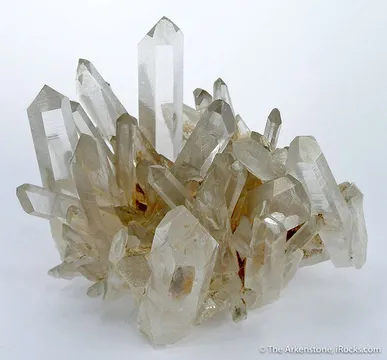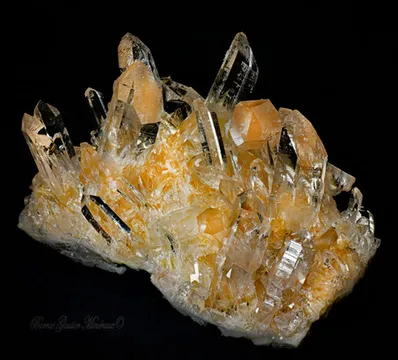
Mount Ida Mountain Mine, Arkansas — Ouachita quartz locality with water-clear, sharply terminated crystals from pocket fissures and old-mine provenance.
Key facts
Mount Ida Mountain Mine is a small but instructive Arkansas quartz locality: a named, older quartz mine on Mt Ida in Montgomery County, not a loose trade label for every crystal sold from the Mount Ida district. Its importance to collectors lies in that specificity. The mine is recorded as a quartz operation about 3 miles north-northwest of Norman, with mineralization in quartz veins cutting the Crystal Mountain Sandstone, one of the Ordovician sandstone units that made the Crystal Mountains famous for crystal-lined fissures.
The locality belongs to the western Arkansas quartz province of the Ouachita Mountains, where folding and fracturing of Paleozoic sedimentary rocks opened space for hot silica-bearing fluids. In sandstone-hosted deposits, the total volume of quartz may be less than in massive shale-hosted veins, but the collector yield can be better: open pockets, sheeted fissures, and cavities are the places where transparent rock crystal grows cleanly into space. That geological distinction is central to understanding why Arkansas quartz has long been prized: the best specimens are not merely quartz; they are bright, water-clear, sharply terminated crystals from pocket environments.
Mount Ida Mountain Mine’s verified mineral assemblage is deliberately simple. Quartz, including rock crystal, is the principal collector mineral, with dickite documented as an associated clay mineral. A wavellite attribution formerly connected with the locality has been corrected as erroneous, and knowledgeable Arkansas field people have stated that the mine was a quartz mine rather than a wavellite producer. For the serious collector, that makes the locality less of a species list and more of a label problem: a credible “Mount Ida Mountain Mine” quartz is a precise old-mine Arkansas specimen, not simply a generic “Mt. Ida” crystal.
The best pieces expected from this locality are the classic Arkansas look: colorless to faintly smoky quartz crystals with vitreous luster, hexagonal prisms, crisp rhombohedral terminations, and a clean pocket-grown feel. Small clusters, miniatures, and isolated crystals dominate the documented photo record, while smoky examples require extra caution because at least some smoky quartz attributed to the mine has been disclosed as irradiated.
Regional View
Country View
Historically, the mine sits within a much broader story. The Crystal Mountains of Montgomery County were among the early principal sources of Arkansas rock crystal, and Arkansas quartz later acquired strategic importance during World War II, when eye-clear crystals were sought for optical and oscillator uses. Mount Ida Mountain Mine itself is not documented in the accessible literature as a large modern tourist mine or as the source of a famous named pocket; its collector value is quieter and more curatorial. Properly labeled specimens help pin down one exact locality in a district where names such as “Mount Ida,” “Mt. Ida area,” “Fisher Mountain,” “Collier Creek,” and “Crystal Mountain” are often blurred in commerce.
Search for specimens: View all specimens from Mount Ida Mountain Mine, USA
Mount Ida Mountain Mine is a recorded quartz mine on Mt Ida, Montgomery County, Arkansas, at approximately 34.49583, -93.64167. The locality is described as about 3 miles, or roughly 5 km, north-northwest of Norman, and its mineralization is in quartz veins in the Crystal Mountain Sandstone. That host unit is a massive to coarse-grained Early Ordovician sandstone formation named for the Crystal Mountains of Montgomery County; in places it is cut by networks of quartz veins and open fissures wide enough to carry clusters of quartz crystals.
The deposit is best understood as a hydrothermal fissure-vein and pocket system. In the wider Ouachita quartz belt, hot silica-rich fluids filled steep fractures related to regional folding and faulting. The productive belt of Arkansas quartz veins lies in the core region of the Ouachita Mountains and is developed through Paleozoic sandstone, shale, slate, and chert. The most collectible crystals formed where fractures remained open, allowing quartz to grow freely into cavities rather than freezing as massive vein quartz.
Sandstone-hosted quartz deposits in this region commonly occur as veins, sheeted zones, and stockworks. Compared with shale-hosted deposits, they may contain less total quartz, but they often yield a higher percentage of clear, well-developed crystals in pockets. The Crystal Mountain Sandstone is therefore an important host for specimen quartz: its fractures can carry small to substantial openings, but productive pockets are irregular, localized, and easily exhausted. At Mount Ida Mountain Mine, the documented mineral list is correspondingly lean: quartz, quartz var. rock crystal, and dickite.
The mine is recorded as having started in 1928. No named operator is attached to the locality in the main modern mineral-locality record, and it should not be treated as a current public fee-dig unless the present landowner and mineral-rights holder have explicitly granted access. This matters in the Mount Ida region, where several commercial and recreational collecting sites operate or have operated nearby; the existence of fee digging in the district does not imply open access to this older, specifically named mine.
The broader district’s mining history gives the locality its context. Quartz crystals from the Ouachita Mountains were known long before modern collecting, were described from the region by H. R. Schoolcraft in 1819, and by the late nineteenth century were being mined in Montgomery, Garland, and Saline Counties. During World War II, oscillator-grade quartz became a strategic commodity. A federal buying station was established at Hot Springs in June 1943, and several thousand pounds of oscillator quartz from the district were tested there. After synthetic quartz growth displaced much of the technical demand, Arkansas quartz production shifted increasingly toward museums, schools, tourists, collectors, and high-purity lasca feedstock.
No famous named pocket from Mount Ida Mountain Mine itself is documented in the accessible records. The notable finds are instead the small body of attributed specimens: rock crystal pieces recorded at about 3 cm and around 2 inches across, plus smoky quartz examples in the specimen-photo record. One smoky example from the Bill Wall Collection is specifically described as irradiated, a useful reminder that color alone cannot be assumed natural. The strongest Mount Ida Mountain Mine specimens are those whose labels are as clean as the crystals: old collection labels, dealer provenance, or a chain of custody connecting the piece to this exact mine rather than to the Mount Ida district generally.
Quartz from Mount Ida Mountain Mine is the locality’s defining species: colorless rock crystal in small crystals and clusters from quartz veins in Crystal Mountain Sandstone. The documented material includes crystals on the order of a few centimeters, with typical Arkansas habits of hexagonal prisms and bright terminal rhombohedra. The best pieces show the classic “wet” luster and water-clear tips that made the Ouachita quartz belt famous, ideally with minimal iron staining, little bruising on the termination edges, and a natural pocket-grown base or cluster architecture. Dickite may occur as an associated clay mineral, and traces of pocket clay in protected crevices can be more geologically informative than a perfectly scrubbed but poorly documented crystal. What separates a serious piece from an ordinary “Mt. Ida quartz” is not only clarity and sharpness but locality confidence: Mount Ida Mountain Mine is a specific old mine, so a reliable label carries real collector weight.
Smoky quartz attributed to Mount Ida Mountain Mine is present in the specimen record but must be handled as a special case rather than the default expression of the locality. Documented smoky examples include small cabinet-scale material around 5 x 3 x 7.5 cm, but at least one such specimen is explicitly described as irradiated. Arkansas does produce natural smoky quartz in parts of the broader region, and smoky color in quartz can result from radiation-induced lattice defects, yet much smoky quartz in the local trade has been artificially darkened. At this mine, the collector’s standard should therefore be strict: a naturally smoky claim needs old labels, collection history, or expert provenance; otherwise, smoky pieces are best treated as attractive treated Arkansas quartz. Good examples still depend on the same fundamentals as the clear material—sharp terminations, glassy faces, balanced form, and freedom from bruising—but natural color disclosure is central to value.
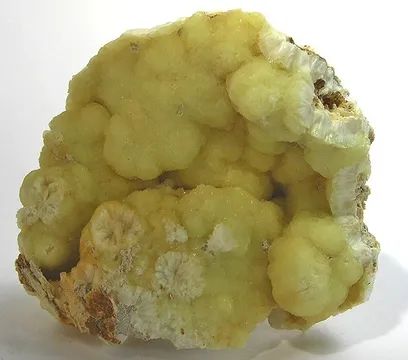
The other verified mineral from Mount Ida Mountain Mine is dickite, Al2(Si2O5)(OH)4, a kaolin-group clay mineral documented with the quartz. Dickite is not the showpiece here, but it is part of the pocket environment and fits the wider Arkansas quartz association in which clay minerals are widespread cavity constituents. Wavellite, Al3(PO4)2(OH)3 · 5H2O, is the important negative entry: it has been marked erroneous for this mine after the previously associated material was identified as coming from Mauldin Mountain Quarries rather than Mount Ida Mountain Mine. No type-locality mineral is documented from this locality, and no rare-species suite should be attached to it without evidence.
The chief authenticity issue is locality precision. “Mt. Ida,” “Mount Ida area,” and “Montgomery County, Arkansas” are common and often legitimate labels, but they are much broader than “Mount Ida Mountain Mine.” A specimen may be genuine Arkansas quartz and still not be confidently assignable to this mine. For locality collectors, an old label, collection history, or dealer documentation is essential.
The most serious mislabeling concern is wavellite. Mount Ida Mountain Mine has been specifically characterized by Arkansas miners and Mindat contributors as a quartz mine, and the wavellite formerly linked to it was corrected as erroneous. A wavellite specimen sold as Mount Ida Mountain Mine should be regarded as suspect unless accompanied by exceptionally strong independent provenance; in most cases, a Montgomery County wavellite label likely points elsewhere.
Smoky quartz also deserves scrutiny. Artificial irradiation of Arkansas rock crystal is well documented in the Mount Ida trade, and at least one smoky quartz specimen attributed to Mount Ida Mountain Mine is explicitly described as irradiated. Treated smoky quartz can still be decorative and collectible when disclosed, but it should not be priced or catalogued as natural smoky quartz from this mine without convincing evidence.
Condition problems are typical of pocket quartz. Check for bruised terminations, chipped prism edges, internal fractures, rehealed cracks, clay-filled contacts, iron oxide staining, broken bases, and hidden damage in crowded clusters. Arkansas quartz is often cleaned after mining, and acid cleaning can improve iron-stained specimens dramatically; however, overcleaning, broken attachment surfaces, and suspiciously uniform dark smoky color should all prompt closer inspection.
Rarity is relative. Arkansas quartz is abundant in the marketplace, but precisely documented Mount Ida Mountain Mine quartz is far less common than generic Mount Ida material or specimens from better-known active mines. For this locality, a modest miniature with an excellent old label can be more important to a serious locality collector than a larger, brighter cluster with only a broad Arkansas attribution.
One of the most revealing stories from Mount Ida Mountain Mine is not a dramatic pocket discovery but a locality correction—the kind of quiet detective work that prevents bad labels from hardening into “facts.” In May 2014, a Mindat discussion opened with a practical question: was the locality really a wavellite site, or were the photographs showing two unrelated Arkansas habits under one name? David Von Bargen answered plainly: quartz. The wavellite photos, he suggested, were probably meant for a broader Mount Ida locality.
Rock Currier then checked with James Zigras, a miner involved in both quartz and wavellite work in Arkansas. Zigras identified the wavellite images as material from Mauldin Mountain Quarries on Mauldin Mountain, not from Mount Ida Mountain Mine. Currier also noted that Zigras had confirmed the point with Shane Manley, another long-time Arkansas quartz and wavellite digger. The result was a useful piece of collector hygiene: Mount Ida Mountain Mine was treated as an old quartz mine, and wavellite was set aside as an erroneous attribution. For a locality where labels are easily blurred, that correction is as valuable as a pocket map.