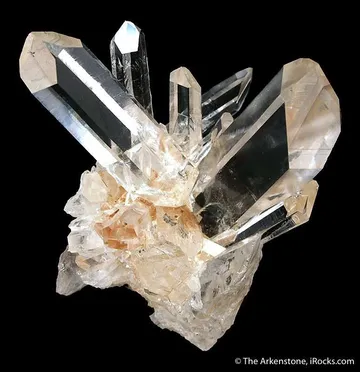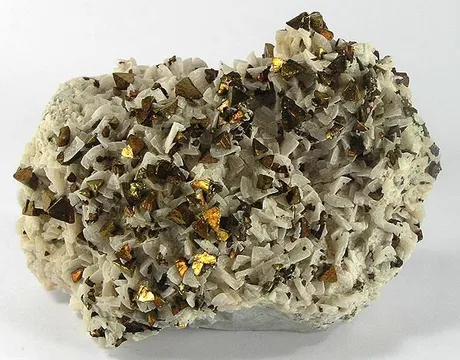
Black Rock, Arkansas — Ozark carbonate-pocket locality known for pink dolomite, calcite, chalcopyrite, and sphalerite; prized for color, texture, and locality…
Key facts
Black Rock, Arkansas, sits at the eastern edge of the Ozark Plateaus in Lawrence County, where Ordovician carbonate strata and the old North Arkansas lead-zinc belt meet the modern crushed-stone industry. For collectors, the name usually means the Black Rock quarry group—especially the Ben Hogan, W. W. Smith, and Vulcan-related workings—rather than a single shaft. The classics are not ore specimens in the massive sense, but vug and fracture pieces from gray limestone and dolostone: salmon-pink to peach dolomite druses, glassy pale calcite crystals, brassy to iridescent chalcopyrite, black to dark-brown sphalerite, and subordinate pyrite, marcasite, galena, and quartz.
The locality’s appeal is visual and immediately recognizable. The best specimens have curved or bladed pink dolomite crystals forming a sparkling carpet over dark carbonate matrix, with sharp little chalcopyrite crystals scattered like bronze and peacock-colored confetti. On finer combination pieces, transparent calcite perches above the dolomite or encloses tiny brassy chalcopyrite crystals, while sphalerite adds dark contrast in resinous black-brown crystal groups. These are unmistakably Ozark carbonate-pocket specimens: modest in crystal size but rich in texture, color contrast, and locality character.
Regional View
Country View
Historically, Black Rock belongs to the Northeast District of the North Arkansas Lead and Zinc Region. The district’s early zinc story reaches back to the Calamine area in the late 1850s, and the Black Rock-Smithville-Sharp County belt was still important enough to be treated in the classic federal surveys of northern Arkansas zinc and lead deposits. In the specimen trade, however, Black Rock became familiar through twentieth- and early twenty-first-century quarry collecting, where blasting for limestone aggregate periodically opened fresh pockets of dolomite, calcite, sphalerite, and chalcopyrite.

Photo: Rob Lavinsky, iRocks.com via Wikimedia Commons

Photo: Rob Lavinsky, iRocks.com via Wikimedia Commons
Search for specimens: View all specimens from Black Rock, USA
Black Rock is best understood as a locality cluster within the Lawrence County Zinc Mining District. Mineral labels may read simply “Black Rock, Arkansas,” but more precise labels commonly name the Ben Hogan Quarry, also called Black Rock Quarry; the W. W. Smith Quarry, which has also appeared under Black Rock Sand & Gravel, Verkler Quarry, Black Rock Quarries, and Vulcan Quarry names; or Meridian-related quarry names including Hogan Quarry, Boorhem Fields Quarry, Meridian Quarry, Valley Stone Quarry, and St. Francis Materials Company. The broader Mindat locality for Black Rock includes these quarry sublocalities as well as older zinc prospects and mines such as the Casper, Gibson, and Roes mines.
Geologically, the district lies in the Salem Plateau portion of the Ozark Plateaus. The old literature separated Smithville and Black Rock limestones in the local Ordovician carbonate succession; recent Arkansas mapping treats those historically troublesome units within the lower part of the Everton Formation in the Northeast District. The rocks exposed around Black Rock are dominantly gray limestone and dolostone, locally fractured, vuggy, and cut by mineralized zones. The collectible minerals occur in cavities, replacement pockets, fractures, and quarry-blast pieces in carbonate host rock rather than in large, continuous specimen pockets of the kind known from some Mississippi Valley-type mines farther north.
The ore minerals fit the North Arkansas lead-zinc pattern: sphalerite as the principal zinc mineral, with galena locally, and chalcopyrite as a copper-bearing accessory. Arkansas Geological Survey summaries describe the north Arkansas deposits as irregular bodies in Paleozoic limestone, dolostone, and chert, commonly associated with structural irregularities. At Black Rock, collectors see the specimen-scale expression of that system: sulfides on and within carbonate druse, calcite and dolomite lining openings, and occasional quartz in vugs or fossil impressions. The Black Rock assemblage is therefore both an aggregate-quarry product and a late expression of the old carbonate-hosted Zn-Pb mineralization that made Lawrence and Sharp counties historically significant.
The mining history has two threads. The regional mining story began in the mid-nineteenth century, with lead mining in the Northeast District beginning in 1851 and the earliest Arkansas zinc mining beginning around 1858 in Sharp and Lawrence counties. Mining in the district had ceased by 1930, with total production estimated at about 4,000 tons, mostly zinc. The specimen-producing quarry story is later and industrial: Black Rock quarries were worked for crushed limestone and aggregate by companies that included Ben M. Hogan Co., Black Rock Sand and Gravel, Black Rock Limestone Products, Meridian-related operators, and Vulcan Construction Materials. Arkansas permit records list the Vulcan Construction Materials Black Rock Quarry as an active facility on Highway 63, so collecting must be treated as private industrial-site access, not casual public rockhounding.
Organized field trips have been the main documented route by which collectors obtained fresh material. Memphis Archaeological & Geological Society notices from the 2000s describe trips to the Vulcan Materials Company Black Rock Quarry for calcite crystals, pink dolomite crystals, chalcopyrite, pyrite, marcasite, and quartz, with hard hats, steel-toed footwear, safety glasses, signed waivers, and age restrictions required. A 2014 field account records a club visit in which quarry staff had blasted a wall in advance, exposing abundant pink dolomite in the first blast area; a lower level had changed substantially over several years and was flooded by about four feet of green water. Those details matter to collectors because Black Rock specimens are tied to ephemeral blast exposures—what is available depends on where the quarry face is being worked and whether a particular shot has opened a clean vuggy carbonate zone.
Notable finds include sizable plates of pink dolomite with chalcopyrite sprinkles, dolomite with pale calcite, calcite and sphalerite on dolomite, and combinations in which small chalcopyrite crystals are perched on sphalerite or visibly enclosed in calcite. Published and cataloged specimen examples show Black Rock dolomite plates up to cabinet size, calcite crystals reaching at least a few centimeters, and chalcopyrite crystals typically in the millimeter range but sharp enough and colorful enough to carry a specimen when scattered densely across pink or white dolomite.
Black Rock chalcopyrite is prized less for large size than for placement, sharpness, and color: the classic pieces show brassy to iridescent crystals, commonly only a few millimeters and documented to about 0.6 cm on some Ben Hogan Quarry examples, studding saddle-shaped white, pink, salmon, or peach dolomite; the finest examples are visually lively, with numerous discrete, well-formed crystals rather than a dull metallic dusting, and the best combination pieces also include calcite or dark sphalerite so the chalcopyrite reads as bright metallic punctuation against the carbonate matrix.
Dolomite is the signature Black Rock mineral, occurring as shimmering druses and plates of curved, bladed, saddle-shaped, pearly crystals in salmon-pink, peach, pale pink, and white tones; individual crystals are commonly small, around the millimeter to sub-centimeter scale, but plates can be cabinet-sized, and the most desirable pieces have even coverage, fresh luster, attractive color, minimal cleaving of exposed blades, and well-balanced associations with chalcopyrite, calcite, sphalerite, pyrite, or marcasite rather than scattered crystals on drab limestone.
Black Rock calcite occurs as transparent to translucent pale yellow, colorless, or lightly honey-toned crystals on dolomite and carbonate matrix, with documented habits including silky-looking crystals with pyramidal terminations, small sharp scalenohedra, and larger isolated crystals to roughly 2.5 cm or more on combination specimens; good pieces show undamaged terminations, internal brightness, and attractive contrast with pink dolomite, chalcopyrite, or sphalerite, while ordinary pieces tend to be bruised, cleaved, or visually lost among the surrounding dolomite druse.
Other documented minerals from the Black Rock locality and its sublocalities include sphalerite, galena, pyrite, marcasite, and quartz. Sphalerite is the most important accessory for collectors, forming dark-brown to black, lustrous crystals and groups that can carry sharp chalcopyrite and calcite; the Casper Mine occurrence is specifically recorded in fractured Smithville Limestone, and Roes and Gibson are also listed for sphalerite in the Black Rock area. Galena is much less commonly seen on modern specimen-market pieces but belongs to the broader lead-zinc suite. Pyrite and marcasite are recorded from the Ben Hogan Quarry, and quartz is recorded from the W. W. Smith/Vulcan quarry area, including drusy linings and small crystal-lined features in carbonate rock.
Black Rock specimens are generally straightforward, but label precision matters. “Black Rock, Arkansas” may refer to the town-level locality, the Lawrence County Zinc Mining District, Ben Hogan Quarry, W. W. Smith/Vulcan Quarry, or one of several nearby old zinc mines. A fine label should preserve the quarry or mine name if known, the Black Rock district, Lawrence County, Arkansas, and any collection or field-trip history. Pieces labeled only “Vulcan Quarry” should not automatically be assumed to be Ben Hogan Quarry unless an older label, collector note, or specimen history supports that assignment; the names overlap in the trade but represent a locality cluster rather than a single immutable pit name.
No well-established, locality-specific fake industry is known for Black Rock, and the characteristic association is difficult to imitate convincingly at specimen scale: pink dolomite druse, small chalcopyrite, pale calcite, and dark sphalerite on carbonate matrix. The more practical authenticity concern is mislocality. Pink dolomite with chalcopyrite is not unique to Black Rock, and Midwestern and Ozark carbonate localities can look superficially similar. Conversely, some older Black Rock material was sold simply as “Arkansas dolomite” or “Black Rock Quarry,” so provenance may be under-described rather than fraudulent.
Condition is the main grading issue. Dolomite blades are easily cleaved, calcite terminations bruise, and chalcopyrite crystals can be knocked off or dulled by rough collecting, trimming, or cleaning. On high-grade specimens, examine the tops of dolomite blades for repeated flat breaks, check calcite for edge bruising and internal cracks, and look closely at chalcopyrite coverage: a few scattered tarnished specks are common, but sharp, numerous, colorful crystals make a specimen stand out. Some chalcopyrite is naturally iridescent from surface tarnish; aggressive chemical cleaning can reduce the very color that collectors value.
Handling is simple but should be gentle. The carbonate matrix and dolomite druse are not especially hard, and calcite is softer still, so avoid ultrasonic cleaning unless testing a sacrificial fragment, and avoid acids entirely because both calcite and dolomite are carbonates. Sphalerite and chalcopyrite are stable under normal cabinet conditions, but marcasite-bearing pieces deserve dry storage and periodic inspection, as marcasite from many localities can deteriorate in humid conditions. Fluorescence is not a defining feature of Black Rock material in the specimen literature; judge these pieces by daylight aesthetics, crystal sharpness, color balance, and provenance.
On the market, Black Rock is available but selective. Small dolomite-chalcopyrite plates and calcite-on-dolomite pieces appear with some regularity from older collections and club-trip material, while large, clean, balanced combination pieces with calcite, sphalerite, and bright chalcopyrite are much less common. The most desirable specimens combine a recognizable pink dolomite base, discrete sparkling chalcopyrite, a clean calcite focal point, and a reliable quarry-level label.
The most vivid modern collecting account from Black Rock comes from a Memphis Archaeological & Geological Society trip to the Vulcan Quarry on May 31, 2014. James, writing at JWJ Rocks, left home at 3:00 a.m. for the long drive down Highway 63 and reached the rest area north of Black Rock at about 7:00 a.m., half an hour before the group’s 7:30 meeting time. There he met Paul Sides, president of MAGS, turned in the signed waivers, and followed the group to the quarry for a safety talk from Jeff, one of the foremen. The picture is wonderfully specific: hard hats, steel-toed shoes or boots, safety glasses, a quarry morning in the high eighties that began warm, clouded over, and then became breezy enough to spare the collectors the worst of the heat.
The quarry had been prepared for the visit. Staff had blasted down a large wall of rock, and both the east and west sides of the first blast area showed pink dolomite. The group drove down to the first level and spread out over the pile. It had changed noticeably since James’s previous visit four years earlier. Then, collectors had been able to drive to the bottom floor; in 2014, that bottom was covered by green water about four feet deep, and Jeff was pumping daily to keep ahead of it. That image—fresh blast rock above, flooded lower floor below—is exactly the kind of industrial setting that explains why Black Rock specimens are episodic: a good pocket may be abundant one month and inaccessible, flooded, or crushed the next.
The first blast pile was productive enough that James wrote that he did not think anyone left unhappy. He found pretty pink dolomite plates with calcite and “hematite balls” attached, while others concentrated on sections of the pile where the dolomite was richest. Steven Gibbs searched for bigger boulders on the west side of the pile; April took a break on the tailgate; Jeff and Bentley searched near the top, and Bentley later climbed down in colorful fireman’s steel-toed boots. After about 90 minutes, the group moved to a second, smaller blast location lower in the quarry, but that spot produced little.
The day’s oddest find came not as a mineral pocket but as a fossil-like surprise in a boulder. While checking rocks along the road, April spotted a beach-ball-sized boulder with the impression of a seashell in it, and the impression was lined with quartz crystals. Jeff gave permission for the group to stay behind and try to reduce the boulder. Steven brought out a sledgehammer, WC and Cornelia came over to inspect it, and the rock refused to cooperate. In James’s phrase, the boulder “merely laughed” at the cobbing attempt, so Steven loaded the entire thing into his pickup. Jeff reportedly said he had never seen anything like it at the quarry.
That same account also preserves the collector’s-eye reality of Black Rock: much of the day was not dramatic pocket mining but careful searching through blast rock for small plates worth wrapping. The memorable material was pink dolomite, dolomite with calcite attached, and the occasional unusual vug or fossil impression. Black Rock rewards attention to surfaces—pale carbonate druse, a glint of chalcopyrite, a dark sphalerite face, a transparent calcite termination—rather than brute-force pursuit of giant crystals.