






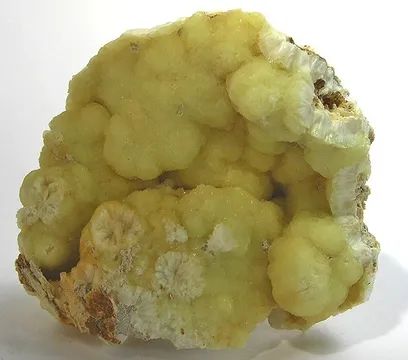
Arkansas — a mineral province with glassy Ouachita quartz, wavellite and phosphates, and Magnet Cove minerals; classic sources include Avant and Mauldin Mounta…
Key facts
Arkansas is not a single collecting locality so much as a compact mineral province: a state-sized convergence of Ouachita quartz veins, aluminum-phosphate pockets, barite deposits, vanadium-bearing novaculite, northern Ozark lead-zinc occurrences, and the singular alkalic igneous complex at Magnet Cove. For collectors, its name is anchored first by the glassy rock crystal of the Ouachita Mountains around Mount Ida, Jessieville, Blue Springs, Avant, and Crystal Springs—clear, lustrous, iron-stained when fresh from the clay, and capable of forming clusters large enough to move by machine rather than by hand. Those crystals formed principally in open fractures and cavities in Ordovician sandstone units during the late stages of Ouachita mountain building, and Arkansas quartz has been praised for both its beauty and its purity.
Regional View
Country View
The second great collector’s identity of Arkansas is phosphate mineralization: wavellite, variscite, planerite, kidwellite, rockbridgeite, beraunite, strengite, cacoxenite, and related species developed in fractures of Bigfork Chert and Arkansas Novaculite. Fine Arkansas wavellite has a look unlike most world material: radial fans and hemispheres in grass-green, bluish green, yellow-green, and pale translucent tones, sometimes with pearly luster across broken “sunburst” sections. The classic sources are the Avant area in Garland County and the Mauldin Mountain quarries in Montgomery County, where the best pieces show separate, lustrous balls or fans on cherty matrix rather than dull, massive phosphate crust.

Photo: James St. John via Wikimedia Commons
Arkansas also carries a deeper mineralogical pedigree. Magnet Cove, a small Hot Spring County community set within an alkalic igneous complex and altered novaculite country rock, has supplied brookite once called “arkansite,” magnetite lodestones, titanium minerals, eudialyte, sodalite, kimzeyite, delindeite, lourenswalsite, and some of the finest kolbeckite crystals reported from the region. In Montgomery County, the Pigeon Roost barite deposit produced rare Arkansas witherite—pale to golden-white, sharply bladed, and far scarcer than the state’s quartz. At Fodderstack Mountain, kidwellite entered the mineral record as an Arkansas type-locality species, part of the state’s unusually long list of minerals first described from within its borders.


Search for specimens: View all specimens from Arkansas, USA
Arkansas’ specimen-producing geology is concentrated in several very different belts. The Ouachita Mountains of west-central Arkansas are the source of the state’s most famous quartz and much of its phosphate mineralization. The collectible rock crystal deposits are hydrothermal vein systems occupying fractures and cavities in Ordovician Crystal Mountain and Blakely sandstones, with related milky “bull quartz” veins cutting sandstone and shale. The main quartz-producing counties are Garland, Montgomery, Saline, and Perry, with additional occurrences in Hot Spring, Pike, Pope, Pulaski, Sevier, Yell, and Polk counties. In the Ozark region of northern Arkansas, smaller clear-to-white, stubby quartz crystals occur with lead-zinc mineralization in carbonate rocks, but these are generally secondary to the Ouachita quartz in collector fame.
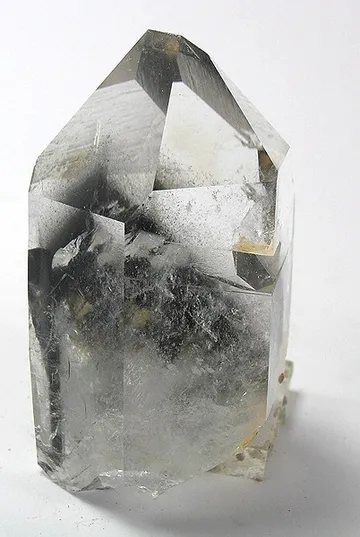
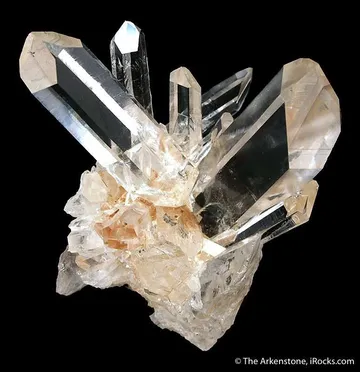
The best Ouachita quartz forms as single crystals, parallel-growth groups, druses, clusters, faden quartz, doubly terminated crystals, skeletal or rehealed crystals, chlorite or shale phantoms, and iron-oxide-stained groups that clean to bright, glassy surfaces. Arkansas Geological Survey summaries record crystals as large as 5 feet long and over 500 pounds, and clusters as large as 15 feet by 10 feet and over 10 tons. The state’s most recognizable commercial and fee-digging names—Ron Coleman, Jim Coleman, Wegner, Twin Creek, Sweet Surrender, Fisher Mountain, and others—belong to the modern expression of a much older mining district. Modern mining began at Mount Ida in 1930 with Ocus Stanley, while quartz had been gathered and mined in the region since the early 1800s.
Quartz mining gained a military-industrial importance during World War II, when Arkansas crystals were used for radio-frequency control. The Blocker Lead No. 4 mine near Jessieville—later the Old Coleman mine and now associated with Ron Coleman Mining—came under federal control, and the Willis mine in Saline County was also an important wartime source. With the postwar rise of synthetic quartz, the industrial demand shifted from flawless natural oscillator crystals to quartz feedstock, museum pieces, dealer stock, tourist digging, and specimen mining. Today most specimen quartz is recovered from open pits, often from clay-filled pockets where the crystals must be removed carefully before cleaning.
The aluminum-phosphate belt is closely tied to Bigfork Chert and Arkansas Novaculite, especially around Avant, Mauldin Mountain, and phosphate-bearing localities in Montgomery, Garland, Polk, and Saline counties. Wavellite, variscite, planerite, crandallite, and related species occur along fractures, bedding planes, and brecciated zones. At Mauldin Mountain, the mineralogically important eastern county quarry exposed wavellite, variscite, and planerite along fractures and bedding planes; at Avant, shallow pits and roadcut-style occurrences produced the locally famous “cat’s eye” wavellite rosettes and associated variscite. These deposits are not “pocket quartz” localities in the usual sense: good specimens are won by recognizing phosphate seams and carefully trimming chert so that radial fans, balls, and vugs remain intact.
The Pigeon Roost mine near Glenwood represents another Arkansas collector niche: barite mineralization in the Stanley Formation. Arkansas barite deposits were mined commercially in several districts, and Pigeon Roost is remembered by collectors chiefly for scarce witherite specimens rather than bulk ore. The best witherites are pale gray, white, or soft golden-white clusters of bladed to pseudo-hexagonal crystals, commonly on or near Stanley Shale matrix, with barite and barytocalcite reported from the deposit.
Magnet Cove in Hot Spring County is a different world altogether. Instead of quartz veins in folded sedimentary rocks, it is an alkalic igneous complex surrounded by altered sedimentary host rocks, including novaculite. Its collector history reaches back to the nineteenth century, when Charles Shepard’s 1846 description of “arkansite” helped broadcast the locality’s reputation; the mineral was later shown to be brookite. Magnet Cove is famous for titanium-rich species—brookite, rutile, anatase, perovskite—along with magnetite, schorlomite, kimzeyite, eudialyte, sodalite, aegirine, vesuvianite, apatite, and many rarities. Historically, collectors worked small knolls, roadcuts, creek beds, and fields, but the modern reality is stricter: Magnet Cove has no public collecting land, and permission from individual landowners is essential.
Collecting access in Arkansas is varied and must be treated locality by locality. Fee quartz mines in the Ouachitas are the safest and most productive way for visiting collectors to obtain self-collected quartz. Crystal Vista in the Ouachita National Forest is a designated public quartz collecting site near Mount Ida, but Forest Service rules and boundaries must be respected. Arkansas state parks generally prohibit excavation and removal of minerals unless written permission is granted, with the major exception of Crater of Diamonds State Park, where the posted diamond-search rules apply and visitors may keep diamonds and other minerals found in the search field. Many of the classic wavellite, phosphate, Magnet Cove, vanadium, barite, and rare-species localities are private, leased, reclaimed, restricted, or no longer productive in the way older literature describes.
Arkansas quartz is the state’s defining mineral specimen: clear to milky, commonly lustrous, and best from the Ouachita quartz belt in Garland, Montgomery, Saline, Perry, Pulaski, Hot Spring, Pike, Polk, and neighboring counties. The classic habits include short to long prismatic rock crystals, bright clusters, faden growths, doubly terminated crystals, skeletal and rehealed forms, Japan-law twins, chlorite or shale phantoms, and smoky crystals from certain districts; inclusions may include adularia, cookeite, dickite, kaolin, brookite, pyrite, chalcopyrite, marcasite, galena, goethite, chlorite, fluid, shale, sand, or carbonaceous material. The best collector pieces are not merely large, but balanced: transparent points with sharp terminations, minimal bruising, lively luster after cleaning, attractive iron or chlorite contrast when natural staining is retained, or crisp phantom architecture visible through the crystal. Ordinary Arkansas quartz is abundant enough for tourist buckets; fine Arkansas quartz is judged by clarity, pocket freshness, crystal separation, lack of repaired tips, and whether the piece carries a real mine provenance such as Ron Coleman, Wegner, Fisher Mountain, Crystal Springs, Sweet Surrender, or another named Ouachita source.
Arkansas witherite is a scarce, connoisseur-level carbonate best known from the Pigeon Roost mine near Glenwood in Montgomery County, with additional Arkansas records from Garland County and Magnet Cove. The Pigeon Roost material is prized for sharply crystallized, bladed to pseudo-hexagonal twinned crystals in colorless, white, gray, or soft golden-white tones, sometimes forming rich intergrown clusters on minor Stanley Shale matrix; barite and acicular barytocalcite are part of the broader deposit association, though they are not always present on the same hand specimen. Good Arkansas pieces stand out because they are crisp, relatively large for the find, visibly crystalline rather than massive, and far more sharply sculptural than the small witherite grains most collectors expect from American barite deposits. Damage matters here: broken blades, bruised terminations, and altered surfaces are common enough that a complete, lustrous Pigeon Roost cluster with old provenance is a genuinely significant Arkansas specimen.
Arkansas wavellite is one of the world’s great expressions of the species, especially from the Avant area of Garland County and the Mauldin Mountain quarries of Montgomery County. It occurs as acicular radiating aggregates, hemispheres, balls, fan-shaped “sunbursts,” vein fillings, and vugs in Bigfork Chert and Arkansas Novaculite, with colors ranging from grass-green and lime-green to yellow-green, blue-green, yellow, white, and colorless; the green tones are tied to trace vanadium. It is associated locally with variscite, quartz, planerite, crandallite, and other aluminum phosphates, and the Mauldin Mountain material is especially loved for isolated pea-green balls or shimmering sprays on pale chert matrix. Top pieces show saturated color, glassy-to-pearly luster, distinct radial structure, open separation between balls, and undamaged hemispheres; lower-grade material tends to be dull, massive, crusty, or badly sawed through the display surface.
Kidwellite is an Arkansas type-locality mineral, first described from Fodderstack Mountain in Montgomery County, and it remains a specialist phosphate for collectors who appreciate microscopic to small but richly textured secondary mineralization. In Arkansas it occurs in fractured novaculite as pale green, greenish yellow, dark green, silky to dull minute acicular crystals, radiating spherical masses, feathery fracture fillings, and alteration coatings on earlier iron phosphate minerals. The key associations are rockbridgeite, beraunite, dufrenite, strengite, cacoxenite, lipscombite, goethite, and the historically problematic “laubmannite” material later recognized as a mixture in related phosphate assemblages. Good Arkansas kidwellite is judged under magnification: clean radiating sprays, sharp fibrous tufts, contrasting dark iron-phosphate matrix, and verifiable Fodderstack Mountain, Coon Creek, York mine, or Three Oak Gap provenance matter far more than cabinet-scale size.
Beyond these four, Arkansas is exceptional for minerals first described from the state, including schorlomite, rectorite, miserite, kimzeyite, benstonite, kidwellite, eggletonite, straczekite, delindeite, lourenswalsite, mahlmoodite, haggertyite, and artsmithite. Magnet Cove alone anchors several of the state’s rarest collector names, including kimzeyite from carbonatite, delindeite and lourenswalsite from the Magnet Cove region, and historic “arkansite” brookite. The Wilson Springs and related Garland County vanadium deposits add miserite, vanadium minerals, and rare species associations; the Ouachita phosphate localities add planerite, variscite, crandallite, cacoxenite, rockbridgeite, beraunite, strengite, and turquoise-group minerals; and northern Arkansas lead-zinc districts contribute sphalerite, smithsonite, galena, dolomite, calcite, marcasite, pyrite, hemimorphite, and related oxidation minerals.
Arkansas quartz is common enough that provenance is often treated casually, but serious collectors should insist on a named mine or district whenever possible. “Arkansas quartz” may mean anything from a freshly dug Ouachita cluster to a polished point, a garden-rock mass, a tourist pile specimen, or a re-sold piece with no mine history. Condition is the first issue: pocket crystals commonly have rehealed fractures, clay-filled cracks, iron staining, bruised terminations, contacted faces, and broken side points. Iron staining is normal on freshly mined specimens and is often removed with commercial iron removers or oxalic-type cleaning; cleaning itself is not a problem when disclosed, but over-cleaned, etched, or acid-damaged luster should lower value.
Smoky quartz from Arkansas deserves special caution. Arkansas Geological Survey material notes that much “smoky quartz” marketed from the state has been irradiated, and very dark, nearly black material should not be assumed natural without a reliable mine history and disclosure. Natural smoky quartz does occur in Arkansas, especially around igneous-contact and hydrothermal settings, but the market contains treated rock crystal darkened by gamma radiation. Labels such as “natural smoky,” “irradiated smoky,” “black Arkansas quartz,” and “Morion” are not interchangeable.
Wavellite and phosphate specimens are more delicate than quartz. Wavellite has perfect to good cleavages and a hardness near 3.25 to 4, so radial fans and hemispheres bruise, shear, and dull easily. Many older Arkansas wavellites were trimmed hard from chert, leaving saw cuts, broken hemispheres, or polished-looking radial sections. A clean natural edge is preferable to a slabby face unless the specimen is meant to show internal radial structure. Some Arkansas wavellite is rarely fluorescent apple-green to yellow, but fluorescence is inconsistent and should be treated as a bonus, not an identifying requirement. Variscite, planerite, crandallite, and white alteration products can be mistaken for pale wavellite; magnification and, for rarities, analytical confirmation are wise.
Witherite from Pigeon Roost is rare and should be handled with care. It is softer than quartz, dense, and cleavable; bladed crystals are easily broken. Because witherite, barytocalcite, barite, and pale calcite-like carbonates can look similar in small fragments, old labels alone are not enough for valuable pieces unless supported by credible provenance or testing. Arkansas witherite is not a common field find today, and significant examples generally come from old collections.
Kidwellite and associated Arkansas iron phosphates are frequently micro- to small-cabinet specimens that can be misidentified visually. Kidwellite, dufrenite, rockbridgeite, beraunite, strengite, cacoxenite, and discredited “laubmannite” material may coexist or replace one another in fractured novaculite. For high-value Arkansas phosphate specimens, especially those sold as type-locality kidwellite, analytical confirmation or a dependable chain of locality history adds real value.
Access labels are also part of authenticity. Magnet Cove specimens without landowner permission should raise ethical concerns, and many classic Magnet Cove spots described in older literature are private or no longer collectible. Arkansas state parks do not generally allow mineral excavation or removal; Crater of Diamonds is the specific exception under posted search-field rules. Fee quartz mines and designated Forest Service quartz-collecting areas are the appropriate modern route for self-collected material.
In 1929, William L. Haltom described Magnet Cove as a place where the casual observer could miss the prize entirely. One collecting spot near the road looked so unpromising that many passed it by, yet careful digging there could be “most profitable” if boulders were not rolled onto the highway. A small knoll about 250 yards southwest of the Cove Creek Bridge yielded dysanalyte, magnetite, pyrite, limonite after pyrite, and rare rutile eightlings. Eastward, in front of an old church about half a mile from the bridge, a small creek bed held schorlomite, apatite, biotite, quartz, and feldspar. The most practical field tool Haltom recommended was not a meter or a microscope but a needle or nail tied to a thread, swung against likely specimens to test for lodestone. The whole cove, he reminded readers, was only about a mile in diameter, yet specimens from it were already present in collections across America and Europe.
The nineteenth-century “arkansite” episode remains one of Arkansas mineralogy’s most memorable identity shifts. Charles Shepard’s 1846 report of a new titanium oxide from Magnet Cove helped make the locality famous under an Arkansas name, but later work showed that the supposed new species was brookite. The name did not survive as a valid species, but the story did exactly what a mineral discovery often does: it drew collectors, mineralogists, and museums toward a small rural community whose plowed soil was already known for pulling at iron tools with lodestones.
Ocus Stanley gave Mount Ida’s quartz district much of its modern character. He began modern quartz mining there in 1930, opened Mount Ida’s first rock shop, held a long lease in the Ouachita National Forest, and became known as the “undisputed grand old man of quartz in Arkansas.” Stanley’s confidence in the district was extraordinary: he believed that only about four percent of the crystals in the Ouachita Mountains had been removed. Whether that estimate was optimistic or prophetic, it captures the feeling every Arkansas quartz miner knows—the sense that each clay seam could still open into a pocket the size of a room.
World War II gave Arkansas quartz an urgency far removed from the rock-shop counter. Clear, untwinned quartz crystals were needed for oscillator plates in military radio equipment and other precision devices. The Blocker Lead No. 4 mine near Jessieville came under federal control, and the Willis mine in Saline County became another important wartime operation. The value was not simply beauty but geometry and internal quality: the larger and cleaner the crystal, the more oscillator plates could be cut from it. After the war, synthetic quartz gradually displaced the strategic role of natural crystal, and the same districts turned increasingly toward specimens, lasca, museum pieces, and public digging.
Richard Wegner’s entry into Arkansas quartz began not with a mine plan but with broken clear stones in a garden. After moving from northern Illinois to the Lake Ouachita area in 1979, he found shallow trenches on his new land and small quartz crystals gleaming in the piles. By 1980 he had founded Wegner Quartz Crystal Mines; by 1983, he employed thirty full-time workers and was taking semi-trucks loaded with crystals to Tucson. His account of the early Tucson years is the classic Arkansas quartz boom compressed into one image: many tons of crystals hauled west, nearly everything sold, “except the truck.”
The state’s largest recent museum-stage quartz story is the Berns Quartz at the Smithsonian National Museum of Natural History. Recovered from the Ron Coleman mine in 2016, it consists of two pieces that fit together, weighs about 9,200 pounds in total, and is covered with glittering quartz crystals. Donated by Michael and Tricia Berns, it now sits in the Smithsonian’s National Gem and Mineral Collection as one of the largest quartz specimens on display anywhere—a public monument to the scale that Arkansas pockets can reach.
_1.jpg)

_2.JPG)