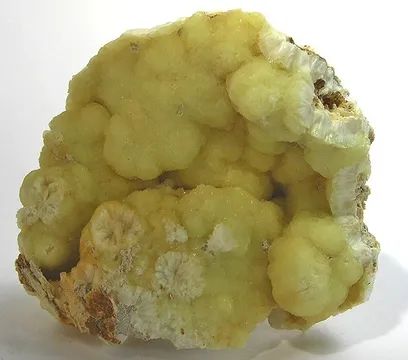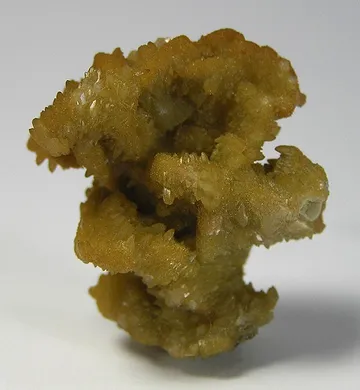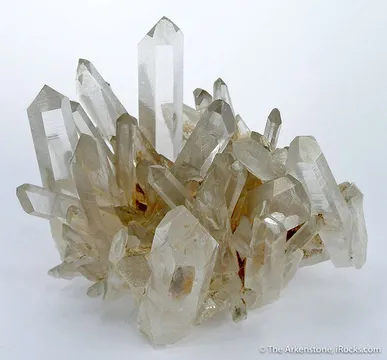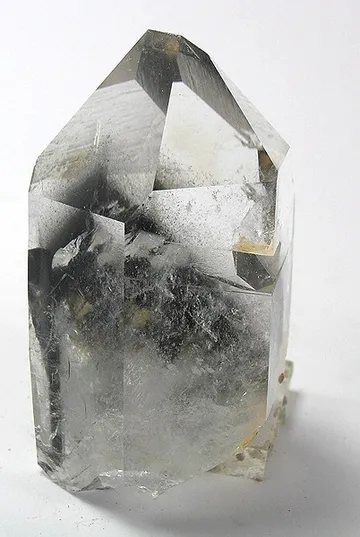
Ben Hogan Quarry, USA: Ozark MVT locality yielding pink dolomite and amber sphalerite with calcite; prized for lustrous curved dolomite rhombs and druses.
Key facts
Ben Hogan Quarry—better known on older mineral labels as the Black Rock Quarry—is a small but instantly recognizable collector locality in the Lawrence County Zinc Mining District of northeastern Arkansas. Its fame rests on a deceptively simple Mississippi Valley-type assemblage: pink to salmon dolomite, honey-yellow to colorless calcite, amber to brown sphalerite, brassy chalcopyrite, and scattered iron sulfides. The quarry cuts Paleozoic carbonate rocks on the southern Ozark Plateau, where warm basinal brines moved through faults, solution-collapse breccias, and permeable carbonate horizons, depositing zinc-lead-copper sulfides with late hydrothermal dolomite and calcite. For collectors, the importance of the locality is not tonnage but texture: bright curved dolomite rhombs, often in densely packed druses, set off by isolated chalcopyrite points or glassy calcite scalenohedra.
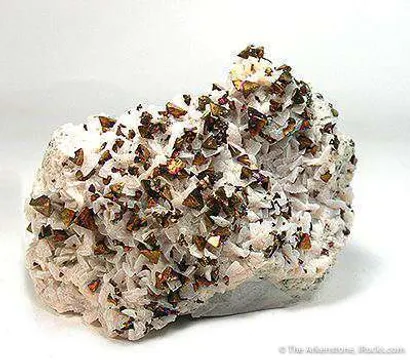
The best Ben Hogan specimens have a look that is hard to fake convincingly: lustrous saddle-shaped dolomite crystals in a warm pink or salmon cast, generally forming sparkling crusts over pale carbonate matrix. On finer combination pieces, translucent light-golden calcite crystals rise from the dolomite as sharply terminated, silky-faced scalenohedra, while chalcopyrite appears as small metallic accents rather than as the overwhelming mass one expects from many Tri-State specimens. Sphalerite is less often the aesthetic center of cabinet pieces, but it is central to the ore story: resinous brown to amber zinc sulfide tied the quarry’s mineralization to the broader northern Arkansas MVT belt.
Regional View
Country View
The locality occupies a useful middle ground in American collecting: not a giant sulfide mine, not a commercial specimen mine, and not a one-off curiosity, but a quarry whose aggregate benches happened to expose classic Ozark MVT vugs. The mineral suite is compact, and that compactness is part of the appeal. A Ben Hogan label should usually imply dolomite first, calcite or chalcopyrite second, and a carbonate-hosted Arkansas zinc-district context rather than a generic Midwestern quarry specimen.

Photo: Wikimedia Commons
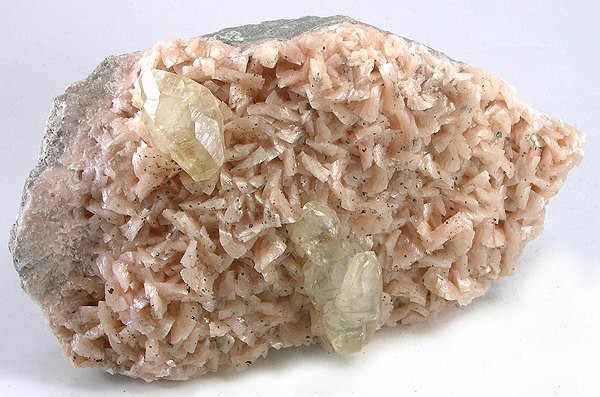
Photo: Wikimedia Commons
Search for specimens: View all specimens from Ben Hogan Quarry, USA
Ben Hogan Quarry is recorded as Ben Hogan Quarry (Black Rock Quarry), Black Rock, Lawrence County Zinc Mining District, Lawrence County, Arkansas, USA. The locality belongs to the northern Arkansas Mississippi Valley-type zinc-lead province, a broad Ozark Plateau belt in which sphalerite and galena occur in irregular carbonate-hosted bodies rather than in vein systems of igneous origin. In the north Arkansas district, ore minerals occupy limestone, dolostone, and chert of Paleozoic age; Arkansas Geological Survey summaries specifically note production from Ordovician Cotter, Powell, and Everton Formations and from Mississippian Boone and Batesville Sandstone Formations across the district. The district was not a single continuous mine but a constellation of prospects, shafts, pits, replacement bodies, and quarry exposures.
At Ben Hogan, the specimen story is tied to hydrothermal dolomite and late carbonate vugs. Fluid-inclusion work on material from the quarry described the inclusions as occurring in coarse, pink, vug-filling saddle dolomite crystals. That is precisely the collector’s habit: curved rhombs with pearly to vitreous luster, commonly pink, salmon, or pale flesh-colored, lining open cavities and fracture surfaces in carbonate rock. The same paragenesis produced calcite, sphalerite, chalcopyrite, pyrite, and marcasite; galena is documented in the broader Black Rock district, though it is not the mineral for which Ben Hogan specimens are best known.
The ore style is classic MVT: metal-bearing brines moving through faults, collapse breccias, and permeable carbonate beds, replacing limestone locally with dolomite and depositing sulfides where fluid chemistry changed. Regional studies of northern Arkansas MVT deposits emphasize solution-collapse breccias, replacement zones bordering faults and breccias, and relatively undeformed carbonate strata with low regional dip. Those details matter to collectors because they explain the specimens. The best pieces are not massive ore lumps but open-space growths from vugs and seams—dolomite first, then calcite and sulfides in successive or overlapping pulses.
The Black Rock quarrying history is rooted in aggregate rather than specimen mining. The Ben M. Hogan Company opened a rock crusher at Black Rock in 1954; local histories note that this operation later became the St. Francis Material Company. State crushed-stone aggregate records list Hogan Quarry at Black Rock, along with later or related Black Rock-area names including St. Francis Materials, Boorhem Fields, Meridian Quarry, Valley Stone, Black Rock Limestone Products, W. W. Smith Quarry, and Vulcan. The modern Black Rock quarrying complex remains an industrial aggregate setting, with Martin Marietta listing a Black Rock Quarry facility at 133 Lawrence Road 208, Black Rock, Arkansas, offering aggregates and rail access. That current facility should not be treated casually as a collecting destination: this is private industrial property, and any access requires explicit permission from the operator.
Specimen production appears to have been episodic, depending on fresh quarry cuts intersecting vuggy or mineralized zones. Collectors and dealers most often encounter older cabinet and small-cabinet pieces, especially dolomite plates and dolomite-calcite combinations. Material described in dealer and museum-style listings commonly shows calcite crystals to roughly 2–3 cm on salmon dolomite, pink saddle dolomite crystals near the centimeter scale, and chalcopyrite as millimetric to sub-centimetric accents. A few pieces are larger display specimens, including a documented 24 x 16 x 8 cm dolomite specimen in the Wikimedia Commons collection and market examples around 10–15 cm across. The quarry’s best aesthetic finds were clearly from open vugs rather than from solid sulfide ore.
Ben Hogan dolomite is the locality’s signature mineral: pink to salmon, sometimes pale cream or white where bleached or weathered, in lustrous curved rhombs and saddle-shaped crystals that carpet carbonate matrix. Good specimens show a warm, even color and bright crystal faces, typically with individual dolomite crystals around the millimeter to low-centimeter range; documented examples include pink saddle crystals to about 1.1–1.3 cm on cabinet-size plates, and larger drusy plates reaching full cabinet scale. The best pieces are not merely pink—they have rhythm: stacked, warped rhombs with pearly highlights, open areas for contrast, and well-placed associations such as light-golden calcite, resinous sphalerite, or small sharp chalcopyrite crystals. Ordinary pieces tend to be flat crusts of dull or chalky dolomite, while the desirable Ben Hogan examples preserve luster, color, and clean contrast between the dolomite and later sulfides or calcite.
Other documented minerals from Ben Hogan Quarry and the immediate Black Rock locality include calcite, chalcopyrite, sphalerite, pyrite, and marcasite, with galena recorded in the broader Black Rock district. Calcite is the most important accessory for display specimens: transparent to translucent light-golden scalenohedra on salmon dolomite make the most elegant combination pieces. Chalcopyrite generally appears as sharp brassy to iridescent microcrystals or small crystals scattered on dolomite, and its proportion is a useful locality clue—Ben Hogan pieces usually do not look like massive Tri-State chalcopyrite ore. Sphalerite is the economic zinc mineral of the district and occurs as brown to amber resinous crystals or masses in the carbonate assemblage. Pyrite and marcasite are minor but well documented, especially as small crystals with chalcopyrite on dolomite; their presence also means that damp storage should be avoided.
Ben Hogan Quarry specimens are collectable because their appearance is distinctive but subtle. The common label language—“Ben Hogan Quarry,” “Black Rock Quarry,” “Black Rock,” “Lawrence County Zinc District,” and occasionally “Hoxie” on trade labels—requires attention. Black Rock is the collector locality name to favor; Hoxie is a nearby Lawrence County reference that appears in the trade but is not a substitute for a precise Ben Hogan label unless the specimen’s provenance actually supports it.
The main authenticity issue is misattribution, not artificial treatment. A documented Mindat discussion challenged a chalcopyrite-on-dolomite specimen labeled Ben Hogan and argued that it was instead Tri-State material; the warning signs were dolomite that looked too bleached and chalcopyrite that was too large and too abundant for Black Rock. That is a useful practical test. Genuine Ben Hogan pieces usually show pink, salmon, or pale dolomite with modest sulfide accents, not dense carpets of oversized chalcopyrite crystals. There is some overlap with nearby Black Rock-area quarries, especially Meridian Aggregates, where similar dolomite-calcite-chalcopyrite associations have been collected, so old labels should be preserved rather than “improved” beyond what they actually say.
Condition is usually the decisive value factor. Dolomite crusts can be bruised along exposed ridges, and the curved rhombs may show dull, chalky zones if weathered. Calcite is more vulnerable: broken scalenohedral tips, cleaved faces, and contact bruising are common on specimens that came from quarry rubble or old collections. Sphalerite is relatively soft and can show edge wear. Chalcopyrite may tarnish naturally to attractive iridescent colors, but harsh cleaning can produce an artificial-looking metallic glare or remove the delicate contrast that makes these pieces appealing. Because marcasite is documented from the locality, keep specimens dry and avoid sealed, humid boxes; any sulfur odor, white efflorescence, or crumbling iron sulfide should be isolated from the rest of a collection.
Ben Hogan material is not abundant on the market, but it is not unattainable. Small dolomite plates and modest dolomite-calcite combinations appear periodically from old collections and dealer back stock, while top cabinet pieces with clean salmon color, gemmy calcite, and attractive chalcopyrite accents are much scarcer. Recent market examples show modest pieces in the tens of dollars and better small-cabinet combination specimens reaching higher three-figure asking prices, depending on aesthetics and condition. The locality rewards collectors who buy for look and label integrity rather than for species count.
One of the most instructive modern Ben Hogan episodes did not happen in the quarry at all, but on a photo discussion thread. A specimen posted as chalcopyrite with dolomite from Ben Hogan was challenged by Dana Slaughter, who wrote that it was “not from the Ben Hogan quarry but rather the Tri-State district.” The reason was not a laboratory analysis or a hidden provenance file; it was field memory and visual texture. In his experience, the dolomite was too bleached and the chalcopyrite too large and too numerous for Black Rock. Kelly Nash, who had collected similar material at the nearby Meridian Aggregates Quarry, asked what exactly looked wrong and pointed out that the matrix might not be clear from the photograph. The exchange is a collector’s lesson in miniature: Ben Hogan identification lives in the small differences—pink versus bleached dolomite, accent crystals versus sulfide overload, carbonate matrix versus cherty or foreign-looking support.
Another quiet but telling field detail comes from the way modern specimens circulate. A micromount photographed in 2023 was described as chalcopyrite with pyrite and marcasite on dolomite from Ben Hogan Quarry, acquired from Don Smoley at the Cuyahoga Falls autumn mineral show and formerly in the Philip C. Evanoff collection. That is the typical afterlife of this locality now: not crowds of collectors breaking new pockets, but small Arkansas carbonate pieces moving through old collections, regional shows, and careful micromount circles. The specimen itself was only 2 x 1.6 x 1.1 cm, with a 0.4 cm field of view, yet it recorded three sulfide species on the quarry’s familiar dolomite base.