Milpo mine, Peru — Central Peruvian locality famed for glassy green fluorite atop metallic sulfides (pyrite, sphalerite, galena) and a rich collector assemblag…
Key facts
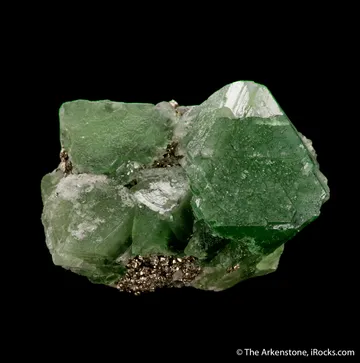
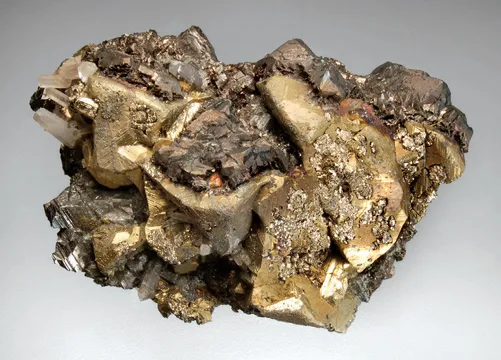
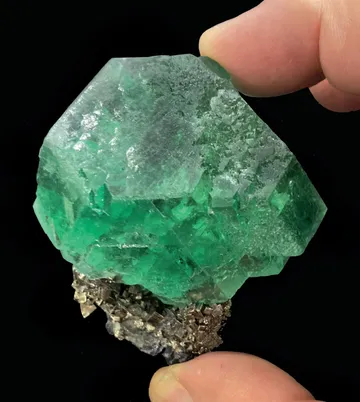
Milpo is one of the Central Peruvian localities whose modern collector reputation has arrived in a rush: a long-worked polymetallic zinc-lead-silver mine that, in the 2020s, began yielding some of the most immediately recognizable fluorite combinations on the market. The best pieces are small to cabinet-size sculptures of glassy apple- to emerald-green fluorite perched on metallic sulfides—golden pyrite in some pieces, dark sphalerite and silvery galena in others, and, most distinctively, black to steel-gray crystals in the geocronite-jordanite series. The visual signature is unusually sharp: bright green transparent fluorite against a glittering, almost black base-metal matrix, often with enough contrast that even modest miniatures read across a room.
Geologically, Milpo belongs to the Atacocha mining district near Cerro de Pasco in the high Central Andes. In mining-company language the operation is treated with El Porvenir, a long-lived underground polymetallic mine historically operated by Compañía Minera Milpo and now part of Nexa’s Cerro Pasco complex. The deposit sits in a structurally and metallogenically rich belt of the Western Cordillera, where carbonate rocks of the Pucará Group, quartz-rich sandstones of the Goyllarisquizga Group, Oligocene intrusive rocks, the Milpo-Atacocha fault, skarn alteration, epithermal veins and breccias, and stratabound mantos all overlap. That geological mixture explains the collector assemblage: fluorite and quartz with pyrite, sphalerite, galena, arsenopyrite, bournonite, tetrahedrite-subgroup minerals, manganese carbonates and silicates, and rare lead sulfosalts.
Regional View
Country View
For collectors, the reason Milpo matters is not simply that it produced attractive green fluorite; it produced green fluorite in an assemblage that rewards close mineralogical work. A specimen may be sold as fluorite on “geocronite,” “jordanite,” “bournonite,” “galena,” or “black sulfides,” and in some cases more than one of those names may be involved. The best labels now increasingly acknowledge the geocronite-jordanite series unless a particular specimen has been analyzed. That uncertainty has not hurt the locality’s reputation; it has made Milpo one of the few recent fluorite occurrences where serious collectors talk equally about aesthetics, paragenesis, and analytical proof.

Photo: Fabre Minerals
Search for specimens: View all specimens from Milpo mine, Peru
Milpo is in the Atacocha mining district of Pasco, near Cerro de Pasco, in the Central Andes of Peru. The locality used by specimen collectors—“Milpo mine”—is closely tied to the modern El Porvenir underground operation, the historic mine of Compañía Minera Milpo. The mine area is high, cold Andean ground, around 4,200 m elevation, and lies roughly 13 km from Cerro de Pasco along the Lima–Huánuco route. It is not a casual collecting locality; it is an active industrial mining area with concessions, underground workings, processing infrastructure, tailings facilities, water management, and corporate safety controls.
The geologic framework is classic central Peruvian polymetallic ground, but Milpo is not a single simple vein. The main units of interest are carbonate rocks of the Pucará Group and quartz-rich sandstones of the Goyllarisquizga Group. Intrusive rocks in the property area range from porphyritic dacite to quartz diorite and are part of the Milpo-Atacocha-Vinchos intrusive belt, with Oligocene ages around 28–30 Ma. The Milpo-Atacocha fault is the key structural feature of the district: a north-south, steeply east-dipping structure traced for nearly 15 km from Yarusyacán toward Carmen Chico, with large reverse displacement and probable strike-slip movement. In practical collecting terms, that fault-controlled intrusive and hydrothermal architecture is why the district can produce skarn sulfides, silica breccias, base-metal veins, fluorite pockets, and unusual sulfosalts in a compact area.
The deposit is described in modern technical reports as a combination of skarn, intermediate-sulfidation epithermal vein/breccia-style mineralization, and stratabound Pb-Ag-Zn mantos. Skarn-related mineralization formed around the Milpo stock in Pucará carbonate rocks and is associated with garnet and silica-skarn-chlorite assemblages carrying pyrite, chalcopyrite, sphalerite, galena, and minor pyrrhotite, bornite, covellite, orpiment, and realgar. Later hydrothermal stages introduced veins, veinlets, silica breccias, and carbonate-rich assemblages. In the Ag-Pb-Zn breccias, the reported matrix minerals include pyrite, sphalerite, galena, quartz, calcite, rhodochrosite, rhodonite, and additional sulfides and sulfosalts. The stratabound mineralization occurs in sandstone mantos near the Goyllarisquizga-Pucará contact, including the Sara and Porvenir 2W areas, where disseminated galena, sphalerite, and pyrite are important.
The mining history is unusually well documented. The El Porvenir site was granted in 1939, and operations began in 1949 as a small-scale artisanal mine. Compañía Minera Milpo S.A. was incorporated the same year by Aquiles Venegas, Amador Nycander, Ernesto Baertl, Manuel Montori, and Luis Cáceres P. A gravity separation plant followed in 1953, and a flotation plant was completed in 1979. Production increased over the decades, with a new mineralized zone called Porvenir Nueve discovered in 1997, production rising to 3,000 tpd in 1999, and later output reaching about 5,600 tpd. Milpo acquired the neighboring Atacocha mine in 2008. Votorantim, later Nexa, gained control of Milpo and its assets in 2010, and the Atacocha and El Porvenir operations were progressively integrated through administration, tailings facilities, power supply, and eventually underground connection by drift.
The specimen-producing zones that matter to collectors are less precisely documented than the ore domains, but the material itself is now well established. Older Milpo material included quartz, amethyst, fluorite, pyrite, bournonite, arsenopyrite, calcite, and other hydrothermal assemblages, but the locality’s current fame rests on the green fluorite pockets that reached the market beginning around 2022. Those pockets produced transparent to translucent green fluorite crystals—commonly octahedral, modified octahedral, cubic, or cuboctahedral—on pyrite, sphalerite, galena, quartz, arsenopyrite, and rare geocronite-jordanite-series sulfosalts. One rich group offered at Munich in 2023 was described as a March 2023 Milpo find, with pale to medium-green fluorites to 3 cm, drusy pyrite, and knobby partial coatings of geocronite-jordanite crystals with individual sharp crystals to 7 mm. Other pieces from the broader find include gemmy fluorite crystals to roughly 3.5 cm on black sulfide matrix, and a few large display pieces reach cabinet size.
Access today should be considered closed except through legitimate specimen channels. The mine is an operating underground polymetallic mine under Nexa-related ownership and control, with industrial hazards, underground workings, tailings infrastructure, seismic and ventilation systems, and regulated surface rights. Collectors should not attempt to enter mine property or dumps without explicit permission from the operator and local rights holders. Most specimens now reach the market through Peruvian mineral dealers, international show dealers, and resale collections; locality confidence depends heavily on dealer provenance and, for sulfosalts, analytical confirmation.
Milpo fluorite is the locality’s calling card: transparent to translucent apple-green, lime-green, bottle-green, and emerald-green crystals, most often octahedral to modified octahedral, with some cubic and cuboctahedral forms, set on pyrite, sphalerite, galena, quartz, arsenopyrite, and geocronite-jordanite-series sulfosalts. Common small crystals are under 1 cm, good miniatures show crystals around 1–3 cm, and reported show pieces include crystals to about 3.5 cm; large cabinet plates are scarce but dramatic when the green fluorites are evenly distributed over sparkling pyrite. Better specimens have saturated color, transparency, sharp undamaged edges, balanced placement, and a strong contrast against metallic matrix. The most mineralogically interesting examples are those with analyzed geocronite or geocronite-jordanite, and at least one Milpo fluorite has been documented with geocronite inclusions confirmed by Raman spectroscopy; some green crystals also show attractive blue fluorescence under ultraviolet light.
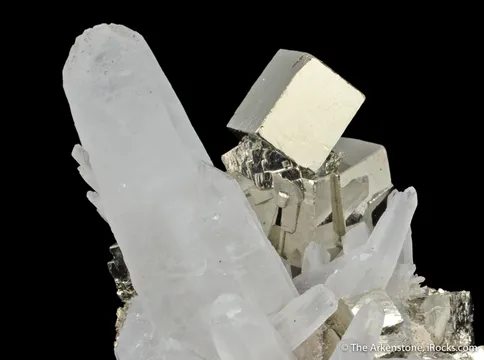
Pyrite at Milpo is both an ore mineral and the most important display matrix for the modern fluorites. It occurs as bright golden drusy coatings, striated cubic crystals, dense sparkling crusts, and massive to microcrystalline pyrite-rich skarn or breccia matrix; modern dealer descriptions record fluorite sitting on striated cubic pyrite and on mirror-lustrous pyrite carpets. The finest collector pieces are not isolated pyrite specimens so much as pyrite architecture: a glittering, undamaged golden base with enough relief to lift the green fluorite crystals into a three-dimensional composition. In the mine geology, pyrite belongs to skarn, vein, breccia, and stratabound assemblages, and pyrite-argillic skarn locally contains very high proportions of massive pyrite, explaining why pyrite can range from dull ore matrix to sparkling display surface.
Milpo sphalerite is typically a dark gray to black, resinous to metallic-looking associate of the green fluorite finds, appearing as small lustrous crystals, aggregates tucked among pyrite, and darker patches in mixed sulfide matrix with galena, pyrite, quartz, and geocronite-jordanite. Specimen descriptions from recent market material record sphalerite crystals around the 8–9 mm range on miniature-sized fluorite combinations, while larger display pieces use sphalerite more as a textural and color accent than as the dominant species. Good sphalerite-bearing Milpo pieces are those where the sphalerite is clearly crystallized and helps frame the fluorite instead of merely forming a dark massive substrate. In the deposit, sphalerite is one of the principal zinc ore minerals, present in skarn, vein/breccia, and stratabound settings; in the collector material it is valued most when it adds black contrast to saturated green fluorite and golden pyrite.
Geocronite is the rare species that turned Milpo from a pretty fluorite source into a serious locality for sulfosalt collectors. It appears in the recent material as opaque silvery gray to metallic black crystals and aggregates, commonly intergrown with or partly coated by green fluorite; the best reported crystals reach around 2 cm in some black-matrix material, while richly crystallized 2023 pocket specimens showed sharp geocronite-jordanite individuals to about 7 mm. A GIA study of a 29.60 × 23.84 × 18.35 mm Milpo cluster used optical microscopy and Raman spectroscopy to identify geocronite crystals included in fluorite, a significant documentation of the species as an inclusion in another mineral. The finest Milpo geocronite specimens show distinct crystal form, high metallic luster, and intimate association with sharp green fluorite; ordinary examples are darker mixed sulfosalt patches that should be labeled conservatively unless analyzed.
Jordanite from Milpo is best approached analytically: visually it overlaps strongly with geocronite, and many specimens from the recent green fluorite finds are more safely labeled geocronite-jordanite or jordanite-geocronite unless a specific piece has XRD, SEM-EDS, or equivalent work. The reported habit is metallic black to steel-gray sulfosalt crystals and polycrystalline aggregates with pseudohexagonal or foliated appearances, occurring with green fluorite, pyrite, sphalerite, galena, bournonite, and quartz. Jordanite is arsenic-dominant relative to geocronite’s antimony-dominant composition, so two specimens that look identical may not deserve the same species name. Good Milpo jordanite-labeled pieces therefore have two levels of quality: aesthetic sharpness and contrast, plus analytical credibility. Without analysis, a sharp black sulfosalt on Milpo fluorite is interesting; with confirmed jordanite, it becomes a much more important specimen.
Quartz from Milpo occurs as ordinary white to milky hydrothermal quartz, quartz-rich breccia material, small crystals on sulfide matrix, and amethyst or chalcedony varieties documented from the locality. In the modern fluorite suite it is usually a supporting gangue mineral, visible on undersides, in pockets between sulfides, or as pale matrix that makes the green fluorite stand out; older Milpo quartz and amethyst pieces appear in locality records with associations including pyrite, fluorite, bournonite, calcite, arsenopyrite, and chalcopyrite. The best quartz-bearing Milpo specimens are not judged by quartz alone but by how the quartz contributes to the composition: clean white contrast under fluorite, sharp small crystals adding sparkle, or a credible older association with bournonite and arsenopyrite. Pure quartz from Milpo is a locality piece; quartz in a well-balanced fluorite-sulfide specimen can be an important part of the display.
Galena at Milpo occurs as silvery metallic crystals and aggregates in the same Pb-Zn-Ag system that produced the mine’s ore, and in collector specimens it is most often an associate of green fluorite, pyrite, sphalerite, quartz, and geocronite-jordanite. Recent Milpo fluorite specimens have been described with galena as the tested metallic associate, including pieces with apple-green fluorite zoning and galena distinguished analytically from geocronite in the same find. Galena-bearing pieces are especially attractive where silvery galena forms a lustrous base or edge accent beneath transparent green fluorite; massive gray galena with little form is much less desirable. Because several metallic gray to black minerals occur together at Milpo, visually calling every silvery-gray mass “galena” is risky—good labels distinguish galena from geocronite-jordanite, bournonite, and other sulfosalts where possible.
Arsenopyrite is a less common but important associate in Milpo collector specimens, appearing with fluorite, quartz, pyrite, calcite, and the mixed sulfide-sulfosalt assemblage. It is documented from the locality and from modern dealer material, including fluorite with pyrite, geocronite, and arsenopyrite. The habit in these pieces is generally small metallic silver-gray crystals or aggregates rather than large freestanding arsenopyrite specimens; its collector value lies in sharpening the paragenetic story of the specimen and adding another species to the high-contrast fluorite-sulfide suite. The best arsenopyrite-bearing Milpo pieces show the arsenopyrite visibly and cleanly enough to be identified, ideally with the same rich green fluorite and bright pyrite that define the locality’s top combinations.
Other minerals documented from Milpo include bournonite, calcite, kutnohorite, rhodochrosite, rhodonite, siderite, tetrahedrite-subgroup minerals, chalcedony, and amethyst. Bournonite is particularly important because it can be part of the black sulfosalt assemblage in the modern fluorite pieces and has contributed to labeling uncertainty. Kutnohorite and tetrahedrite-subgroup minerals are significant older documented species from the Milpo-Atacocha literature, while rhodochrosite and rhodonite fit the manganese-rich carbonate and silicate signature of the breccia and skarn environment. No well-established type-locality mineral is documented for Milpo in the standard locality records; the locality’s mineralogical importance rests instead on its rare geocronite-jordanite fluorite assemblage and on the unusually attractive presentation of base-metal ore minerals.
The principal Milpo authenticity issue is not fake manufacture; it is label discipline. Since the 2022–2024 appearance of the new green fluorites, specimens have circulated under Milpo, Atacocha, Cerro de Pasco, and even Huanzalá attributions. Milpo and Atacocha are neighboring mines in the same district and share closely related geology, but they are not simply interchangeable labels. For a high-value specimen, “Atacocha mining district” may be a safer broad geographic description when the mine-level source is uncertain; “Milpo mine” should be reserved for pieces with credible dealer, collector, or analytical provenance.
Species labeling is the second major concern. The black metallic sulfosalt matrix may include geocronite, jordanite, bournonite, galena, pyrite, or mixtures. Geocronite and jordanite form an isostructural series, and hand-specimen appearance alone is not enough to determine whether a crystal is Sb-dominant geocronite or As-dominant jordanite. The best current practice is to label unanalyzed material as geocronite-jordanite series, or as geocronite-jordanite with a note that the exact species is unconfirmed. Specimens sold as definite jordanite or definite geocronite are more convincing when accompanied by XRD, SEM-EDS, Raman, or dealer-supplied analytical documentation.
Condition matters greatly. Fluorite crystals from Milpo can be transparent and sharp, but the exposed octahedral points and edges are vulnerable to bruising. Many specimens have natural contacts or broken matrix on the underside; that is acceptable if the display face is clean. Top pieces should be inspected for tiny edge chips, bruised fluorite tips, scratched faces, and repaired or glued crystals. The sulfide matrix can also shed small grains, especially where drusy pyrite or brittle sulfosalt coatings are present, so specimens should be handled over a tray and mounted securely.
Fluorite fluorescence adds a useful collecting dimension. At least some green Milpo fluorites fluoresce blue under ultraviolet light, and one published discussion attributed the effect in a photographed specimen to trace europium substituting for calcium in the fluorite structure. Not every piece should be assumed to respond equally, so fluorescence should be tested and described specimen by specimen. As with all fluorite, keep Milpo pieces away from prolonged strong sunlight and heat cycling, and avoid ultrasonic cleaning. For pieces with galena, arsenopyrite, geocronite, jordanite, or other Pb-As-Sb sulfides and sulfosalts, wash hands after handling and avoid creating dust.
Market availability remains active but uneven. Small and miniature green fluorite-pyrite pieces are now obtainable from multiple dealers, while fine geocronite-jordanite combinations, well-balanced cabinet plates, and specimens with documented analysis command stronger competition. Prices in published show and dealer reports range from low hundreds of dollars or euros for modest miniatures to several thousand for fine small-cabinet pieces, with exceptional large display examples offered far higher. The sweet spot for serious collectors is usually a sharp miniature or small cabinet specimen with saturated green fluorite, undamaged display crystals, visible sulfosalt association, and a conservative, well-documented label.
The modern Milpo story begins like many important new mineral stories do: with whispers at a show and bad labels. At the 2022 Tucson Show, green Peruvian fluorite was being talked about, but good specimens were hard to pin down. Photographs circulated later, showing gorgeous green crystals on dark sulfide matrix. The locality first attached to the material was not Milpo at all, but Huanzalá in Ancash, and the black sulfides were tentatively compared with geocronite-jordanite-series minerals. Then testing added another twist: some unit-cell data reportedly looked close to bournonite. The crystals were beautiful before anyone knew quite where, or what, they were.
By September 2022, at the Hardrock Denver Show, the story had shifted. Evan Jones of Unique Minerals had about 15 good miniatures of the new Peruvian fluorite, with cubic, octahedral, and cuboctahedral crystals to 3.5 cm on a black matrix then described as galena, possible bournonite, and a little quartz. The label now read Cerro de Pasco, Chaupimarca District, Pasco. That was closer, but still not satisfying. Cerro de Pasco is a city and a famous mining center, not a mine. For collectors trying to preserve locality data on a new occurrence of real quality, the label was still too broad.
Two months later, at the 2022 Munich Show, Jaroslav Hyršl gave the story its decisive direction. Hyršl, who has long experience with Peruvian minerals, identified the material as coming from the Milpo mine in the Cerro de Pasco area. He emphasized the sulfide matrix: sphalerite, galena, pyrite, perhaps rare jordanite, and above all geocronite, described in the Mineralogical Record report as “brilliantly metallic black crystals” reaching 2 cm. The best summer 2022 pieces were not merely fluorite specimens; they were gleaming black sulfosalt blankets carrying spatters of lime-green fluorite.
The labels still did not settle down. By the 2023 Munich Show, good selections of Milpo fluorite-sulfide specimens had become common enough that more collectors could own them, but the black crystals remained contentious. Some dealers called them geocronite, others jordanite, and both sides could be too confident. The practical solution was simple and rather elegant: without analysis, write geocronite-jordanite or jordanite-geocronite. The chemistry decides the name—jordanite is arsenic-dominant, geocronite antimony-dominant—not the shine, the color, or the dealer’s certainty.
One of the finest reported 2023 offerings came from Burillo Minerals: about 35 thumbnails, miniatures, and small-cabinet specimens from a March 2023 Milpo find. They showed transparent pale to medium-green octahedral fluorite, a few cubic crystals, drusy pyrite, and knobby geocronite-jordanite coatings with sharp equant individuals to 7 mm. Prices ranged from 300 to 2,400 euros, and they sold quickly. The report’s author even admitted missing a fine thumbnail by waiting and dithering for a day—an honest little collector’s tragedy that says as much about the appeal of the material as any price list could.
The most scientifically memorable Milpo episode happened under the microscope. GIA examined a small but important cluster measuring 29.60 × 23.84 × 18.35 mm, obtained from Luciana Barbosa of Barbosa Minerals. The specimen combined bright apple-green fluorite with opaque silvery-gray geocronite, and the fluorite hosted several small, well-formed monoclinic crystals near its surface. Optical microscopy suggested geocronite; Raman microspectrometry confirmed it. The authors noted that, to their knowledge, this was the first time geocronite had been identified as an inclusion in any mineral. A pocket find that first moved through show gossip had become a publishable gemological observation.