






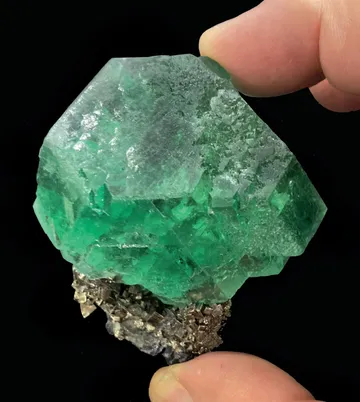
Cerro de Pasco, Peru — a renowned Cordilleran polymetallic locality famed for green fluorite, pyrite, sphalerite, and rare sulfosalts, prized by collectors.
Key facts
Cerro de Pasco is one of the great mineral names of the central Andes: a city built around an orebody, and an orebody large enough to have shaped four centuries of mining history. For collectors, the name carries two overlapping meanings. In the strict sense it refers to the Cerro de Pasco mine complex itself—especially the historic Excelsior workings and the immense Raúl Rojas open pit. In the marketplace it is also used for the wider Cerro de Pasco collecting region, including the Atacocha–Milpo area and the Huarón district, whose specimens commonly travel under the larger Cerro de Pasco label. The best modern pieces from this region are unmistakable: sharp apple- to emerald-green fluorite, brilliant pyrite, dark sphalerite, quartz, galena, and rare lead sulfosalts, with some of the most discussed recent material carrying geocronite-jordanite associations that demand careful labelling.
Geologically, Cerro de Pasco is a classic Cordilleran polymetallic system in the upper part of a porphyry environment. The deposit sits on the eastern margin of a middle Miocene diatreme-dome complex, where hydrothermal fluids attacked Pucará Group carbonate rocks, diatreme breccias, and related volcanic-intrusive rocks. The ore system is not a simple vein field: it includes a huge pyrite-quartz replacement body, pyrrhotite pipes with sphalerite-galena rims, east-trending enargite-pyrite veins, and later Zn-Pb-Ag-Cu-Bi carbonate-replacement bodies with strong mineral zoning. That complexity is exactly why Cerro de Pasco specimens can be visually and chemically so varied—massive sulfide ore, vuggy quartz-pyrite material, black sulfosalt clusters, bright cubic and octahedral fluorite, and rare species that make the locality important well beyond commercial mining.
Regional View
Country View
The mineralogical reputation of Cerro de Pasco rests on two different eras. The older, museum-era material includes classic gratonite from the Excelsior Mine, the type locality for the species, where dark metallic lead-arsenic sulfosalt crystals were preserved in small but choice clusters. The modern collecting era is dominated by the Atacocha–Milpo green fluorites, many found with pyrite, sphalerite, galena, arsenopyrite, bournonite, and the geocronite-jordanite series. These fluorites brought Cerro de Pasco back into high-end specimen conversation in the 2020s because they combine saturated color, transparency, and strong geometry with dark metallic matrix minerals rare enough to interest systematic collectors as much as fluorite specialists.


Search for specimens: View all specimens from Cerro de Pasco, Peru
The Cerro de Pasco district lies in the central highlands of Peru at roughly 4,330 metres elevation, where the mining city is wrapped around the enormous open pit and related mine infrastructure. The main Cerro de Pasco deposit is a sulphide-rich, well-zoned Cordilleran polymetallic system, chiefly Zn-Pb-Ag with Cu, Au, and Bi components, developed in and beside a middle Miocene diatreme-dome complex. The older stratigraphic framework includes Devonian Excelsior Group shale, phyllite, and quartzite, Permo-Triassic Mitu Group sandstone and conglomerate, and thick Late Triassic Chambará Formation carbonate rocks of the Pucará Group. The regional Longitudinal Fault places the Excelsior metamorphic rocks against the carbonate sequence and helped focus later structures, alteration, and replacement bodies.
The igneous centre is one of the keys to understanding the locality. West of the Longitudinal Fault, a diatreme-intrusive dome complex about 2.5 km in diameter was built by magmatic, phreatomagmatic, and phreatic events. The common diatreme breccia, known locally as Rumiallana agglomerate, contains clasts of Excelsior phyllite, Mitu sandstone, Pucará limestone, tuff, altered porphyry, and juvenile material. Dacitic to rhyodacitic domes were emplaced along the western margin, and east-west quartz-monzonite porphyry dikes cut the diatreme and locally cross into the carbonate sequence. U-Pb and Ar-Ar work on zircons, sericite, and alunite places the magmatic-hydrothermal episode broadly between about 15.4 and 14.4 Ma, with second-stage advanced argillic alteration tied to alunite ages around 14.54 to 14.41 Ma.
The ore system developed in distinct but telescoped stages. A first major stage produced pyrrhotite pipes and sphalerite-galena rims. A later Stage B pyrite-quartz replacement body became the largest sulphide mass: a north-trending, funnel-shaped body roughly 1.5 km long, tens to hundreds of metres wide, and hundreds of metres deep, chiefly replacing Pucará carbonates and locally diatreme breccia. In that body, pyrite can make up more than 90% of the rock, occurring as anhedral to euhedral grains, commonly octahedral and locally cubic, with quartz and black to red hematite-bearing chalcedony. A still later Stage C introduced high- to intermediate-sulphidation Zn-Pb-Bi-Ag-Cu carbonate-replacement bodies and east-trending enargite-pyrite veins. The carbonate-replacement bodies are irregular, upward-flaring pipes controlled by N35°, N120°, and N170° structures, with cores of famatinite-pyrite-kaolinite-alunite, intermediate pyrite-tetrahedrite-bismuth/silver sulfosalt zones, outer Fe-poor sphalerite-galena zones, and outermost magnetite-hematite-carbonate assemblages.
Mining history at Cerro de Pasco is as important as the mineralogy. Silver mining began in colonial times, with 1630 generally accepted as the discovery date, and 85 small mines worked between 1630 and 1784. From 1784 to 1886, silver production supervised by the Lima mint totaled more than 164 million ounces. In the early twentieth century, A.W. McCune and James Ben Ali Haggin consolidated scattered holdings through the Cerro de Pasco Investment Company, backed by a remarkable list of investors that included Henry Clay Frick, Michael P. Grace, Phoebe Hearst, Darius Ogden Mills, J.P. Morgan, and Hamilton McKown Twombly. The company became Cerro de Pasco Copper Corporation in 1915. Copper production was recorded by 1905; the Paragsha plant was operating by the 1940s; and from 1956 the McCune open pit—now the Raúl Rojas open pit—made Zn-Pb-Ag ores increasingly dominant. The corporation was nationalized in 1974 into CENTROMIN, and Volcan acquired the mining operation in 1999 during privatization.
The Raúl Rojas open pit is now one of the defining physical features of the city, about 1.8 km long, 1.5 km wide, and approximately 340 m deep at its central point. Volcan placed the open pit and underground mines into care and maintenance in 2012 and 2015 respectively; subsequent activity centered on oxide Ag-Au material at Santa Rosa and treatment of low-grade Zn-Pb-Ag sulphide stockpiles. Collecting access to the main mine complex should be considered closed in practical terms: this is a large industrial and urban mine environment, with active concessions, stockpiles, tailings, environmental controls, and safety restrictions. Loose “Cerro de Pasco” specimens in the market are therefore overwhelmingly legacy material, dealer-sourced mine specimens, or material from nearby producing districts such as Milpo, Atacocha, and Huarón that have been distributed commercially.
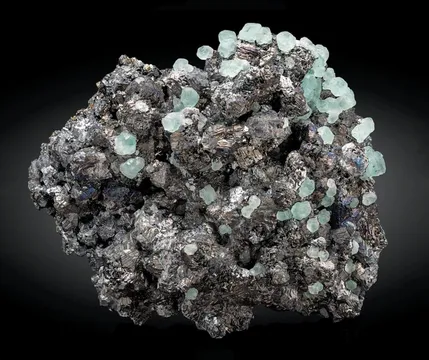
The most important recent specimen story is the green fluorite from the Atacocha–Milpo area. Early examples reached shows in 2022 labelled broadly as Cerro de Pasco or Atacocha-area material; by the Munich Show that year, Jaroslav Hyršl identified key material as Milpo mine specimens from the Cerro de Pasco area. These pieces show green octahedral, cuboctahedral, and modified cubic fluorite on pyrite, sphalerite, galena, bournonite, arsenopyrite, and geocronite-jordanite series sulfosalts. A March 2023 Milpo find produced transparent pale- to medium-green octahedral fluorite to about 3 cm with drusy pyrite and knobby partial coatings of geocronite-jordanite, including individual sulfosalt crystals to several millimetres. Related Atacocha-mine material has also appeared, with deep emerald-green cuboctahedral fluorite on sphalerite and pyrite. For collectors, the distinction matters: “Cerro de Pasco” is often the regional shorthand, but Milpo, Atacocha, Huarón, Excelsior, Raúl Rojas, and Santa Rosa are not interchangeable names.
Cerro de Pasco-region fluorite is best known today from the Atacocha–Milpo finds: green, transparent to translucent octahedra, cuboctahedra, and octahedra with small cube modifications, commonly on bright pyrite or dark sphalerite-geocronite-jordanite matrix. The most admired pieces have saturated apple, emerald, bottle, or “electric” green color, glassy faces, undamaged tips and edges, and enough matrix contrast to set off the crystals rather than bury them; ordinary examples tend to be paler, contacted, crowded, or labelled only as broad “Cerro de Pasco” without a specific mine. Documented specimen sizes range from thumbnail and miniature pieces with fluorite crystals around 1–2 cm to small-cabinet examples with fluorites reported to about 3–3.5 cm, and the best Milpo material may show strong long- and short-wave UV fluorescence. Associations include pyrite, sphalerite, galena, arsenopyrite, bournonite, calcite, quartz, and especially geocronite-jordanite series sulfosalts, whose correct identity often requires analysis.
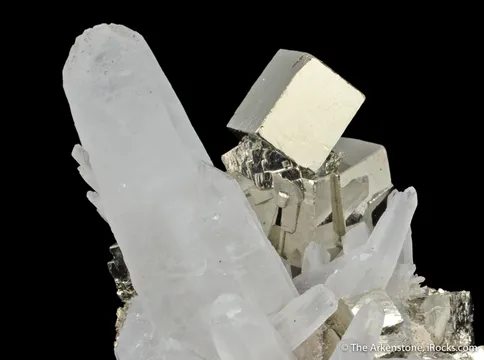
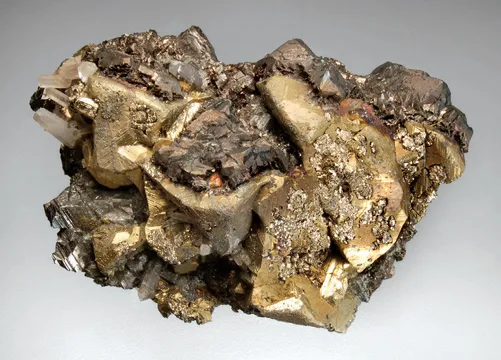
Pyrite is not merely an accessory at Cerro de Pasco; it is a structural mineral in the deposit and a visual anchor for many specimens. In the main Cerro de Pasco mine it forms the enormous pyrite-quartz replacement body, where pyrite occurs as massive material and as euhedral octahedral, and less commonly cubic, grains reported up to about 2 cm, with inclusions of pyrrhotite, chalcopyrite, sphalerite, arsenopyrite, stannite, rutile, hematite, and stibnite in different zones. In the specimen market, pyrite is most familiar as bright, brassy, fine-grained to drusy matrix beneath green Atacocha–Milpo fluorite, or as glittering accents with sphalerite and quartz from the broader Cerro de Pasco region. Good pieces show crisp metallic luster, clean contrast against fluorite or quartz, and little oxidation; mediocre ones are dull, massive, bruised, or beginning to show the instability problems that can affect pyrite-rich sulphide assemblages.
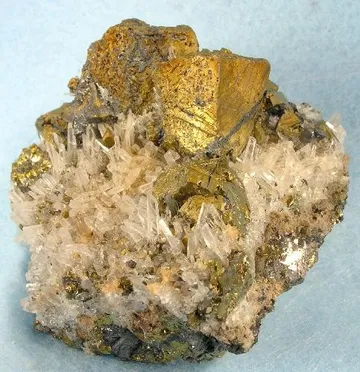
Sphalerite at Cerro de Pasco records the deposit’s complicated thermal and chemical history, from Fe-rich sphalerite associated with early pyrrhotite-pipe rims to Fe-poor sphalerite in later Zn-Pb replacement ores and vein assemblages. Collectible specimens from the wider region are typically lustrous black to dark brown crystals, pseudo-octahedral or complex, commonly with quartz, pyrite, galena, and fluorite; Atacocha–Milpo fluorites may sit on dark sphalerite-rich matrices, while Huarón-region pieces can carry sharply formed black sphalerite with colorless quartz and pyrite. Good sphalerite specimens from this label group have isolated, bright crystals, clean edges, and either a strong quartz contrast or attractive green fluorite accent; weaker examples are massive ore pieces or mixed sulphide plates whose locality has not been narrowed beyond “Cerro de Pasco, Peru.”
Quartz from Cerro de Pasco is part of both the ore geology and the display-specimen suite. In the main deposit it is a major component of the pyrite-quartz replacement body and occurs with black and red hematite-bearing chalcedony; studies of the body describe euhedral quartz grains up to about 1 cm and inclusions of rutile, anatase, hematite, and apatite in the quartz. In the collector market, quartz most often appears as clear to milky crystals with pyrite and sphalerite from the wider Cerro de Pasco province, including Huarón and Atacocha-related material, or as subordinate crystals on fluorite-pyrite specimens. The most attractive quartz pieces here are not judged by quartz size alone but by association: bright quartz points over metallic pyrite, dark sphalerite contrast, and intact crystal groups that preserve the sulphide-and-gangue texture of a central Andean polymetallic vein or replacement system.
Gratonite, Pb9As4S15, is the great systematic mineral from Cerro de Pasco proper, with the Excelsior Mine as the type locality. The original material was recognized after specimens thought to be jordanite were sent for study in 1938; Palache and Fisher showed it was a distinct species, later named for L. C. Graton. Mindat and classic descriptions record type material from slender needles about 0.1 mm in diameter and 0.5 mm long to stout prisms as much as about 1 cm across and 1.5 cm long, generally in radiating groups; specimen descriptions from the Excelsior Mine emphasize dark lead-gray to steel-gray metallic crystals, commonly trigonal-prismatic, in small clusters on matrix. Good Cerro de Pasco gratonite is sharply crystallized, lustrous, and well isolated despite thumbnail scale; damage, dull surfaces, and vague “Peru” labels matter greatly because the locality and crystal quality are much of the specimen’s value.
Geocronite from the Cerro de Pasco collecting region is most visible in the modern Milpo fluorite finds, but it is also one of the trickiest labels in the whole district. The black metallic sulfosalts on many green fluorite specimens fall in the geocronite-jordanite series: geocronite is Sb-dominant Pb14Sb6S23, jordanite is As-dominant Pb14As6S23, and without analysis a confident single-species label may be unjustified. The best material forms lustrous black to metallic gray aggregates and crystal clusters with striated, curved, or complex faces, sometimes as blankets or knobby coatings under transparent green fluorite; show reports have noted geocronite-jordanite crystals to several millimetres and, in discussion of the 2022 material, metallic black crystals reportedly reaching centimetre scale in matrix material. For collectors, the finest geocronite-associated pieces combine analyzable sulfosalt richness with transparent green fluorite and bright pyrite, while ordinary examples are visually attractive fluorites whose sulfosalt component is too fine-grained or too ambiguous to carry much species weight.
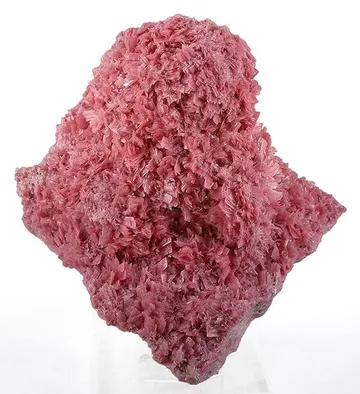
Cerro de Pasco and its surrounding Pasco mining districts have an unusually broad mineral list. The main mine and nearby districts have documented galena, chalcopyrite, pyrrhotite, enargite, luzonite, famatinite, tetrahedrite-tennantite, matildite, cuprobismutite, emplectite, arsenopyrite, bournonite, boulangerite, stibnite, marcasite, magnetite, hematite, siderite, rhodochrosite, calcite, kaolinite, alunite, sericite, and APS minerals, among others. Type-locality and first-record importance extends beyond the ore pit: gratonite is a Cerro de Pasco classic from Excelsior, revoredite was first recorded from cavities in the lead-zinc sections of the Cerro de Pasco mine, and the wider Pasco province includes Ragra Mine vanadium species such as minasragrite and patrónite, though those belong to the Minas Ragra/Ragra vanadium locality rather than the Raúl Rojas-Excelsior mine itself.
The biggest authenticity issue for Cerro de Pasco specimens is labelling, not artificial enhancement. The name “Cerro de Pasco” is used at several levels: city, mine complex, province, and broad collecting region. A specimen labelled simply “Cerro de Pasco, Peru” may be from the Raúl Rojas/Excelsior mine, from Atacocha, from Milpo, from Huarón, or from another Pasco district mine unless the provenance is more precise. For modern green fluorites, the difference between Milpo mine and Atacocha mine labels is especially important because both have produced attractive fluorite in the same broader Atacocha mining district, and early show labels did not always settle the exact mine.
The second major issue is geocronite versus jordanite. These minerals are isostructural members of a series, and visually similar black metallic sulfosalts on Milpo fluorites may not be separable by eye. Dealer and collector labels have used geocronite, jordanite, and geocronite-jordanite; the most cautious label for unanalyzed material is “geocronite-jordanite series” or “geocronite-jordanite,” while a single-species label should ideally be backed by SEM-EDS, XRD, or other analytical documentation. For high-value pieces, ask whether the analysis applies to the actual specimen or merely to material from the same find.
Condition standards vary by species. The green fluorites are valuable for transparency, color, and sharp geometry, so small bruises on octahedral edges, cleaved corners, and contacted rear faces have a noticeable effect. Pyrite-rich matrices should be examined for oxidation, sulfate bloom, and acidity; keep them dry, avoid sealed humid display cases, and do not wash sulphide specimens unnecessarily. Sphalerite is generally stable but can be brittle along crystal edges and may hide small cleaves in dark luster. Gratonite is soft, brittle, rare, and usually small, so it should be handled like a systematic thumbnail rather than a robust display sulphide.
Market availability is split sharply between modern and classic material. Atacocha–Milpo fluorite with pyrite, sphalerite, and sulfosalts remains available on the secondary market and through dealers, though the best transparent, saturated green crystals on dark geocronite-jordanite matrix are already treated as modern classics. Attractive miniatures and small cabinet pieces appear regularly enough for patient collectors, but top examples with analysis, strong aesthetics, and clean condition are much scarcer. Classic gratonite from the Excelsior Mine is far less available: most good pieces are old collection material, often thumbnails, and prices reflect both type-locality status and the fact that Cerro de Pasco produced some of the world’s best crystallized gratonite.
The old Cerro de Pasco story begins not with fluorite or gratonite but with silver, altitude, and persistence. The accepted discovery date is 1630, and for the next century and a half the mining field was a patchwork of small operations. Between 1630 and 1784, 85 little mines worked the silver-bearing oxidized ores around the hill. Then the Lima mint took a more formal role in supervising production, and from 1784 to 1886 it recorded 164,540,808 ounces of silver. Those numbers are not abstract local history; they explain why the city grew where it did, why later companies could consolidate old claims into a modern mining giant, and why Cerro de Pasco became one of the few mineral localities where the urban map and the orebody map are almost the same document.
By the nineteenth century, Cerro de Pasco was already being drawn as a mining city. Mariano Felipe Paz Soldán’s 1865 atlas included Román Batanero’s topographic plan of the city, surveyed in 1862, with mine shafts and a cross section built into the image. It is the kind of map collectors love because it shows a locality before the modern pit erased so much of the old topography: streets, workings, hills, and drainage captured in the same lithographic frame. The city was not beside the mine; it was threaded through it.

The twentieth-century consolidation reads like an industrial roll call. A.W. McCune and James Ben Ali Haggin began purchasing individual concessions in the early 1900s, then formed the Cerro de Pasco Investment Company in 1902. The shareholder list attached to that enterprise is startling even now: Henry Clay Frick, Michael P. Grace, Phoebe Hearst, Darius Ogden Mills, J.P. Morgan, and Hamilton McKown Twombly. The company did not just fund a mine; it funded mines, hydroelectric plants, railway work, and agricultural projects in Peru. In 1915 it took the name Cerro de Pasco Copper Corporation, a name that would remain embedded in geological literature and old mineral labels for decades.
Gratonite has a quieter but very collector-friendly origin story. In October 1938, material was sent to the Harvard Mineralogical Laboratory by Mr. Vance of Ward’s Natural Science Establishment. Around the same time, Dr. George W. Rust of the geological staff at Cerro de Pasco sent specimens to D. Jerome Fisher in Chicago. Rust had thought the mineral was jordanite, but the Harvard and Chicago work showed it was something new. Palache and Fisher announced a preliminary description in 1939 and a full description in 1940, naming the species for Louis Caryl Graton of Harvard, whose work and consulting were closely tied to Cerro de Pasco. The mineral itself is not flamboyant in the way fluorite is flamboyant—it is dark, metallic, and usually small—but for systematic collectors the moment is memorable: a mistaken jordanite label became a new species from one of the Andes’ great mines.
The modern fluorite story has its own show-floor drama. In 2022, green Peruvian fluorites appeared with broad Cerro de Pasco-area labels and uncertain matrix identifications. At the Hardrock Denver Show that September, Evan Jones of Unique Minerals had miniatures with cubic, octahedral, and cuboctahedral fluorite to 3.5 cm on black matrix described as galena, possible bournonite, and quartz. The following Munich Show sharpened the story when Jaroslav Hyršl identified important material as Milpo mine specimens from the Cerro de Pasco area and emphasized the black sulphides in the matrix: sphalerite, galena, pyrite, perhaps jordanite, and geocronite. The best line from the reports is visual enough to stick: “gleaming blankets of geocronite crystals overlain by spatters of small, lime-green fluorite crystals.” By 2024, more refined Milpo pieces were circulating, including transparent green octahedra with drusy pyrite and geocronite-jordanite coatings, and the labelling debate—geocronite, jordanite, or the series—had become part of the specimens’ identity.
Baumgartner, R., Fontboté, L., & Vennemann, T. (2008). “Mineral zoning and geochemistry of epithermal polymetallic Zn-Pb-Ag-Cu-Bi mineralization at Cerro de Pasco, Peru.” Economic Geology, 103(3), 493–537. DOI: 10.2113/gsecongeo.103.3.493. Foundational modern paper on the two mineralization stages, pyrite-quartz body, zoned carbonate-replacement bodies, and sphalerite chemistry.
Baumgartner, R., Fontboté, L., Spikings, R., Ovtcharova, M., Schaltegger, U., Schneider, J., Page, L., & Gutjahr, M. (2009). “Bracketing the age of magmatic-hydrothermal activity at the Cerro de Pasco epithermal polymetallic deposit, Central Peru: A U-Pb and 40Ar/39Ar study.” Economic Geology, 104, 479–504. Key geochronology paper constraining the middle Miocene diatreme-dome complex and hydrothermal activity.
Cheney, E.S. (1991). “Structure and age of the Cerro de Pasco Cu-Zn-Pb-Ag deposit, Peru.” Mineralium Deposita, 26, 210–221. Important structural interpretation of the massive sulphide bodies, Longitudinal Fault, mine geology, and production context.
Einaudi, M.T. (1977). “Environment of ore deposition at Cerro de Pasco, Peru.” Economic Geology, 72, 893–924. Classic ore-deposition study emphasizing pyrrhotite pipes, Fe-rich and Fe-poor sphalerite, pyrite-marcasite alteration, and telescoped mineral stages.
Palache, C., & Fisher, D.J. (1939). “Gratonite—Preliminary description of a new mineral from Cerro de Pasco, Peru.” American Mineralogist, 24(2), 136. Preliminary announcement of gratonite, including the story of material first mistaken for jordanite.
Palache, C., & Fisher, D.J. (1940). “Gratonite—a new mineral from Cerro de Pasco, Peru.” American Mineralogist, 25(4), 255–265. Full description of the lead-arsenic sulfosalt gratonite, Pb9As4S15, from the Excelsior Mine type locality.
Rust, G.W. (1940). “Geologic occurrence of gratonite at Cerro de Pasco, Peru.” American Mineralogist, 25(4), 266–270. Companion occurrence paper for gratonite from the Cerro de Pasco mine.
Johnson, R.F. (1955). “Geology and ore deposits of the Atacocha district, Departamento de Pasco, Peru.” U.S. Geological Survey Bulletin 975-E. Primary reference for the Atacocha district, including galena-sphalerite-pyrite ores and gangue minerals such as calcite, rhodochrosite, quartz, and fluorite.
Hyršl, J., & Rosales, Z. (2003). “Peruvian Minerals: An Update.” The Mineralogical Record, 34(3), 241–254. Widely cited collector-oriented reference for Milpo and Atacocha minerals.
Moore, T.P. (2024). “What’s New in the Mineral World.” The Mineralogical Record, 55(1), 116–117. Report on the modern Milpo green fluorite and geocronite-jordanite material, including show observations and labelling concerns.
Moore, T.P. (2025). “What’s New in the Mineral World,” Online Report 73. Useful narrative on the 2022 Denver and Munich appearances of the new Cerro de Pasco-area fluorites and the Milpo/Atacocha locality clarification.
CSA Global / Cerro de Pasco Resources Inc. (2021). “El Metalurgista Concession – NI 43-101 Technical Report.” Technical report with mine history, stockpile history, geology, production figures, and summaries of the Cerro de Pasco deposit.
Mindat: “Gratonite: Mineral information, data and localities.” Type-locality details, type material description, formula, and reference list for gratonite.
Mindat: “Cerro de Pasco, Pasco province, Pasco, Peru.” Locality index for the main Cerro de Pasco mineral list, including type-locality and first-record flags.
Mindat: “Milpo mine, Atacocha mining district, Cerro de Pasco, Pasco province, Pasco, Peru.” Current locality page documenting Milpo species, associations, and the July 2022 geocronite with green fluorite note.
Mindat: “Fluorite from Atacocha mining district, Cerro de Pasco, Pasco province, Pasco, Peru.” Occurrence and photo-association data for Cerro de Pasco-area fluorite.
Mindat: “Minasragrite: Mineral information, data and localities.” Type-locality information for minasragrite from Ragra Mine in Pasco province, useful for separating the Cerro de Pasco mining complex from the wider Pasco mineral province.
“Fluorite from Milpo Mine, Cerro de Pasco, Peru” — Fabre Minerals / Vimeo — Short specimen video of a 2022 Milpo fluorite with green gem-quality octahedral character and galena matrix.
“Fluorite on Pyrite with Barite & Sphalerite” — Wilensky Minerals / Vimeo — Dealer specimen video showing deep green Milpo fluorite on bright pyrite with barite and sphalerite.
“¿Dónde estas cerro de Pasco?” — DOCUPERU / Ministerio de Cultura Videoteca — Seven-minute 2008 documentary by Christian Ricaldi on memory, mining, and urban space in Cerro de Pasco.
“Contaminated and Devoured by a Mine. Discover the City of Cerro de Pasco” — Eddie Garcia / YouTube — Modern travel-documentary style overview of the city, open pit, and environmental conflict.
“The DANGEROUS open-pit mine | Cerro de Pasco” — Epicrol / YouTube — Visual tour centered on the open-pit mine and its relationship to the surrounding city.
“Mining Peru’s Cerro de Pasco” — NASA Earth Observatory — Satellite-image feature showing the Cerro de Pasco open pit and regional mining footprint.
Mindat: Cerro de Pasco, Pasco province, Pasco, Peru — Best starting point for the main locality mineral list and linked sublocalities.
Mindat: Milpo mine, Atacocha mining district — Essential page for modern green fluorite, geocronite-jordanite, and associated Milpo specimens.
Mindat: Fluorite from Atacocha mining district — Useful occurrence page summarizing fluorite associations from Atacocha-area photo data.
USGS Bulletin 975-E: Geology and ore deposits of the Atacocha district — Primary geological source for Atacocha ores and gangue assemblages.
Cerro de Pasco Resources: El Metalurgista NI 43-101 Technical Report — Detailed technical source for mine history, geology, stockpiles, tailings, and production figures.
Economic Geology record: Baumgartner, Fontboté & Vennemann 2008 — Core academic reference on mineral zoning and epithermal polymetallic mineralization.
Economic Geology record: Baumgartner et al. 2009 — Key age constraints for the magmatic-hydrothermal system.
Cheney 1991: Structure and age of the Cerro de Pasco Cu-Zn-Pb-Ag deposit — Structural paper with useful historical mining and deposit-scale context.
American Mineralogist archive: preliminary gratonite description — Historic 1939 note introducing gratonite from Cerro de Pasco.
Mindat: Gratonite — Mineral data and type-locality details for Cerro de Pasco’s signature type species.
Wikimedia Commons: Mina Cerro de Pasco1.jpg — Freely licensed modern photograph of the Cerro de Pasco pit.
Wikimedia Commons: Gratonite-72276.jpg — Freely licensed Rob Lavinsky photograph of a classic gratonite specimen from the type locality.
NASA Earth Observatory: Mining Peru’s Cerro de Pasco — Remote-sensing perspective on the mine and city.
The Mineralogical Record: January–February 2024 PDF — Includes show-report discussion of Milpo fluorite and geocronite-jordanite labelling.
The Mineralogical Record: Online Report 73 — Useful account of early market appearances and locality clarification for the new green fluorites.


.jpg)