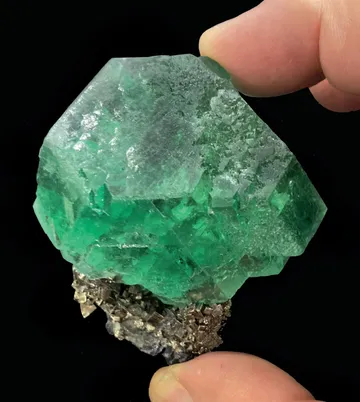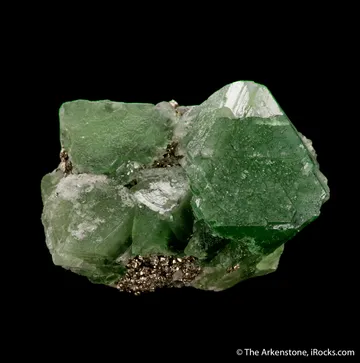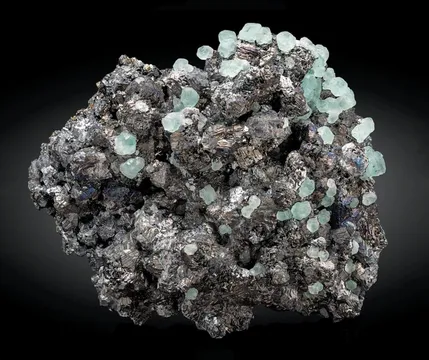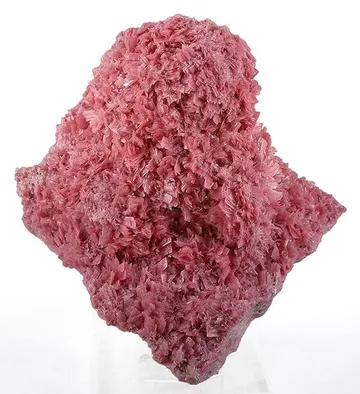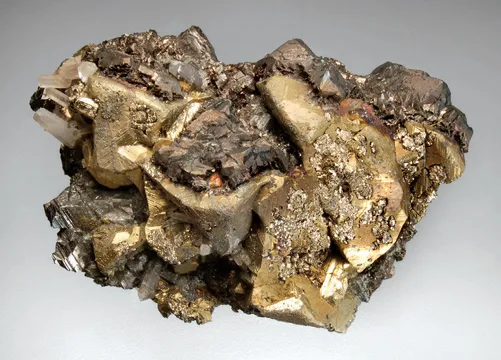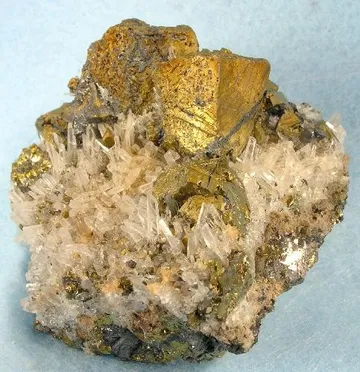
Huarón mine, Peru — a premier locality for collectors, known for pyrite cubes on quartz, with sphalerite and chalcopyrite and striking color contrasts.
Key facts
Huarón is one of the great Central Peruvian polymetallic localities for collectors: an old, high-Andean silver–base-metal system whose specimen identity is as recognizable as its mining geology. The mine lies in the Huayllay district of Pasco, in the Western Cordillera, where folded Cretaceous limestones and Tertiary red-bed sedimentary rocks are cut by quartz-monzonite intrusions and a complex network of veins, mantos, and stockworks. In ore-deposit terms, Huarón is a hydrothermal silver-copper-lead-zinc deposit; in cabinet terms, it is the source of brilliant pyrite cubes and pyritohedrons, black to brown sphalerite, bright chalcopyrite, galena, tetrahedrite-group sulfosalts, rhodochrosite, calcite, and the slender, glassy quartz sprays that give many specimens their unmistakable architecture.
The best Huarón pieces have a distinctly Peruvian look: metallic sulfides on pale quartz, often in strong color contrast rather than in massive ore. Fine examples may show black sphalerite as a glittering mound or matrix, pierced by clear to milky prismatic quartz; sharp brassy pyrite cubes may sit like deliberate accents between quartz blades; chalcopyrite can form bright, golden, often twinned crystals on quartz-sphalerite matrix; and occasional galena adds steel-gray cubic or skeletal forms. The deposit’s paragenesis helps explain this diversity: early high-temperature quartz-pyrite-tetrahedrite assemblages were followed by sphalerite-galena stages and later lower-temperature barite, carbonate, quartz, chalcopyrite, rhodochrosite, calcite, and silver sulfosalts.
Historically, Huarón matters on two parallel tracks. As a mine, it has been worked in modern form since 1912 and has produced silver-rich copper, lead, and zinc concentrates through several operating eras. As a specimen locality, it entered the international collector market through the broader Huarón district—especially material long labeled “Huaron” from the Animón/Alimón side of the district—where textbook combinations of chalcopyrite, sphalerite, pyrite, quartz, galena, dolomite, calcite, and rhodochrosite appeared in quantity during the late twentieth century. That label history is important: “Huarón” on a specimen label may refer to the formal Huarón mine, the Huarón mining district, or neighboring Animón material sold under the familiar district name.
Regional View
Country View
The aesthetic appeal of Huarón specimens is not simply that the species are common ore minerals; it is the way they are staged. Quartz commonly provides height and transparency, sphalerite provides dark mass and luster, pyrite and chalcopyrite provide brassy sparkle, and galena gives density and sculptural relief. Good pieces feel three-dimensional and balanced, with sulfides perched rather than smeared, quartz undamaged at the tips, and enough matrix to tell the story of a vein cavity rather than a trimmed ore fragment.

Photo: Wikimedia Commons

Photo: Wikimedia Commons
Search for specimens: View all specimens from Huarón mine, Peru
Huarón is an underground silver-copper-lead-zinc mine in the Central Highlands of Peru, in the Huayllay district, Pasco province, Pasco department. It sits high in the Western Cordillera, reached from Lima by the central Peruvian highland road system, with mine elevations and workings in the alpine puna environment of the Cerro de Pasco region. The modern Pan American Silver operation describes the mine as a 100%-owned underground producer with silver, zinc, copper, and lead as principal products and a flotation plant producing silver-rich zinc, lead, and copper concentrates.
Geologically, the deposit is built around the Huarón anticline, a north-south-trending fold that deformed Cretaceous Machay Group limestones and Tertiary Pocobamba continental sediments, commonly referred to in the mining literature as the Casapalca Red Beds. The local stratigraphy includes red shales, siltstones, sandstones, conglomerates, calcareous chert, marls, and volcanic units, all overprinted by deformation, faulting, hydrothermal alteration, and mineralization. North-south-trending, subvertical quartz-monzonite dikes cut the sequence, and the deposit is interpreted as hydrothermal polymetallic mineralization related to these intrusive events and the structural preparation of the anticline.
The ore bodies are varied, which is one reason the collector assemblage is varied. Mineralization occurs in veins, mantos, and stockworks. Veins may be only a few centimeters wide or as much as 10 m wide, with some structures extending along strike up to about 1,800 m. The mine’s modeled mineralized structures are grouped into families by orientation and position; named veins and systems in company reporting include, among many others, Cometa, Fastidiosa, Patrick, Shiusha, Rey, Bernabé, Juanita, Consuelo, Teresa, Mariana, Roxana, and related ramales. Mantos occur as gently dipping replacement bodies, especially on the western flank of the anticline, where calcareous horizons in conglomerates and other favorable beds provided sites for replacement mineralization. Stockworks developed where veins intersected one another, where veins crossed conglomerate beds, and where mineralizing fluids entered favorable calcareous sandstone strata.
The zoning is important both economically and aesthetically. A central copper-rich core is characterized by enargite, copper minerals, pyrite, and quartz; to the east and west, silver-lead-zinc mineralization is associated with calcite and rhodochrosite; to the north, silver-lead-zinc mineralization is associated more strongly with pyrite. Sphalerite and sulfosalts with rhodochrosite follow a narrow north-south belt near the anticline axis. The mine report describes three broad stages: a high-temperature assemblage with milky quartz, pyrite, and tetrahedrite; an intermediate stage with milky quartz, pyrite, brown sphalerite, and galena; and a lower-temperature stage including barite, siderite, dolomite, blonde sphalerite, galena, argentiferous tetrahedrite, polybasite, chalcopyrite, rhodochrosite, quartz, and calcite.
Mining began in modern form in 1912, when the underground mine, mill, and supporting villages were built by a subsidiary of the French Peñarroya company. The mine was sold to Hochschild in 1987. In April 1998, a portion of the bed of nearby Lake Naticocha collapsed into neighboring underground workings; water entered interconnected tunnels and flooded Huarón as well, forcing closure. The labor force was terminated, the camp was closed, and dewatering and cleanup work followed. Pan American Silver acquired a majority interest in 2000, then fast-tracked feasibility, financing, and construction so full-scale operations could resume in 2001. Pan American later acquired the remaining interest and operates the mine through Pan American Silver Huarón S.A.
Before Pan American’s acquisition, approximately 22 million tonnes of silver-rich base-metal sulfide ore had been mined from the property. Historic sales value was dominated by silver, with zinc, lead, and copper making up the balance. In recent years, Huarón has remained an active underground mine, with mechanized methods, ongoing underground diamond drilling and channel sampling, and continued near-mine exploration aimed at replacing and expanding mineral reserves and resources. Pan American’s current public operating page lists the mine as producing, with proven and probable silver reserves of 40.7 Moz as of June 30, 2025 and average plant throughput of 2,500 tonnes per day.
For collectors, access should be understood as access to specimens on the market, not as a casual field-collecting destination. Huarón is an operating underground mine, and the best specimens have historically come through mine channels, miners, dealers, and older collections. The practical collector’s distinction is label quality: a precise old label to “Huarón mine” is desirable, but many classic pieces labeled simply “Huaron” or “Huaron, Peru” may in fact be district material, often from Animón. This does not make them uncollectable—indeed, much of the famous material belongs to that district tradition—but it does mean provenance should be described honestly.
Notable specimen finds include late twentieth-century Animón/Huarón district combinations of bright chalcopyrite, dark sphalerite, pyrite, quartz, galena, dolomite, calcite, and rhodochrosite. The district became especially known for “textbook” sulfide combinations around the mid-1980s, when attractive specimens reached the international market in volume. Older Huarón material tends to show sharp brassy chalcopyrite and pyrite with slender quartz on dark sphalerite, while more massive ore specimens may be less collectible unless they show crystal form, color contrast, or a rare sulfosalt association.
Quartz from Huarón is the stage on which many of the locality’s best sulfide specimens perform: slender, prismatic, often clear to milky crystals in sprays, divergent “porcupine” aggregates, and combs rising from sphalerite, pyrite, chalcopyrite, or galena-bearing matrix. The mine’s own paragenetic model places milky quartz in early high-temperature and intermediate stages with pyrite, tetrahedrite, sphalerite, and galena, and later quartz again with chalcopyrite, rhodochrosite, calcite, and silver sulfosalts. The most desirable collector pieces are not simply quartz specimens but balanced combinations—transparent to translucent quartz needles or tapered prisms standing cleanly above dark sphalerite or brassy pyrite/chalcopyrite, with undamaged terminations and open spacing; ordinary pieces tend to be bruised, massive, iron-stained, or so crowded with sulfides that the quartz loses definition.
Pyrite is one of Huarón’s principal gangue minerals and one of the district’s most reliable visual signatures, appearing as bright golden cubes, pyritohedrons, and striated crystals on quartz or sulfide matrix. It belongs to the early quartz-pyrite-tetrahedrite stage and continues as an important associate in later sphalerite-galena assemblages, with particularly attractive examples showing crisp pyrite set among slender quartz crystals or perched on dark sphalerite. Fine Huarón pyrite is judged by sharpness, luster, contrast, and placement: small to centimeter-scale cubes can be excellent if they are brilliant and undamaged, while larger blocky groups are less compelling when dull, corroded, or crowded into massive sulfide without quartz relief.
Sphalerite from Huarón is typically dark brown to black, locally described as brown in the intermediate stage and blonde in lower-temperature assemblages, and it commonly forms lustrous tetrahedral, octahedral, tritetrahedral, twinned, or rounded compound crystals that provide the dark foundation for quartz, pyrite, chalcopyrite, and galena. The most admired pieces show well-formed, highly lustrous sphalerite crystals several centimeters across or dense groups of smaller sharp crystals, especially when they contrast with colorless quartz or bright metallic accents. Ordinary sphalerite from Huarón is abundant as ore or massive matrix; the collector-grade difference is crystal definition, luster, intact edges, and a composition that reads as a specimen rather than a broken sulfide lump.
Chalcopyrite is one of the principal ore minerals at Huarón and a major reason the locality is beloved by collectors, occurring as bright brassy, commonly sharp crystals on quartz-sphalerite matrix and in combinations with pyrite, galena, tetrahedrite-group minerals, dolomite, calcite, and rhodochrosite. In the mine’s paragenesis, chalcopyrite is especially tied to the lower-temperature stage with carbonates, quartz, and silver-bearing sulfosalts, though copper-rich zones in the central core also contain abundant copper minerals with pyrite and quartz. The best Huarón chalcopyrites are sharp, lustrous, golden, and visually isolated enough to catch light; larger crystals often show contact, bruising, tarnish, or edge wear, so clean faces and a lively association with quartz or black sphalerite carry a premium.
Galena at Huarón occurs as part of the intermediate quartz-pyrite-brown sphalerite-galena assemblage and also in lower-temperature associations with barite, siderite, dolomite, blonde sphalerite, argentiferous tetrahedrite, chalcopyrite, rhodochrosite, quartz, and calcite. Collector specimens range from small, bright cubic crystals nestled among quartz and sphalerite to heavier pieces with skeletal or hoppered galena on massive sphalerite, sometimes accented by chalcopyrite. The best pieces combine sharp metallic form with contrast—galena standing distinctly against black sphalerite, white quartz, or brassy chalcopyrite—whereas ordinary galena-rich ore is heavy, gray, and visually closed, with little crystal relief.
Beyond these five market staples, Huarón is important for its broader sulfide-sulfosalt-carbonate suite. Documented species include tetrahedrite-group minerals, tennantite-tetrahedrite, enargite, polybasite, pyrargyrite, bournonite, arsenopyrite, stibnite reported with uncertainty, baryte, calcite including manganese-bearing calcite, dolomite, ankerite, rhodochrosite, and rhodonite. Vinciennite, Cu7+Cu3+Fe2+Fe3+Sn(As,Sb)S16, is a notable rarity recorded from Huarón, though its type locality is Chizeuil in France rather than Peru. Enargite from the central copper core is especially characteristic of the district’s zoned mineralization, while pyrargyrite, proustite, polybasite, and pearceite record the silver-rich sulfosalt side of the system that made the mine economically important.
The main authenticity issue with Huarón specimens is not widespread treatment; it is locality precision. Many labels reading “Huaron Mine” should be interpreted cautiously because the collector trade has long used “Huaron” for material from the broader Huarón mining district, and a significant portion of classic material is attributed to Animón, a neighboring mine in the district rather than the formal Huarón mine group. A specimen with an old label to “Alimon,” “Animón,” or “Huarón district” may actually be more precise than a simplified modern “Huaron mine” label. When buying higher-end examples, ask whether the dealer means the Pan American Huarón mine, the Huarón mining district, or Animón district material sold under the historic Huarón name.
Condition is critical. Huarón quartz sprays and “needle” groups are easily chipped at their tips, and many otherwise attractive specimens lose value through broken or truncated quartz terminations. Chalcopyrite is softer and more brittle than pyrite and commonly shows bruising, edge wear, dull tarnish, or contact marks on larger crystals. Galena is soft and heavy, so cubic edges abrade easily; old specimens may show rounded corners or cleaved surfaces from handling. Sphalerite can chip along edges and may appear deceptively massive unless the crystal faces are clean and lustrous. Pyrite is generally more robust, but dull, oxidized, or crudely contacted crystals are common.
Fluorescence is not the central attraction at Huarón, though calcite—including manganese-bearing calcite—may fluoresce on some district specimens. Handle all sulfide and sulfosalt-rich pieces as ore specimens: keep them dry, avoid prolonged exposure to humidity, wash hands after handling lead-, arsenic-, antimony-, or copper-bearing associations, and do not cut, grind, or ultrasonic-clean fragile combinations. Enargite, tennantite-tetrahedrite, pyrargyrite, polybasite, and related sulfosalts are best treated as display minerals, not as material for lapidary or casual educational handling by children.
Market availability remains good for modest combination pieces because Huarón/Animón material circulated widely, but truly fine examples are no longer casual commodities. Excellent quartz-sphalerite-chalcopyrite or quartz-pyrite compositions with undamaged terminations, strong three-dimensional form, and reliable old provenance are increasingly treated as classic Peruvian cabinet specimens. Top chalcopyrite pieces, sharp sphalerite twins, well-composed pyrite-on-quartz groups, and unusual galena or sulfosalt associations deserve careful inspection and provenance documentation.

Photo: Wikimedia Commons
The most dramatic chapter in Huarón’s modern history began not in a stope but beneath a lake. In April 1998, part of the bed of Lake Naticocha collapsed into underground workings at neighboring Animón. The water did not stop there. Through interconnected tunnels it entered Huarón as well, flooding the mine and forcing a shutdown. The mine, camp, and labor force were abruptly brought to a halt while crews began the long work of draining workings, cleaning up flood damage, and preparing for a possible reopening. The event permanently changed the way the lake was managed: the water level has since been kept well below the elevation at which it could flood old workings, and in September 2000 a channel was built under a settlement agreement involving the Animón mine and Cía Ltda. Minera Huarón S.A. to route water around the lake and reduce flooding pressure upstream.
The flood sits between two eras. Before it, Huarón was an old Peñarroya-Hochschild mine with a long twentieth-century production record and a specimen reputation already established in the collector trade. After it, Huarón became part of Pan American Silver’s early growth story in Peru. Pan American acquired a majority interest from Hochschild in 2000 and moved quickly: feasibility, financing, construction, and restart were compressed into a fast-track reopening program, and full-scale operations resumed in 2001. For collectors, that break matters because many classic Huarón specimens on the market are pre-restart pieces or district pieces that circulated during the older mining era.
The collector story has its own turning point around the mid-1980s, when the Animón side of the Huarón district became a major supplier of exceptionally attractive sulfide combinations. Dealers and writers singled out the material for textbook habits: long, tapered quartz prisms radiating from dark sphalerite; blackish-brown sphalerite crystals in tetrahedral and related forms; bright pyrite cubes; lustrous gray galena; and brassy chalcopyrite, with dolomite, calcite, and rhodochrosite as occasional companions. That is the material many collectors picture when they hear “Huaron”: not a rare single species but a complete miniature landscape of a Peruvian polymetallic vein.