






A collector's guide to Huayllay District, Peru: its geology, mining history and notable minerals, illustrated with the 74 specimens documented from this locality on EarthWonders.
Key facts
Huayllay District sits in the cold, high mining country of central Peru’s Pasco Department, where the Western Cordillera rises above 4,500 m and some of the Andes’ most productive polymetallic veins cut folded limestones, red beds, volcanic rocks, and monzonitic intrusions. For collectors, “Huayllay” most often means the Huarón mining district and especially the Animón/Alimon specimen pipeline: brassy chalcopyrite, black to reddish-brown sphalerite, bright pyrite, galena, quartz, fluorite, barite, calcite, rhodochrosite, and tetrahedrite-tennantite assembled in busy, highly three-dimensional sulfide specimens. The best pieces have a distinctly Peruvian look: water-clear to milky quartz sprays standing upright from lustrous black sphalerite, sharp golden chalcopyrite crystals to thumbnail and small-cabinet scale, galena modified into cubo-octahedral forms, and pyrite cubes or rarer pyritohedra adding a crisp metallic counterpoint.
Huayllay is not a single-pocket locality in the collector’s sense. It is a district-scale name applied to several mines and mineralized systems. Huarón itself is an underground silver-copper-lead-zinc mine; nearby Animón, often labelled Alimon on older specimen tags, has supplied many of the fine display specimens traded under the Huarón/Huayllay umbrella. The district’s broader mineralogical importance is even older: the Ragra Mine, also known as Minas Ragra, is one of the classic vanadium localities of the world and the type locality for patrónite, pascoite, hewettite, minasragrite, melanovanadite, fernandinite, dwornikite, retgersite, and stanleyite. Few Peruvian districts can match Huayllay’s combination of modern, aesthetic sulfide specimens and early-twentieth-century type-mineral history.
Regional View
Country View
The geology behind the specimens is unusually readable in good cabinet pieces. Huarón’s ore system is zoned: copper-rich assemblages with enargite, chalcopyrite, pyrite, quartz, and gray copper minerals occupy the central core, while silver-lead-zinc assemblages with sphalerite, galena, calcite, rhodochrosite, quartz, and pyrite dominate outward and along favorable structural corridors. That zoning helps explain why some specimens are chalcopyrite-rich and brassy, some are dark sphalerite-and-quartz combinations, and others are galena-barite-pyrite or rhodochrosite-bearing pieces.

Photo:
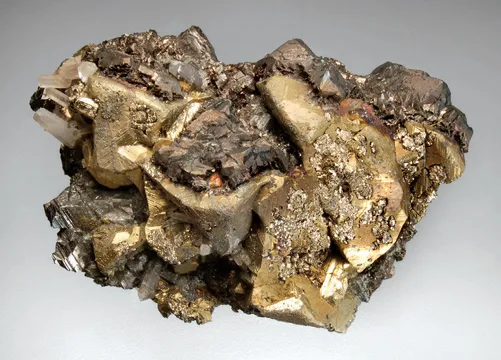
The specimen style that made Animón famous is well shown here: dark, glassy sphalerite forming the visual ground, lustrous golden chalcopyrite crystals perched across the surface, and sprays of clean quartz giving height and sparkle. The finest examples are not just ore minerals made visible; they are balanced, sculptural sulfide-and-quartz compositions from a working Andean mine.

Photo: Wikimedia Commons
Ragra specimens are entirely different in character from the Huarón-Animón display pieces. They are historically important vanadium ores and rare secondary vanadates: black, pitchy to dull masses of patrónite-bearing material, colorful vanadium oxidation products, and delicate efflorescences that belong more to systematic mineralogy than to glittering cabinet aesthetics.
Search for specimens: View all specimens from Huayllay District, Peru
Huayllay District lies in Pasco Province, in the central highlands of Peru, southwest of Cerro de Pasco and within one of the great polymetallic belts of the Central Andes. The collector locality is dominated by the Huarón mining district, a high-altitude underground silver-copper-lead-zinc system developed in folded sedimentary and volcanic rocks. At Huarón, Cretaceous Machay Group limestones and Tertiary continental red beds of the Casapalca Formation were folded into the Huarón anticline, cut by quartz monzonite dikes, fractured by north-south and east-west fault systems, and mineralized by hydrothermal fluids. The district’s major structures include veins, mantos, and stockworks; individual veins range from centimeter scale to several meters wide and some extend along strike for well over a kilometer.
The ore assemblage at Huarón is a classic Andean polymetallic suite. The principal ore minerals include tetrahedrite-tennantite, sphalerite, galena, chalcopyrite, and enargite, with pyrite, quartz, calcite, rhodochrosite, rhodonite, manganocalcite, dolomite, siderite, barite, fluorite, and alabandite as important gangue or accessory minerals. The mineralization was deposited in multiple pulses: an earlier high-temperature stage with milky quartz, pyrite, and tetrahedrite; an intermediate stage with milky quartz, pyrite, brown sphalerite, and galena; and a later lower-temperature stage with barite, carbonates, blond sphalerite, galena, silver sulfosalts, chalcopyrite, rhodochrosite, quartz, and calcite. This paragenetic overprinting is one reason Huayllay specimens can be so visually complex: quartz may sit on sulfides, sulfides may intergrow, and later carbonates or barite may decorate earlier metallic matrices.
Huarón’s mining history reaches back to 1912, when the underground mine, mill, and supporting villages were built by a subsidiary of the French Peñarroya Company. The property later passed to Hochschild in 1987. In April 1998, a collapse in the bed of nearby Lake Naticocha flooded the adjacent Animón workings and then Huarón through interconnected tunnels, forcing closure. Pan American Silver acquired a majority interest in 2000, rehabilitated and reopened the operation, and began full-scale mining in 2001. Today Huarón remains a producing underground mine owned by Pan American Silver Huarón S.A., producing silver-rich zinc, lead, and copper concentrates by flotation.
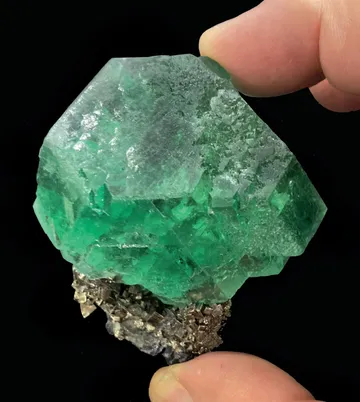
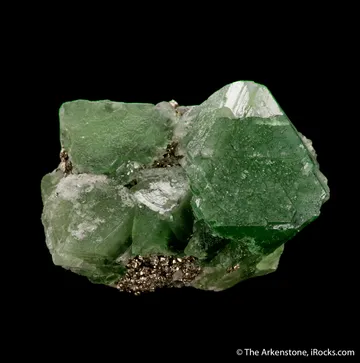
Animón, historically and commercially entangled with Huarón in specimen labelling, is one of the most important sources of aesthetic collector pieces from the district. Many older and dealer labels use “Alimon Mine,” a spelling variant commonly applied to Animón specimens. Fine chalcopyrite-quartz-sphalerite combinations from Animón are known from late-1980s and early-1990s production, with additional notable material appearing around 2001. Very large colorless fluorite crystals, reported to reach 30 cm across, were found at Animón in 2004, though fine fluorite specimens are far scarcer on the market than the chalcopyrite, sphalerite, pyrite, and quartz combinations.
The Ragra Mine, northwest of the Huarón-Animón workings, belongs to a different mineralogical chapter of Huayllay. It was an extraordinary vanadium deposit developed in carbonaceous, asphaltic material and red shale, famous for patrónite and a suite of hydrated vanadates and vanadium sulfates. It operated from the first years of the twentieth century until the mid-twentieth century and was once the leading vanadium source in the world. For collectors, Ragra is not primarily a modern field-collecting locality but a historic source of type material and rare systematic species; many specimens now encountered are old museum, university, or specialized systematic pieces.
Collecting access in Huayllay today should be understood in practical terms. Huarón and Animón are active industrial underground mines with controlled access, formal safety systems, and company permitting requirements. Specimens reach the market through miners, local dealers, old collections, and occasional lots from past production, not through casual recreational collecting. Ragra is inactive, remote, and historically significant; its specimens are best approached through old collections and reputable dealers rather than field expectations. Good labels matter here: a specimen described simply as “Huaron, Peru” may be from Huarón proper, Animón/Alimon, another mine in the Huarón district, or an older broad-label lot from Huayllay District.
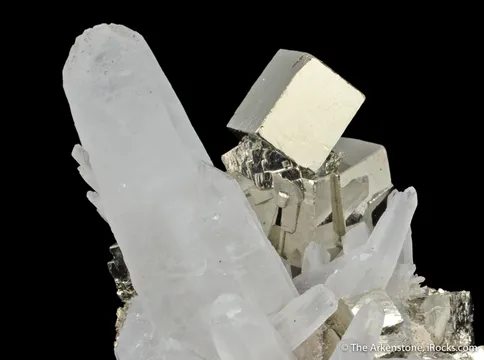
Quartz from Huayllay District is most admired as an architectural mineral rather than as isolated single crystals: clear to milky prisms rise in sprays, rosettes, doubly terminated points, and occasional scepter-like crystals on matrices of sphalerite, chalcopyrite, pyrite, galena, tetrahedrite-tennantite, fluorite, calcite, or rhodochrosite. Animón/Alimon pieces show the best collector expression, with water-clear quartz needles and small prisms sharply contrasting against black sphalerite and brassy chalcopyrite; known specimen sizes range from thumbnails and miniatures to small-cabinet and cabinet plates, while individual quartz crystals may be only a few millimeters or several centimeters. The finest Huayllay quartz pieces are those in which the quartz is clean, upright, undamaged, and compositionally integrated with bright sulfides, rather than merely forming a dull white crust over massive ore.
Chalcopyrite is the signature show mineral of many Huayllay specimens, especially from Animón/Alimon, where it occurs as sharp, lustrous brassy crystals on dark sphalerite with quartz, pyrite, galena, fluorite, calcite, and tetrahedrite-tennantite. Good examples show distinct disphenoidal or pseudo-tetrahedral forms, sometimes twinned, with crystals around 1–2 cm common in fine miniatures and small cabinets and exceptional individual crystals reported around 2.3–3 cm. The best pieces avoid the two common weaknesses of the locality: crowded sulfide surfaces with little contrast, and rubbed chalcopyrite faces that have lost their mirror-bright brassy finish; top examples have bright, isolated chalcopyrite crystals set off by transparent quartz sprays or black sphalerite.
Pyrite from Huayllay District appears both as a major gangue mineral in the Huarón ore system and as a collector mineral on Animón/Alimon specimens, where it is usually seen as small, bright cubes or modified crystals scattered among quartz, chalcopyrite, sphalerite, galena, barite, calcite, and tetrahedrite-tennantite. Cubic pyrite is the ordinary habit, but rarer pyritohedral examples from Animón are prized when the crystal is sharp, mirror-bright, and isolated enough to read as the focal point rather than as background sparkle. The most attractive pyrite specimens here combine crisp metallic form with pale quartz rosettes or sprays; condition is decisive, because bruised cube edges and dulled faces quickly reduce an otherwise good Huayllay piece to ore-grade appearance.
Sphalerite from Huayllay District ranges from lustrous black, iron-rich crystals to dark orange-brown and blond material, reflecting the district’s zoned and multi-stage mineralization. Animón/Alimon specimens commonly show sphalerite as tetrahedral to complex, glassy crystals forming dark matrices for chalcopyrite and quartz, while Huarón’s ore descriptions also note brown sphalerite in intermediate-temperature assemblages and blond sphalerite in lower-temperature assemblages with barite, carbonates, galena, chalcopyrite, rhodochrosite, quartz, and calcite. The best sphalerite specimens are not simply dark ore plates; they have sharp crystal definition, strong resinous luster, and enough associated quartz, chalcopyrite, galena, pyrite, or calcite to give contrast and visual depth.
Galena is an important ore and collector species in Huayllay District, occurring with sphalerite, quartz, pyrite, chalcopyrite, calcite, barite, and tetrahedrite-tennantite in the lead-zinc-silver portions of the system. Animón/Alimon specimens include lustrous cubo-octahedral galena crystals, flattened modified crystals, and galena on sphalerite or pyrite matrices, sometimes partly coated by quartz or calcite; individual crystals of a few centimeters are documented in fine cabinet specimens. The best Huayllay galenas have bright metallic luster, clean crystal edges, and a balanced matrix association, while ordinary pieces tend to be heavy, dark, massive sulfide lumps with bruised corners or indistinct crystal form.
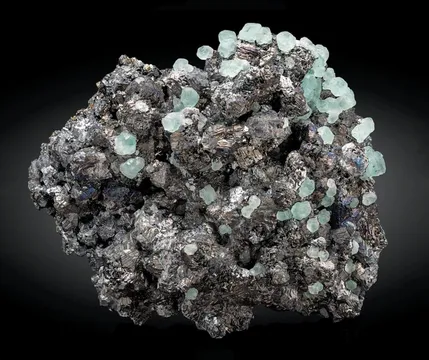
Beyond the five principal EarthWonders species, Huayllay District is exceptionally rich in documented minerals. Huarón and Animón add tetrahedrite-tennantite, enargite, bornite, fluorite, barite, calcite, siderite, dolomite, rhodochrosite, rhodonite, manganocalcite, alabandite, pyrargyrite, proustite, polybasite, pearceite, pyrrhotite, arsenopyrite, and silver-bearing sulfosalts to the collector vocabulary. Ragra gives the district its greatest systematic-mineral claim: patrónite, hewettite, pascoite, minasragrite, melanovanadite, fernandinite, dwornikite, retgersite, and stanleyite all have Ragra as their type locality, with associated roscoelite, sherwoodite, bariandite, morenosite, native copper, gypsum, and bravoite-bearing pyrite documented from the same vanadium system.
The main authenticity issue with Huayllay specimens is locality precision, not widespread fabrication. “Huaron, Peru” is a classic old label, but many of the finest chalcopyrite-quartz-sphalerite combinations that circulated under that name are more accurately Animón or Alimon Mine specimens within the Huarón mining district. Labels using “Chungar” can also be confusing because the operating company name has been applied to Animón and Islay operations, while the historic Chungar mine is a different locality outside the Huayllay district context. Serious collectors should preserve all original labels and, when possible, record both the broad district name and the mine name as written: Huayllay District; Huarón mining district; Animón/Alimon Mine; Huarón Mine; Ragra Mine.
Condition is the critical value factor. Chalcopyrite bruises and rubs easily; once its bright brassy faces become dull, a specimen loses much of its appeal. Quartz sprays are vulnerable to broken terminations, especially on old cabinet pieces with upright needle crystals. Galena may show contacted edges, cleavage nicks, and tarnish; sphalerite crystals often hide tiny chips because their luster is so strong under show lighting. Pyrite from this district is generally stable in normal cabinet conditions, but any sulfide specimen should be kept dry and away from acidic storage materials. Ragra vanadates and sulfates are more delicate: efflorescent pascoite, minasragrite, and related hydrated species can be fragile and should be handled as historic systematic specimens, with stable humidity, minimal touching, and no cleaning beyond careful dust protection.
Fluorescence is not the main reason collectors buy Huayllay specimens, though calcite and fluorite on some Animón pieces can respond under ultraviolet light. The principal visual value remains luster, contrast, composition, and accurate attribution. Fine old Animón chalcopyrite-quartz-sphalerite pieces from the late 1980s to early 1990s are genuinely collectible and not abundantly replaced by modern production; later specimens exist, but top-quality, undamaged, balanced examples are much less common than ordinary sulfide plates. Ragra material is a separate market: patrónite and type-locality vanadates appeal to systematic collectors and institutional collections, and provenance is often more important than size or display aesthetics.
The most dramatic Huayllay story begins not with a glittering pocket, but with a search for fuel. In 1905, Antenor Rizo Patrón Lequérica and Eulogio E. Fernandini de la Quintana rode on horseback into the bleak country of Minas Ragra, looking for burnable rock to feed Fernandini’s smelter. Ragra was remote even by Andean mining standards: high, cold, wind-scoured, and more than 25 miles from the nearest railway. They gathered samples of black, carbonaceous material because it looked combustible. Instead of merely finding fuel, they had stumbled onto one of the richest vanadium deposits ever mined.
The discovery quickly drew the attention of the American industrialist Joseph M. Flannery, who needed vanadium for stronger steel alloys. In 1906 he sent the geologists Donnel F. Hewett and Alfred Thompson to Peru. Their first stop, the Llacsacocha mine, disappointed them. They returned to Lima ready to leave the country, but José Julián Bravo, head of the laboratory for Peru’s Corps of Mining Engineers, showed them a Minas Ragra sample. That single specimen changed their itinerary: the Americans turned back toward the mountains, examined the deposit, and recommended its purchase. Fernandini sold the property for 2,000 Peruvian pounds, roughly U.S. $10,000 at the time, plus 10% of the stock in the new company.
Ragra’s ore took an extraordinary route to market. The early mine produced only 201 metric tons of vanadium ore in 1907, yielding 28.2 metric tons of V2O5. But that ore did not simply move from mine to mill. It began on the backs of llamas, then passed by rail and ship, traveling nearly 3,800 miles from the Peruvian Andes to processing facilities in Pennsylvania. Within a few years the scale had transformed: by 1910, output had increased to 3,130 metric tons of ore containing 702.4 metric tons of V2O5. At its best the ore ran up to 40% V2O5, a grade that explains why Ragra became, for a time, the world’s indispensable vanadium source.
The physical description of the Ragra ore body reads like something between a mineral deposit and a geological oddity. Later summaries describe an inverted cone-shaped mass occupying about 850 by 180 feet at the surface, extending to roughly 210 feet deep, and tapering downward into a narrower vein zone. The central ore was black natural coke shot through with patrónite veins, wrapped in lustrous black hydrocarbon material called quisqueite, and enclosed by shale impregnated with patrónite and quisqueite. In the upper oxidized zone, secondary vanadium minerals added bright colors to an otherwise black, carbon-rich deposit. That contrast—the pitchy ore below and the vivid vanadate alteration above—is central to Ragra’s mystique.
Huarón’s defining modern crisis came in April 1998. A portion of the bed of Lake Naticocha collapsed, sending lake water into the neighboring Animón underground mine. Through connected workings, the flood reached Huarón as well. Mining stopped, the labor force was terminated, the camp closed, and the mine entered a period of draining, cleanup, and rehabilitation. The event left a permanent mark on the district’s mining history: water management became not an abstract engineering problem but the condition for reopening the mine. A channel was later constructed to route water around the lake system, and Pan American Silver acquired Huarón in 2000, rehabilitated the operation, and brought it back into full-scale production in 2001.

.jpg)