






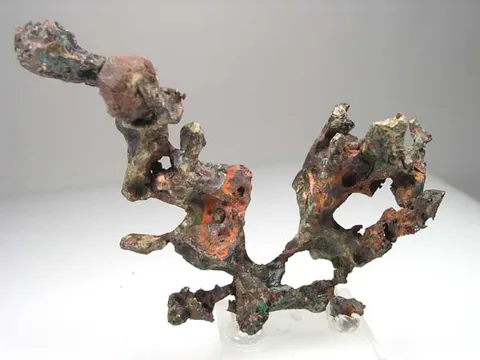
Michigan, USA — renowned for the Keweenaw Peninsula native copper district, with dramatic copper forms and associated minerals; a top pick for collectors.
Key facts
Michigan is one of the indispensable American names in mineral collecting, not because it is a single mine or a single species locality, but because the state contains several world-class mineral provinces under one label. For fine-mineral collectors, the first association is still the Keweenaw Peninsula and the Lake Superior native copper district: a Mesoproterozoic Midcontinent Rift volcanic pile in which native copper, native silver, calcite, datolite, prehnite, epidote, quartz, zeolites, and copper alteration minerals occupy amygdaloidal basalt tops, interflow conglomerates, and crosscutting fissure veins. This is the classic district for native copper as a collector’s mineral—copper not merely as ore, but as sculptural metal, in branching, hackly, sheetlike, “moss,” “wire,” crystallized, and copper-silver halfbreed forms.
Regional View
Country View
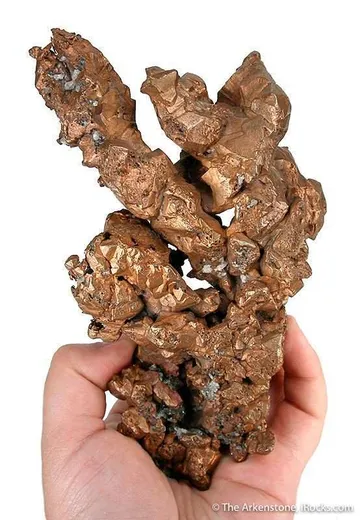
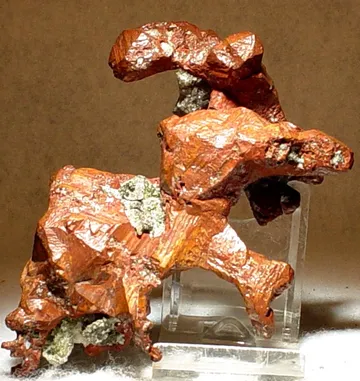
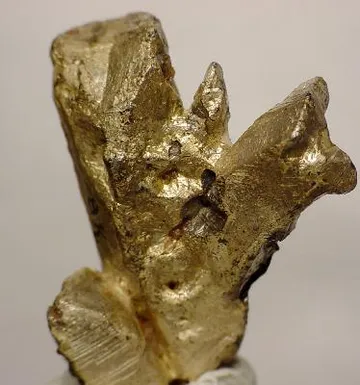
The Keweenaw specimens that made Michigan famous have a look no other district quite duplicates. The best native copper groups show sharp modified cubic, dodecahedral, tetrahexahedral, and distorted twinned crystals linked into open branching frameworks, sometimes with a rich old brown patina, sometimes etched to reveal brilliant fresh copper, and sometimes still accompanied by white calcite, green epidote or prehnite, quartz, datolite, cuprite, malachite, or blebs and crystals of native silver. Conglomerate-lode copper can preserve the rounded forms of pebbles as hollow “skull” copper, while fissure-vein copper can be wildly arborescent or densely crystallized.

Photo: Wikimedia Commons
Michigan’s collector importance does not stop in the Upper Peninsula. Southeastern Michigan, especially Monroe County, is a classic American district for celestine and native sulfur from Devonian carbonate quarries around Maybee, Scofield, Woolmith, Newport, Rockwood, and South Rockwood. There the collector aesthetic is entirely different: pale blue to icy gray celestine, honey to white calcite, bright lemon-yellow sulfur, and occasional fluorite and strontianite in vugs and cavities in limestone, dolostone, and associated sedimentary units. Fine Maybee celestine has the clean, architectural look of a textbook orthorhombic sulfate crystal—tabular, chisel-terminated, glassy, and surprisingly delicate.

Photo: Wikimedia Commons
Historically, Michigan is also one of the few places where mineral collecting, economic geology, Indigenous metalworking, industrial labor history, and museum mineralogy are inseparable. Indigenous miners worked Lake Superior native copper thousands of years before the nineteenth-century mining rush. The industrial copper era brought the Cliff, Central, Phoenix, Quincy, Calumet & Hecla, Wolverine, Baltic, Champion, Mohawk, Tamarack, and many other mines into the literature and into collections. Later, the A. E. Seaman Mineral Museum in Houghton became one of the essential repositories for Michigan minerals, preserving the state’s great copper, silver, datolite, calcite, sulfur, celestine, and rarity specimens.
Search for specimens: View all specimens from Michigan, USA
Michigan’s great specimen-producing deposits fall into several distinct geological families. The most famous is the Keweenaw native copper district of the western Upper Peninsula, hosted chiefly by the Portage Lake Volcanics and related Keweenawan rocks of the Midcontinent Rift. During rifting, enormous thicknesses of basaltic lava flows accumulated with interbedded conglomerates and sandstones. Later mineralizing fluids deposited native copper, native silver, calcite, quartz, epidote, prehnite, datolite, zeolites, chlorite-group minerals, and related phases in permeable flow tops, brecciated zones, amygdules, conglomerate beds, and steep fissures. In mining terminology, the main stratabound ore zones were “lodes,” especially amygdaloid lodes and conglomerate lodes; the early bonanza specimen mines often worked fissure veins that cut the layered volcanic pile.
The Keweenaw ore bodies were unusual because copper occurred dominantly as the native element rather than as sulfide. In amygdaloid lodes, copper and gangue filled vesicles, cavities, and breccia openings in the tops of basalt flows. In conglomerate lodes, copper filled intergranular spaces, coated clasts, and locally formed shell-like masses around pebbles and cobbles. In fissure veins, copper could form coarse masses, crystallized sheets, dendritic sprays, and pockets with quartz, calcite, prehnite, epidote, datolite, silver, and arsenide minerals. This structural and textural variety is why Michigan copper specimens range from dense rounded float masses to delicate miniature crystals, from polished ore slices to museum-size slabs of sheet copper.
The nineteenth-century mining history began in earnest in the 1840s after reports of Lake Superior copper circulated widely in the eastern United States. The Cliff Mine became the first major successful copper mine in the district, and the rush that followed predated the California Gold Rush. Quincy Mining Company was established in the mid-1840s and became famous as “Old Reliable,” while Calumet & Hecla grew into the dominant industrial power on the Calumet conglomerate lode. Other major or specimen-important names include Central, Phoenix, Minesota, Copper Falls, Delaware, Allouez, Ahmeek, Wolverine, Mohawk, Baltic, Champion, Tamarack, Franklin, and Isle Royale. Mining evolved from high-grade fissure work to large-scale amygdaloid and conglomerate mining, with deep shafts, stamp mills, smelters, rail lines, and company towns reshaping the peninsula.
Production from the native copper district continued for more than a century, with the Keweenaw losing national dominance only after western copper districts such as Butte rose to prominence. The final decades of native-copper mining were marked by declining grades, deeper workings, corporate consolidation, reclamation of stamp sands, and eventual closure of the old mines. The Quincy and Calumet units of Keweenaw National Historical Park now preserve parts of this industrial landscape, while mine dumps, ruins, museums, and historic districts remain central to the collecting culture of the region.
Southeastern Michigan’s celestine, sulfur, and calcite localities are geologically unrelated to the Keweenaw copper district. The classic Maybee-Woolmith-Stoneco/Scofield occurrences are in Devonian carbonate rocks quarried for building stone, limestone, or dolostone. Calcite, celestine, and sulfur occur in cavities and vugs, with celestine forming pale blue, colorless, gray, or locally included tabular crystals and sulfur forming bright yellow crystals and etched aggregates. Older geological accounts noted that these minerals were deposited from percolating solutions after consolidation of the host rock. The Maybee quarry system has been known since the nineteenth century, was studied by Michigan geologists around 1900, was visited by Edward Kraus and Walter Hunt in the early twentieth century, and then became especially productive for collectors after the quarry was drained and returned to production around the middle of the twentieth century.
Other Michigan mineral provinces matter to collectors as well. The iron ranges of Marquette, Menominee, and Gogebic counties produced hematite, magnetite, goethite, manganite, pyrolusite, jasper, and banded iron formation material. The state’s gypsum and salt resources supplied specimens of gypsum, selenite, anhydrite, and halite from Lower Peninsula evaporite deposits. The Rogers City area is famous industrially for the Calcite Quarry, one of the great limestone quarries of North America, and calcite crystals are widespread in Michigan carbonate rocks. The state’s beaches and glacial deposits add a different collecting dimension: Lake Superior agates, jasper, copper-bearing pebbles, chlorastrolite-bearing material, and glacially transported native copper.
Access today is mixed and requires caution. Many old Keweenaw mine sites and dumps are on private land, and ownership is often complicated by separate surface and mineral rights. Some collecting is possible through fee operations, organized club trips, museum or society field trips, and public-access areas where rules allow modest hand collecting. The Michigan DNR gives an annual personal limit for rock collecting on state-owned land, and collecting in National Park Service units is generally prohibited except under scientific permit. Isle Royale is particularly sensitive: it is the classic source area for chlorastrolite, but mineral collecting there is not allowed. Active quarries in southeastern Michigan are industrial sites; productive access for celestine, sulfur, fluorite, and calcite is normally by permission or organized field trip only.
Michigan copper is the state’s signature mineral, and the collector standard is set by the Keweenaw native copper district, where Cu occurs as masses, sheets, wires, mossy and arborescent sprays, crystallized groups, copper skulls from conglomerate lodes, and copper-silver halfbreeds. The finest specimens come from named mines and zones such as Cliff, Central, Phoenix, Copper Falls, Quincy, Calumet & Hecla, Wolverine, Ahmeek, Mohawk, and related Keweenaw County and Houghton County workings; they may show sharp dodecahedral, tetrahexahedral, octahedral, or modified cubic forms, copper-red fresh surfaces, old brown patina, green malachite or chrysocolla films, red cuprite, white calcite, pale to green prehnite, epidote, quartz, datolite, or native silver. Good Michigan copper is separated from ordinary material by crystallization, openness, undamaged projections, attractive patina, strong mine attribution, and meaningful associations; common dense nuggets and acid-brightened masses are abundant, but sharp, aesthetic, well-documented old-time crystals and natural copper-silver intergrowths remain genuinely desirable.
Michigan calcite ranges from common carbonate vug material to some of the most coveted copper-associated calcite in American mineral collecting. In the Keweenaw mines, calcite occurs in veins, amygdules, and vugs with native copper, native silver, quartz, epidote, prehnite, pumpellyite-group minerals, and datolite; at Quincy and several neighboring mines it can form transparent to translucent scalenohedra and complex twinned crystals enclosing brilliant native copper as sheets, blebs, dendritic particles, phantoms, or irregular internal clouds. These copper-in-calcite specimens are prized when the calcite is complete, lustrous, transparent enough to show the metal, and still perched on copper-rich matrix rather than detached or bruised. In southeastern Michigan, calcite also accompanies celestine and sulfur in Monroe County quarry vugs, commonly as white, honey, tan, or orange-brown crystals; there the best pieces are judged by clean crystal faces, contrast with blue celestine or yellow sulfur, and minimal bruising from quarry extraction.

Photo: Wikimedia Commons
Michigan celestine is chiefly a southeastern Lower Peninsula specialty, with the Maybee/Stoneco/Scofield and Woolmith quarry area in Monroe County supplying classic pale blue, blue-gray, colorless, white, and locally included SrSO4 crystals from cavities in Devonian carbonate rocks. Maybee celestines are typically tabular to prismatic, often chisel-terminated, glassy to frosted, and associated with calcite, native sulfur, strontianite, and rarely fluorite; documented crystals from the quarry are recorded to cabinet scale, while common collector specimens are thumbnails to small cabinets with crystals from millimeters to several centimeters. The best pieces show sharp form, transparency, even pale blue color, undamaged terminations, and aesthetic contrast—especially blue celestine with lemon-yellow sulfur or honey calcite—whereas ordinary material tends to be bruised, chalky, massive, or heavily contacted from growth across narrow vugs.
Michigan’s other documented minerals are unusually rich for a northern U.S. state. The Keweenaw assemblage includes native silver, datolite, prehnite, epidote, quartz, Lake Superior agate, analcime, laumontite, thomsonite, microcline, chlorite-group minerals, pumpellyite-group minerals, cuprite, tenorite, malachite, chrysocolla, chalcocite, arsenopyrite, cobaltite, skutterudite, domeykite, algodonite, and related copper-arsenide material. The Centennial Mine near Calumet is the type locality for anthonyite and calumetite, two rare copper chloride minerals described from the Michigan copper district. Pumpellyite was first described from Michigan Keweenawan occurrences, and chlorastrolite—the stellate green variety of pumpellyite-(Mg) known to collectors as Isle Royale greenstone—is one of the state’s iconic lapidary materials. Mohawkite and keweenawite are important historical names from the Mohawk Mine, but collectors should know that they represent discredited or mixture names rather than current valid mineral species. In the iron country, hematite, magnetite, goethite, manganite, pyrolusite, jasper, and banded iron formation material form a second great Michigan suite; in the evaporite and carbonate districts, gypsum, selenite, anhydrite, halite, fluorite, barite, pyrite, marcasite, and strontium minerals round out the state’s specimen record.
Michigan copper is abundant in the general marketplace but highly variable in quality. Affordable pieces include cleaned nuggets, copper-bearing basalt, polished ore slices, and small masses from old dumps or modern collecting operations. Fine crystallized specimens with old labels, precise mine attribution, natural patina, native silver, datolite, copper-in-calcite, or undamaged branching form are much scarcer and command strong prices. The best labels name not only “Michigan” or “Keweenaw,” but a mine or shaft: Quincy, Cliff, Central, Wolverine, Phoenix, Copper Falls, Ahmeek, Calumet & Hecla, Mohawk, Tamarack, Baltic, Champion, Franklin, or another specific locality.
Cleaning is the major authenticity and value issue for Michigan copper. Acid cleaning has long been part of the local tradition, especially to remove calcite, basalt grime, iron staining, and secondary coatings. A bright, uniform salmon-pink or freshly metallic surface may be attractive, but it usually indicates aggressive modern cleaning rather than old natural patina. Cleaning can also leave residues in crevices, weaken associated calcite or datolite, and erase the mellow brown-black surface that many advanced collectors prefer. Conversely, not all cleaned copper is inferior: some specimens require careful preparation to reveal crystallization. The key is disclosure, stability, and whether the cleaning improved or diminished the specimen.
Condition must be judged differently from hard silicate specimens. Copper is soft, malleable, and easily bent. Fine wires, dendrites, points, crystal edges, and sheet margins can be flattened by handling or transport. Old copper can be naturally rounded if it is float copper, but saw-cut bases, polished faces, broken attachment points, and clipped edges should be recognized for what they are. On copper-in-calcite specimens, look carefully for cleavage damage to the calcite, bruised terminations, internal fractures, and evidence that a copper flake is merely stuck to a surface rather than naturally enclosed.
Copper-silver halfbreeds require particular scrutiny. Natural Keweenaw copper and silver intergrowths are classic, but a convincing halfbreed should show intimate, geological contact between the two native metals. Under magnification, the silver should not look like a loose chip wedged into a crack, glued into a cavity, or plated onto copper. True halfbreed specimens can show copper and silver side by side without being alloyed; the contrast between reddish copper and white native silver is part of their appeal.
Michigan celestine and sulfur specimens have different vulnerabilities. Celestine has perfect cleavage, modest hardness, and brittle edges, so large tabular crystals from Maybee, Rockwood, or related Monroe County quarries often show peripheral chips, contacted faces, or repaired breaks. Sulfur is soft, brittle, and sensitive to heat, abrasion, and some chemicals; keep it away from strong light and excessive warmth. Calcite from the same quarries may fluoresce in some specimens, especially honey-colored material, and the response can be a useful added feature, though not a substitute for locality documentation.
Mislabelling is common at the state level. “Michigan copper” should not automatically be assumed to mean Keweenaw County, and “Keweenaw” should not be accepted as a mine name. “Celestite” labels from older collections usually refer to celestine; the current accepted mineral name is celestine. “Isle Royale greenstone” should be treated carefully: true Isle Royale origin is historically important, but modern legal collecting from Isle Royale National Park is prohibited, and much available greenstone-like material comes from beaches, glacial deposits, old collections, or Keweenaw-area material outside the park.
Long before the mine shafts, hoists, stamp mills, and company towns, Michigan copper was being quarried with stone, fire, water, and patience. On the Keweenaw Peninsula and Isle Royale, early miners followed copper-bearing lodes by digging shallow pits, some only a few feet deep and others far larger, breaking rock with hammerstones and using fire-setting to fracture the basalt around masses of native metal. Imagine a copper mass partly exposed in the rock, heated by a wood fire, shocked with water, then worked loose with stone mauls—not for smelting, but because the metal was already copper. That single fact defines the Keweenaw: the ore was the metal.
The most famous single copper object in Michigan lore is the Ontonagon Boulder, a huge mass of native copper from the Ontonagon River country. Nineteenth-century accounts turned it into a kind of mineral celebrity. It was drawn, described, pursued, disputed, and finally removed from the Upper Peninsula under federal authority. Reports differ in the stated weight because the boulder was measured and described at different points in its history, but the classic figure is roughly 1.5 tons. To collectors, it is more than a large copper mass; it is the object that helped make Lake Superior copper real to the eastern public imagination, a mineralogical ambassador hauled out of the forest and into national history.
The Keweenaw rush has the feel of a hard-rock prelude to the western mining booms. By the 1840s, “copper fever” had reached the region, and men came north into a cold, forested peninsula where transport was difficult, winters were severe, and blackflies were part of the cost of speculation. The early fissure mines could be spectacularly rich and spectacularly uneven. Cliff became the first great success, proving that industrial copper mining could work in the Copper Country. Quincy, founded in the same era, became “Old Reliable” because it paid dividends with rare steadiness. The name says much about mining economics: reliability itself was extraordinary.
Some of the most collector-relevant stories are pocket stories rather than corporate histories. At the Wolverine Mine, later collectors documented copper, silver, epidote, quartz, and copper-included agate material from the Kearsarge lode rock piles; one Mindat account notes that about 450 copper-included agates have been found there. At Eagle Harbor, Don Pearce of Calumet collected many hundreds of kilograms of well-crystallized copper from an underwater Lake Superior vein in 1971; one described specimen weighed about 45 kg and carried a half-meter face of herringbone copper with large blocky crystals on the opposite side. At the Point prospect southeast of Copper Harbor, road construction exposed a small fissure vein that yielded some of the largest known native copper crystals, with individual crystals reported up to 6.4 kg. These are the kinds of finds that keep Keweenaw labels alive in advanced collections: not merely “copper,” but copper with a story, a geometry, and a place.
The Maybee quarry story is quieter but no less satisfying for collectors. Around 1900, Michigan geologists studying the quarry’s stratigraphy also noticed its mineral cavities. A few years later, Edward Kraus and his student Walter Hunt examined the celestine and sulfur, including the geochemical problem of how native sulfur could form in sedimentary rocks. The quarry was then a building-stone operation; as that market declined before World War I, the site was abandoned and flooded. When new owners drained the quarry and returned it to production around 1960, the timing was perfect for the American rockhounding boom. From about 1960 into the late twentieth century, local collectors from Michigan and Ohio visited repeatedly, pulling celestine and sulfur from vugs that otherwise would have gone through the crusher.
One Maybee episode has become a touchstone among specimen collectors: a 1995 pocket described in connection with “American Mineral Treasures.” The pocket measured about 1.9 x 1.7 x 0.5 meters and reportedly yielded about 100 specimens collected by Dave Doherty, Dave Lowrie, and Dave Pachon. That is a large cavity by quarry-collecting standards, but not a limitless one; the reason good Maybee celestine is still uncommon on the market is that even a memorable pocket supplies only a finite number of undamaged, aesthetic pieces. Many of the best specimens stayed with the people who found them or entered regional museum collections.
The darker story in Michigan’s copper landscape is the 1913–1914 Copper Country strike. The Keweenaw was not only a mineral district; it was a labor district, with immigrant communities, company housing, dangerous underground work, and bitter conflict over wages, hours, management, and safety. On Christmas Eve 1913, during a party for children of striking miners at the Italian Hall in Calumet, a false cry of “fire” caused a panic. More than 70 people died, many of them children. For mineral collectors, that history matters because every old Keweenaw label—Calumet & Hecla, Quincy, Tamarack, Wolverine—is tied to real communities, not just pretty copper.

_3.jpg)
