Maybee Quarry, Michigan - a Midwest locality prized for lemon-yellow sulfur on celestine and calcite, set in vuggy dolostone and sought after by collectors.
Key facts
Maybee Quarry is one of the great understated Midwestern mineral localities: an active limestone and dolostone quarry near the village of Maybee in Monroe County, southeastern Michigan, worked for industrial stone yet treasured by collectors for sulfur, celestine and calcite. The locality sits in the carbonate belt of the Michigan Basin/Findlay Arch region, where vuggy, bituminous dolostone and limestone provided both the cavities and the unusual chemistry needed for its classic specimens. At its best, Maybee is instantly recognizable: lemon-yellow native sulfur crystals, sometimes blocky or dipyramidal and translucent enough to glow when backlit, perched on pale blue-gray to white celestine or honey to colorless calcite. The finest pieces have the satisfying contrast of a sedimentary vug suite rather than a metallic ore assemblage—soft carbonate matrix, pale strontium sulfate crystals, and sudden, vivid yellow sulfur.
Regional View
Country View
The old collecting name “Maybee” folds together several historical names that still appear on labels: Woolmith Quarry, Scofield Quarry, Michigan Stone and Supply Company Quarry, Borin Brothers Quarry, and Stoneco Quarry. Labels using any of those names can be perfectly legitimate, but for modern cataloging the collector’s shorthand is almost always Maybee Quarry. Its reputation rests less on a long list of species than on the quality of a small assemblage. Sulfur and celestine were noted by Michigan geologists around 1900, studied by Edward H. Kraus and Walter F. Hunt in the early 1900s, and collected heavily during the mid- to late-20th-century rockhounding period. Much of the best surviving material never circulated widely outside Michigan and northern Ohio collections, which explains why fine Maybee pieces can still feel surprisingly elusive on the broader market.
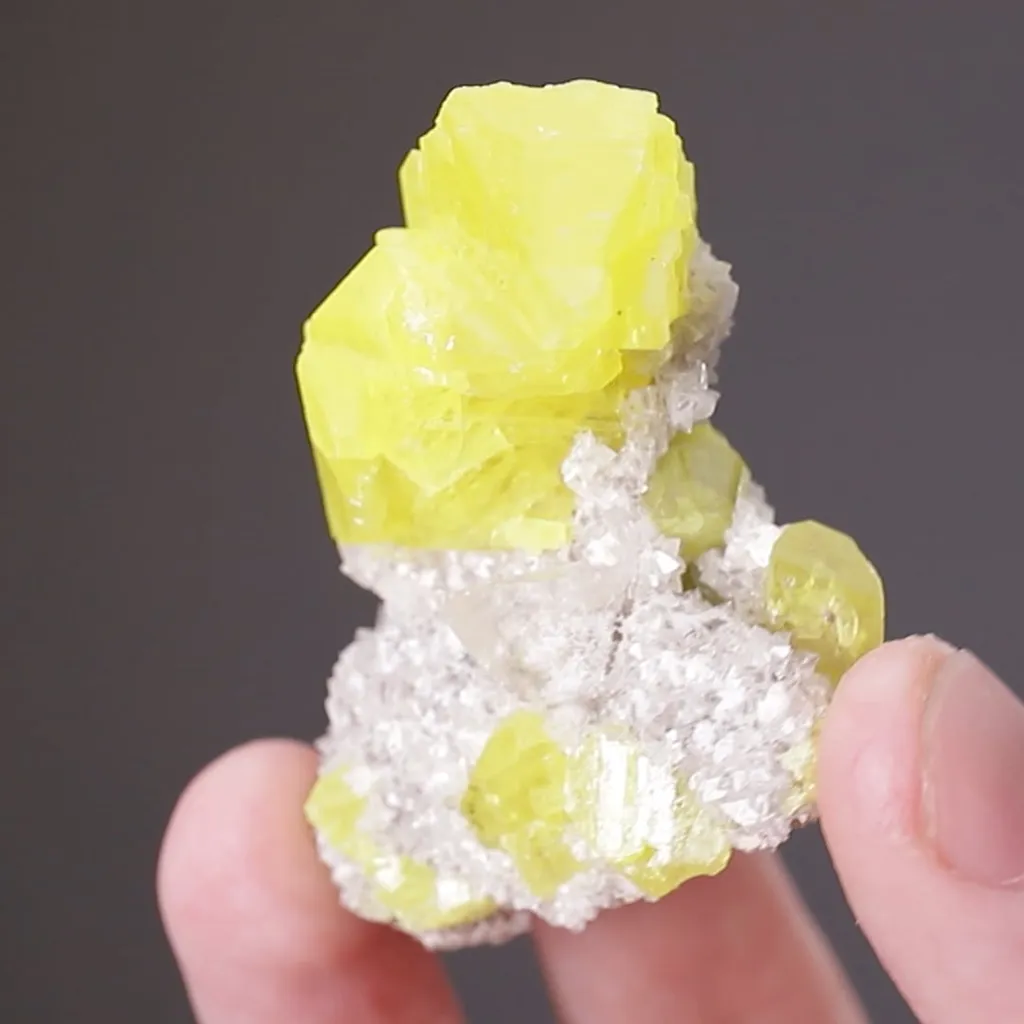
Photo: EarthWonders
Search for specimens:
Maybee Quarry is in Exeter Township, Monroe County, Michigan, near Scofield and just north of the village of Maybee. The modern operation is Stoneco’s Maybee limestone quarry, with current regulatory and company records placing it at 6837 Scofield Road. It is an industrial aggregate and limestone operation, not a public collecting site; recent collector-oriented accounts describe it as off-limits for collecting for many years, and any visit or collecting activity would require explicit permission from the operator.
Geologically, the quarry exposes carbonate rocks of southeastern Michigan’s Paleozoic sedimentary section. Modern mineral-collecting sources commonly place the classic vug mineralization in Middle Devonian Detroit River Dolomite—brown and gray carbonate rock with small vugs—while older Michigan geological reports used the older “Monroe beds” terminology and described the exposed sequence as dolomites, locally siliceous and bituminous, with underlying sand-rich dolomitic beds and Sylvania Sandstone below. The important point for collectors is the vuggy, oil-impregnated carbonate environment: porous horizons, carbonaceous films, bituminous odors, and local cavities provided the setting for celestine, calcite, and sulfur to crystallize.
The mineralization is secondary and cavity-controlled. Early descriptions divided the old Woolmith quarry section into a series of beds. Small cavities in an upper dolomitic oolite carried celestine, calcite and minor sulfur, while larger cavities occurred in an open brown dolomite bed that quarrymen knew as the “sulphur bed.” That bed was described as porous, oil-impregnated, fossil-bearing and full of ellipsoidal cavities from tiny openings to cavities two or three feet across. Those cavities held intergrown crystallizations of calcite, celestine and sulfur, and the same early work noted sulfur being deposited from water entering the quarry—white and mealy at first, yellowing on exposure.
The geochemistry of Maybee is one of the locality’s enduring scientific attractions. Kraus and Hunt argued that disseminated celestine in the upper strata supplied strontium sulfate, which could be moved downward by percolating water; in the bituminous, organic-rich lower beds, reduction produced sulfide species and hydrogen sulfide, and oxidation of that hydrogen sulfide then yielded native sulfur. Later summaries continue to treat Maybee as a key example of native sulfur generation in sedimentary carbonate rocks. The sulfur-celestine association is therefore not incidental—it is a visible expression of the local strontium-sulfate chemistry and reducing organic matter in the host rock.
Mining history at Maybee is older than many collectors realize. In the 1900 geological report on Monroe County, the Woolmith quarries were described halfway between Maybee and Scofield, in the NE 1/4 SE 1/4 of section 29, then chiefly owned by the Michigan Stone and Supply Company of Detroit and operated by George E. Currie. At that time a short railroad branch entered the quarry grounds, a rectangular opening about 500 by 300 feet had reached about 45 feet deep, and the operation included a large crusher with stone-sawing equipment. The quarry was then worked for building stone and related crushed-stone products, and the deeper siliceous dolomite was even marketed as a “sandstone.”
The building-stone era declined before World War I, and the quarry was later abandoned and flooded. New ownership eventually drained and revived the operation in the late 1950s to around 1960, just as American rockhounding was booming. From about 1960 into roughly 1990, Maybee became a productive field-collecting locality for regional collectors, and much of the material now regarded as classic Maybee was recovered during that period. The best pieces from those decades tend to remain in old private collections and regional institutions, especially Michigan collections, rather than appearing continuously on the international mineral market.
The most important specimen-producing zones were the vuggy carbonate beds rather than a single ore body in the mining sense. The old “sulphur bed” is the classic historic reference, but collector labels seldom preserve bed-by-bed detail. Specimens commonly show broken dolostone or limestone matrix lined with calcite or celestine druse, with sulfur added as sharp yellow crystals or etched aggregates. Others are loose celestine crystals or ribs of matrix coated on multiple sides by celestine from pocket breakage. Because the quarry is an active industrial operation and older productive benches have changed or been mined out, modern specimen supply is chiefly from historical collections, estate dispersals, and occasional pieces retained by local collectors.
Sulfur is the signature collector mineral of Maybee Quarry, occurring as bright yellow to lemon-yellow native sulfur in vugs and fractures of bituminous carbonate rock, most prized as sharp translucent crystals on celestine or calcite rather than as dull coatings or massive blebs. Documented Maybee sulfur ranges from small crystal groups to important crystals and aggregates several centimeters across, with locality records noting crystals up to 15 cm and published or traded examples including 3 cm blocky crystals, a 5.5 cm sulfur crystal on celestine, and a 7.5 cm sulfur crystal group. The best specimens show complete, lustrous, well-formed crystals—blocky, elongate, dipyramidal or doubly terminated—with minimal bruising and strong contrast against white, pale gray, or blue-gray celestine; ordinary pieces are more etched, contacted, broken, massive, or visually swallowed by the carbonate matrix.
Calcite at Maybee is both a specimen mineral and an important stage for the sulfur-celestine assemblage, lining cavities as glassy rhombs, honey to golden scalenohedra, colorless to white crystals, and drusy coatings on limestone or dolostone matrix. Good collector pieces show calcite in crisp association with sulfur or celestine: golden scalenohedral calcite with gemmy soft-blue celestine makes attractive thumbnails, while calcite rhombs with yellow sulfur produce classic small-cabinet combinations. Maybee calcite is also notable to fluorescent-mineral collectors; documented specimens show bright fluorescence and phosphorescence under ultraviolet light, with responses involving white to blue-white fluorescence and greenish or bluish afterglow depending on wavelength and associated minerals. The strongest calcite pieces are undamaged, lustrous, well positioned, and not merely matrix support; the best combinations let the calcite contribute form, light response and composition rather than sitting as a rough carbonate crust.
Celestine is Maybee’s other classic mineral, occurring in vugs as white, colorless, grayish-blue, pale blue, and icy blue-gray crystals on carbonate matrix, commonly tabular to prismatic with chisel-like terminations and glassy luster. Locality records describe blue tabular crystals to 20 cm, while collector and museum examples more often show sharp crystals from a few millimeters to several centimeters, including documented specimens with 3.5 cm crystals on tan matrix, 6 cm crystals in blue clusters, 8 cm main crystals, and large loose or clustered examples exceeding 10 cm. The finest Maybee celestines combine pale blue color, transparency or translucency, undamaged terminations, high luster, and an architectural arrangement—ribs coated on several sides, isolated doubly terminated crystals, or celestine matrix carrying sulfur. More ordinary material is chalkier, gray-white, contacted, cleaved, or pocket-broken without a display face.
Other documented minerals from Maybee Quarry include fluorite, gypsum and its selenite variety, pyrite, and strontianite. These are collector-significant mostly as accessory or rarity species rather than the primary reason to seek the locality. Selenite has been documented in transparent crystals from the quarry, pyrite belongs to the same carbonate-vug paragenesis, fluorite is a confirmed but much less common member of the Findlay Arch–style suite, and strontianite is a noteworthy strontium carbonate companion to the celestine-rich environment. No accepted mineral species is known from Maybee Quarry as a mineral type locality; its “type” importance is instead geological and geochemical, especially in early 20th-century discussions of celestine-bearing carbonate rocks and sedimentary native sulfur formation.
Maybee specimens should be bought with the label history in mind. “Maybee Quarry,” “Stoneco Quarry,” “Scofield Quarry,” “Woolmith Quarry,” “Borin Brothers Quarry,” and “Michigan Stone and Supply Company Quarry” may all refer to the same collector locality or its historical operating names. Conversely, Monroe County and the wider southeast Michigan–northwest Ohio carbonate district contain other celestine and sulfur localities, so a vague “Maybee” or “Michigan celestine” label is weaker than one naming the quarry or one of its known aliases. The most desirable old labels are those linking specimens to regional collectors active during the 1960–1990 collecting window or to documented old collections.
Condition is the main authenticity and value issue. Sulfur is soft, brittle, heat-sensitive, and prone to edge bruising; sharp crystals with complete terminations are much scarcer than etched or damaged aggregates. Celestine has perfect cleavage and can be deceptively fragile, especially where crystals spanned vugs or detached as pocket ribs. Calcite is sturdier, but rhombs and scalenohedra chip along edges and points. A small amount of natural pocket contact is normal for Maybee, but major termination repair, glued reattachment to matrix, or sulfur crystals mounted artificially on celestine would be serious concerns; examine contact points and old glue lines under magnification.
Cleaning and preparation should be conservative. Avoid heat, hot water, steam, ultrasonic cleaning, aggressive acids, and strong solvents on sulfur-bearing pieces. Sulfur’s low melting point and thermal sensitivity make display lighting important: keep specimens out of direct sun and away from hot lamps. Celestine and calcite specimens without sulfur are less thermally delicate, but they still deserve careful mechanical handling because vug crystals often sit on thin carbonate matrix.
Fluorescence can add interest but should be interpreted carefully. Calcite and celestine from Maybee can fluoresce and phosphoresce under ultraviolet light, and some sulfur-bearing specimens appear to glow because translucent sulfur transmits the light emitted by fluorescent calcite or celestine beneath it. Isolated tests on sulfur fragments have shown that apparent sulfur fluorescence may be an optical effect from associated minerals, not true sulfur fluorescence. For display, a UV response is a bonus; it should not substitute for sharp daylight crystal quality.
Market availability is uneven. Small or damaged Maybee sulfur and celestine pieces appear periodically, but strong sulfur-on-celestine or sulfur-on-calcite combinations are now hard to find. Fine celestine crystals from Maybee are also scarcer than the locality’s historical reputation might suggest, partly because many good examples remain in old regional collections. Top pieces command a premium for three reasons at once: classic Michigan provenance, limited modern access, and the visual distinctiveness of yellow sulfur against celestine or calcite.
In 1900 the old Woolmith quarry was not yet a collector’s legend; it was a hard-working stone operation with a short railroad branch, a large crusher, gangs of saws, and a quarry opening already about 500 by 300 feet and 45 feet deep. The stripping was only a few feet of blue boulder clay in places, but the moment quarrymen peeled it back they found something memorable: surface solution had made the upper dolomite porous and cavernous, and early observers recorded sinkholes “large enough to take in a horse.” That image belongs to Maybee’s mineral history as much as any crystal plate—the quarry was literally opening into a leached carbonate system full of hidden cavities.
The old bed-by-bed descriptions read like a pocket collector’s map. Bed B had small cavities carrying celestine, calcite and a little native sulfur. Bed C had larger cavities and thin seams of impure asphaltum above and below. Then came the most evocative horizon, Bed E, a one- to three-foot zone known locally as the “sulphur bed.” It was dark brown, porous, oil-impregnated and strong-smelling, with black blotches and fossil molds of corals, brachiopods and lamellibranchs. Its cavities ranged from tiny openings to ellipsoidal pockets two or three feet across, and those cavities held the crystallized trio—calcite, celestine and sulfur—that still defines Maybee specimens today.
One detail from the early geological work gives Maybee unusual immediacy: sulfur was not treated merely as an ancient pocket filling. At the level of the sulfur bed, a stream of water entered the quarry and was observed depositing sulfur in real time, first as a white, soft, mealy material and then yellowing on exposure. For a collector used to thinking of fine specimens as relics of closed geological episodes, Maybee offered something startling—a mineral-forming process still visible in quarry water.
The scientific detective story unfolded soon after. Edward H. Kraus visited with Walter F. Hunt, and their work tried to explain why a Michigan limestone quarry should contain native sulfur at all. The tempting answer was pyrite or marcasite oxidation, but Hunt’s analyses showed very little iron in the key rock and significant strontium sulfate instead. The explanation they developed was more elegant: celestine dispersed in the upper beds was dissolved and transported; organic matter in the lower carbonate beds helped reduce sulfate to sulfide; hydrogen sulfide was liberated; and oxidation produced native sulfur. The bright yellow crystals on collector shelves were, in that interpretation, the final visible step in a quiet chemical chain running through bituminous carbonate rock.
The modern collecting story has a different rhythm. After the building-stone market declined, the quarry was abandoned and flooded. When later owners drained and revived it around the start of the 1960s, the timing coincided almost perfectly with the American rockhounding boom. For roughly three decades, local collectors from Michigan and northern Ohio had access to a quarry that was simultaneously industrial, scientifically interesting, and capable of producing world-class sulfur and celestine. Many of the best pieces never traveled far. They went into basements, club collections, regional cabinets, and institutions such as the A. E. Seaman Mineral Museum, which is why Maybee can seem both famous and scarce: the locality is well known to Midwestern collectors, yet the great specimens have never been abundant on the open international market.