A collector's guide to Madhya Pradesh, India: its geology, mining history and notable minerals, illustrated with the 157 specimens documented from this locality on EarthWonders.
Key facts
For collectors, Madhya Pradesh is best understood not as a single mine but as a broad central-Indian province where several very different mineral worlds overlap. The specimens most often traded simply as “Madhya Pradesh, India” come from the northern and northeastern reaches of the Deccan volcanic province: vesicular and amygdaloidal basalt flows, especially around Burhanpur, Khandwa, Khargone, Dhar and the Pithampur area, where late low-temperature fluids lined cavities with silica, calcite, fluorite and zeolites. The state is also home to important non-zeolite mineral districts, including the Kajlidongri manganese mine in Jhabua District, the Malanjkhand copper deposit in Balaghat District and the Panna diamond field; these broaden the locality’s mineralogical significance far beyond the pastel zeolite cabinet pieces for which modern collectors know it best.
The best Madhya Pradesh display specimens have a look that is quite unlike the classic Jalgaon or Pune zeolite aesthetic. The most distinctive are rounded yellow, honey, tan, grayish or reddish botryoidal fluorite aggregates perched on quartz, chalcedony or amethyst; orange-red to salmon mesolite balls with white acicular terminations; and the highly desired red calcite with white mesolite from the Pithampur-area “Moldy Razzberry Pocket.” At their finest these pieces are sculptural rather than merely crystalline: glossy hemispheres, fuzzy radiating needles, red rhombs and sparkling quartz-lined vugs that preserve the shape of the gas cavities in the original basalt.
Regional View
Country View
Historically, the Madhya Pradesh material entered a collecting landscape already transformed by the Deccan Trap zeolite boom of the 1970s and by later show finds in Maharashtra. The state’s contribution has been strongest in unusual habits and newer discoveries: Burhanpur-area iridescent quartz, Kalagwani and Khargone-area fluorite spheres, Deshgaon-area mesolite/thomsonite-style specimens, and the 2023 Pithampur-area red calcite–mesolite find. The result is a collector’s locality best approached with a locality-aware eye: “India zeolite” is too broad a label here, and good Madhya Pradesh pieces are valued precisely because they are not the standard Pune–Nashik–Jalgaon material.
The principal specimen-producing setting for the species featured in this guide is the Deccan volcanic province, exposed across western and southern Madhya Pradesh as stacked basaltic lava flows of Late Cretaceous to Paleogene age. In practical collecting terms, the important rock is vesicular basalt: gas cavities and interflow openings later served as small hydrothermal reaction chambers. Silica commonly entered early as chalcedony, quartz and amethyst; zeolites such as mesolite, heulandite, stilbite and thomsonite-group material followed in suitable cavities; calcite may occur as late rhombs or scalenohedra; and, in selected districts, fluorite developed as unusual rounded and botryoidal aggregates over earlier quartz or chalcedony.
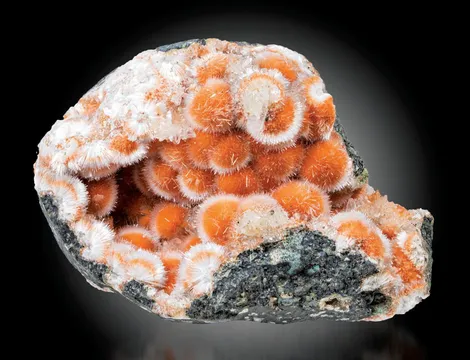
The Burhanpur–Khargone–Khandwa part of the state is central to the modern collector reputation. Kalagwani in Burhanpur District is documented for fluorite, quartz, chalcedony and baryte, with spheres of fluorite found at several localities near the village. Burhanpur District is also the source area for much of the Indian iridescent quartz sold as “iris quartz,” “rainbow quartz” or “anandalite,” material whose market locality is generally described as west of Burhanpur near the Maharashtra border. Deshgaon in Khandwa District became known to collectors after late-2021 finds of orange-red spherical mesolite aggregates with white acicular terminations on calcite and basalt; much of this material was first marketed as thomsonite with mesolite, but careful discussion and later identifications have shown that at least some specimens are entirely mesolite, including the orange center as well as the pale terminal needles.
Dhar District, particularly the Pithampur area, produced one of the state’s most talked-about recent specimen finds. In spring 2023, an aggregate quarry yielded red to pink calcite with white mesolite, quickly nicknamed the “Moldy Razzberry Pocket” because the equant red calcite crystals resemble raspberries dusted or tufted with mesolite “mold.” The find was small enough that selected miniatures were reported at major show venues soon after discovery, yet the name spread rapidly and the material became a high-value niche within the broader Indian zeolite market. The strongest specimens combine saturated raspberry-red calcite, intact glassy faces, and airy mesolite sprays attached naturally rather than glued or reconstructed.
Mining in the Deccan basalt specimen districts is not specimen mining in the classic underground-pocket sense. Most pockets are incidental finds in aggregate quarries, road-metal operations, construction cuts, drainage works and basalt extraction. Cavities are opened by blasting or mechanical breaking, and specimens survive only when miners, quarry workers or local dealers recognize them quickly enough. That means production is irregular: a small vug may produce a handful of miniatures, a larger cavity may supply the show market for a season, and then the precise source may be gone beneath quarry advance or backfill. Current collecting access should be assumed to be restricted. Active quarries, industrial leases and village lands require permission from the operator and landholder, and many pieces now reach collectors only through Indian dealers, show wholesalers and secondary-market resales.
Outside the basalt-cavity specimen suite, Madhya Pradesh has several major mineral localities of scientific or economic importance. Kajlidongri in Jhabua District is a manganese mine in the Jhabua Manganese Belt, with massive supergene manganese oxides and Mn-silicate gondites hosted by rocks of the Aravalli Supergroup. It is important for unusual Mn-rich silicates and amphiboles, including type-locality amphibole species and historically significant hollandite-group material. Malanjkhand in Balaghat District is the state’s great copper locality, operated by Hindustan Copper Limited; systematic exploration began in 1969, the mining lease was granted in 1973, and the Malanjkhand Copper Project was established in 1982 to mine a large granitoid-hosted copper deposit. Panna, meanwhile, gives Madhya Pradesh a different kind of fame as India’s diamond-producing district, although Panna diamonds are outside the main zeolite-and-fluorite collector suite treated here.
Fluorite is Madhya Pradesh’s most distinctive modern collector mineral, not for classic cubes but for rounded, hemispherical to botryoidal masses in yellow, honey, tan, gray, brownish and rarer reddish tones, commonly grown on quartz, chalcedony or amethyst-lined cavities from the Burhanpur–Khargone area, including Kalagwani and trade localities such as Tekhdi and Khadakwani/Khadakwadi. Individual rounded fluorite bodies on documented specimens commonly fall in the centimeter range, with examples described at about 21–26 mm and cabinet pieces carrying larger clustered spheres; the best examples show translucent, undamaged domes with a glossy or waxy surface, strong contrast against sparkling quartz or pale-purple amethyst, and little cutting or trimming visible on the display face. Ordinary pieces are dull, bruised, chalky or isolated from their silica matrix, while top examples preserve the strange “bubble” habit that made these Indian fluorites famous among specialists.
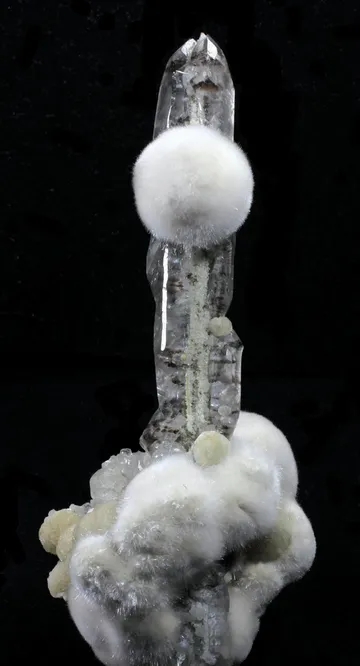
Mesolite from Madhya Pradesh is most strongly associated with the Deshgaon–Khandwa material and the later Pithampur-area red calcite find, appearing as dense acicular sprays, fuzzy white coatings, and orange-red to salmon spherical aggregates with pale to white needle terminations. At Deshgaon, documented specimens show orange-red rounded aggregates of mesolite needles to about 8 mm on calcite in basalt, and these pieces are especially prized when the needles radiate cleanly from colorful spherical centers without crushing or matting. From the Pithampur “Moldy Razzberry” association, mesolite is valued as a visual counterpoint to red calcite: the finest pieces have airy white tufts naturally attached to glassy red crystals, whereas common pieces show only patchy white fuzz, broken needles, or suspicious joins where calcite and mesolite fragments have been assembled.
Thomsonite from Madhya Pradesh requires a more cautious collector’s eye than the label often suggests, because much orange “thomsonite with mesolite” from the Deshgaon–Khandwa finds has been discussed and, in some cases, reidentified as mesolite throughout. In the marketplace the thomsonite name is still encountered for orange to red-orange rounded zeolitic balls partly covered by white mesolite needles, a habit that made the late-2021 Deshgaon-area material instantly recognizable. The best pieces under the thomsonite label are those with clear provenance, convincing analysis or at least careful seller disclosure, strong orange color, intact radial texture, and delicate white mesolite overgrowths; the least desirable are vague “India zeolite” pieces where the orange core is merely assumed to be thomsonite without testing.
Calcite in Madhya Pradesh spans ordinary Deccan-cavity calcite and a very special recent collector style: the red to pink calcite with mesolite from the Pithampur area of Dhar District, discovered in spring 2023 and marketed as the “Moldy Razzberry Pocket.” The celebrated specimens show equant to rhombohedral calcite crystals, commonly around the 2 cm scale in described miniatures, colored raspberry-red to saturated pink, with white mesolite sprays attached on surfaces or included in the calcite. Quality here is governed by color and construction: fine pieces have lustrous, undamaged red crystals, natural mesolite placement, and balanced display, while ordinary pieces are pale, etched, chipped, detached from matrix, or show obvious glue repairs between calcite and mesolite.
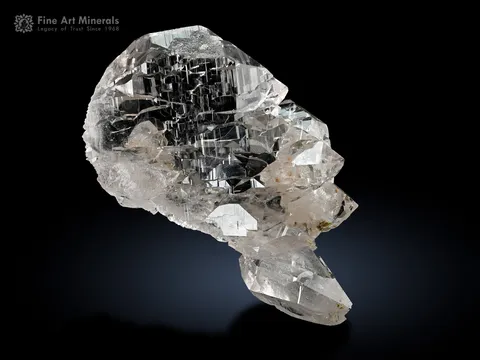
Quartz from Madhya Pradesh is most important both as a matrix mineral for fluorite and as the state’s famous iridescent Burhanpur-area quartz, long sold as iris quartz, rainbow quartz or anandalite. The Burhanpur material forms transparent to colorless or faintly amethystine crystal groups and plates from basaltic cavities, with flashes of spectral color seen under certain faces when the specimen is turned in strong light; gemological work attributes the effect to extremely thin parallel Brazil-law twinning lamellae rather than to a surface coating. Fine collector specimens are not necessarily large, but they must be bright, transparent, and truly iridescent in natural light; weakly iridescent quartz, coated “aura” material, or ordinary drusy quartz without internal color-play should not command the same locality premium.
Amethyst from Madhya Pradesh most often appears as pale to medium purple quartz lining basalt cavities and serving as a sparkling substrate for botryoidal fluorite, particularly in Burhanpur–Khargone-area specimens and trade material from Tekhdi and Khadakwani/Khadakwadi. The amethyst crystals are usually small, commonly around the millimeter to centimeter scale in specimen descriptions, and their value lies less in individual crystal size than in the contrast they provide beneath honey-yellow or yellow-brown fluorite domes. The best specimens show continuous amethyst druse with intact points, visible purple color around the fluorite, and no heavy iron staining or sawed display face interrupting the natural cavity; ordinary examples are simply pale quartz with only a faint amethyst tint.
Heulandite from Madhya Pradesh is less famous than the great Pune, Jalgaon and Nashik productions, but it occurs in the state’s Deccan-cavity assemblage and appears on collector specimens as pearly, wedge-shaped to bladed crystals in white, cream, peach or tan tones, sometimes with apophyllite, stilbite, calcite or mesolite. The best pieces are those with sharp, lustrous individual crystals or sculptural heulandite-rich matrix supporting more colorful associated minerals; historical or older-collection specimens can be attractive precisely because many Madhya Pradesh heulandites were not marketed with precise quarry names. Ordinary pieces tend to be massive, dull, confused with stilbite, or labeled only broadly as “zeolite,” so careful visual comparison and, for high-value pieces, analytical confirmation are worthwhile.
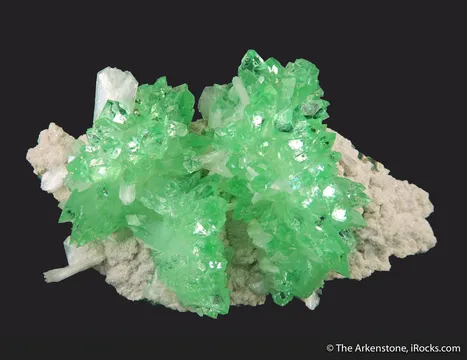
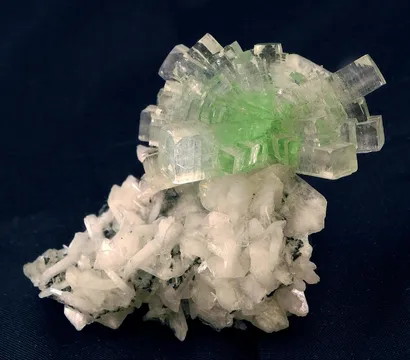
Apophyllite from Madhya Pradesh is a minor but attractive part of the state’s Deccan specimen output, seen as colorless to green, glassy, sharply terminated crystals associated with stilbite, heulandite and zeolite-rich basalt-cavity matrix. Compared with the classic Maharashtra apophyllite districts, Madhya Pradesh examples are scarcer in the trade and often carry broad state-level labels, so a good specimen is judged by transparency, undamaged pyramidal or pseudo-cubic terminations, strong green color where present, and a natural association rather than by sheer abundance. The best pieces show crisp crystals rising cleanly from pastel zeolite matrix; lesser pieces are cloudy, bruised, cleaved, or indistinctly labeled Indian material that may not be separable from more common Maharashtra production without provenance.
Stilbite from Madhya Pradesh occurs as white, cream, peach or salmon bladed sprays, sheaves and small bow-tie aggregates in Deccan basalt cavities, commonly associated with heulandite, apophyllite, calcite and mesolite. In the Pithampur-area red calcite material, small stilbite blades have been observed as a subordinate association, while broader Madhya Pradesh zeolite specimens may show stilbite as free-standing bladed groups over heulandite-rich matrix. Top pieces have separated, lustrous blades with a clean sculptural arrangement and undamaged terminations; ordinary pieces are compact, chalky, heavily contacted or difficult to distinguish from heulandite without close inspection.
“Zeolite” on Madhya Pradesh labels is usually a group or trade label rather than a species name, most often covering mixed Deccan-cavity assemblages involving mesolite, heulandite, stilbite, thomsonite-group material and related sodium-calcium aluminosilicates in basalt vugs. These specimens are best appreciated as paragenetic miniatures: orange mesolite balls with white needles, red calcite and mesolite from Pithampur, or mixed apophyllite–stilbite–heulandite plates from basalt cavities. Good zeolite-group pieces from Madhya Pradesh are clean, balanced, locality-specific and mineralogically honest; ordinary ones are generic “Indian zeolite” plates with uncertain species identities and no district-level provenance.
Other documented Madhya Pradesh minerals remind collectors that the state is much more than a Deccan zeolite source. Kajlidongri in Jhabua District is especially important for Mn-rich silicates and amphiboles, including helvine in gondite, ardennite-(As), piemontite, spessartine, alurgite, ferri-leakeite, mangani-dellaventuraite, and historically significant hollandite-group material; Kajlidongri is listed as the type locality for several valid amphibole species and is generally considered the original locality tied to winchite-type material, although later amphibole nomenclature has complicated the exact identity of early “winchite.” Malanjkhand adds a copper-molybdenum dimension with chalcopyrite, molybdenite and associated secondary copper minerals, while Panna remains the state’s best-known gem district through diamond production.
Madhya Pradesh labels deserve close attention because the state-level name is often used when the real collecting site is uncertain, commercially sensitive, or lost in the dealer chain. For fluorite, ask whether the specimen is from Kalagwani, Burhanpur District, Khargone-area localities such as Khadakwani/Khadakwadi, Tekhdi, or merely “Madhya Pradesh.” For red calcite–mesolite, “Pithampur” or “Pithamur” and “Dhar District” are more useful than a generic India label. For orange mesolite/thomsonite-style material, Deshgaon or Khandwa District provenance is a significant plus, but the species identification may still require caution.
The most important authenticity issue specific to current Madhya Pradesh material is reconstructed red calcite with mesolite. Dealers have reported glued composite specimens made by joining calcite and mesolite fragments, especially because the “Moldy Razzberry” association became popular and expensive quickly. Examine contact points under magnification: natural mesolite sprays should enter cracks, sit in growth positions, or be included beneath calcite faces; suspicious pieces may show glossy adhesive, unnatural gaps, repeated attachment angles, broken mesolite mats used as camouflage, or calcite crystals perched too neatly on unrelated white fuzz.
Botryoidal fluorite presents different concerns. Some pieces are cut flat for display, which is not inherently fraudulent if disclosed, but the value should reflect the amount of natural cavity preserved. Check for bruised domes, chipped rims, dull abraded high spots, heavy oiling or wetting to improve translucency, and confusing sales language that calls the fluorite “crystals” without explaining that the habit is radiating microcrystalline to hemispherical rather than conventional cubic. Shortwave ultraviolet reactions have been reported for some Madhya Pradesh fluorites, from white to purple-white or faint yellow, but fluorescence should be treated as a specimen feature rather than a primary authentication test.
Iridescent Burhanpur quartz should not be confused with artificial aura-coated quartz. True iris quartz shows internal flashes tied to specific crystal faces and viewing angles, not a uniform metallic surface film. If the color looks like a continuous vapor-deposited rainbow sheen, especially on all faces equally, it is probably treated quartz rather than natural Madhya Pradesh iris quartz. Because the best internal color-play is hard to capture in photographs, buy from dealers who understand the difference and can describe how the specimen behaves in direct light.
Condition standards vary by species. Mesolite needles crush easily and often arrive with flattened or dusty patches. Heulandite and stilbite cleave and bruise along pearly faces. Apophyllite can chip on terminations and cleave at the base. Calcite is vulnerable to contact marks, acid cleaning and repairs. For all of these, natural pocket damage is common, but the price premium should go only to specimens with intact display faces and honest disclosure of trimming, repair and restoration.
Market availability is uneven. Small botryoidal fluorite on quartz or amethyst is obtainable, though exceptional large, translucent, well-centered pieces are much rarer. Deshgaon-style mesolite/thomsonite specimens appear periodically but good color and undamaged needles are selective. The red calcite–mesolite “Moldy Razzberry” material remains a high-demand niche, with modest miniatures available at times and top cabinet pieces priced far above ordinary Indian zeolite specimens. Precisely labeled older Madhya Pradesh heulandite, stilbite and apophyllite are less common than comparable Maharashtra pieces, so provenance can be as important as aesthetics.
One of Madhya Pradesh’s best mineral stories begins not in a modern quarry but in the age of railway building. The earliest known reference to Indian iris quartz is tied to an 1860 donation to the British Museum of Natural History: an iridescent quartz cluster given by an engineer who had worked on construction of the Central India Railway. More than a century and a half later, gemologists studying natural iridescent quartz could still match the old descriptions to modern Burhanpur-area material from the Deccan Traps. That continuity is remarkable: a nineteenth-century railway engineer, a museum specimen, and twenty-first-century gemological microscopy all converge on the same peculiar optical phenomenon—little spectral flashes sealed inside otherwise colorless quartz.
The Burhanpur quartz had a second, more modern moment in the collector press in 2013, when about a dozen specimens were being offered from the district in sizes from roughly 2 cm to almost 10 cm. In still photographs the pieces looked like ordinary transparent quartz groups, but the point was motion: in strong sunlight, scattered faces flashed small rainbows as the specimen was turned. Alfredo Petrov was reported showing one around at the 2013 Tucson Show, where the effect was strong enough in person to make the material memorable despite its understated appearance in photographs. For collectors accustomed to color coming from pigment, inclusions or coatings, Burhanpur iris quartz is a lesson in structure: the show happens inside the crystal.
The spring 2023 Pithampur discovery had a different kind of drama—modern, fast-moving and market-driven. An aggregate quarry produced a limited find of red calcite with white mesolite, and almost immediately the material acquired a pocket name: “Moldy Razzberry.” The name worked because it was funny and visually exact. The calcite crystals looked like red raspberries; the mesolite looked like white mold. Within months, a handful of miniatures appeared with David Ziga at the Hardrock show, and newly prepared pieces were expected for the Tucson market in early 2024. The best examples did not need explanation once seen: saturated red calcite, white fibrous sprays, and a mineralogical joke that collectors repeated because it described the specimens perfectly.
The Deshgaon-area orange mesolite find shows how fast a locality identity can evolve. When the orange-red balls with white needle terminations first appeared around the end of 2021, many were sold as thomsonite with mesolite. The look was convincing enough: orange rounded zeolite centers with white radiating needles make an easy mental match to thomsonite-overgrown-by-mesolite specimens from other basalt localities. But later discussion and identification showed that some examples were mesolite throughout, including both the orange centers and the pale terminal needles. In that small correction lies a larger truth about Indian zeolite collecting: beauty reaches the market quickly, but names sometimes need to catch up.