Deshgaon, India — rising Deccan zeolite locality producing orange-red spherical zeolites with white mesolite terminations, prized by collectors.
Key facts
Deshgaon is one of the newer collector names to emerge from the great Indian zeolite province: a small village in Khandwa District, Madhya Pradesh, sitting in the eastern part of the Deccan Volcanic Province, where vesicular basalt, weathered flow tops, and later mineral-charged fluids created cavities lined with zeolites and calcite. Its fame rests on a highly distinctive 2021-era find of orange-red, radially built spherical aggregates with white to colorless needle terminations—specimens that entered the trade as “thomsonite with mesolite,” but which have since become an instructive case in the difficulty of assigning visually similar zeolite intergrowths without analysis.
Regional View
Country View
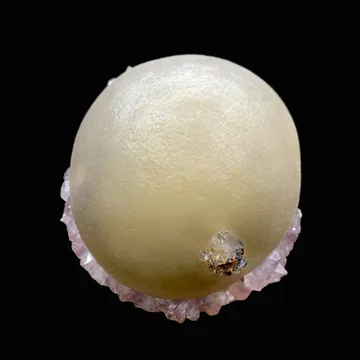
The best Deshgaon pieces have an immediately recognizable look: dark basalt or calcite-bearing matrix carrying hemispheres and balls of warm orange, salmon, or red-orange fibrous zeolite, overgrown by fine white to colorless sprays of mesolite. At their most aesthetic, the balls stand proud of the matrix like miniature sea urchins or frosted berries; at their worst, the same material can be rubbed, flattened, or fuzzed into an indistinct fibrous crust. The locality is significant not because it is an old, prolific classic like Jalgaon, Nashik, or Pune, but because it represents the modern specimen trade at its most dynamic: a road-and-quarry-age Indian zeolite occurrence, rapidly marketed, rapidly relabeled, and then partly reinterpreted by analytical work.
Search for specimens: View all specimens from Deshgaon, India
Deshgaon is a village in the Khandwa area of Madhya Pradesh, recorded in modern mineralogical usage as Deshgaon, Khandwa District, Madhya Pradesh, India. The locality lies near 21°53'54" N, 76°11'12" E, in the basalt country of the Deccan Volcanic Province. In administrative terms it is a village locality rather than a named underground mine, and that distinction matters for collectors: labels may refer to Deshgaon, Khandwa, Madhya Pradesh, or nearby road/quarry work rather than to a single formal mine name.
Geologically, the occurrence belongs to the great family of Deccan Trap secondary-mineral deposits. These are not ore veins in the classic metallic sense; they are cavity, vesicle, amygdule, and fracture fillings in basaltic lava flows. In Khandwa District, official groundwater and environmental documents describe the district as underlain by multiple Deccan Trap basalt flows, with vesicular zones, red bole or weathered flow breaks, and interflow contrasts that can control permeability. Those physical contrasts are exactly the sort of architecture that allows late fluids to move through basalt, dissolve components from the rock, and deposit zeolites, silica, and calcite into open spaces.
The documented specimen mineralization at Deshgaon is dominated by mesolite and associated calcite, with heulandite-subgroup, stilbite-subgroup, quartz varieties, fluorite, and thomsonite-subgroup entries also recorded. The famous orange-and-white aggregates reached the market at the end of 2021. They were first sold broadly as mesolite on “thomsonite,” with the reddish spherical interior described as thomsonite and the white to colorless radiating terminations as mesolite. Later analytical reporting summarized by Ottens and coauthors indicated that the aggregates studied were mesolite throughout, including both the red-orange center and the colorless terminal part; the red color was described as a thin zone, roughly 2 mm thick, within mesolite rather than a separate thomsonite core.
Mining around Deshgaon is tied to basalt as a construction stone rather than to specimen mining as a primary industry. A Deshgaon Basalt, or metal-stone, quarry lease of 18.84 hectares was granted to Shri Rakesh Bansal of Khandwa for the period from 20 June 2008 to 19 June 2018, with a listed production capacity of 19,800 cubic meters per year. The official environmental-clearance material describes open-cast manual and semi-mechanized quarrying, benches in weathered basalt and basalt metal stone, and a quarry setting in government revenue land near Deshgaon. The same government record gives elevations in the lease area of roughly 306 to 324 m above mean sea level and notes a public hearing at Deshgaon on 20 November 2009. Environmental-clearance status records later show revocation action in 2019 for that specific case. These records establish active basalt extraction at Deshgaon, though they do not by themselves prove that every mineral specimen sold as Deshgaon came from that exact lease.
The locality also sits amid current and recent road-building corridors. Tender records identify major road works involving Deshgaon, including widening and improvement projects on NH-347B and related Khandwa–Deshgaon sections. Dealer descriptions have repeatedly associated the zeolite finds with road construction near Deshgaon, which is plausible for Deccan zeolite occurrences because fresh basalt cuts and aggregate work are often the exposures that briefly reveal collectible cavities. For collectors, the important practical point is that Deshgaon material is construction-exposure material, not the output of a maintained specimen mine.
Collecting access should therefore be treated as restricted and opportunistic. Active quarries, highway cuts, construction benches, and government or private lease areas in India require permission; loose reports of road-work discoveries should not be read as an invitation to collect. The specimen supply now in collections and on the market appears to have come through Indian dealers after pockets or zones were exposed, removed, and dispersed. Once such work faces are advanced, blasted, backfilled, paved, or weathered, the specific cavities are usually gone.
Deshgaon “thomsonite” is best understood as a collector-trade and visual label for the orange to reddish, radially fibrous spherical portions of the locality’s famous zeolite aggregates, commonly paired with white to colorless mesolite needles on basalt or calcite-bearing matrix; good cabinet pieces show discrete orange balls or hemispheres with intact, evenly radiating white terminations, while ordinary examples are more massive, abraded, or visually muddy. The most important caution is analytical: published discussion of the Deshgaon find reports that representative orange-and-white aggregates proved to be mesolite throughout, with the red-orange color confined to a thin zone rather than a confirmed thomsonite core, so high-end “thomsonite” labels from Deshgaon should ideally be supported by analysis or worded conservatively as thomsonite-subgroup/mesolite material.
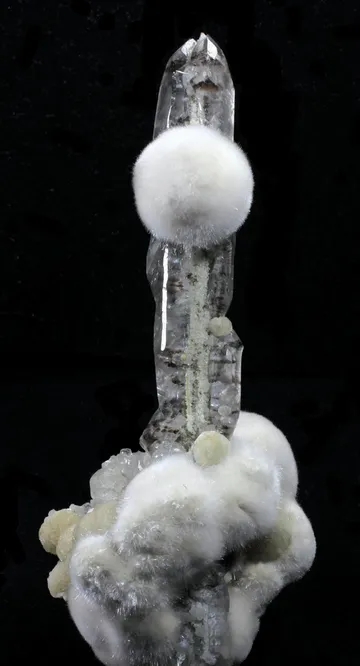
Mesolite is the scientifically central species at Deshgaon, forming fine acicular to fibrous, radially arranged crystals in white, colorless, and orange-red zones, often as spherical aggregates or sprays rising from basalt and calcite matrix. Reported aggregate diameters reach about 20 mm, with documented crystals to around 8 mm on photographed specimens and show reports noting white mesolite sprays to about 1.5 cm; the best pieces combine strong orange-red cores, crisp white radial terminations, open spacing, and undamaged needles, while lesser material loses appeal when the fibers are bruised, dusty, flattened against matrix, or confused with more common pale zeolite crusts.
Calcite at Deshgaon is chiefly important as the carbonate matrix and companion phase for the mesolite-bearing pockets, with specimens documented as mesolite and calcite on basalt rock and market examples showing calcite as white to pale crystalline support beneath the orange-red and white zeolite sprays. Unlike some Indian Deccan localities where calcite itself is the sculptural centerpiece, Deshgaon calcite is most collectible when it contributes contrast, elevation, and compositional integrity to the mesolite aggregates; clean miniature to cabinet specimens in which calcite is visible but does not overwhelm the zeolite display are preferable to pieces where the calcite is merely a broken backing or a heavy, unattractive base.
Other minerals documented from Deshgaon include quartz and its agate, amethyst, and chalcedony varieties, fluorite, heulandite-subgroup minerals, stilbite-subgroup minerals, and thomsonite-subgroup material. None of these has given Deshgaon the specimen identity that mesolite has; they are best regarded as part of the local basalt-cavity assemblage unless supported by sharp crystals, unusual color, or strong association with the orange-white zeolite material. No accepted type-locality mineral is documented from Deshgaon in the verified locality records used for this guide.
Deshgaon is a locality where the label is almost as important as the specimen. The biggest authenticity issue is not artificial treatment, but identity and locality drift. Specimens have circulated as “thomsonite with mesolite,” “mesolite on thomsonite,” “orange thomsonite,” or simply “Madhya Pradesh zeolite,” and some have been confused with or labeled as Pithampur/Pithamur, Khadakwani, Burhanpur, or generic Khandwa material. For serious collections, the strongest label is “Mesolite, calcite, basalt matrix, Deshgaon, Khandwa District, Madhya Pradesh, India,” with any thomsonite wording made conditional unless the piece has analytical support.
Condition is critical. The finest visual feature of Deshgaon material—the white to colorless mesolite fringe—is also the first thing to suffer. Needles break, mat, gather dust, or abrade in transit, and the damage may not be obvious in frontal photographs. Inspect the silhouette of the sprays, the tips of the radial needles, and the contact points where orange balls meet matrix. A specimen with fewer but fully intact hemispheres is usually preferable to a larger piece with broad rubbed patches.
Be cautious with cleaning. Mesolite is a hydrous zeolite and the aggregates are mechanically delicate; calcite, when present, is acid-sensitive. Avoid ultrasonic cleaning, acids, aggressive water jets, and stiff brushes. Dust removal is best limited to a gentle air bulb or very soft brush, and even then only if the fibers are not loose. Store specimens where they will not be touched by foam lids, cotton, or adjacent minerals.
There is no well-documented Deshgaon-specific treatment or fake industry comparable to dyed agates or repaired high-value metallic specimens, but the form is unusual enough that novelty imitations and fantasy “fiber ball” material elsewhere in the trade can confuse newer buyers. Real Deshgaon pieces should show mineral growth integrated with basalt/calcite matrix, not loose synthetic-looking tufts glued to a base. Under magnification, natural specimens show radial mineral continuity, variable crystal lengths, and contact relationships with the matrix.
Market availability is moderate: enough material has reached dealers and online platforms that Deshgaon is obtainable, but fine, undamaged, well-isolated orange-and-white aggregates remain selective. Small cabinet examples are commoner than truly sculptural cabinet pieces. Premium value rests on strong orange color, three-dimensional balls, bright white mesolite terminations, a stable matrix, and a label that acknowledges the modern analytical uncertainty.
The Deshgaon story began, in collector terms, not with a century-old mine monograph but with a sudden appearance on dealer tables and websites. At the end of 2021, Indian dealers began offering striking orange-and-white zeolite aggregates as mesolite on “thomsonite.” The look was memorable enough to travel faster than the locality data: reddish spheres with colorless to white radial terminations, the kind of specimen that could be recognized from across a room but not easily named from a photograph. Soon the village name Deshgaon, in Khandwa District, Madhya Pradesh, emerged as the proper source.
Then came the unraveling of the easy label. Collectors noticed that similar specimens were being sold under several Madhya Pradesh localities, and in 2023 a Mindat locality discussion opened with a practical collector’s problem: a specimen labeled simply “Thomsonite and Mesolite from Madhya Pradesh, India” did not match the then-current locality listings. Names such as Deshgaon, Khadakwani, and Burhanpur were all in circulation. One response cut directly to the problem—Madhya Pradesh is a very large state—and the thread became a miniature case study in how quickly attractive new Indian zeolites can outrun formal documentation.
The more interesting twist was mineralogical rather than geographic. The orange center was supposed to be thomsonite; the white terminations were supposed to be mesolite. That made visual sense to collectors familiar with fibrous zeolites. But later reporting of analyses in Ottens and coauthors’ Deccan Volcanic Province work indicated that the studied Deshgaon aggregates were mesolite in both the reddish center and the colorless terminal zone. The red-orange color, so visually decisive on the specimen, was described not as a separate thomsonite core but as a thin zone within mesolite. In a field where a label can add or remove hundreds of dollars from a cabinet piece, Deshgaon became a quiet reminder that zeolite names can be treacherous when they are assigned by habit alone.
The trade record added one more layer of confusion. A 2024 Mineralogical Record show report illustrated orange “thomsonite” grading to white mesolite sprays from near Deshgaon and explicitly separated that occurrence from a different Madhya Pradesh find of pink calcite and mesolite at Pithamur. That distinction matters. Both occurrences produced pink-orange-to-white, calcite/mesolite-related specimens from Madhya Pradesh; both could be described in fruity language; both arrived through the same international show-and-dealer circuit. For a collector trying to build a serious Indian zeolite suite, the difference between Deshgaon and Pithamur is not a footnote—it is the difference between two separate modern finds.