Mysore District, India — renowned metamorphic corundum (ruby) crystals from southern Karnataka; red-to-pink hues, distinctive matrix, and collector appeal.
Key facts
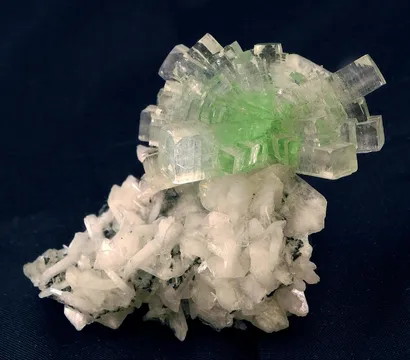
Mysore District—now officially Mysuru District in Karnataka—occupies a special place in mineral collecting because “Mysore ruby” is both a real South Indian classic and a cautionary label. The best-known specimens are not faceted gems in the Mogok or Montepuez sense, but robust corundum crystals: blocky to barrel-shaped hexagonal prisms and pyramidal-ended crystals, commonly red to raspberry, red-violet, pink, purplish, brownish, or grey-white, set in pale feldspathic or quartzose matrix, dark mica schist, albite, biotite, muscovite/fuchsite, calcite, and—most distinctively—the green micaceous material long called mavinite. Fine pieces show sharp trigonal terminations, growth hillocks, a waxy to vitreous luster, and a dramatic red-on-green contrast that is instantly recognizable in old collections.
Geologically, these are high-grade metamorphic and metamorphic-metasomatic corundum occurrences in the southern Karnataka sector of the Dharwar craton. The corundum is tied to aluminous pelitic schists and gneisses of the Sargur Group, cordierite-sillimanite assemblages, enclaves within Peninsular Gneissic Complex rocks, and contacts involving ultramafic bodies, pegmatites, aplites, and feldspathic veins. Weathering freed the resistant corundum into residual soils and gravels, so the historical “mining” was often closer to picking, washing, and hand-dressing than underground extraction. That weathered origin is part of the look: many crystals are complete floaters or partly freed from matrix, often with pitted faces, bruised edges, or natural surface irregularity rather than pristine gem transparency.
Regional View
Country View
For collectors, the locality’s significance rests on three overlapping histories. First is the old industrial corundum history of Mysore State, when corundum was valued as an abrasive and exported in modest tonnages through Madras. Second is the gemological history of southern Karnataka, where ruby, star-ruby, sapphire, and star-sapphire were repeatedly noted from Mysore, Mandya, Tumkur, Hassan, and related districts. Third is the modern specimen market history: since the late twentieth century, Mysore District has supplied showy cabinet and miniature rubies in matrix, often sold simply as “Mysore, India,” a label that may be historically meaningful but geographically vague unless a district, village, or older collection note accompanies it.
The classic Mysore corundum occurrences belong to a broad belt of corundum-bearing Precambrian rocks in southern Karnataka. Modern geological summaries place gem corundum in pelitic schists, cordierite-sillimanite schists and gneisses, gravel derived from those rocks, contacts between ultramafic rocks and pegmatite veins, and locally as disseminated grains in anorthosite. In Mysore District specifically, recorded corundum localities include the Kupya, Varuna, Bannur, H.D. Kote, Sargur, Chikunda/Chilkunda, Budipadaga, Jagankote, and Jakkanahalli areas, with ruby and star-ruby especially noted from Kupya, Bannur, and Budipadaga. A band of bluish green kyanite with deep red corundum has also been recorded at Itna in the district, a reminder that the corundum is part of a broader aluminous metamorphic assemblage rather than an isolated gem pocket phenomenon.
The older Mysore State literature described corundum as occurring in veins or bands of pegmatite, syenite, or granite cutting older gneisses, but with an important qualification: many of those feldspathic veins lie against, or are enclosed in, basic Dharwar rocks such as hornblende and mica schists, hornblende-pyroxene granulites, pyroxenite, and amphibolite. The corundum was interpreted in some cases as a primary constituent of the acid veins and in others as a product of reaction or enrichment near contacts with mafic and ultramafic rocks. Modern summaries refine that picture by emphasizing high-grade psammo-pelitic schists of the Sargur Group, corundum-bearing cordierite-sillimanite schist/gneiss near the Closepet Granite, and contact zones involving ultramafics and pegmatitic intrusions.
The ore bodies were not large, persistent lodes comparable to major industrial corundum mines elsewhere. Historically, much of the Mysore corundum was recovered as loose grains and crystals from residual soil, where weathering had decomposed the softer host rocks and left the hard Al2O3 crystals behind with other resistant minerals. A smaller proportion came from excavating soft decomposed rock, crushing or pounding it with wooden mallets or tilt hammers, sieving, and hand-picking the harder corundum. The dressed material could still carry substantial adherent impurities, and early writers noted that no serious attempt had then been made to work the hard rock on a modern scale. Even when the corundum-bearing rocks were recognized in place, the scattered nature of the deposits and the limited tonnage made large centralized dressing plants difficult to justify.
Mysore State’s early twentieth-century corundum trade was a small but real extractive industry. Licenses were granted over broad areas—often around a taluk—and licensees bought material collected intermittently by villagers before sorting and dispatching it toward Madras. Reported production during the years 1900–1914 varied markedly, with the better years around the First World War period reaching several thousand hundredweight. The old Mineral Resources of Mysore bulletin recorded recent production before 1916 as generally between about 2,000 and 4,000 hundredweight per year, and it already warned that the better classes of loose corundum had become less abundant or less easily obtained than formerly.
The best-known collector specimens appear to come from the corundum villages and occurrences now grouped under the Mysore corundum deposits: Chikunda/Chilkunda near the Piriyapatna-Hunsur side of the district, and Jagankote and Jakkanahalli farther south toward Sargur and Heggadadevankote. Mindat’s locality structure records these as gem-corundum occurrences or villages rather than single named mines. That distinction matters: “Mysore” on a label may refer to a modern district, a city, a former princely state, a pre-1998 administrative district, a division, or a broad trade source. Unless a specimen has an old label specifying Mysore District or a village name, it should not be over-precisely assigned.
Today there is no well-documented public collecting mine for these rubies. The corundum occurrences lie in villages, agricultural lands, weathered outcrops, quarryable rock, and government-regulated mineral ground where access depends on landowner permission, mineral rights, and local safety conditions. Serious collectors should treat field access as closed unless arranged through proper local channels. The market supply is almost entirely older stock, dealer-held material, estate pieces, and intermittent parcels of weathered or matrix material sold through mineral dealers rather than freshly documented pocket finds.
Mysore District corundum is best represented by sturdy hexagonal crystals, barrel-shaped to blocky prisms, pyramidal-ended crystals, crystal sections, and granular or massive material weathered from high-grade pelitic schists, gneisses, feldspathic veins, ultramafic-contact zones, and derived gravels. Colours range from ruby red and raspberry to purplish red, pink, brown, grey, greenish, white, and bluish varieties; the transparent gem grades are uncommon, and much material is translucent to opaque, included, fractured, or naturally pitted. The most collectible examples are not the largest masses but the sharp, complete, lustrous crystals in matrix—especially those with trigonal growth features, good red to red-violet colour, partial translucency under strong light, and contrasting albite, biotite, muscovite/fuchsite, calcite, or green mavinite-like mica. Ordinary pieces are dull grey-white abrasive corundum, broken sections, or heavily bruised crystals with weak colour; better pieces preserve the unmistakable Mysore morphology and sit cleanly on their matrix rather than being merely embedded in massive rock.
Ruby from Mysore District is the classic collector face of the locality: deep pink-red to raspberry, red-violet, purplish red, and locally “pigeon’s blood”-described corundum crystals, commonly as stout hexagonal individuals or clusters set in mica- and feldspar-bearing matrix. Specimen-scale crystals in modern collections are commonly in the centimetre range, with documented examples around 1.5–3 cm and larger floater or matrix pieces reaching several centimetres across; old catalogue descriptions mention raspberry-coloured crystals and crystal sections to about one inch in rich matrix specimens. Associations include green mavinite-like micaceous material, albite, K-feldspar, biotite, muscovite/fuchsite, quartz, calcite, and locally kyanite or sillimanite-bearing rocks. The best Mysore rubies have sharp hexagonal form, intact terminations, lustrous faces, saturated red to red-violet colour, visible translucency, and red fluorescence under long-wave ultraviolet light; lesser pieces are opaque, highly fractured, muddy brownish, or merely red patches in a larger ornamental rock.
Other minerals documented from Mysore District’s corundum and related metamorphic settings include albite, K-feldspar, quartz, calcite, biotite, muscovite, fuchsite, kyanite, sillimanite, feldspar-group minerals, zoisite, garnet, cordierite, staurolite, tremolite including chrome-tremolite, carbonate, and orthopyroxene. The locality is also historically important for mavinite, a dark green brittle mica-like material named from Mavinhalli/Mavinahalli and long associated with ruby specimens from the district; it is not treated as a robust modern mineral species, but it remains one of the most useful old-label words on Mysore ruby specimens because it describes the locality’s characteristic green micaceous matrix. Mavinahalli is also notable for carbonate-orthopyroxene-chrome-tremolite rocks described as sagvandite-like metasomatic products formed from ultramafic rocks in the Sargur schist complex under upper-amphibolite to lower-granulite facies conditions.
The first authenticity issue with Mysore specimens is locality precision, not whether the ruby is natural. “Mysore” has been used historically for the city, the princely state, the old Mysore State, the modern district, the wider division, and the trade source for South Indian ruby-bearing matrix. Many specimens in circulation are simply labelled “Mysore, India” or “Mysore, Karnataka,” and that is often all the evidence supports. Do not upgrade such a label to a specific village such as Chilkunda, Jagankote, Jakkanahalli, Mavinahalli, Sargur, or H.D. Kote unless the specimen came with reliable older documentation.
The second issue is matrix naming. Green material on Mysore ruby is often casually called fuchsite, mica, ruby-in-fuchsite, ruby-in-zoisite, or mavinite. Some green mica-rich Indian carving material was studied gemologically as corundum-fuchsite-kyanite rock, and material said to be from Mysore can resemble ruby in zoisite from Tanzania; the two should not be confused. On collector specimens from Mysore District, “mavinite” is a historically entrenched field/dealer name for green brittle micaceous material, not a modern IMA-approved species one can safely guarantee from appearance alone. If matrix identity matters, verification requires analytical work rather than colour.
Condition is critical. Because many crystals were freed by weathering and hand collection, natural pitting, etched or hillocked faces, and minor edge wear are common; however, impact bruising, cleavage-like parting, repaired terminations, and polished or sawn bases are also seen. Corundum itself is hard, but matrix minerals such as mica, feldspar, calcite, or green micaceous aggregates can be friable. Avoid aggressive cleaning: acids may attack calcite or alter the look of associated matrix, and mechanical cleaning can pop crystals out of mica or feldspar. A soft brush, distilled water where appropriate, and restraint are usually better than attempting to “improve” contrast.
Mysore ruby can fluoresce strongly red under long-wave ultraviolet light, and some specimens show weaker short-wave response. UV response is useful as a viewing feature and a rough screening tool for ruby-bearing zones in matrix, but it is not a locality proof and should not be used alone to distinguish Mysore from other Indian or East African ruby-in-matrix material. When examining a piece, look for the complete package: stout hexagonal habit, red to purplish-red colour, feldspathic or mica-rich matrix, possible green mavinite/fuchsite-like association, old Indian label style, and credible provenance.
Market availability is uneven. Small low-grade matrix pieces and ruby-in-green-rock ornamental material remain fairly common, but sharp, complete, bright, lustrous crystals on attractive matrix are far less plentiful than casual online listings suggest. Fine miniatures with clean ruby crystals perched on green mavinite-like mica and albite have been valued by dealers in the hundreds of dollars, while damaged, opaque, or massive pieces can be inexpensive. The strongest premiums go to old collection specimens with precise Mysore District labels, complete doubly terminated crystals, dramatic colour contrast, and documented fluorescence.
In the old Mysore corundum trade, the “mine” was often not a mine at all. The country rock weathered, the soil mantle thickened, and the corundum—too hard and stubborn to decay with the gneiss and schist around it—remained as loose crystals and grains. Villagers gathered it from the surface or from shallow diggings, and licensees bought the material as it appeared. The image is not of a great shaft or organized gem mine, but of broad taluk licenses, intermittent village collection, hand sorting, and sacks of imperfect abrasive and ruby-coloured corundum moving toward Madras.
The 1916 Mineral Resources of Mysore bulletin caught the industry at an anxious moment. Better grades had become less abundant, wages had risen, and the authors were already wondering whether Mysore should stop exporting raw, dirty corundum and instead dress it locally. Their proposed solution was practical and provincial: since much of the corundum passed through Bangalore on the way to Madras, perhaps a single treatment plant at Bangalore could buy the state’s output, crush and grade it, and create a steadier market. But the same report admitted the difficulty—the deposits were scattered, the total output was small, and artificial abrasives such as carborundum and alundum were becoming serious competitors.
There is a wonderful tactile detail in the old description of extraction. Where soft decomposed corundum-bearing rock was dug, the material was pounded with wooden mallets or tilt hammers, then sieved and picked by hand. Even after this treatment, the “corundum” shipped out could carry 30 or 40 percent adherent impurity. For a modern specimen collector, that number explains a great deal: the Mysore material was never primarily a gem-mining enterprise, and many surviving specimens are rugged, matrixy, and imperfect because the original economy valued hardness and tonnage more than cabinet aesthetics.
The old valuations also show why red material was always special. Good ruby grades could bring several times the value of ordinary pink, brown, grey, or greenish corundum, but the report repeatedly stressed that the quantity of the best ruby material was small. Transparent gem ruby was described as practically unknown in Mysore in the early industrial literature, yet the red crystals were still the most prized class. That tension—poor gem transparency but superb specimen colour and form—is exactly what gives the locality its character today.