






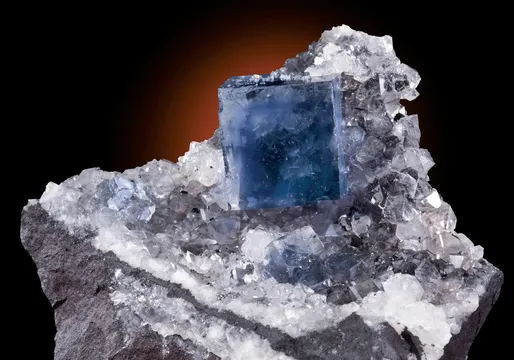
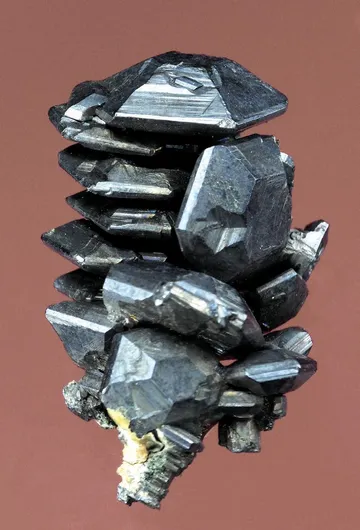
Levant Mine, UK - renowned locality for crystallized chalcocite (black, sharp twins) on quartz; classic Cornish mining history and an undersea lode setting.
Key facts
Levant Mine stands on the storm-cut cliffs at Trewellard, between Botallack and Geevor in the St Just mining district of west Cornwall, where copper-tin lodes descend through the granite margin and its metamorphic aureole before plunging northwestward beneath the Atlantic. For mineral collectors its name is not merely historical romance: Levant is one of the great British localities for crystallized chalcocite, and fine specimens from the mine helped establish the classic Cornish look of the species—black to lead-grey, sharply twinned, striated, metallic crystals, commonly seated on quartz or calcite and sometimes altered or overgrown by bornite, djurleite, covellite, or green copper chlorides.
The geological setting is central to the appeal. Levant worked the spatially zoned Cu-Sn mineralization characteristic of Cornwall, with early copper-rich ground giving way to increasing tin importance as workings advanced deeper and seaward. The lodes are hydrothermal veins and wall-rock replacement bodies related to the Land’s End granite, cutting granite inland and metasedimentary “killas” and greenstone toward the coast. In specimen terms, that produced a collection suite with two personalities: primary sulphides—chalcocite, chalcopyrite, bornite, pyrite, arsenopyrite, tennantite-tetrahedrite group minerals, luzonite—and later carbonate, quartz, and secondary copper minerals formed in fractured, sea-influenced ground.
Historically Levant is inseparable from Cornish engineering. Its restored 1840s beam whim engine survives in its original engine house and is still steamed for visitors on guided tours. The mine is also remembered as the “mine under the sea”: ore shoots and levels were driven far out below the seabed, and the old accounts of hearing boulders grind overhead during Atlantic storms remain among the most vivid pieces of British mining lore. That same undersea setting, rich copper ore, deep lode work, and dangerous access gave Levant both its productive life and its tragic memory.
Regional View
Country View
The finest specimens have an unmistakably old-Cornwall character: dense little cabinet and miniature pieces, often without showy gangue, where crisp black chalcocite crystals rise in intergrown clusters; quartz pieces with iron staining or hematite-red interiors; cream to white calcite scalenohedra and platy crystals on quartz; and the occasional native copper or “blistered copper” association that hints at the complex replacement history of the copper lodes. Levant specimens with early labels are especially prized, since most good material was removed generations ago and the locality is now a protected heritage site rather than an active collecting ground.

Photo: Nilfanion, Wikimedia Commons

Search for specimens: View all specimens from Levant Mine, UK
Levant Mine is at Trewellard, Pendeen, near St Just, Cornwall, with the commonly cited National Grid reference SW368345 and approximate WGS84 coordinates 50.15139, -5.68472. It belongs to the St Just district on the northwest flank of the Land’s End granite, part of the broader Cornwall and West Devon Mining Landscape. The mine worked copper and tin from hydrothermal lodes genetically tied to granite-related fluids; the exploited mineralized volume has been described as roughly 2000 × 800 × 200 m, with ore shoots plunging 10–20° northwestward beneath the present seafloor.
The country rock relationship is unusually important here. Inland, the lodes cut granite; toward the cliff and offshore workings they pass into killas, the Cornish miners’ term for the metamorphosed Devonian country rocks. Greenstone was also encountered and was hard, troublesome, and relatively poor where the lodes passed through it. Two principal lode directions were recorded in the official accident report: one striking about W. 28° N. and underlying south at about 20°, the other about N. 30° W. and underlying north at about 20°. That structural arrangement, combined with the seaward-dipping granite-killas contact, created the celebrated undersea ore field.
The mineralization is classic Cornish Cu-Sn zoning rather than a single simple vein assemblage. Chalcocite is the specimen mineral that made Levant famous, but the mine also records cassiterite, chalcopyrite, bornite, covellite, pyrite, arsenopyrite, sphalerite, bismuth minerals, native copper, native silver, quartz, calcite, fluorapatite, fluorite, hematite, rhodochrosite, scheelite, schorl, and a suite of secondary copper minerals including atacamite-group and paratacamite-type species, brochantite, botallackite, langite, malachite, azurite, cuprite, and connellite. The presence of chloride copper minerals is unsurprising in a mine whose workings approached seawater and whose near-surface copper minerals experienced saline alteration.
Mining at Levant is recorded before the nineteenth-century company phase. A copper production record of 10 tons is cited for 1793, and the name Levant appears in eighteenth-century mapping and documentation associated with older workings including Zawn Brinney, Boscregan, and Wheal Unity. The great productive phase began in 1820, when the Levant Mining Company was formed with a small capital and local investors. The mine rapidly became profitable from copper, and by 1836 it employed 320 men, 44 women, and 186 children, many of the women and children engaged in ore dressing at surface.
Tin became increasingly important after the early copper success. By the mid-nineteenth century Levant had developed into a substantial tin-and-copper operation with stamps, dressing floors, winding and pumping engines, arsenic and sulphur recovery from calciners, and eventually extensive seaward development. A man-engine was installed in 1857 because the crooked shafts were unsuitable for ordinary cage access, and the workings were already deep enough that ladder travel consumed an exhausting share of a miner’s day. By the late nineteenth and early twentieth centuries, the mine was being pushed deeper and farther offshore, including submarine shafts below the land shafts and extensive tramming levels under the sea.
The principal operating lineage runs from the Levant Mining Company through cost-book and later limited-company arrangements, with the mine continuing until 1930. A cost-book company operated from the 1870s; Levant Tin Mines Limited followed in 1920 after the disaster, under the influence of the Oats and Geevor interests. Levant also absorbed or controlled associated ground, including Higher Levant, also known as Higher Bal, which Historic England records as opened in 1830, purchased by Levant in 1877, and abandoned by Levant in 1915 so effort could be concentrated on deeper seaward sections.
The mine’s deepest and most dramatic ground lay offshore. Contemporary and later accounts record levels and shafts extending roughly a mile or more beneath the Atlantic, with bottom workings at about 350 fathoms. Seaward development began in earnest in the 1870s, and the growing distance from land shafts increased haulage costs. Pit ponies were used in 1893 on the mile-long tramming level under the sea, a detail that neatly captures the scale of the subterranean operation.
Levant’s great interruption came on 20 October 1919, when the man-engine failed during the afternoon shift change. Thirty-one miners were killed and many more injured. The man-engine was not repaired, and the deepest levels served by it were abandoned; upper-level work continued until the economic depression and falling tin prices closed the mine in October 1930. The beam engine, however, was not lost. In 1935 the Cornish Engines Preservation Committee secured it in situ for £35, and after decades of care, culminating in work by volunteers later known as the Greasy Gang, the engine returned to steam in 1992.
Collecting access today should be understood in heritage rather than field-collecting terms. Levant Mine and Beam Engine is managed by the National Trust and is open by pre-booked guided tour rather than as a collecting site. The South West Coast Path passes through the mining landscape, but the underground workings, shafts, and protected industrial remains are not places for specimen extraction. Serious collectors should look for documented old specimens, ideally with early Cornish, museum, or reputable dealer labels, rather than expect new field material from the property.
The most important specimen finds appear to have come from old productive copper-rich ground rather than a modern collecting pocket. Levant chalcocites were already in the classic literature and museum collections by the nineteenth century. A noted Natural History Museum, London specimen collected in 1899 measures 7.1 × 6.3 cm, with crystals reported to 4.5 cm, and it is precisely this generation of old-time material that gives Levant its standing among British mineral collectors. Later dealer records and surviving specimens show smaller but fine chalcocite clusters in quartz cavities, chalcocite on calcite, chalcocite with paratacamite and other green copper chlorides, and altered chalcocite groups sold historically as bornite, djurleite, or “after chalcocite” material.
Levant chalcocite is the locality’s collector’s mineral: sharp, black to lead-grey metallic crystals of Cu2S, commonly twinned, striated, and developed as thick tabular, prismatic, pseudohexagonal, or “nail-head” groups, most often as miniatures and small cabinet pieces but with rare historic crystals reaching several centimeters. Good specimens may show freestanding, lustrous crystals on quartz or calcite, or dense crystal clusters without matrix; ordinary pieces are massive, bruised, or visually ambiguous because Levant and neighboring St Just material is notorious for partial replacement or overgrowth by bornite, djurleite, digenite, covellite, chalcopyrite, and green copper chlorides. Documented associations include quartz, calcite, paratacamite, fluorapatite, hematite, chalcopyrite, fluorite, bornite, pyrite, brochantite, cassiterite, and tennantite-group minerals, with the finest pieces combining crystal sharpness, old provenance, minimal edge wear, and clear visual separation from altered pseudomorphs.
Calcite from Levant is a gangue and pocket mineral rather than the headline species, but the better specimens are highly characteristic: cream to white, translucent to opaque crystals, sometimes sharply hexagonal or platy, and occasionally showing geometric zoning on quartz crystals reddened or darkened by hematite. Historic dealer descriptions record whitish zoned crystals encrusting quartz, creamy calcite crystals to about half an inch with chalcocite and botryoidal chalcopyrite, and a particularly attractive modern-reference style of sharp platy calcite on quartz with hematite inclusions from the 24-fathom level. The best Levant calcites are valued not for exceptional size, but for clean crystal form, contrast against quartz or dark sulphides, association with chalcocite or hematite, and credible locality provenance separating them from more abundant Cornish calcite of less specific origin.
Quartz is the structural and aesthetic backbone of many Levant specimens: white vein quartz, iron-stained quartz, clear to milky prismatic crystals, amethyst recorded historically from the locality, and chalcedony are all documented from the mine. In the classic chalcocite suite, quartz commonly forms the cavity walls or matrix on which black metallic chalcocite crystals are scattered, sometimes accented by hematite staining, fluorapatite, calcite, or green copper chlorides. Collectors should favor pieces where the quartz provides a crisp, undamaged stage for associated ore minerals, rather than merely massive vein quartz; the most desirable quartz-bearing Levant specimens are those in which small bright sulphide crystals sit in open vugs or where hematite-included quartz gives the specimen color and locality character.
Chalcopyrite at Levant occurs as a copper-iron sulphide companion to the chalcocite-rich assemblage, appearing as brassy metallic crystals, botryoidal to massive ore, and as part of the replacement-overgrowth history of altered chalcocite groups. Dealer records document brassy, well-formed Levant chalcopyrite crystals to about half an inch richly intergrown on slate matrix, and another association where small hexagonal chalcocite crystals and crystal sections were scattered on botryoidal chalcopyrite with creamy calcite. Good Levant chalcopyrite is therefore judged less by isolated perfection than by context: bright brassy form, old-label Cornish provenance, and association with chalcocite, calcite, quartz, or hematite make it much more desirable than massive sulphide with indistinct locality style.
Native copper from Levant is a scarcer and more specialized part of the suite, recorded both as native copper and as the Cornish “blistered copper” association, the latter often tied to replacement textures involving chalcocite and other copper sulphides. Old dealer descriptions note hackly sheet-like copper supporting a large, well-formed elongated crystal and cream calcite, while the broader Levant mineral list includes native copper among a chloride-rich secondary copper assemblage developed in fractured, sea-influenced ground. Good pieces are those with unmistakable natural hackly or sheet copper, honest patina, associated calcite or copper chlorides, and secure labels; loose, acid-brightened, or vaguely Cornish native copper without Levant provenance should be treated with caution.
Beyond these collector staples, Levant has a long and chemically rich mineral list. Cassiterite records the tin side of the operation, while arsenopyrite, pyrite, pyrrhotite, sphalerite, bismuthinite, wittichenite, luzonite, native bismuth, native silver, scheelite, fluorapatite, fluorite, hematite, rhodochrosite, schorl, and K-feldspar round out the primary and alteration assemblage. The secondary copper suite is especially noteworthy: atacamite, clinoatacamite, botallackite, brochantite, langite, connellite, azurite, malachite, cuprite, nantokite, covellite, and paratacamite are all documented. Botallackite is not named for Levant itself but for neighboring Botallack; nonetheless, Levant material is important because old attributions in the St Just district have sometimes been revised, and specimens from the 24-fathom level have figured prominently in discussions of Cornish botallackite-group occurrences. A further cautionary entry is danalite, listed with doubt because some Kingsbury-provenance material from Cornish localities has required later confirmation.
The chief authenticity issue with Levant is not outright forgery so much as identity and locality discipline. The classic black “chalcocite” habit from the St Just district has been traded for generations, and visually similar material may be unaltered chalcocite, bornite or djurleite replacing chalcocite, digenite, covellite, chalcopyrite overgrowth, or blistered copper pseudomorphs. Without analysis, some altered pieces cannot be confidently separated by eye. This matters because fine Levant chalcocite commands a premium, while attractive pseudomorphs and overgrowths are still collectible but should be sold honestly.
Mislabelling between Levant, Geevor, Botallack, Wheal Cock, and other St Just mines is another real concern. The mines lie close together, worked related lode systems, and many old dealer labels used broad place names such as “Pendeen,” “St Just,” or “Botallack” rather than the exact mine. Levant specimens with early labels, old collection numbers, museum provenance, or a chain through reputable Cornish dealers deserve stronger confidence than loose material assigned to Levant only by appearance. Be especially cautious with specimens described as “from the Levant area” when the asking price assumes Levant Mine proper.
Condition issues are typical for old sulphide miniatures. Chalcocite has good metallic luster when fresh, but old pieces may show bruised crystal edges, rubs on striated faces, dull black coatings, or oxidation along fractures. Because many Levant chalcocite groups are compact and dark, damage can hide in photographs; inspect edge sharpness, terminations, and contact points carefully. Calcite associations are softer and more vulnerable to cleaving, bruising, or acid cleaning. Quartz matrix can be iron-stained naturally, and that staining should not be mistaken for dirt or damage; overcleaning can make a Cornish piece look artificial and strip contextual patina.
Fluorescence is not the main collecting draw, but some Levant calcite specimens have been noted as fluorescent under both longwave and shortwave ultraviolet light. Treat that as a bonus feature rather than a basis for attribution. Copper chlorides and some secondary copper minerals are sensitive to handling, moisture, and aggressive cleaning; keep botallackite, atacamite-group, paratacamite, and brochantite-bearing specimens dry, stable, and away from acidic treatments.
Fine Levant chalcocite is genuinely scarce on the market, especially with sharp crystals, matrix, and old labels. Small matrix pieces and thumbnails appear occasionally through specialist dealers and auctions; museum-grade examples, including large nineteenth-century crystals, are rarely offered and usually carry substantial provenance. Calcite, quartz, and mixed sulphide pieces are more attainable, but the best collecting value lies in specimens that tell the Levant story clearly: black chalcocite on quartz or calcite, secondary green copper minerals from the sea-influenced copper lodes, or labelled material tied to the historic St Just collecting tradition.
The most repeated Levant story begins underground, not on the cliff. In nineteenth-century accounts of the mine beneath the Atlantic, visitors described the strange acoustic world of working below the sea. At the farthest end of the mine in a storm, the ocean could seem remote, but nearer the base of the cliff the illusion vanished. One writer recorded standing where only nine feet of rock separated the workings from the ocean, hearing boulders roll and pebbles grind above as the waves struck the shore. For a collector used to holding a chalcocite crystal in a case, that detail changes the specimen: the black copper sulphide becomes a piece of ore won from a lode where the miners could hear the sea moving overhead.
In 1866, fear of the sea became immediate. At a shallow level far out under the water, miners raised an alarm that seawater was entering the workings and might destroy the mine. The later geology and engineering reports make clear why the fear was rational. Levant’s lodes were followed seaward through granite, killas, and greenstone, with some stopes close enough to the seabed that storm movement could be heard underground. The mine’s wealth lay in exactly the direction that made it hazardous: down and out, under the Atlantic.
The man-engine was installed in 1857 because Levant’s shafts were too crooked for simple cage haulage and too deep for humane daily ladder travel. It was a moving ladder system: a long pitch-pine rod, 9 inches square, reciprocated up and down the shaft with a 12-foot stroke. Men stepped from a platform, or sollar, onto a step fixed to the moving rod, rode one stroke, and then stepped back to the next fixed platform as the rod reversed. The machine normally made five up-and-down strokes per minute and could move men at about 60 feet per minute, making a journey of 300 fathoms in about half an hour. It was ingenious, rhythmic, and by 1919 almost an anachronism.
On Monday afternoon, 20 October 1919, the rhythm failed. Between 130 and 150 men were on the man-engine during the shift change when the link between the reciprocating rod and the beam broke. The rod was within 18 inches of the top of its stroke when the failure occurred. It dropped 10 feet 6 inches onto the catches, but the loosened upper portion swayed out of line and the catch system failed progressively. A section of rod carrying 30 men broke away about 60 fathoms below the cap and fell 46 fathoms to the 70-fathom level, destroying platforms as it went.
The human details are difficult to compress. The last body was recovered on the morning of 25 October. Thirty-one men died, among them Stephen J. Brewer aged 18, Nicholas H. Thomas aged 20, Edwin Francis Pascoe aged 22, Leonard Semmens aged 25, and older miners who had spent lifetimes in Cornish lodes. Nineteen injured men were named in the official account, including W.J. Lawry aged 14, John Semmens aged 15, and Martin Murrish aged 15. Robert Penluna’s recollection survives in one short line: “the smash gave a terrible shook to us all.” The inquest verdict was accidental death, caused by the breaking of a strap plate through fatigue in defective metal.
The disaster did not quite end Levant, but it ended its deepest life. The man-engine was never repaired, and the lower levels it served were abandoned. Work continued above, then faltered through post-war conditions, falling tin prices, and the Great Depression. In 1930 Levant closed, and its equipment was sold off. Yet one machine survived when others vanished: the beam engine installed in 1840. In 1935 preservationists secured it for £35 rather than allow it to be scrapped or removed. Decades later, a group of volunteers known as the Greasy Gang cleaned, repaired, and coaxed the engine back toward life. In 1992 it steamed again in its original house for the first time in six decades.
There is also a postscript beneath Geevor. After Levant closed, seawater entered old workings and complicated later attempts to reopen or explore the ground. In the 1960s, Geevor’s development toward Levant required dealing with a hole in the seabed before the abandoned levels could be drained. The old ore field was not simply exhausted and forgotten; it remained a geological and engineering problem, still pulling later miners toward the same undersea copper-tin ground that had made Levant famous.
.jpg)
