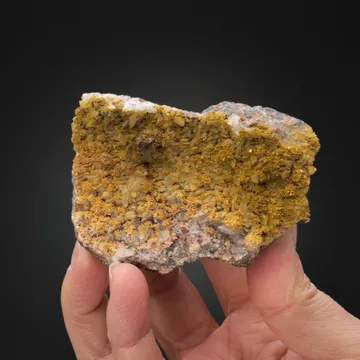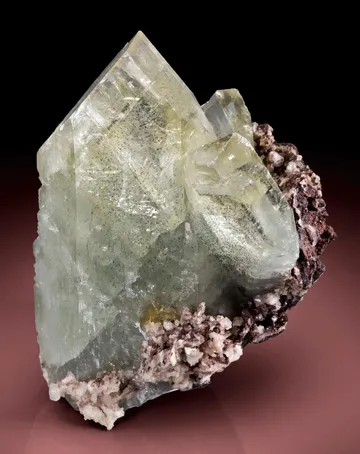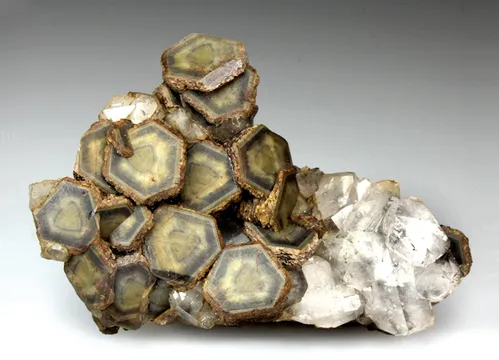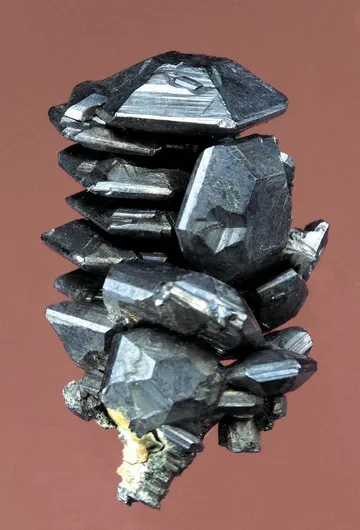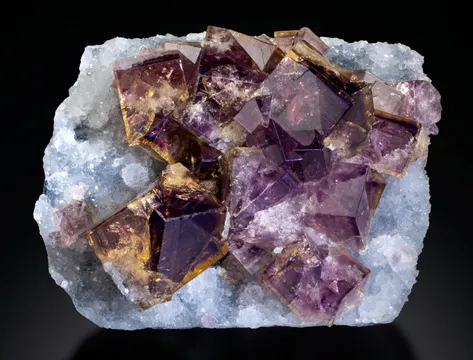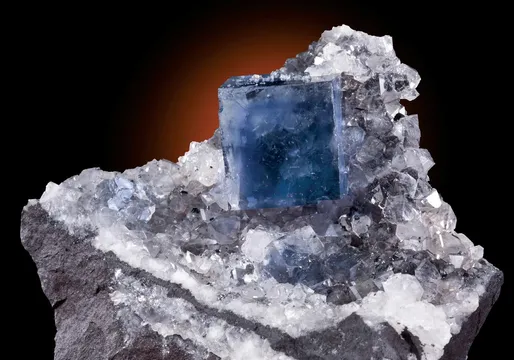
Ladywash Mine, UK - Derbyshire locality famed for distinctive post-war fluorite and calcite specimens with marcasite and sphalerite, prized by collectors.
Key facts
Ladywash Mine stands high above Eyam on the southern edge of Eyam Moor, in the eastern part of the Hucklow Edge vein system of the Derbyshire orefield. To collectors it is one of the great modern Derbyshire specimen mines: not a romantic Blue John cavern, and not one of the old lead-mining showpieces of Matlock, but a deep, hard-working fluorspar mine whose twentieth-century stopes yielded some of the most distinctive English fluorite, calcite, marcasite, and sphalerite specimens of the post-war period.
The setting is classic South Pennine vein mineralization: low-temperature hydrothermal veins, flats, breccias, and associated replacements in Carboniferous limestone, complicated here by the thick Namurian mudstone and grit cover along Hucklow and Eyam Edges. The deposit was first valuable as a lead mine, with galena the ore mineral, but Ladywash became truly important to mineral collectors during its later fluorspar life, when the same old lead-bearing structures were reopened, deepened, connected, and worked on an industrial scale for fluorite.
The best specimens have an unmistakable Ladywash look. Fluorite commonly forms colourless, smoky grey, pale lilac, honey-yellow, or yellow-to-violet cubic groups, often crowded with brassy marcasite or pyrite inclusions and commonly associated with black sphalerite, chalcopyrite, galena, baryte, and later calcite. Fine pieces are not just “Derbyshire fluorite”; they are three-dimensional records of a complicated vein paragenesis, with transparent cubes enclosing sulphides, dark phantoms, later metallic overgrowths, or perched scalenohedral calcite. The finest cabinet specimens can be broad, architectural plates of pale fluorite and calcite; the more intimate pieces reward close inspection with microscopic marcasite, pyrite, chalcopyrite, and rare wulfenite or enargite.
Regional View
Country View
Ladywash is also important historically because it links the Georgian lead-mining world of soughs, meers, and hand-won ore with the mechanized fluorspar industry that supplied steelmaking, chemical production, and Cavendish Mill in the twentieth century. Its surviving chimney and mine buildings are not merely picturesque surface remains; they mark a mine that was repeatedly revived as economics changed, first for lead, then for “spar,” and finally as part of the larger underground system later superseded by Milldam Mine.

Photo: Peter Barr / Geograph
Search for specimens: View all specimens from Ladywash Mine, UK
Ladywash Mine is situated near Eyam, Derbyshire, at about SK 218 775, above the village and within the Hucklow Edge–Eyam Edge vein belt. The mine exploited part of one of the major east-west vein systems of the White Peak, a mineralized fault and fracture zone that can be traced for kilometres from the Tideslow and Great Hucklow area eastwards beneath Hucklow and Eyam Edges. In this part of the orefield the veins are not simple single fissures but connected and en-echelon structures, with near-vertical veins, branch veins, flats, breccias, solution cavities, and replacement bodies developed in the Carboniferous limestones.
The geology is unusually important to understanding the mine. The mineral veins lie mainly within Lower Carboniferous limestone, but along Eyam and Hucklow Edges the limestone is concealed beneath a cover of Namurian mudstone and grit. Early miners followed signs of the buried vein system through this cover, and later workings intersected the ore at substantial depth. In the Glebe–Ladywash underground crosscut, geological memoirs record Eyam Limestones and Monsal Dale Limestone relationships, with the Old Edge Vein and associated structures cutting through the limestone sequence. Workings encountered not only vein fillings but also flat or replacement-style mineralization along favourable beds and cavities adjacent to the main fissures.
The characteristic ore and gangue assemblage is fluorite, baryte, calcite, galena, sphalerite, marcasite, pyrite, chalcopyrite, and related minor species. Galena was the old lead ore; fluorite became the major twentieth-century product; baryte, calcite, sphalerite, and sulphides supplied both gangue and collector interest. In specimen terms, the most celebrated material came from the period when the veins were being worked for fluorspar, especially the mid-twentieth-century operations on the Hucklow Edge and Old Edge vein system. Colourless to grey fluorite with internal marcasite or pyrite, fluorite with black sphalerite, fluorite and baryte banded material, and calcite perched on fluorite are all part of the Ladywash signature.
Mining began in the old lead-mining period. A drainage sough to Old Ladywash was begun in 1714, and the mine itself is recorded as starting in 1740 as the vein was worked from the west. Further drainage came through Stoke Sough, a major engineering undertaking that reached the Ladywash area by the later eighteenth century. The surviving chimney belongs to the Victorian phase, broadly dated to about 1860–1880 or circa 1870, when the Eyam Mining Company was working the mine for lead. By the late nineteenth century, low lead prices and water problems had brought much of this deep lead mining to an end.
The modern life of Ladywash began when the economic value of fluorspar changed the meaning of old waste and old ground. Surface hillocks along Hucklow and Eyam Edges were reworked for spar, and then underground reserves left in the cheeks of the veins became worth pursuing. Blackwell & Sons leased Ladywash in 1920; Ladywash and nearby New Engine Mine were later reopened by Ashover Mines Ltd.; and in the later 1930s the Ladywash shaft was again examined and reopened. A crosscut driven from Glebe Mine reached Old Edge Vein at about 160 m depth within Ladywash, leading to the discovery of a long unworked section of Old Edge Vein that supplied major fluorspar production. Ladywash then became the main haulage shaft, and its shaft diameter was enlarged in 1949.
Glebe Mines Ltd became central to the fluorspar era, and Laporte Minerals acquired Glebe Mines in 1959. Cavendish Mill, opened near Stoney Middleton in 1965, processed ore from Ladywash and related Derbyshire sources, and Ladywash specimens of the 1960s and 1970s are consequently among the best documented modern pieces from the locality. The mine finally closed in March 1979. The closure was not simply because the vein was exhausted; published mining accounts emphasize the limitations of the deep shaft, increasing underground haulage distances as work moved westwards, a one-tonne winding capacity, and the growing unsuitability of in-vein sub-level stoping where weak mudstone roof conditions and incompetent vein material made the method unsafe and uneconomic.
After Ladywash, the same broad mineralized system continued to matter through Milldam Mine, developed farther west with a decline access and a different mining method. The old Ladywash workings were later linked into the Milldam system, and the Ladywash shaft remained relevant for ventilation and emergency access. By the early twenty-first century the original Ladywash site was inactive, with buildings surviving, the shaft gridded and fenced, and a boulder pile on the surface. Collecting today should be regarded as highly restricted: the site is on private land, the shaft and underground workings are dangerous and controlled, and any surface collecting from loose material requires permission. The mine should not be treated as an open collecting locality.
The notable specimen finds were largely production-era and old-stock pieces rather than modern casual finds. Published and dealer-described examples include large display pieces of clear to grey fluorite, yellow-to-violet fluorite, fluorite with marcasite inclusions, sphalerite-rich fluorite groups, calcite on fluorite, banded fluorite-baryte-galena-sphalerite material, and sulphide-rich fluorite specimens carrying chalcopyrite, galena, pyrite, and the rare copper arsenic sulphide enargite. The best pieces are those that preserve sharp, undamaged fluorite cubes with internal sulphide zoning or attractive contrast, well-sited calcite, and enough matrix to show the vein context without overwhelming the crystals.
Fluorite is the defining collector mineral of Ladywash, occurring chiefly as cubic crystals and intergrown cube plates in colourless, pale grey, smoky grey, pale lilac, honey-yellow, and yellow-to-violet material, commonly with internal marcasite, pyrite, or other sulphide inclusions that give the crystals grey phantoms or glittering metallic interiors; documented specimen descriptions include cubes to around 15 mm on some pieces and fine Derbyshire beds reported with cubes reaching about 50 mm, while cabinet specimens may be much larger as groups. The strongest Ladywash fluorites are not necessarily the most saturated in colour: collectors prize transparency, sharp cubic form, internal marcasite or pyrite arranged in attractive zones, contrast with black sphalerite or brassy chalcopyrite, and later calcite placed cleanly on the fluorite rather than obscuring it. Much of the best material belongs to the third quarter of the twentieth century, when Hucklow Edge and Old Edge vein workings were exploited for fluorspar and the mine was producing the classic pale fluorite-sulphide-calcite assemblage for which it is now remembered.
Marcasite at Ladywash is most familiar to collectors as brassy metallic inclusions and tiny crystals in or on fluorite, rather than as large free-standing sprays; Mindat photo associations and specimen descriptions repeatedly link it with fluorite, sphalerite, baryte, and galena, and many “marcasite in fluorite” pieces owe their appeal to the way the sulphide sparkles inside otherwise pale transparent cubes. Under magnification, Ladywash material can be more complex than old labels suggest, with pyrite and marcasite both present on some specimens, so the finest pieces are those where the marcasite is fresh, bright, and compositionally plausible rather than decomposing or ambiguously labelled. Good collector specimens show the marcasite distributed as attractive phantoms or internal flecks, or as sharp metallic accents with fluorite and black sphalerite; ordinary examples are dull, massive, or oxidized, and should be watched for instability if marcasite is abundant.
Ladywash calcite is a major part of the mine’s specimen character, most often seen as later translucent cream to colourless scalenohedral or twinned crystals on fluorite, with classic “dog-tooth” habits and small crystal groups perched on pale fluorite and sulphide-bearing matrix. Documented examples include a double-terminated scalenohedral calcite crystal about 4.2 cm long on small colourless to pale lilac fluorite cubes, pieces with twinned calcite on fluorite and sphalerite, and fluorite masses encrusted by later generations of twinned calcite. Good Ladywash calcite specimens have clean separation between the calcite and the underlying fluorite, undamaged terminations, translucency, and a balanced display; lesser pieces are common where the calcite is bruised, etched, crowded, or simply hides the more diagnostic fluorite-sulphide association beneath.
Sphalerite from Ladywash occurs as black to dark brown lustrous crystals, including twinned crystals on or with fluorite, and the locality is also noted by collectors for red “ruby” sphalerite; it is commonly associated with fluorite and marcasite, and may appear as sharply contrasting dark crystal groups on pale cubic fluorite. Fine sphalerite pieces from Ladywash depend on luster, isolation, and contrast: a few glossy crystals placed along the edge of transparent fluorite cubes can be far more desirable than a heavy, dark sulphide mass. Some specimens also show chalcopyrite and minor galena in the same association, recording the sulphide-rich late stages of the vein; the best old-stock pieces from the 1960s and 1970s combine sharp fluorite, sparkling marcasite or pyrite inclusions, and crisp sphalerite without the abrasion and bruising common on mine-run material.
Other minerals documented from Ladywash include baryte, galena, gypsum, hemimorphite, pyrite, pyrrhotite, smithsonite, wulfenite, chalcopyrite, and the questioned occurrence of hawleyite as bright yellow crusts on sphalerite. The most significant rarity is enargite, identified on a sulphide-rich fluorite specimen from the Hucklow Edge Vein workings; the crystals are tiny, metallic grey-black, and associated with chalcopyrite, galena, pyrite, and sphalerite. Wulfenite is also an important micromount rarity at the mine, usually requiring magnification and careful checking, especially where old labels record only fluorite and baryte. Ladywash is not best understood as a type-locality mine; its importance lies in the quality of its fluorite-calcite-sulphide assemblage and in the rare late-stage or secondary species tucked into that assemblage.
Ladywash specimens are most often encountered as old-stock pieces from the 1960s and 1970s, or as later recycled collection material with older labels. Provenance matters. Specimens collected before the March 1979 closure, especially those with dated Derbyshire labels, Crystal Classics, Tideswell Dale Rockshop, R. Barstow, John Jones, or other recognized British collection histories, carry more confidence and market interest than anonymous pieces simply labelled “Derbyshire.”
The most common authenticity issue is not deliberate fakery but imprecision. Ladywash, Glebe, Old Edge Vein, Hucklow Edge, New Engine, and Milldam are geologically and historically connected, and some specimens from the broader Hucklow Edge–Eyam Edge system have been labelled inconsistently. A specimen simply labelled “Eyam,” “Hucklow Edge,” or “Derbyshire” may or may not be Ladywash. Conversely, modern commercial labels sometimes use the best-known mine name for material from the connected system. For serious cataloguing, retain every old label and avoid “upgrading” uncertain pieces to Ladywash unless the provenance is explicit.
No specific, well-documented class of fabricated or treated Ladywash specimens is established in the sources reviewed. The practical problems are condition and identification. Fluorite corners chip easily, and many Ladywash fluorites show small bruises on cube edges from production handling. Calcite terminations are vulnerable, particularly on scalenohedral and twinned crystals. Marcasite-rich specimens should be kept dry and stable; although many Ladywash pieces remain sound, any marcasite with dullness, powdering, sulphurous smell, or active oxidation deserves isolation and careful humidity control.
Identification of metallic inclusions is worth caution. Old labels may call all brassy inclusions “marcasite,” but some specimens contain both marcasite and pyrite, and chalcopyrite may also be present as brassy sphenoidal crystals on fluorite surfaces. Yellow coatings on sphalerite should not automatically be catalogued as greenockite or hawleyite without analysis; the documented Ladywash hawleyite occurrence is questioned, and “bright yellow cadmium sulphide crust” is a safer descriptive note unless confirmed.
Good Ladywash fluorite remains obtainable on the market, but genuinely fine examples are much scarcer than the number of modest included fluorites might suggest. Large undamaged plates, pieces with strong colour zoning, clean yellow-to-violet contrast, sharp sphalerite, fresh marcasite inclusions, or well-positioned calcite command a premium. Wulfenite, enargite, and other rarities are specialist micromount or analytical material rather than display-specimen minerals, and they should be bought for documentation as much as aesthetics.
Ladywash is a mine of second lives. Its first story belongs to the old lead miners, working eastward under Eyam Moor where the vein vanished beneath mudstone and grit. A drainage sough was begun to Old Ladywash in 1714, and by 1740 the mine itself was being worked from the west. These were not shallow show workings in exposed limestone. Along Hucklow and Eyam Edges, miners had to understand hidden ground: the main vein lay concealed beneath thick cover, and the old men traced it by “symptoms” in the mudstone, by iron-stained calcite veinlets, fault breccias, and the geometry of the edge itself.
The twentieth-century revival is almost cinematic. By the early 1900s, the mineral once discarded as gangue had become valuable. Fluorspar hillocks along the edge were reworked, then the old underground ground was tried again. In 1937, W. Braithwaite, the Glebe Mines agent, explored and reopened Ladywash Shaft for English Lead Mines Exploration Ltd. The gamble was rewarded when a crosscut from Glebe reached Old Edge Vein at about 160 m depth and almost immediately found an unworked section of vein about 760 m long. That single concealed length of Old Edge Vein provided the bulk of production until 1948 and transformed Ladywash into the main haulage shaft. In 1949, the shaft was enlarged, giving the old lead mine a modern industrial role.
Collectors often remember mines by specimens, but Ladywash was remembered by machinery as well. The surviving accounts of the closed mine describe a 721-foot shaft, a winding house, workshops, battery charging areas, flooded lower levels, winding gear and controls, and the shaft cage eventually submerged in water. One underground account describes the base of the shaft as almost impossible to photograph without getting soaked. Another surface visitor heard roaring water far below through the grated shaft. That sense of depth is part of the Ladywash experience: pale fluorite and calcite now sit in cabinets, but they came out of a wet, noisy, mechanically constrained mine whose winding capacity was only about one tonne per wind.
The closure in 1979 had a human scale. In February of that year, management called the workforce to the Cavendish Mill offices and told them Ladywash would close. The explanation was not simply that the spar was gone. World fluorspar prices had fallen, costs had risen, and safety investment had become more urgent. Forty-one Ladywash miners took voluntary redundancy, while another 24 were redeployed to Laporte’s sister mine at Sallet Hole. The mine was placed on care and maintenance in March 1979, and by March 1986 the headgear was gone, the shaft capped and fenced, the track lifted, and the twin tipplers removed.
The ground itself continued to tell stories after mining ceased. On the Hucklow Edge system, old in-vein stopes, shale gates, weak mudstone roofs, and collapse structures produced dramatic surface failures. One account of a collapse near the old Miners’ Engine Mine describes the floor of an upper level giving way into an open worked-out stope, followed almost immediately by failure of the mudstone roof and its support rings. The collapse propagated upward through the entire overlying sequence in seconds, blasted air through the workings, filled the empty stope with debris, and opened a crater at surface. Fortunately, the only thing swallowed was a single tree. That detail is unforgettable: an entire hidden mining history announcing itself by taking one tree down into the vein.
Modern underground explorers have described Ladywash as part of a large connected system with Glebe and related workings. Their accounts are not collecting guides and should not be treated as access advice, but they preserve the physical atmosphere of the place after closure: haulage levels with carts, a substation, winch, engineers’ workshop, the base of the deep shaft, and even an old telephone. One photographer, trying to bring cameras and tripods through wet caving access, wrapped the tripods in towels, only to find the towels had soaked up water and turned the load into “Thor’s hammer.” It is a small comic detail, but it captures the same truth as the specimens do: Ladywash rewards patience, punishes carelessness, and is much larger underground than the quiet chimney above Eyam suggests.
Steve A. Rust, “Enargite from Ladywash Mine, Eyam, Derbyshire,” Journal of the Russell Society, 22, 6–10, 2019 — The key paper documenting enargite at Ladywash, including crystals to about 0.75 mm on a fluorite specimen from the Hucklow Edge Vein workings, with chalcopyrite, galena, pyrite, and sphalerite.
Trevor D. Ford, W. A. S. Sarjeant, and M. E. Smith, “The minerals of the Peak District of Derbyshire,” UK Journal of Mines and Minerals, 13, 16–55, 1993 — The standard published mineralogical reference repeatedly cited for Ladywash species including fluorite, calcite, marcasite, sphalerite, smithsonite, pyrrhotite, hemimorphite, gypsum, chalcopyrite, and wulfenite.
John Hunter, “Old mines and new sinkholes along the Hucklow Edge vein, Derbyshire,” Mercian Geologist, 18(4), 213–226, 2015 — Essential geological and mining-history treatment of the Hucklow Edge vein system, Ladywash’s twentieth-century reopening, the Old Edge Vein discovery, closure reasons, and collapse hazards.
E. Colman, “The last 50 years of mineral exploration in Britain,” Mercian Geologist, 17(4), 2011 — Gives broader fluorspar-industry context, including Ladywash production by Laporte Minerals, Cavendish Mill’s 1965 opening, and the peak of British fluorspar production in the 1970s.
J. V. Bramley, “Fluorspar Mining in Derbyshire,” Mining History, 11(3), 153–158, 1991 — A core mining-history reference for the Derbyshire fluorspar industry and the Ladywash closure context, cited in later geological work.
British Geological Survey, “Chapel en le Frith. Explanation of 1-inch geological sheet 99, New Series” — Provides geological detail on the Glebe–Ladywash underground crosscut, limestone stratigraphy, Old Edge Vein relationships, and nearby borehole records.
UK Journal of Mines and Minerals index, issues 11–20 — Useful index confirming Ladywash entries in UKJMM issue 13 for calcite, chalcopyrite, gypsum, hemimorphite, marcasite, pyrrhotite, smithsonite, sphalerite, and related Derbyshire species.
ASG4660 Fluorite, Ladywash Mine, Derbyshire, UK — Crystal Classics — Dealer specimen video showing a Ladywash fluorite specimen in motion, useful for judging luster, transparency, and display geometry.
Fluorite from Ladywash Mine, Eyam, Derbyshire, England, UK — Fabre Minerals — Specimen video of a yellow-to-violet Ladywash fluorite, with dimensions and descriptive dealer context.
TUC4271 Calcite on Fluorite, Ladywash Mine, Derbyshire — Crystal Classics — Video of a calcite-on-fluorite specimen, useful for understanding the three-dimensional relationship between late calcite and fluorite matrix.
Mindat — Ladywash Mine, Eyam, Derbyshire, England, UK — Best concise mineral list, coordinates, occurrence records, and specimen-photo hub for the locality.
Mindat — Fluorite from Ladywash Mine — Fluorite occurrence page with associated minerals and photo-data associations.
Mindat — Calcite from Ladywash Mine — Calcite occurrence page documenting Ladywash calcite and its strong association with fluorite.
Mindat — Marcasite from Ladywash Mine — Marcasite occurrence page, useful for associations with fluorite, sphalerite, baryte, and galena.
Mindat — Sphalerite from Ladywash Mine — Sphalerite occurrence page for the locality’s black to dark sulphide crystals and their fluorite-rich associations.
Derbyshire Historic Environment Record — Ladywash Mine, Sir William Hill Road, Eyam — Heritage record for the surviving chimney, buildings, shaft, grid reference, and historical notes.
MineArchive — Ladywash Mine — Concise modern summary of the mine’s lead and fluorspar history, geology, workings, closure, and surviving surface feature.
John Hunter, “Old mines and new sinkholes along the Hucklow Edge vein, Derbyshire” — The most useful geological and historical paper for understanding the vein system and why Ladywash developed as it did.
Derbyshire County Council — Vein minerals background paper — Planning and industry context for fluorspar, barytes, and associated vein minerals in Derbyshire.
Mines and minerals in Derbyshire — Ladywash Mine — Field-oriented account with surface observations, boulder-pile mineral notes, and a useful collector’s perspective.
Steetley Minerals — Derbyshire locality notes — Dealer/collector notes highlighting Ladywash fluorite, sphalerite, calcite, wulfenite, marcasite, chalcopyrite, and banded fluorite-baryte material.
Derelict Places — Ladywash Mine, Derbyshire, April 2024 — Surface-photo report with historical notes on closure, redundancy, surviving buildings, and the fenced shaft.
28DaysLater — Ladywash Spar Mine, Eyam, Derbyshire, July 2022 — Underground-photo report documenting remaining industrial features and post-closure mine conditions.
Geograph — Chimney of Ladywash Mine, Peter Barr — Reusable photograph of the surviving Ladywash chimney and landscape setting above Eyam.