La Morita Mine, Mexico — a defining wulfenite locality renowned for glassy orange tabular crystals on barite with mimetite accents, prized by collectors.
Key facts
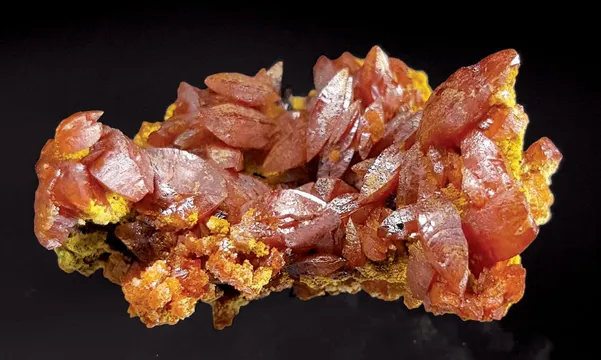
La Morita Mine has become one of the defining modern Mexican wulfenite localities: a small hydrothermal barite vein in Ascención Municipality, Chihuahua, with base-metal mineralization that was mined for silver, lead, zinc, and barite before it startled the collector market with superb wulfenite–mimetite combinations beginning in the late 2010s. The best pieces are instantly recognizable: sharp, square to bladed tabular wulfenite crystals in yellow, butterscotch, caramel-orange, and richer orange tones, commonly perched on pale barite or quartzitic matrix and dusted or carpeted with lemon-yellow to yellow-green mimetite in botryoidal balls and spheroidal aggregates. Unlike older Mexican classics whose reputation was built over decades, La Morita arrived almost all at once, with specimens that looked mature from the beginning: lustrous, airy, well-composed, and often surprisingly pristine for such a fragile species.
Regional View
Country View
For collectors, the locality matters because it gave Mexico a fresh wulfenite style distinct from Ojuela, Los Lamentos, San Francisco, and San Pedro Corralitos. La Morita crystals tend to be glassy, thin, and intensely lustrous, with beveled or pyramidal edge modifications that make even small thumbnails read as sculptural. On better specimens, the mimetite is not a background mineral but part of the composition: it forms warm yellow cushions beneath the wulfenite, tiny globules on crystal faces, or contrasting balls that give the plates their characteristic honey-and-citrus palette. Phosphohedyphane, documented from the mine by analysis, can appear as a pale layer in association with the wulfenite and mimetite, adding an additional rarity to the best combinations.
Search for specimens: View all specimens from La Morita Mine, Mexico
La Morita Mine, also recorded as Mina La Morita, is in Ascención Municipality in northern Chihuahua, Mexico, near the Ejido El Sabinal area. The locality is an active inclined mine developed on a hydrothermal barite vein with base-metal mineralization. Its documented ore and gangue suite reflects that setting: barite is fundamental to the mine, while galena and sphalerite provided the lead and zinc sources, and secondary oxidation-zone minerals such as wulfenite, mimetite, cerussite, hemimorphite, smithsonite, and phosphohedyphane record later supergene alteration of the primary ore.
The deposit is best understood as a barite-rich hydrothermal vein carrying polymetallic silver–lead–zinc mineralization, rather than as a classic large carbonate-replacement district locality. Barite is abundant enough to have been a mined commodity, and dealer and locality records repeatedly identify barite matrix as the typical support for wulfenite and mimetite specimens. Quartz and calcite also occur, and some notable high-end pieces are described on quartzitic matrix, with wulfenite plates and mimetite aggregates developed over pale layers or coatings.
The mine has been associated commercially with CAMEX, S.A. de C.V. and Camex Mining Company S.A. de C.V. Government and press accounts in Chihuahua list the operation among the state’s silver, lead, zinc, and barite mines, with published production figures varying by year and source. A Chihuahua economic-development document for the 2010–2016 period described Camex Mining operating La Morita through a ramp at about 90 tonnes per day, processed in a small plant. Later reporting, citing the Servicio Geológico Mexicano’s 2020 state mining panorama, gave the concessionaire as Camex S.A. de C.V. and cited average production of about 100 tonnes per day of silver, lead, zinc, and barite. A 2025 local report described Camex Mining Company as seeking municipal support for an expansion of La Morita’s activities.
As a collector locality, La Morita’s importance begins in earnest with the late-2018 to 2019 wulfenite–mimetite production. Earlier material exists: at least one collector account describes a La Morita specimen mounted and dated January 2, 1972, but the mine was not broadly known to the international specimen market until the recent pockets appeared. By the Denver and Tucson show circuits of 2019 and 2020, flats of new wulfenite were being offered, and the locality’s name quickly became familiar to thumbnail, miniature, and cabinet collectors.
The most important finds produced thin, lustrous wulfenite crystals in isolated groups and clusters, commonly with yellow botryoidal mimetite. Published auction descriptions document named or numbered pockets, including a “first Wulfenite pocket” and a “Pocket #5,” the latter yielding a large, museum-level wulfenite–mimetite specimen with exceptionally intact crystals. Museum records and auction descriptions also document much larger La Morita wulfenites than the typical thumbnail-to-miniature material: slabs and matrix specimens with crystals in the several-centimeter range, including major museum examples with individual wulfenite crystals reported at 8.6 cm and 9.8 cm.
Collecting access should be considered closed without explicit permission from the operator and lawful rights holders. La Morita is an active mining property, not a casual collecting site. Serious collectors should acquire specimens through established dealers, auction records, or direct provenance to the people who handled the modern specimen production, rather than attempting a visit.
La Morita wulfenite is most prized as sharp, lustrous, tabular to platy crystals in yellow, butterscotch, caramel, orange-yellow, and orange colors, usually perched on barite or quartzitic matrix and commonly associated with yellow to yellow-green mimetite. Many crystals show beveled edges, pyramidal modifications, stepped or slightly composite growth, and a glossy “wet” or vitreous luster that separates the best specimens from ordinary plates. Thumbnail and miniature pieces often carry crystals around 1–2 cm across, while exceptional cabinet and museum specimens document far larger crystals, including very large thin plates in the 8–10 cm class. The strongest pieces have isolated, undamaged crystals rising cleanly from contrasting matrix or mimetite-rich surfaces; lesser examples are crowded, contacted, chipped along the razor-thin edges, or have flat, unaesthetic crystal placement.
La Morita mimetite is the essential companion to the wulfenite and is usually seen as creamy yellow, lemon-yellow, orange-yellow, or pale yellow-green botryoidal to spheroidal aggregates rather than as large isolated prismatic crystals. It may form small balls scattered over barite, cushions beneath wulfenite plates, coatings around crystal groups, or globules perched directly on wulfenite faces. A few photographed examples show more unusual dumbbell-like or wheat-sheaf habits at the millimeter scale, with whitish puffy alteration or overgrowths at the tips. Good La Morita mimetite specimens are those in which the mimetite improves the composition—bright color, rounded texture, and contrast under the wulfenite—rather than merely appearing as sparse yellow specks on a damaged or visually flat wulfenite plate.
Other documented minerals from La Morita include barite, calcite, cerussite, galena, hemimorphite, phosphohedyphane, quartz, smithsonite, and sphalerite. Barite is the key gangue and commodity mineral, and it is also the most common matrix for display pieces. Galena and sphalerite represent the primary lead–zinc ore system that supplied the chemistry for later secondary minerals. Cerussite, hemimorphite, and smithsonite fit the oxidized lead–zinc environment, while phosphohedyphane is the notable rarity in the assemblage: a lead-calcium phosphate-chloride member of the apatite supergroup documented analytically from La Morita and reported in association with top wulfenite–mimetite pieces.
The principal authentication issue for La Morita is locality precision, not a well-documented problem of artificial or treated specimens. The most important label caution is the recurring “Sierra Mojina District” attribution. A Friends of Minerals Forum exchange in 2020 specifically challenged this wording, and Peter Megaw replied that La Morita is indeed the source of the wulfenite but that it is in Ascención Municipality and that the Mojina attribution is wrong. Serious labels should therefore read La Morita Mine, Ascención Municipality, Chihuahua, Mexico; older or dealer labels mentioning “Sierra Mojina” should be kept as provenance but corrected in catalog records.
Condition is the major value divider. La Morita wulfenite crystals are thin, sharp-edged, and vulnerable to edge chips, corner bruises, cleaves, and lost peripheral crystals. Even visually fine pieces may have tiny edge nicks that only reveal themselves under raking light or magnification. Examine the crystal rims, bevels, and exposed front faces carefully; La Morita crystals can be so lustrous that small chips flash just like crystal faces until viewed from several angles. Top-tier pieces are scarce precisely because broad plates with many intact blades are difficult to extract and trim without damage.
Matrix and association matter strongly. Loose or matrix-free clusters exist and can be attractive, but the classic La Morita look is wulfenite with mimetite on barite or pale quartzitic matrix. The best combinations show depth: wulfenite elevated above yellow mimetite botryoids, or orange-yellow plates on a clean pale base. Pieces with phosphohedyphane association deserve extra attention, especially when the provenance is clear and the identification is credible.
Market availability remains better than for many old Mexican classics because the finds are recent, but fine pieces have already moved into major collections, museum holdings, and high-end auction records. Small thumbnails and miniatures remain obtainable, especially with minor damage or less saturated color. Superb, undamaged cabinet specimens with aesthetic crystal placement, strong mimetite coverage, and large wulfenite plates are genuinely rare and have commanded serious auction prices.
La Morita has also been caught up in non-mineralogical ownership and investment claims connected to the Aras Business Group controversy in Chihuahua. For collectors, the practical lesson is simple: do not treat promotional ownership claims as locality provenance. Specimen provenance should rest on dealer records, collector history, labels, mining-source information, and, where relevant, analytical confirmation—not on investment marketing.
La Morita entered the collector world with the feel of a show-floor whisper that suddenly became a roar. At the 2019 Denver Show, new wulfenites from the mine were already drawing attention. Michael Shaw wrote that there was a plentiful supply and that prices were “all over the place,” the sort of early-market moment when sharp-eyed collectors walk the aisles twice before buying. He was told the mine was not far from the famous San Pedro Corralitos mimetite locality, which helped explain why the yellow mimetite on the La Morita pieces looked so familiar to Mexican-suite specialists. At that stage the mine was still described in practical terms: originally exploited for lead and silver, and then working barite for drilling mud. The wulfenites were the surprise.
A Tucson account from the Old Pueblo Show in 2020 catches the locality at street level. The collector-writer wandered into a small motel room that had not been on his planned route. The room was sparse, occupied by two young men from North Carolina who were selling at their first show after spending the previous month stopping at localities and collecting material on the way to spring and summer shows along the East Coast. An abandoned seller space had given them a “good deal” on the lease, and the writer became their first customer. What they brought out was a flat of La Morita wulfenite: clusters of lustrous orange plates on barite, with yellow botryoidal mimetite balls perched among them. It is one of those modest show stories collectors recognize instantly—the locality’s future reputation sitting unannounced in a flat in a motel room.
The named-pocket history gives the mine a sharper edge. A Heritage Auctions specimen from the Bruce Carter collection was described as coming from the first wulfenite pocket at the mine. Carter’s note is a compact oral history of the find: Daniel Ulibarri first showed him samples at the Seattle Mineral Show in 2018, so Carter was ready when he saw the right piece the following year. That specimen carried numerous pristine orange tabular wulfenites across translucent orange-yellow mimetite botryoids, all over a thin layer of phosphohedyphane, with the largest wulfenite crystals measuring to 1.7 cm across. In May 2026 it sold for $32,500, a striking result for a locality whose specimen reputation was less than a decade old.
Pocket #5 added another benchmark. A 27.2 x 19.7 x 11.0 cm wulfenite–mimetite specimen, ex Thomas Everitt collection, was described as the finest example excavated from that pocket. The description emphasized how improbable its condition was: a broad specimen covered with thin, sharp wulfenite crystals, yet with only one small area of notable chipping and no repairs or restorations. It sold at Heritage in March 2023 for $13,750. For La Morita, that piece helped establish that the mine was not merely producing attractive thumbnails; it could produce museum-scale plates.
The mim Museum records show just how far that scale could go. One La Morita specimen in the museum, MIM number 2299, is a 35 x 22 x 12 cm quartzite slab with wulfenite crystals up to 4 mm thick, some small and others very large for the species, dotted with yellow mimetite balls. Its mass is recorded as 6700 g, and the main crystal as 8.6 cm. Another, MIM number 2300, is smaller overall at 14 x 9 x 10.5 cm but carries a 9.8 cm yellow-amber tabular wulfenite only 3 mm thick, with yellow mimetite balls on the wulfenite and a pink coating on the reverse faces. The museum description calls it one of the largest known crystals of the species. Whether one reads that claim conservatively or not, the specimen records make clear that La Morita produced wulfenite far beyond the ordinary show-flat scale.
The locality even acquired a public lecture trail. In November 2022, the Mineralogical Society of Arizona’s Phoenix Heritage Gem & Mineral Show scheduled Daniel Ulibarri as keynote speaker for a dinner program titled “La Morita Wulfenite.” The evening was a classic club-and-show affair—cash bar at 5:00, Italian dinner at 6:00, special program at 7:30, live and silent auctions afterward—but the subject was very current: a modern Mexican wulfenite project still being sorted into collector history almost in real time.
Away from the specimen tables, the mine’s name surfaced in a much rougher Chihuahua news story. During the Aras Business Group investment scandal, La Morita was repeatedly invoked in claims about mining-backed repayment, ownership, and production. State and press reports pushed back: the concessionaire was Camex, not Aras, and authorities and witnesses described the mine as part of the public confusion around the investment scheme. One report cited a geologist witness connected to the plant, and others described workers, disputed contracts, and claims of promised mineral revenue. For mineral collectors, the episode is not part of the beauty of the specimens, but it is part of the mine’s modern paper trail—a reminder that locality names can be pulled into commercial narratives far outside mineralogy.