Guerrero, Mexico — a premier ore province and the source of the famed Guerrero amethyst, with pocket amethyst quartz, phantoms, and strong collector appeal.
Key facts
Guerrero matters to mineral collectors for two different but intertwined reasons: it is one of Mexico’s great ore provinces, and it is the source of one of the most recognizable amethysts in the world. The collector locality behind most “Guerrero amethyst” labels is the Amatitlán area in Eduardo Neri Municipality, north-central Guerrero, in the mountains south of the Río Balsas. There the crystals were not mined from basalt geodes, as in Brazil or Uruguay, but from small veins, pods, and pocket zones in a contact-metasomatic district related to the Guerrero Gold Belt. Around the larger region, Cretaceous carbonate and calcareous sedimentary rocks were intruded by granodioritic to tonalitic bodies, producing skarn systems rich in garnet, pyroxene, magnetite, specular hematite, sulfides, gold, silver, copper, and related alteration. The amethyst pockets occupy the collector-facing edge of that geological story: localized open spaces, often shallow and erratic, that yielded sculptural quartz rather than industrial ore.
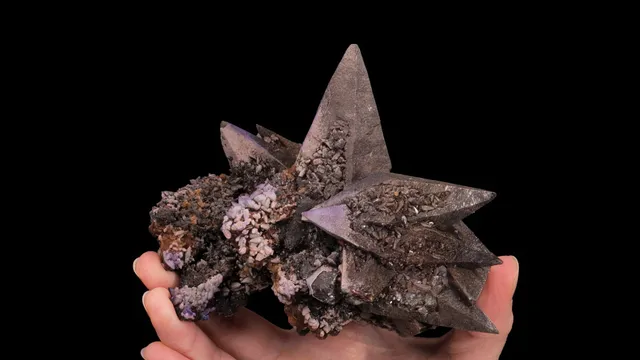
The classic assemblage is simple but visually unforgettable: amethystine quartz, colorless to milky quartz, calcite, manganese oxides, and weathered carbonate or silicified matrix. The best Guerrero amethyst has thick, tapered, glassy crystals with wine-purple, reddish-purple, or grape-purple cores suspended inside paler quartz. Many show strong phantoms, smoky zones, frosted or colorless tips, and stepped growth faces. Fine groups spread from a common base like a small purple candelabrum; fine singles may show a “bowtie” waist, doubly terminated form, or a deep internal chevron of color. They are immediately different from the slender lavender sprays of Veracruz and from the dense geode linings of South America.
Regional View
Country View
Historically, Guerrero amethyst bridges the gem and specimen trades. Early material was valued largely as cutting rough, and important crystals were broken apart to recover clean purple pieces for faceting. Only later did collectors fully prize the intact groups, their pale terminations, and the internal architecture that makes the locality so diagnostic. By the late twentieth century, pieces from Amatitlán, Margarita, Valenciana, La Sorpresa, Palo Verde, and related workings had become Mexican classics, with the best examples entering major private collections and museum holdings.
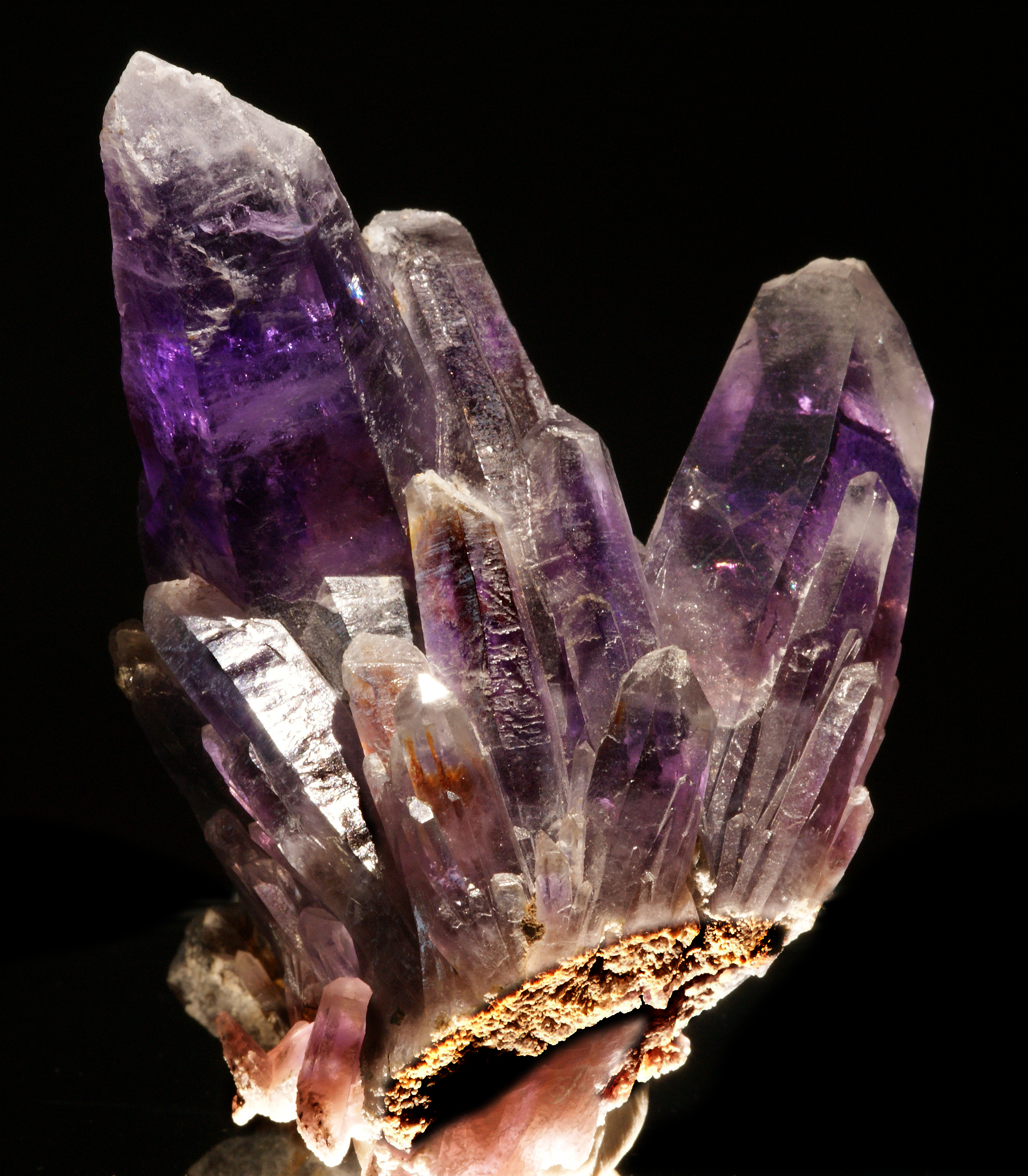
Photo: Wikimedia Commons
Guerrero as a state is broader than the amethyst district. Taxco, one of Mexico’s historic silver camps, contributes proustite, pyrargyrite, native silver, pyrite, fluorite, sphalerite, calcite, baryte, ilvaite, rhodochrosite, and smoky to amethystine quartz. Huitzuco is the type locality for livingstonite, a rare mercury-antimony sulfosalt. Together, Amatitlán, Taxco, Huitzuco, and the modern Guerrero Gold Belt make the state unusually rich in both specimen lore and metallogenic importance.
Search for specimens: View all specimens from Guerrero, Mexico
For collectors, “Guerrero, Mexico” most often means Amatitlán amethyst. The productive district is best understood not as one tidy mine but as a group of veins and pocket diggings spread over rugged terrain north of the village of Amatitlán and south of the Balsas River. Older specimen labels may read simply “Guerrero,” “Amatitlán,” “Iguala,” “Zumpango del Río,” or “Río Balsas district.” More precise labels may cite Margarita, Margareta, Valenciana, La Sorpresa, Palo Verde, Rayas, Santa Rita, Altamirano, El Rodeo, or the Amatitlán Mine, but mine-level attributions should be trusted only when supported by old labels, invoices, collection history, or a specimen that is clearly from a documented find.
The deposit type is small-scale quartz-vein and pocket mineralization superimposed on a larger skarn-and-intrusive setting. The regional Guerrero Gold Belt developed where Mesozoic carbonate-rich rocks of the Morelos platform and associated sedimentary formations were intruded by Laramide to Paleocene granodioritic and tonalitic stocks, sills, and dikes. Around the major gold deposits, skarn mineralization is developed along contacts between intrusive rocks and carbonate rocks; the ore assemblages include pyroxene, garnet, magnetite, sulfides, gold, silver, and copper. The amethyst pockets are not the ore bodies themselves in the modern mining sense. They are discontinuous quartz-rich openings along veins, faults, altered contacts, and decomposed zones in the same mineralized highlands.
The Amatitlán workings were shallow, opportunistic, and pocket-driven. Miners opened trenches along quartz veins, followed color or open space, and stopped when the vein pinched out, the ground hardened, or the pocket was exhausted. Some workings reached only several meters; others were deeper small mines or cuts. The best pockets released loose crystals and groups from sand, clay, decomposed rock, or weathered vein material. This mining style explains why Guerrero amethyst can show little matrix, why loose singles are common, and why many old pieces carry only regional locality labels.
The discovery story begins around 1930 with Donato Retana, a farmer near Amatitlán and Tenantla who found white and purple quartz while working cornfields. Querétaro’s lapidary trade soon became important because the crystals could be cut into attractive amethyst gems. In those early years, specimen preservation was secondary to gem value: large crystals were routinely broken for clean rough. Later, the Ontiveros family and other miners worked claims including La Cuna, Margarita, and Palo Verde, gradually establishing the mineralogical reputation of the district.
Specimen production appears to have been especially important from the mid-twentieth century through the 1970s and 1980s, with later pockets and rediscoveries adding important material in the 1990s. Margarita is associated with some of the finest specimen groups; Palo Verde was remembered as a major early bonanza, including a large pod-like pocket in decomposed granitic rock; La Sorpresa became well known in the 1997–1998 period when mining by people associated with Mike New, Wayne Thompson, and Ruben Avila recovered fine collector pieces from a hillside exposure of veins overlooking a tributary of the Río Balsas. One celebrated 12.2 cm Guerrero amethyst group from the Margarita/Santa Margarita area, collected in 1994, became an icon specimen, published on the cover of the 2004 Mexico issue of The Mineralogical Record and later recorded in the Smale, Fuss, and Wilensky collecting chain.
Taxco gives Guerrero a second, very different collector identity. Its polymetallic silver district, active since the colonial period and historically tied to veins and replacement bodies, has produced specimens from mines including Remedios, Guerrero I, San Antonio, El Solar, San Lorenzo, and related workings. Collectors know Taxco for pyrargyrite and proustite on quartz, native silver, rhodochrosite on quartz, ilvaite from Remedios, fluorite, sphalerite, pyrite, calcite, baryte, and mixed carbonate-sulfide pieces. The Taxco suite should not be confused with Amatitlán amethyst even when both involve quartz and purple tones; the geology, habit, associations, and label traditions are distinct.
Huitzuco, north of Taxco, is important scientifically rather than as a major cabinet-specimen source. It is the type locality for livingstonite, HgSb4S8, described from low-temperature hydrothermal mercury-antimony veins. Good Huitzuco livingstonite specimens show metallic lead-gray prismatic to columnar crystals, commonly with stibnite, and are prized by systematic collectors because of the type-locality status.
Collecting access today is not casual. The Amatitlán amethyst diggings lie on claimed, private, or concessioned ground in remote terrain, and the broader state has serious security concerns. Current field visits require permission, local knowledge, and careful attention to travel advisories, land status, and mining rights. For most collectors, the responsible route is to acquire Guerrero material through reputable dealers, old collections, museum deaccession channels where applicable, or documented auctions rather than attempting independent field collecting.
Guerrero amethyst from the Amatitlán district is prized for stout, tapering crystals that carry their richest purple in the body of the crystal rather than only at the tips. The best pieces show saturated reddish-purple to grape-purple cores, smoky or milky outer zones, sharp internal phantoms, glassy faces, and pale or colorless terminations; singles commonly fall in the miniature to small-cabinet range, while cabinet groups with crystals over 10 cm are much scarcer and top examples are world-class. Classic associations are quartz, calcite, manganese-oxide films, and weathered carbonate or silicified matrix, with named finds from Margarita, Valenciana, La Sorpresa, Palo Verde, and related Amatitlán workings. Good Guerrero amethyst is not merely dark; it has depth, transparency, intact tips, balanced architecture, and that unmistakable “purple heart in clear quartz” look that separates fine Amatitlán specimens from ordinary damaged clusters or vague purple quartz.
Quartz from Guerrero is most famous as amethyst, but the same specimens often include colorless, milky, smoky, or faintly amethystine quartz overgrowths that are essential to the locality’s identity. At Amatitlán, the quartz habit tends toward thick prisms with tapered or slightly barrel-shaped outlines, strong horizontal striations, stepped faces, color zoning, and phantoms; crystals may form divergent clusters, groups on sparse matrix, or loose singles released from decomposed pocket fill. In the Taxco district, quartz plays a different role as a gangue and display matrix for rhodochrosite, pyrargyrite, proustite, sphalerite, calcite, pyrite, fluorite, and native silver. The best Guerrero quartz specimens are those in which the clear-to-white quartz growth is not just background but part of the aesthetic: transparent windows into amethyst cores at Amatitlán, or bright, lustrous quartz matrices carrying contrasting ore minerals at Taxco.
Beyond amethyst and quartz, Guerrero has an unusually varied documented mineral suite. Huitzuco is the type locality for livingstonite, HgSb4S8, a rare mercury-antimony sulfosalt that occurs as lead-gray metallic prisms and columnar aggregates in low-temperature hydrothermal veins, commonly associated with stibnite. Taxco contributes a classic Mexican silver-polymetallic assemblage: proustite, pyrargyrite, native silver, acanthite, galena, sphalerite, pyrite, fluorite, baryte, calcite, dolomite, siderite, rhodochrosite, ilvaite, magnetite, and numerous alteration minerals. Remedios Mine specimens are especially valued for pink rhodochrosite on quartz or ilvaite, lustrous black ilvaite prisms, sphalerite with fluorite and quartz, and calcite-pyrite-quartz combinations. Guerrero’s skarn and gold-belt deposits add garnet, pyroxene, magnetite, hematite, epidote, amphibole, chlorite, calcite, and sulfides to the state’s broader mineralogical character, though many of those are more important geologically than as fine collector specimens.
Guerrero amethyst is heavily dependent on condition and provenance. Many crystals have pale, colorless, or frosty terminations, so chips, bruising, and polished-looking impact marks are conspicuous. Inspect the tips, prism edges, and the bases of clusters under magnification. Missing companion crystals, repaired contacts, glued reattachments, and reconstructed groups are all practical concerns. Repairs are not automatically unacceptable on classic old specimens, but they must be disclosed and priced into the piece.
The most common mislabelling issue is imprecision. “Guerrero” may be true but vague; “Amatitlán” is usually the safest refined locality for classic purple-core quartz if no mine name is documented. Named-mine labels such as Margarita, Valenciana, La Sorpresa, Palo Verde, or El Rodeo deserve more scrutiny, not less, because precise names can add value. Unless a specimen came with a strong old label, invoice, or collection history, over-specific mine names should be treated cautiously.
Guerrero amethyst is also sometimes confused with Veracruz amethyst. Veracruz crystals are typically more slender, often lavender, and commonly show color concentrated nearer the terminations. Guerrero crystals tend to be thicker and more tapered, with stronger central purple phantoms and paler caps. Brazilian and Uruguayan geode amethyst, dyed quartz, and broken geode fragments should not resemble proper Amatitlán material in form or growth style.
A specific treatment warning exists for amethyst attributed uncertainly to Guerrero: a documented experimental specimen had broken terminations hydrothermally “re-healed” in an autoclave, regrowing clear quartz over damaged amethyst. That example was not presented as a deceptive commercial fake, but it demonstrates the risk. On suspect pieces, look for abrupt changes in surface texture, unnatural perfection of clear tips, interrupted striations, odd secondary faces, or terminations that do not match the wear, luster, and growth history of the rest of the crystal.
The principal treatment concern for Guerrero specimen amethyst is not routine heating or dyeing; it is repair, assembly, reattachment, synthetic overgrowth, and misleading locality attribution. Heating can alter amethyst color in quartz generally, and synthetic amethyst is known in the gem trade, but collector-grade Guerrero specimens are bought for intact natural crystal form, internal zoning, and locality character. A specimen that looks too cleanly “completed” at the tips, or too conveniently assembled as a fan of loose crystals, deserves careful examination.
Taxco material has its own authenticity problem: fake “silver” crystals attributed to Taxco have been documented in the mineral literature and were widely distributed. For Taxco native silver, proustite, pyrargyrite, and related silver minerals, buyers should pay attention to matrix consistency, crystal attachment, old labels, tarnish pattern, and whether the association is known from the district. Wire or crystal silver on quartz or pyrite should be approached with healthy skepticism unless provenance is strong.
Livingstonite from Huitzuco deserves normal toxic-mineral handling precautions. It contains mercury, antimony, and sulfur; specimens should not be cut, ground, cleaned aggressively, or handled around food. Store pieces boxed and labelled, wash hands after handling, and keep fragments or dusty matrix away from children and pets.
Market availability is uneven. Lesser Guerrero amethyst still appears in dealer stock and online sales, often as small clusters, single crystals, or pieces with damage. Fine, undamaged, saturated, well-composed Amatitlán groups are much scarcer and can move into serious quartz-collection prices. The spread is wide: modest damaged or pale examples may be accessible, while elite groups with strong phantoms, rich color, fine architecture, named locality history, and old provenance are increasingly treated as Mexican classics.
The Guerrero amethyst story begins not in a mine office but in cultivated ground. Around 1930, Donato Retana, a farmer near Amatitlán, was working cornfields in the mountain country near Tenantla when he found white and purple quartz crystals. He carried the material toward the lapidary trade, where purple quartz meant gem rough rather than cabinet specimens. Because Donato could not write, he needed help filing a claim. Manuel Ontiveros later recalled that Donato’s nephew, Margarito Retana, filed the claim in his own name. What followed was a bitter family dispute over ownership, the kind of hard, local conflict that often sits behind polished mineral labels. The crystals that now rest under museum lights entered commerce through illiteracy, claim trouble, and the sudden realization that the purple stones in a cornfield had value.
Querétaro was a cutting center, and the Ontiveros family needed amethyst for lapidary work. Their trips into Guerrero sound like field notes from another century. One route passed by the Balsas Train Station, then continued by mule and on foot toward Aguacatillo, a climb of about five hours. Another began at the Iztla Bridge over the Balsas River and required about six hours on foot to reach Amatitlán. Along that trail they passed an old copper occurrence where azurite crystals lay loose in the soil. They noticed them, admired them, and walked on. They were looking for amethyst rough, not azurite specimens; collector priorities had not yet caught up with what the ground was offering.
Joaquín Ontiveros, Manuel’s father, staked a claim near Amatitlán and named it La Cuna. The claim lay high in vegetated ground and was easy to overlook. Manuel worked it with trusted men, and the crystals were astonishing: some were remembered as Coke-bottle sized and others larger, with deep amethyst color. Yet the collector market for intact Guerrero specimens was still immature. Large crystals were broken for clean faceting rough. What would now be a heartbreaking destruction of classic specimens was then practical lapidary work.
The Margarita claim produced one of the district’s great moments. Joaquín Ontiveros staked the ground high in the mountains, and Manuel hired an engineer to survey it for an official claim. Manuel named it Margarita after his older sister. While surveying, the engineer noticed a chalky zone with crystals in it. Manuel dug there, and at about 3 meters depth opened a sand-filled pocket rich in amethyst crystals. Margarita became closely associated with some of the finest specimen groups from the district, and later collectors would prize the very intact clusters that earlier miners might have reduced to rough.
La Cuna ended abruptly. Within two months, the Ontiveros party learned that dangerous rivals planned to attack them on a Sunday. A friend warned them. The miners worked day and night to hide the evidence of their operation, scattering rock and vegetation to disguise the working. Rain helped wash away the traces. Rather than leave by known trails, they escaped over the mountains by a pathless route. The mine was never found again. Ontiveros later summarized the matter with one unforgettable line: “I am the last man who still knows where it is.”
Their escape became a month-long prospecting march through difficult country toward the Pacific side. They found floater amethyst near Chilpancingo but considered it poor and moved on. At Campo Morado, villagers helped them with food and knowledge of edible plants. At Corral de Piedra, they found a chalky formation with good-colored amethyst crystals in soft ground and dug about 15 kg, dividing the load into three parts because more would have been impossible to carry.
The most cinematic episode came when the party was hungry and reached a stream where a small dam had formed a pool full of fish. Manuel joked that it was unfortunate they had no hooks. A guide disappeared into the woods and returned with branches from a plant the others did not know. He crushed the branches with a rock and let the sap run into the water. Fish floated up, stunned for about 15 minutes, and the men gathered and cooked them. After that they pushed through forest so thick that machetes were needed to cut interwoven fern leaves and branches. Their guides navigated by sun and stars until the party emerged at Atoyac on the coast. Manuel was 17 years old.
Not every Guerrero amethyst occurrence became a formal mine. The Ontiveros family bought lapidary-grade amethyst at Taxco, and one day, while eating in the market and examining their purchases, a man told them he knew where there were many such crystals. They met him at Huitzuco and followed him to the Barranca del Ocote area, about 5 km east of town. There they recovered about 5 tons of massive amethyst suitable for cabochons and sent it to Querétaro. Farther up the barranca they found two sites with purple and white crystals resembling Amatitlán material. They worked the pocket zone for about six months, sold the crystals as Amatitlán material, never filed a formal claim, and stopped when the digging reached hard, unaltered bedrock beyond their tools.
The final Ontiveros amethyst expedition had a darker edge. A report came of crystals visible on Pico de Oro near Caballos, and Manuel and his brother Alfonso searched the Filo Mayor range for a month before finding a deposit on a peak. They used burros to haul food and tools, returning with supplies each weekend. One Sunday, as they planned further exploration, two armed men appeared and accused them of being spies. The brothers were taken into the countryside to a foreign leader. Along the way they saw people working among poppy flowers, though Manuel later said they did not understand at the time what they were seeing. The men considered killing them, but someone recognized them as miners and intervened. They were allowed to collect their crystals, load the burros, and leave under guard. At the road, the guards warned them not to return. Ontiveros never again went prospecting for amethyst in Guerrero.