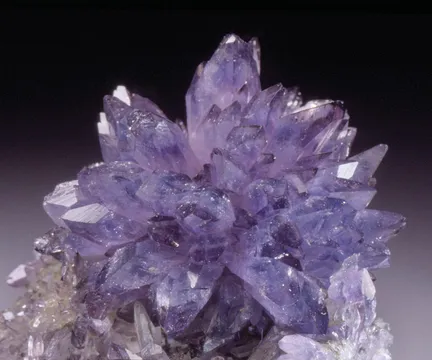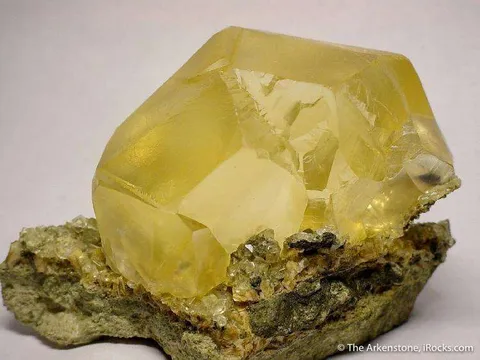
Kara-Oba W deposit, Kazakhstan - a renowned greisen locality producing wolframite and fluorite, with smoky quartz and octahedral fluorite prized by collectors.
Key facts
Kara-Oba is one of the great Central Asian greisen localities: a tungsten–molybdenum–tin system tied to a late Paleozoic granitic massif in the Betpak-Dala desert country of central Kazakhstan. For ore geologists it is a complex rare-metal deposit, with wolframite-series tungsten minerals, molybdenite, cassiterite, bismuth minerals, fluorite, beryl and bertrandite. For collectors, it is something more memorable: a locality whose best pieces have an unmistakable look—smoky to milky quartz, green to violet octahedral fluorite, black wolframite-series blades, bright pyrite, bismuth sulfosalts, and delicate sprays of white bertrandite in the cavities and fractures of greisened granite.
Kara-Oba specimens entered Western collections chiefly from Soviet and early post-Soviet material, especially from the 1980s and early 1990s, and the classic stock has the feel of a vanished mine. The locality was long described under several names—Karaoba, Kara-Oba, the Dzhambul mine, and, in older specimen labels, Karaganda or Betpak-Dala. Modern locality databases may place the EarthWonders entry under Jambyl Region, while many mining and Russian-language geological sources place the mine in Shet District, Karaganda Region, near the former settlement of Dzhambul. Serious collectors should expect these label variants and read them as part of the locality’s collecting history rather than as evidence of multiple unrelated occurrences.
Regional View
Country View
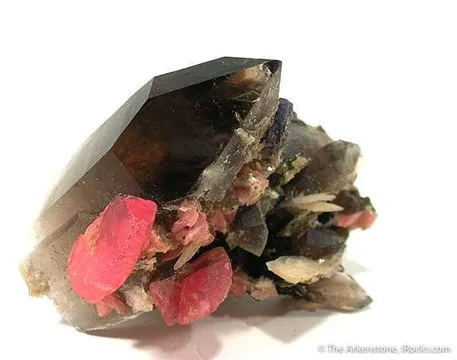
The best-known Kara-Oba display specimens are not colorful in the way of alpine fluorites or pegmatite tourmalines; they are architectural. Fluorite commonly forms octahedra and cubo-octahedral modifications perched on quartz, sometimes with stepped triangular faces and purple-green zoning. Wolframite-series crystals occur as heavy black blades, locally large enough to dominate a cabinet specimen. Bertrandite, by contrast, is a connoisseur’s mineral here: small, white to colorless, flat prismatic or bladed crystals, most attractive when they sit cleanly on smoky quartz with a scatter of pyrite.

Photo: Wikimedia Commons

Photo: Wikimedia Commons
Kara-Oba is also important beyond the cabinet. It is the type locality for betpakdalite-CaCa, the namesake mineral of the betpakdalite supergroup, and the type locality of chukhrovite-(Y); chukhrovite-(Nd) was also described from the Kara-Oba area. That combination—collectible fluorite and quartz, major tungsten history, and rare-mineral type-locality significance—makes Kara-Oba a locality that belongs in both a display case and a research drawer.
Search for specimens: View all specimens from Kara-Oba W deposit, Kazakhstan
Kara-Oba is a greisen and vein-stockwork tungsten–molybdenum deposit genetically associated with the Karaoba granitic massif. Russian-language geological summaries describe it within the Shalgiya–Karaoba fault zone of the western Balkhash structural region, where Devonian volcanic and volcaniclastic rocks, lower Carboniferous units, upper Devonian porphyries and Permian granites are all part of the district architecture. The ore-forming system is tied to leucocratic granite, and the collector assemblage reflects exactly that: quartz, fluorite, muscovite, feldspar, topaz and other greisen minerals carrying tungsten, molybdenum, tin, bismuth, beryllium and polymetallic sulfides.
Published summaries describe several styles of ore body. Vein and stockwork mineralization occur in granite and granite-porphyry, with quartz veins and veinlet-greisen zones forming the main mineralized framework. One Soviet-era review divided the granite massif into three mineralized zones: a central polymetallic area with wolframite, cassiterite-bismuthinite and molybdenite; a western molybdenite zone; and a molybdenite zone in the upper part of the massif. Wolframite-series minerals were reported particularly in north-trending quartz veins in the upper part of the massif, with about fifty mineralized veins noted in one English-language review. Russian sources give a broader mine-scale picture: ore veins and greisen zones strike in several directions, including east–west, northwest, submeridional and northeast trends; veins may extend from about 100 to 1000 m with average thicknesses around 0.3 to 1.5 m, and veinlet-greisen zones may run 350 to 800 m along strike with thicknesses of roughly 0.6 to 1.5 m. Steep dips of 65–87° are recorded for many veins and zones.
The principal ore minerals are wolframite-series minerals, molybdenite, cassiterite and bismuthinite, with important associated bismuth sulfosalts and alteration products. Gangue minerals include quartz, albite, feldspar, fluorite, muscovite, calcite, siderite and topaz. The deposit’s richer specimen assemblage adds bertrandite, beryl, helvine, rhodochrosite, pyrite, sphalerite, galena, chalcopyrite, cosalite, russellite, koechlinite, jarosite-group minerals, rare fluorides and hydrated molybdates. More than eighty minerals were noted in older English-language literature; later collector-oriented and Russian-language summaries list more than one hundred species from the wider Kara-Oba mining district and its sublocalities.
The discovery story belongs to the early Soviet rare-metal era. Kara-Oba was discovered in 1946, and one Russian geological account credits the topographer G. N. Zhovanov with the discovery. A mine named for Dzhambul was established in 1947, with production reported from 1950. Other English-language mining summaries emphasize later underground tungsten mining, possibly beginning in the 1970s, and record shrinkage stoping as the mining method. The mine was opened by two vertical shafts, reported at about 240 and 300 m depth. In specimen literature, the productive collector period is most often remembered as the late Soviet to early post-Soviet interval, especially the 1980s and early 1990s, with the mine widely cited as having closed in 1996.
Access today should be treated as closed and industrial rather than recreational. Kara-Oba is not a casual field-collecting locality. Modern Kazakh sources list Karaoba-2005 LLP as the subsoil user associated with the deposit, and public environmental-hearing documents from 2025 describe planned open-pit-style reworking of technogenic mineral formations—tailings and beneficiation waste—to recover tungsten concentrate, with excavation, hauling, blending, processing and backfilling of treated material. That sort of activity is not the same as old underground pocket collecting, and it reinforces the practical point for collectors: modern specimens are expected to come from old stock, estate collections, dealer inventories, and documented historic parcels rather than from legal casual collecting at the mine.
The notable specimen finds seem to cluster around quartz-fluorite and quartz-wolframite vein material rather than a single famous named pocket. Dealers and collections have documented green, bluish and violet octahedral fluorites on smoky or milky quartz, fluorites on ferberite-pyrite-quartz matrix, large smoky quartz groups on wolframite-series crystals, and bertrandite sprays on quartz with pyrite. The most impressive pieces are typically balanced association specimens: fluorite placed cleanly on quartz, black tungsten minerals contrasting against pale gangue, or delicate bertrandite standing proud enough from the matrix to be read as a crystallized species rather than as a white crust.
Kara-Oba quartz is the structural stage on which most of the locality’s best minerals perform: smoky, gray, milky or white crystals, often prismatic, locally doubly terminated, and commonly coated by later microcrystalline quartz or secondary phases that give some pieces a sugary or “cactus” surface. Fine cabinet examples include parallel smoky crystals on ferberite and pyrite, while smaller pieces may show quartz carrying purple or green octahedral fluorite, chalcopyrite, sphalerite, cosalite inclusions, bertrandite, rhodochrosite or helvine. Good Kara-Oba quartz is judged less by isolated perfection than by association and contrast: crisp terminations, visible smoky zoning, attractive placement of fluorite or wolframite-series blades, and clean windows into inclusions separate important pieces from ordinary greisen quartz.
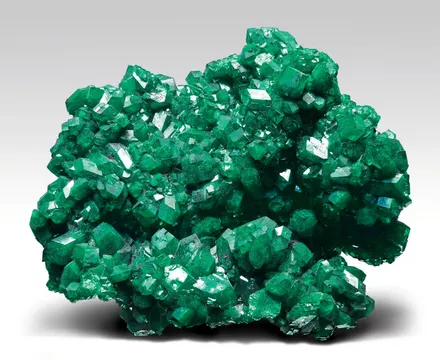
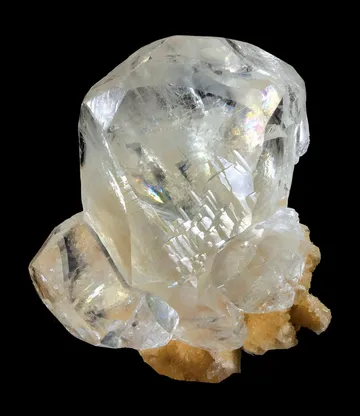
Fluorite is the signature display mineral from Kara-Oba, famous for octahedral to cubo-octahedral crystals in green, bluish, purple, dark violet and mixed purple-green tones, usually on quartz and often with pyrite, muscovite, siderite, sphalerite, ferberite or fluorapatite. The finest examples show sharp isolated octahedra or intergrown groups, crystals to several centimeters on edge, color zoning or phantoms, and the locality’s distinctive stepped triangular growth texture on octahedral faces; some pieces also fluoresce under shortwave and longwave ultraviolet light. Ordinary examples are simply dull fluorite on quartz, but the great Kara-Oba fluorites have sculptural octahedral form, visible zoning, bright contrast against pale quartz, and minimal bruising on exposed edges.
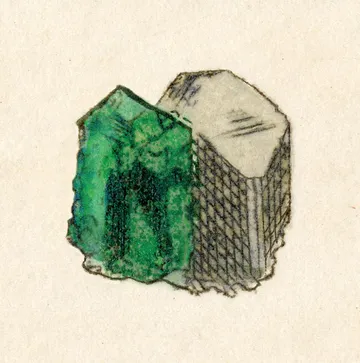
Kara-Oba ferberite is part of the locality’s broader wolframite-series ore suite, and specimens may appear historically labelled as wolframite, ferberite, or sometimes chemically intermediate material depending on the analysis and the period of sale. Collectible crystals are black, heavy, lustrous blades or short prismatic masses, typically associated with quartz, fluorite, pyrite, muscovite, siderite, galena or epidote; fine examples include sharp bladed groups and very large display crystals, including cabinet specimens with blades on the order of many centimeters rather than the more usual miniature scale. The best pieces have distinct terminations, bright black luster, a three-dimensional stance on quartz or fluorite-rich matrix, and enough associated pale gangue or pyrite to keep the visually dense tungsten mineral from becoming a featureless black mass.
Bertrandite from Kara-Oba is one of the locality’s most refined collector minerals, occurring as white to colorless, flat prismatic, bladed and locally doubly terminated crystals, commonly in small sprays or groups on smoky quartz and with bright pyrite. Dealer-documented pieces show individual crystals around the centimeter scale on larger quartz-rich matrices, and the most desirable examples rely on contrast: pearly-white bertrandite set against gray-brown smoky quartz, with pyrite providing scale and sparkle. Because much Kara-Oba bertrandite is small and can be confused at a glance with pale quartz overgrowths, feldspar, mica or unidentified white alteration minerals, the best specimens are those in which the bladed habit is obvious, the crystals are sharply separated from the matrix, and the label history is strong.
Pyrite at Kara-Oba is most important as an association and contrast mineral rather than as the main attraction, appearing as small brassy cubes, microcrystal coatings and glittering crusts on quartz, fluorite, ferberite, sphalerite, chalcopyrite and bertrandite-bearing matrix. The locality’s better fluorites often sit on pyrite-bearing quartz or sulfide matrix, and some ferberite specimens show bright pyrite cubes across the back or edges, giving visual relief to otherwise dark tungsten ore. Good pyrite-bearing Kara-Oba pieces are bright, crisp and stable-looking, with pyrite placed where it frames fluorite, quartz or ferberite; massive, tarnished or crumbly pyrite adds little unless it is clearly part of a documented rare association.
Other documented Kara-Oba minerals give the locality much of its scientific weight. Betpakdalite-CaCa was described from the oxidation zone of the wolframite ore deposit and remains the locality’s most historically important type mineral. Chukhrovite-(Y) was described from the Kara-Oba Mo-W deposit as a rare-earth calcium aluminum sulfate fluoride hydrate, and chukhrovite-(Nd) was later described from Kara-Oba material. The district has also produced bismuth, bismuthinite, cosalite, galenobismutite, aikinite, native bismuth associations, russellite, koechlinite, cassiterite, beryl, helvine, rhodochrosite, siderite, topaz, muscovite, fluorapatite, sphalerite, galena and chalcopyrite. Collector notes also record notable rhodochrosite crystals and quartz with large inclusions of helvine, rhodochrosite and other species, making Kara-Oba a particularly rewarding locality for those who value paragenesis as much as cabinet aesthetics.
The first authenticity issue with Kara-Oba is locality labelling. Old labels may read Kara-Oba, Karaoba, Kara Oba, Dzhambul mine, Betpak-Dala Desert, Karaganda Oblast, Karagandy Province, Jambyl Region, Djambul, or simply Kazakhstan. Those variants are common, but they can also blur the boundary between Kara-Oba and other Central Asian greisen deposits such as Akchatau, Kairakty, Kent Massif or other Kazakh tungsten-fluorite localities. Fluorite on quartz from Kara-Oba has a recognizable style, but it is not safe to rely on “Kazakhstan fluorite” labels alone.
The second issue is species precision. Wolframite-series specimens should not automatically be upgraded to ferberite without analytical support or a reputable historic label; older Soviet and dealer labels often used “wolframite” broadly. Bertrandite, betpakdalite, chukhrovite and other rare species from the locality are best treated as identification-sensitive: habit and association may be suggestive, but high-value rare-mineral specimens deserve analytical confirmation or a strong chain of provenance. White bladed bertrandite can be visually subtle, and yellow to greenish secondary molybdates in the oxidation zone are particularly prone to optimistic naming.
No well-documented modern industry of fabricated Kara-Oba fakes is known, but cleaning and enhancement deserve attention. Collector commentary on Kara-Oba quartz with cosalite inclusions notes that oxalic acid has been used to remove iron staining from specimens. That is not necessarily a problem, but it means buyers should inspect for unnaturally bright white quartz, etched carbonate, loosened secondary minerals, or residue in protected cavities. Fluorite should be examined carefully for edge chips and cleavages, especially on octahedral points and stepped faces. The most exposed fluorites can be contacted at the high points, and broken corners are far more common than dealer photographs sometimes imply.
Handling is straightforward but should be deliberate. Fluorite cleaves easily and should be mounted or packed so that octahedral corners do not take pressure. Bertrandite is small and can be knocked off by careless brushing. Pyrite from this locality is usually encountered as bright accessory crystals rather than pyrite-disease-prone massive material, but any sulfide-rich specimen should still be kept dry and stable. Some Kara-Oba fluorites fluoresce under both longwave and shortwave ultraviolet light; fluorescence is a pleasing bonus, not a primary authentication test, because the response varies from piece to piece.
Market availability is limited and irregular. Most fine specimens trace to older mine production, estate collections, or dealer stock from the late Soviet and early post-Soviet period. Fluorite is the most recognizable and most actively traded Kara-Oba species, with attractive miniatures and small cabinet pieces appearing occasionally. Fine ferberite is scarcer, especially in large, well-terminated crystals. Bertrandite is scarcer still in display quality, and rare-mineral material such as betpakdalite or chukhrovite belongs more to systematic collections than to the general mineral market. Modern tailings work may confirm the continuing economic interest in the deposit, but it should not be confused with renewed access to fresh specimen pockets.
The best Kara-Oba story begins not with a prospector following a vein, but with a topographer trying to steady an instrument. According to the account preserved by GeoWiki from M. D. Dorfman, the deposit was found by accident when the topographer needed a stone to put under the leg of a tripod. The convenient stone turned out to be tungsten ore. It is the kind of discovery anecdote that sounds too neat until one remembers how many ore bodies in harsh country first announced themselves as ordinary, useful rocks in the hand of someone who was not yet thinking like a miner.
There is another, quieter story in the way Kara-Oba specimens surfaced in Western collections. In the 1990s, as Soviet-era mineral channels opened to dealers and collectors, Kara-Oba pieces appeared with labels that seemed almost evasive in their brevity: “Kara-Oba, Kazakhstan,” “Dzhambul,” “Betpak-Dala,” “Karaganda.” A Richard Gunter catalogue note records the purchase of a cosalite-in-quartz specimen from The Russian Stone dealer at the Manitoba Mineral Show in 1994, alongside other minerals from the former Soviet sphere. That small transaction captures a larger moment in collecting history: rare-metal localities that had been military, remote, or simply inaccessible in the Soviet period were suddenly present in North American show flats as polished windows, smoky quartz, sulfide inclusions and unfamiliar locality names.
Kara-Oba’s finest fluorites also carry the aura of a brief collecting window. Jan Buma collection specimens documented by Fabre Minerals include a bluish octahedral fluorite on smoky quartz from around 1992, a green octahedral fluorite with ferberite, quartz and pyrite noted as from around 1975, and a complex purple fluorite with pyrite and sphalerite from around 1995. These are not just dates on labels; they bracket the life of a locality in the specimen market. By the time the mine was widely said to have closed in 1996, the material that would define Kara-Oba for collectors was already dispersed through dealer stocks, private cabinets and old collection catalogues.
L. P. Ermilova, Mineraly molibdeno-volframovogo mestorozhdeniya Karaoba v Tsentral'nom Kazakhstane / Minerals of the molybdenum-tungsten Karaoba deposit in Central Kazakhstan (Academy of Sciences of the USSR, 1964), 175 pp. — The core monograph on the mineralogy of the Kara-Oba Mo-W deposit.
L. P. Ermilova and V. M. Senderova, “Betpakdalite, a new mineral from the oxidation zone of the wolframite ore deposit of Karaoba (Central Kazakhstan),” Zapiski Vsesoyuznogo Mineralogicheskogo Obshchestva, 90, 425–430, 1961. — Original type-mineral description for betpakdalite from Kara-Oba’s oxidation zone.
L. P. Ermilova, V. A. Moleva and R. F. Klevtsova, “Chukhrovite, a new mineral from Central Kazakhstan,” Zapiski Vsesoyuznogo Mineralogicheskogo Obshchestva, 89, 15–25, 1960. — Type-mineral description for chukhrovite-(Y), with Kara-Oba as the reference occurrence.
L. A. Pautov, G. K. Bekenova, V. Yu. Karpenko and A. A. Agakhanov, “Chukhrovite-(Nd), Ca3(Nd,Y)Al2(SO4)F13·12H2O — a new mineral,” New Data on Minerals, 40, 5–10, 2005. — Description of chukhrovite-(Nd) from Kara-Oba material.
G. N. Nechelyustov, V. I. Stepanov, N. G. Shumkova and E. B. Khalezova, “Ikunolite from the Kara-Oba tungsten deposit, Central Kazakhstan — first find in the USSR,” Proceedings of the Mineralogical Museum, Academy of Sciences of the USSR, no. 26, 105–111, 1978. — A documented Soviet-era record of ikunolite from Kara-Oba.
George A. Rabchevsky, The Tungsten Industry of the U.S.S.R., U.S. Bureau of Mines, Mineral Issues analytical series, 1988. — English-language mining and geological summary with Karaoba deposit data, mineralized zones, vein dimensions and mining history.
Bill Smith and Carol Smith, “A Guide to Mineral Localities in the Former Soviet Union,” The Mineralogical Record, 26(6), 517–549, 1995. — Key Western collector reference for former Soviet mineral localities, including Kara-Oba.
Vladimir Jermolenko, “Kara-Oba: Mineralogische Perle der Betpak-Ebene bei Dzhambul, Kasachstan,” Lapis, 27(4), 13–34 + 50, 2002. — Collector-oriented German article on Kara-Oba as a mineralogical pearl of the Betpak plain.
Mindat: Kara-Oba W deposit — The main online locality page, with species list, sublocalities, photographs and references.
GeoWiki: Кара-Оба — Russian-language locality summary with geology, ore-body dimensions, discovery note and publication list.
Geo.web.ru: Кара-Оба minerals gallery and notes — Russian collector page compiling Kara-Oba mineral images and references, including the Lapis article citation.
U.S. Bureau of Mines / UNT Digital Library: The Tungsten Industry of the U.S.S.R. — Useful English-language discussion of Karaoba’s greisen stockwork geology, ore zones and Soviet mining history.
Government of Kazakhstan public hearing record for Karaoba tailings reworking, 2025 — Current-access context for planned reworking of technogenic mineral formations by Karaoba-2005 LLP.
Deloitte / Kazakhstan non-ferrous metals sector overview: tungsten and molybdenum fields — Modern economic-minerals summary listing Karaoba resources, subsoil user and development status.
Fabre Minerals: Bertrandite with smoky quartz and pyrite from Kara-Oba — High-quality documented bertrandite specimen with size and habit details.
Fabre Minerals: Jan Buma Collection Kara-Oba fluorites — Excellent reference for dated fluorite, ferberite, quartz and pyrite specimens from the classic collector period.
EarthWonders: Fluorite with fluorapatite from Kara-Oba — Modern marketplace example of the locality’s dark purple octahedral fluorite with stepped faces.
EarthWonders: Ferberite with quartz, galena, pyrite and epidote from Kara-Oba — Important modern listing documenting a very large ferberite crystal specimen.
Wikimedia Commons: Fluorite-Quartz-158807.jpg — Openly licensed reference photograph of classic green-purple fluorite octahedra on quartz from Kara-Oba.
Wikimedia Commons: Bertrandite-Quartz-101593.jpg — Openly licensed close-up photograph of white bertrandite with smoky quartz from Kara-Oba.