






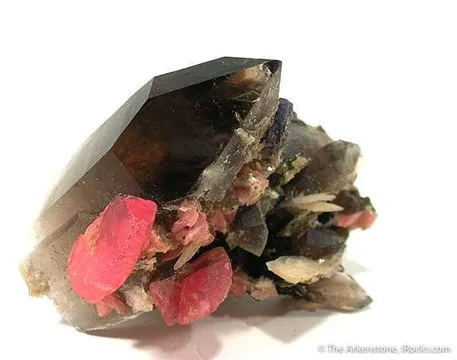
Akchatau Mine, Kazakhstan — a rare W-Mo-Be greisen deposit famed for violet fluorite octahedra, creedite, bertrandite, and blue apatite, prized by collectors.
Key facts
Akchatau is one of the great Soviet-era rare-metal localities: an Early Permian granite-related W-Mo-Be system in the steppe country of central Kazakhstan, worked principally for tungsten and molybdenum but remembered by collectors for a very different reason. The mine’s best specimens look unmistakably “Akchatau”—deep violet to nearly black octahedral fluorite, blue to blue-green fluorapatite, white platy bertrandite, smoky quartz, lilac creedite, sharp wolframite, and large pyrite crystals, all belonging to a fluorine-rich greisen and quartz-vein environment tied to the Akchatau leucogranite massif.
Akchatau matters because it is not merely a pretty-specimen mine that happened to be productive; it is a textbook rare-metal greisen deposit. The ore field belongs to the Balkhash metallogenic belt and is associated with cupolas of the Akchatau complex, where leucogranites intruded older sedimentary rocks and generated quartz-topaz, quartz-muscovite, and quartz-fluorite assemblages rich in W, Mo, Be, Bi, F, and Sn. For specimen collectors, that chemistry translated into a compact but extraordinary suite: purple creedite of world-class color, sharply formed fluorite octahedra, beryllium silicate associations, glassy smoky quartz, and classic tungsten ore minerals in matrix.
Regional View
Country View
The most coveted Akchatau specimens came out during the late Soviet and immediate post-Soviet period, especially the late 1980s and early 1990s, when small lots of remarkable fluorite-fluorapatite-bertrandite combinations and purple creedites reached Western collectors. The finest pieces are not large by modern cabinet-specimen standards, but they have a jewel-box intensity: black-violet fluorite octahedra sitting among frosty bertrandite and blue apatite, or sprays of lilac creedite crystals forming rounded “pincushion” clusters with a color far beyond the common white or colorless creedite seen from many other localities.

Photo: Wikimedia Commons

Photo:
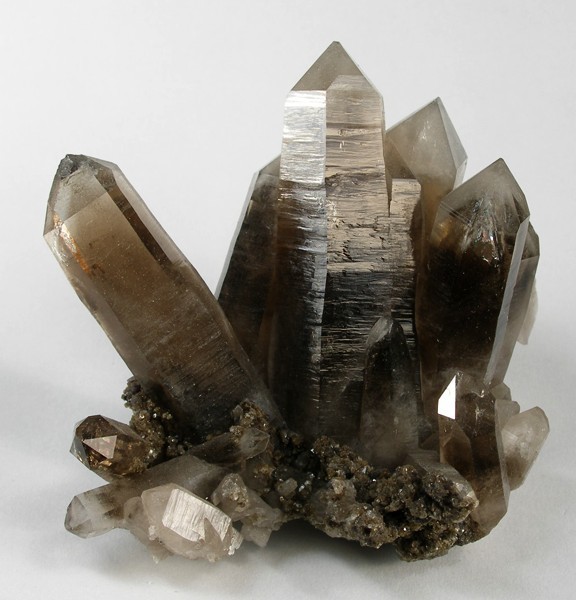
Photo: Wikimedia Commons
Search for specimens: View all specimens from Akchatau Mine, Kazakhstan
Akchatau Mine is near Akshatau, Shet District, Karaganda Region, Kazakhstan, in the broad central Kazakh steppe south to southeast of Karaganda and northwest of Lake Balkhash. Mineralogical sources commonly give the locality name in several transliterations—Akchatau, Akshatau, Aqshatau, and Akschatau—so older labels may vary without necessarily indicating a different locality. The mine is a W-Mo-Be greisen and quartz-vein deposit genetically linked to Permian leucogranites of the Akchatau complex.
The geologic core of the deposit is a granite-related rare-metal system. Ore-forming leucogranites and alaskitic granites are accompanied by greisenization: replacement and alteration dominated by quartz, mica, topaz, fluorite, and related fluorine-rich phases. Published descriptions place the deposit within the western Akchatau granite massif, with more than 300 greisen-vein bodies grouped into numerous ore clusters. Mineralization occurs as veins, greisen bodies, nests, lenses, and stockwork-like zones, rather than as a single simple lode. In the richest zones, tungsten is concentrated as wolframite-series minerals, with scheelite, molybdenite, bismuthinite, cassiterite, pyrite, chalcopyrite, sphalerite, galena, topaz, muscovite, quartz, fluorite, and calcite among the documented ore and gangue minerals.
The deposit shows the zoning one expects in a cupola-related greisen system. Tungsten, molybdenum, and beryllium are not randomly distributed; they are tied to particular vein-greisen facies and to positions around granite cupolas, with quartz-topaz and quartz-muscovite greisens especially important. The beryllium signature is the reason Akchatau yields bertrandite and fluorapatite associations that sit comfortably beside the classic W-Mo assemblage, while the fluorine-rich hydrothermal stages account for the fluorite, creedite, topaz, and apatite that make the locality so recognizable to collectors.
Akchatau was discovered in 1936 and was mined underground from 1941. The Akchatau mining and processing combine was established in the Soviet period and treated rare-metal and polymetallic ores not only from Akchatau itself but also from related district deposits. Soviet industrial descriptions record two vertical shafts at Akchatau, approximately 170 m and 240 m deep, with ore bodies dipping steeply, commonly around 70–80 degrees. Beneficiation included gravity concentration, electromagnetic separation, flotation, and related processing steps, producing tungsten, molybdenum, bismuth, tin, lead, zinc, and barite concentrates from the broader combine’s feed. The combine is recorded as closing in the 1990s, although specimen dealers often use “closed” more loosely for the end of collector-quality production from the workings.
For collectors, the key production interval was late. Museum records and specimen labels document important Akchatau acquisitions in the 1980s, while the most famous fluorite-fluorapatite-bertrandite combinations reached the market around the late 1980s and early 1990s, with some pieces labelled from 1990 or 1993. Dealer and museum descriptions consistently emphasize that the best fluorite combination material was short-lived; good pieces were already scarce by the mid-1990s, and comparable finds have not reappeared in quantity. The purple creedites likewise entered collections in limited numbers and are now regarded as classic, finite, old-find material.
Collecting access today should be treated as closed industrial ground rather than a casual field locality. The old underground workings, shafts, dumps, and processing remains are hazardous, and any visit would require permission from the relevant land and mineral-rights holders. The material circulating in the collector market is overwhelmingly old stock: Soviet-era museum specimens, post-Soviet dispersals, older dealer inventory, and pieces from established private collections.
Akchatau creedite is celebrated for its lilac to purple color, a hue uncommon enough in creedite that fine examples from this mine stand with the better-known purple material from Santa Eulalia, Mexico. The best specimens form sparkling radiating sprays and rounded pincushions of prismatic crystals, sometimes free of matrix and sometimes on quartz or other greisen gangue; documented crystals reach several centimeters, with a famous 15 cm plate carrying purple crystals to about 3.8 cm. Good pieces are judged by depth and evenness of lavender-violet color, glassy luster, sharp undamaged terminations, and the completeness of the radiating groups; ordinary pieces tend to be paler, more fragmented, or visually crowded by dull matrix.
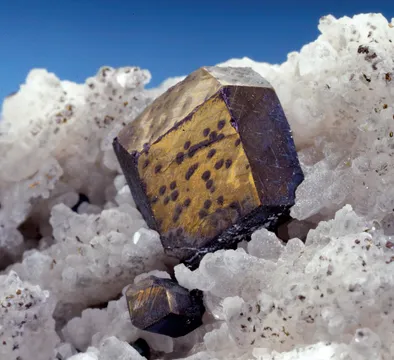
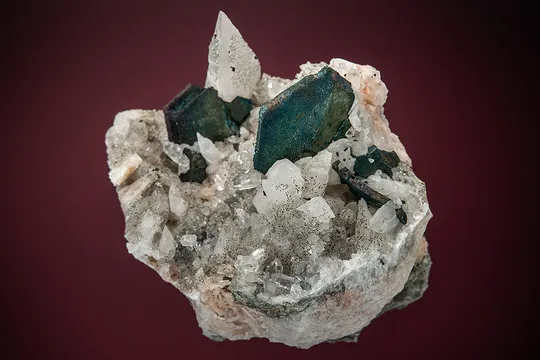
Akchatau fluorite is most distinctive as very dark violet to nearly black octahedra, commonly lustrous and sharply formed, with some pieces showing stepped or second-generation overgrowths that give the faces a textured, almost drusy sparkle. Crystals on documented specimens commonly range from thumbnail size to around 3 cm or more, and the most sought-after examples are matrix combinations with smoky or colorless quartz, blue to blue-green fluorapatite, and white platy bertrandite; some fluorites appear nearly opaque in normal light but reveal their purple body color on edges or under strong backlighting. The best Akchatau fluorites combine crisp octahedral form, strong color, undamaged edges, and recognizable association, especially the late-1980s to early-1990s fluorite-fluorapatite-bertrandite style that has not reappeared in comparable quality.
Quartz from Akchatau ranges from common vein and greisen gangue to highly collectible smoky quartz and morion clusters, including glassy prismatic groups with phantoms, pale or white-tipped terminations, and associations with fluorite, wolframite-series minerals, bertrandite, creedite, calcite, and pyrite. The mine is not a single-species smoky quartz locality in the Alpine sense; quartz here is the structural and visual stage on which the W-Mo-Be-F assemblage developed, so the finest collector pieces are either sculptural smoky clusters in their own right or quartz matrices carrying sharp octahedral fluorite, wolframite blades, or sprays of rarer species. Condition matters greatly, because long, exposed quartz points from old underground finds are prone to bruised tips and edge wear.
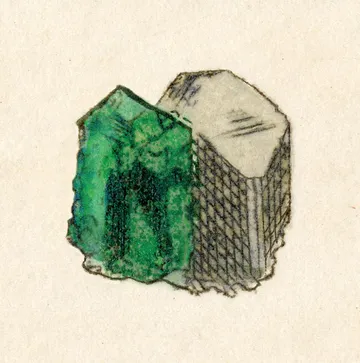
Akchatau bertrandite is a signature accessory of the famous Be-rich combinations, usually appearing as white, cream, or colorless platy crystals, sheaves, and small bladed sprays scattered through quartz-fluorite-fluorapatite matrix. It is rarely the boldest mineral on a specimen, but it is often the locality fingerprint: the pale beryllium silicate filling spaces between dark purple fluorite octahedra and blue fluorapatite crystals. The best bertrandite pieces show discrete, sparkling plates or sheaves that are easy to distinguish from dull white alteration, ideally in balanced association with fluorite and apatite; lesser examples may be visually reduced to chalky pale patches unless the crystals are examined closely.
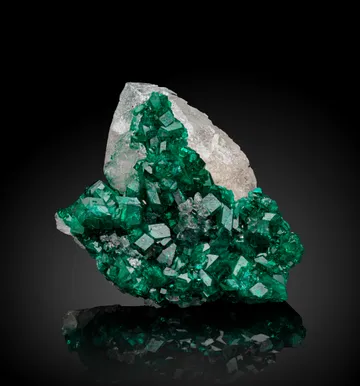
Fluorapatite from Akchatau is best known as blue to blue-green hexagonal crystals in the celebrated fluorite-bertrandite combinations, where the apatite provides the cool, translucent color contrast against black-violet fluorite and white bertrandite. Many crystals are modest in size, but well-crystallized examples around a couple of centimeters are known, and an uncommon honey-colored fluorapatite crystal of about 2.2 cm on sericite-rich matrix has been documented in the trade. Top-quality Akchatau apatite is gemmy, lustrous, well isolated, and correctly identified; some early material was reportedly sold as aquamarine because of its color, so collectors should favor pieces with credible labels, hexagonal apatite morphology, and associations typical of the mine.
Wolframite is the defining tungsten ore mineral of Akchatau, occurring in the greisen-vein system as black to brown-black blades, tabular crystals, segregations, nests, and vein concentrations in quartz-rich and mica/topaz-bearing gangue. Analyses of the ore place the material between the ferberite and hübnerite end members, and collector references describe wolframite or hübnerite crystals from several centimeters to under 10 cm, including specimens on smoky quartz and examples with reddish hübnerite overgrowths or epitaxial-looking growths on darker wolframite. The best collector pieces are not massive ore lumps but sharp, lustrous blades with visible crystal faces, clean contrast against quartz or greisen matrix, and enough locality character to separate them from the many more anonymous wolframite specimens produced by other granite-related tungsten deposits.
Beyond the headline species, Akchatau has a deep rare-metal and sulfide assemblage. Documented minerals include bismuthinite, native bismuth, bismutite, aikinite, gladite, hammarite, krupkaite, cosalite, pekoite, molybdenite, scheelite, cassiterite, pyrite, chalcopyrite, sphalerite, galena, topaz, muscovite, calcite, rhodochrosite, powellite, ferromolybdite, tungstite, beryl, phenakite, helvite, and microcline. The mine itself is not best known as a type locality for a famous display species, but it is important scientifically for bismuth sulfosalt mineralization in a W-Mo greisen setting, and it is unusually strong as a specimen locality for species that are often only microscopic or massive elsewhere. Pyrite deserves special mention: Akchatau produced very large crystals, with museum examples exceeding 20 cm and one Fersman Museum specimen recorded at 28 x 20 x 18 cm.
Akchatau is a locality where labels matter. The same place appears as Akchatau, Akshatau, Aqshatau, Akschatau, Karaganda Oblast, Karagandy Province, or Shet District, and older Soviet labels may use broader “Central Kazakhstan” wording. That variation is normal; what should raise questions is a label that mixes Akchatau with visually similar but geologically different Kazakh localities such as Kara-Oba, or one that assigns the famous blue apatite combinations to aquamarine without persuasive evidence.
The most common identification pitfall is the old “aquamarine” problem on fluorapatite-bearing combinations. Blue-green apatite from Akchatau can look beryl-like at a glance, especially when prismatic and translucent, and some early pieces were reportedly sold as aquamarine. In practice, the classic Akchatau association of dark octahedral fluorite, white bertrandite, and blue fluorapatite is now well understood. Serious buyers should look for apatite’s hexagonal habit, the typical greisen matrix, and any supporting analytical or old-collection documentation, especially on expensive specimens.
No widely documented treatment industry is associated with Akchatau creedite or fluorite, but misidentification and locality confusion are real risks. Purple creedite is sufficiently desirable that pale or damaged fragments may be overpromoted; judge them by crystal sharpness, color saturation, and completeness rather than by locality name alone. Fluorite from Akchatau is usually dark and octahedral, so bright purple cubes from a generic “Kazakhstan” label should not be assumed to be Akchatau without further evidence.
Condition is a central issue. Creedite sprays can have rubbed terminations and broken outer points; fluorite octahedra commonly show small edge nicks, which are visually magnified by their dark color; bertrandite blades are delicate and can look dulled by dust or careless cleaning; and smoky quartz clusters frequently have tiny bruises on projecting tips. Pyrite and pyrite-after-pyrrhotite specimens should be stored in stable, dry conditions, as with any sulfide-rich specimen, although many Akchatau pyritized pieces have remained stable in old collections.
Fluorescence is worth checking but not overvaluing. Fluorapatite from Akchatau has been documented as fluorescent under longwave and shortwave ultraviolet light on at least some specimens, and creedite may be of interest to fluorescent-mineral collectors, but the market for Akchatau material is driven mainly by color, habit, association, and scarcity rather than by UV response.
Market availability is limited and episodic. Small creedites and modest fluorites appear occasionally, often from old collections, but rich cabinet fluorite-fluorapatite-bertrandite combinations, large purple creedite plates, and fine wolframite-on-quartz specimens are much harder to replace. The best material should be treated as finite old-find stock: buy for quality, label history, and condition, not merely for the name.
One of the enduring Akchatau stories is the brief confusion over those blue-green crystals in the famous combination pieces. When the late-1980s material first circulated, some specimens were sold as aquamarine. The mistake is understandable if one imagines the scene: dark purple fluorite octahedra, white beryllium silicate, and cool blue prismatic crystals emerging from a Soviet rare-metal mine at a time when detailed locality literature was hard to obtain in the West. The crystals looked tempting, gemmy, and beryl-like. Only later did the combination settle into its proper identity as fluorite, fluorapatite, and bertrandite—a far more unusual association for mineral collectors than another aquamarine specimen would have been.
The Martin Zinn connection also belongs to the lore of the locality. Descriptions of old Akchatau combination specimens repeatedly point to a small late-1980s find and note that Zinn had an especially important concentration of the material. When his holdings were dispersed, some of the best pieces seen by later collectors emerged: cabinet combinations with enough blue apatite and dark fluorite to read instantly from across a room, yet with the white bertrandite still visible rather than buried.
The purple creedites have their own legend. One widely illustrated Akchatau specimen is a 15 x 14 x 6 cm plate of deep purple creedite with crystals to 3.8 cm, from the Marc Weill collection. Its published description calls it the largest high-quality creedite of that color the describer had seen from Mexico or Kazakhstan, and notes that he first saw it in the late 1990s and still remembered it years later. That is how the best Akchatau creedites tend to behave in memory: not as academic rarities, but as vivid purple objects that collectors remember after a single viewing.
Akchatau’s pyrite story is less famous in the Western specimen trade, but it is wonderfully Soviet in scale. The Fersman Mineralogical Museum records a huge Akchatau pyrite crystal measuring 28 x 20 x 18 cm, acquired in 1985; another museum photograph shows the imprint of a quartz crystal on a face of that giant pyrite. For a locality most Western collectors associate with delicate creedite and small, color-rich fluorite combinations, those blocky pyrite giants are a reminder that Akchatau was a large industrial mineral system before it was a connoisseur specimen locality.
-Bertrandite-180010.jpg)

