A collector's guide to Sokolovskoe Iron Mine, Kazakhstan: its geology, mining history and notable minerals, illustrated with the 20 specimens documented from this locality on EarthWonders.
Key facts
Sokolovskoe is one of the great specimen localities born from a giant industrial iron operation: a Carboniferous magnetite-skarn deposit on the Valerianovka arc of northwestern Kazakhstan, close to the city of Rudny in Kostanay Region. To an ore geologist it belongs with Sarbai and Kachar in the Turgai belt, a NNE–SSW chain of enormous stratabound magnetite deposits developed where hot, saline, iron-rich fluids replaced limestones, tuffs, and intermediate volcanic rocks along a major volcano-plutonic corridor. To collectors, however, the name Sokolovskoe means two quite different things at once: superb golden calcite twins that appeared on the international market around the end of the Soviet period, and a suite of zeolites—especially stellerite, chabazite/gmelinite-group minerals, stilbite-group minerals, natrolite, scolecite, and laumontite—that is far more delicate and mineralogically subtle than the mine’s black magnetite ore might suggest.
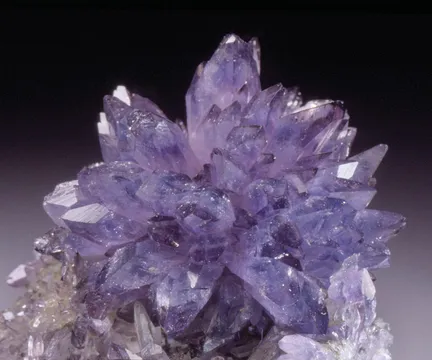
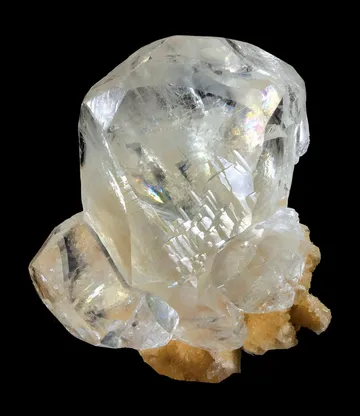
The best Sokolovskoe specimens have an unmistakable look. The calcites are commonly gemmy to translucent, honey-yellow to golden amber, and often interpenetrant or twinned, with the finest pieces showing frosted and water-clear face sectors on the same crystal. Matrix examples are especially desirable because many of the classic calcites reached the market as loose, complete-all-around crystals or small groups. The zeolite specimens present a softer palette: rounded, lustrous, golden-orange stellerite sprays, salmon-pink pseudocubic chabazite or gmelinite-group crystals, occasional quartz-rich matrix, and, on some examples, tiny pyrite or magnetite that reminds the viewer this was never a basalt amygdule locality but an iron skarn and hydrothermal overprint system.
Regional View
Country View
Sokolovskoe’s geological importance is larger than its specimen output. The Sokolov, Sarbai, and Kachar deposits are treated in modern ore-deposit literature as unequivocal Fe-skarn systems with affinities to iron-oxide-apatite and IOCG-related systems: magnetite replacement, diopside-andradite-epidote-actinolite skarn, apatite, late sulfides, and broad albite-scapolite alteration. That paragenesis explains why the locality can yield black andradite-magnetite skarn pieces, orange zeolites, silver minerals, and fluorescent golden calcite from the same industrial mining district.

Photo: Wikimedia Commons

Photo: Wikimedia Commons

Photo: Wikimedia Commons
Search for specimens: View all specimens from Sokolovskoe Iron Mine, Kazakhstan
Sokolovskoe Iron Mine lies at Rudny in Kostanay Region, northern Kazakhstan, and is also encountered on labels as the Sokolovskiy Mine, Sokolovskoye deposit, Sokolov quarry, or Sokol’noye Mine. It is part of the Sokolov-Sarbai mining district, whose modern industrial entity is JSC Sokolov-Sarbai Mining and Processing Production Association, usually abbreviated SSGPO, now within Eurasian Resources Group. The deposit was discovered in 1949; exploration followed from 1949 to 1955, and overburden stripping at the Sokolovskoe open pit began on January 13, 1955. The broader SSGPO project was approved and authorized by the USSR Council of Ministers in 1956, and the city of Rudny grew directly around the new iron-ore enterprise.
The deposit is a magnetite-rich Fe skarn within the Turgai belt, hosted by the Carboniferous Valerianovka Supergroup. At Sokolov the host package includes thick andesite, volcanic breccia, tuff, limestone, basaltic and volcaniclastic units, and calcareous tuffs, all cut or flanked by the Sarbai-Sokolov gabbro-diorite-granodiorite intrusive suite and related dikes. The iron ore occurs mostly as five stacked, stratabound magnetite lenses distributed along a strike length of roughly 5.6 km, within a stratigraphic thickness of about 500 m and dipping eastward at approximately 50 degrees over a vertical extent approaching 1 km. Modern descriptions put the open pit at about 2.3 km long north–south and about 1 km wide at its narrowest, with deeper remaining resources being accessed by underground mining.
Mineralogically, the ore system began as a high-temperature replacement environment. Magnetite replaced limestone and volcanic rocks, preserving local bedding and primary textures while developing skarn gangue dominated by diopside, grossular-andradite garnet, actinolite, epidote, apatite, and magnetite. Later hydrothermal stages brought sulfides and carbonates, with pyrite, pyrrhotite, chalcopyrite, calcite, chlorite, albite, and scapolite alteration. The collector minerals occupy this late and locally open-space part of the system: calcite in transparent golden twins and scalenohedra; zeolites in cavities and veins; and minor but interesting silver, copper, arsenic, and sulfate minerals in the broader mineral list.
The classic specimen-producing period was not a single neat “pocket” in the way collectors use the term for alpine clefts or pegmatites. Instead, good pieces appear to have come episodically from cavities, veins, and skarn/open-space zones exposed during large-scale industrial mining, particularly during the late 1980s and early 1990s when Sokolovskoe calcites and zeolites entered Western collections in quantity. Several well-documented calcites are described as early-1990s material, while dealer records and museum-oriented Russian sources also note later underground finds, including large calcite and extraordinary gypsum from the mine’s deeper levels. One Russian mineral-locality summary records transparent platy gypsum crystals from the 260 m level reaching around 90 x 50 cm, and notes a calcite find in the underground workings in 2003; such pieces are important but far less visible in the international specimen market than the golden calcites and orange zeolites of the earlier commercial wave.
Collecting access today should be regarded as closed unless arranged formally through the operator. Sokolovskoe is an active industrial iron mine and underground operation, not a public collecting site. The scale, blasting, haulage, highwalls, underground development, and processing infrastructure make casual access inappropriate and unsafe. For collectors, the practical source of Sokolovskoe specimens is the secondary market: old dealer stock, former Soviet Union collections, museum deaccession channels where legitimate, and the occasional specimen emerging from long-held private material.
Calcite is the signature collector mineral from Sokolovskoe, best known as gemmy golden-yellow to amber interpenetrant twins and sharp rhombohedral groups, with scarcer pale-golden scalenohedral crystals on matrix. Classic pieces typically range from thumbnail to small-cabinet size, though matrix plates with crystals to several centimeters are recorded, including examples with individual twinned rhombs over 6 cm on edge and scalenohedra approaching 4.6 cm. The best specimens show intense honey color, glassy luster, sharp twinning, undamaged projecting crystals, and ideally some matrix or associated stilbite-group zeolite, pyrite, or dark skarn material; ordinary pieces tend to be loose, bruised, duller, or too crowded for the distinctive Sokolovskoe geometry to read clearly. Many of the famous calcites reached the market in the late 1980s to early 1990s, and well-documented dealers have long noted that comparable new material has not been found again in quantity.
Sokolovskoe stellerite is a classic for the species: lustrous, translucent, golden-orange to yellow-orange aggregates, commonly forming rounded balls, bow-tie sprays, or clustered sheaves on quartz-rich, zeolitic, or skarny matrix. Documented specimens include radial groups several centimeters across and cabinet pieces in which stellerite clusters reach about 8 cm, with forms ranging from flat-ended to pointed terminations. The most attractive examples combine saturated orange color, crisp separated sprays, sparkle on many crystal faces, and contrasting matrix or companion minerals—especially salmon-pink chabazite or gmelinite-group crystals, calcite, quartz, stilbite-group minerals, prehnite, magnetite, and small pyrite. As with many zeolites from visually similar associations, stellerite here can be confused with stilbite by sight alone; confident labels depend on analytical history, reputable provenance, or specimens from well-documented lots.
Beyond calcite and stellerite, Sokolovskoe has a compact but unusually diverse species list for an iron mine. The fundamental ore suite is magnetite with pyrite, hematite and martite, accompanied by andradite—often melanite—epidote, albite, prehnite, and apatite in the skarn assemblage. The cavity suite includes chabazite, gmelinite-Ca and gmelinite-subgroup material, natrolite, scolecite, laumontite, analcime, heulandite-subgroup and stilbite-subgroup minerals, apophyllite-group minerals, quartz including amethyst and chalcedony, gypsum, celestine, thaumasite, svanbergite, pharmacolite, ferrihydrite, and nordstrandite. The most intriguing rarities for systematic collectors are the silver and arsenic-bearing species—native silver, acanthite, mckinstryite, polybasite, proustite, native copper, and native arsenic—because they show that late-stage metal mobility in the deposit was more varied than the magnetite-skarn headline suggests. Sokolovskoe is not chiefly valued as a type locality; its importance lies instead in the quality and recognizability of its calcite-zeolite specimens and in the way those specimens sample the late hydrothermal life of a giant Fe-skarn system.
The main authenticity issue with Sokolovskoe specimens is not widespread faking but misidentification and overconfident labeling. The locality name appears in several forms—Sokolovskoe, Sokolovskiy, Sokolov, Sokol’noye, Rudny, Kustanai/Kostanay—and older former-Soviet labels may be imprecise. The nearby Sarbai deposit produced related zeolite material and is only about 8–9 km from Sokolovskoe, so old “Rudny” or “Sokolovo-Sarbai” labels should be treated carefully. A specimen labelled simply “Kazakhstan calcite” or “Rudny zeolite” is plausible, but not automatically Sokolovskoe.
For calcite, condition is decisive. The best twins are glassy and gemmy but vulnerable at edges and corners; tiny cleaves, bruised rhomb edges, repaired contacts, or incomplete terminations lower value sharply. Many are loose or nearly matrixless, so matrix presence adds desirability when the placement is aesthetic. Some classic calcites show frosted faces naturally alternating with clearer windows; that texture should not be mistaken for acid etching or polishing without close examination. Sokolovskoe calcite has been described by reputable dealers as showing the typical luminescence of the best locality pieces, so fluorescence can support but never prove locality attribution.
For stellerite and associated zeolites, the chief problem is visual separation of stellerite from stilbite-subgroup material and, in some associations, distinguishing gmelinite from chabazite without analysis. Collectors should favor specimens with older reputable labels, analytical references, or provenance from known dealer lots. Zeolite groups can also hide bruising: rounded aggregates may look complete from the front while having crushed backs, rubbed high points, or broken sprays. Laumontite, where present, deserves extra caution because it can dehydrate and deteriorate if stored too dry; keep any laumontite-bearing Sokolovskoe specimen in stable indoor humidity and avoid heat.
Market availability is limited but not hopeless. Classic golden calcites and orange stellerites were available in some number in the 1990s and early 2000s, and examples still surface from former dealer stocks and older collections. Fine calcites with sharp twinning, rich color, matrix, and no visible damage are far scarcer than casual auction listings imply, while good zeolite combination pieces have largely become collection-to-collection material. Expect the strongest prices for matrix calcite twins, large undamaged golden calcites, richly colored stellerite with chabazite/gmelinite, and anything with documented older provenance.
The beginning of Sokolovskoe belongs to the era of aeromagnetic prospecting and Soviet industrial ambition. In 1949 the Bolshoi Turgai iron district changed from a magnetic anomaly into a mining future: on February 12 pilot M. G. Surgutanov discovered the Sarbaiskoye field, and in June the detachment of geophysicist V. L. Nosikov discovered the Sokolovskoye field. Within a few years the open steppe near what would become Rudny was being converted into one of the largest iron-ore enterprises in Kazakhstan.
The official company history preserves the first physical gesture of mining with unusual concreteness. On January 13, 1955, overburden stripping began at the Sokolovskoe open pit; the first bucket of overburden was loaded by Alexander Popov, operator of a one-cubic-meter diesel excavator. By April, the first train of waste rock had left the Sokolov quarry behind a steam locomotive. These are not romantic mineral-collecting details, but they matter: every later calcite twin and stellerite rosette from Sokolovskoe owes its appearance in a cabinet to that massive program of stripping, blasting, and benching.
Rudny itself was effectively built around the ore. On June 30, 1954, the USSR Council of Ministers decided to start construction of the Sokolovsko-Sarbaisky mining plant and the town on the basis of the Sokolov and Sarbai magnetite deposits; about 20,000 young people came from different parts of the country for the construction project. The settlement was formally shaped by the mine before it became a city in the ordinary civic sense. For collectors handling a small, golden, perfectly twinned calcite, it is worth remembering that its locality is not a remote prospect but a city-forming enterprise.
The specimen story then jumps forward several decades. Around the late 1980s and early 1990s, Sokolovskoe calcites suddenly appeared in the mineral trade: golden, gemmy, often twinned, and unlike the drab expectation many Western collectors had for an iron mine. One well-known auction description remembered that these “caused a major stir at all the shows” when they came out in the early 1990s. That reaction is easy to understand. The crystals looked as though they belonged to a classic calcite locality, yet their matrix and associations pointed back to an immense Soviet-era magnetite skarn in Kazakhstan.
The zeolites told a quieter but more mineralogically complex story. Russian museum-oriented summaries record gmelinite from the Sokolovsky quarry in pieces around 6 cm, a gmelinite-Na specimen more than 50 x 20 cm, and chabazite crystals to about 18 mm. The Fersman Mineralogical Museum in Moscow has multiple systematic specimens tied to the locality, including gmelinite specimens acquired in 1991, precisely the period when many Sokolovskoe cavity minerals entered collections. Those museum entries help anchor the locality’s zeolite reputation beyond dealer folklore.