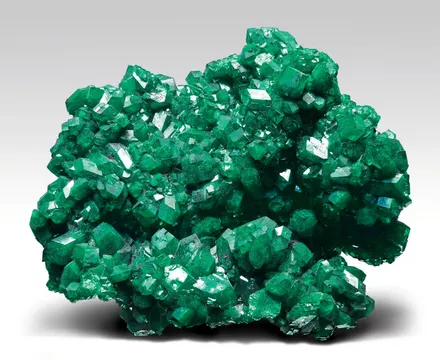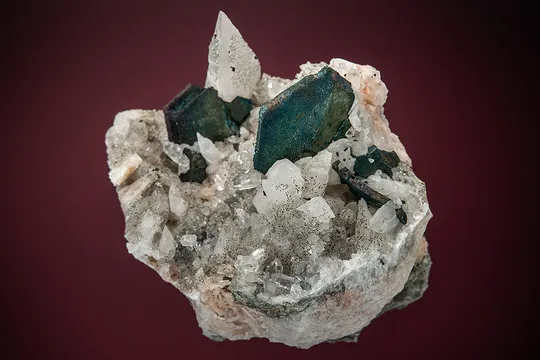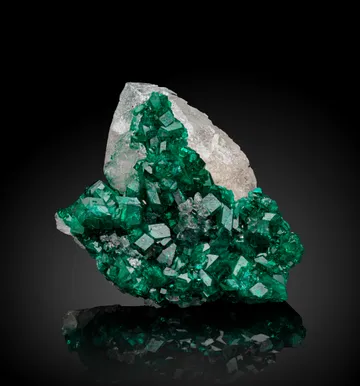
Altyn-Tyube, Kazakhstan - dioptase type locality with emerald-green crystals on calcite in Devonian carbonates; prized for dramatic vugs and its historic colle…
Key facts
Altyn-Tyube is one of the great mineral names: a small limestone knoll on the open Kazakh Steppe that became the type locality for dioptase, CuSiO3 · H2O, long before Tsumeb, Renéville, Kaokoveld, or the Arizona copper mines entered the collector’s vocabulary. The locality lies in the Bukhar-Zhyrau District of Karaganda Region, roughly east of Karaganda, near the Altyn-Su drainage. Its fame rests on a deceptively simple assemblage—emerald-green dioptase, pale to white calcite, limestone matrix, and subordinate copper minerals—but the best specimens have a theatrical intensity: glassy green trigonal crystals lining vugs, perched on translucent calcite or hard silicified limestone, sometimes with malachite accents.
Geologically, the deposit is a copper occurrence in Devonian carbonate-volcanic terrain. Late Devonian clay-rich limestones rest discordantly on Middle Devonian andesite, and the copper mineralization is associated with a nearby andesitic porphyry intrusion. The primary ore suite is a modest one—chalcopyrite, bornite, pyrite, chalcocite, with rare galena and sphalerite—but deep oxidation created the celebrated secondary copper silicate and carbonate assemblage. Dioptase occurs chiefly in cavities in hard, silicified limestone, where open space, copper-bearing fluids, silica, and carbonate host rock combined to make jewel-like green crystals rather than an economic copper ore body.
Historically, Altyn-Tyube is extraordinary. Mineralogical Record’s modern review presents it as a site known to people for thousands of years, mined for green pigment in Neolithic times and later for copper in the Bronze Age. European mineralogists encountered its “emerald” crystals in the late eighteenth century; René Just Haüy recognized the mineral as distinct from emerald and named dioptase in 1797, alluding to the visibility of internal cleavage planes through transparent crystals. For collectors, this means every good Altyn-Tyube dioptase carries two kinds of importance at once: it is attractive in its own right, and it belongs to the locality from which the species entered mineralogy.
Regional View
Country View
Altyn-Tyube specimens are typically more intimate than the grand museum dioptases of Tsumeb, but fine examples are unmistakable. They tend to show rich, slightly bluish emerald-green crystals on limestone or calcite, commonly in dense vug linings rather than isolated freestanding crystals. The strongest pieces combine saturated color, sharp luster, transparency at the crystal edges, an undisturbed pocket surface, and enough contrasting matrix to prove the locality at a glance. The best large matrix pieces from old and modern production are cabinet-level classics; even thumbnails, when sharp and bright, have a legitimacy that few type-locality specimens can match.

Photo: Wikimedia Commons
Search for specimens: View all specimens from Altyn-Tyube dioptase deposit, Kazakhstan
Altyn-Tyube, often rendered on old labels as Altyn-Tube, Altyn-Tjube, Altyn-Tübe, Altyntyube, or the older “Kirghiz Steppes,” is a small copper-mineralized limestone hill in central Kazakhstan. The name is commonly translated as “Golden Hill,” while the nearby Altyn-Su or Altyn-Syu drainage is “Golden Water.” Those romantic names have sometimes created label confusion: Altyn-Syu is a nearby geographic feature, not the dioptase-producing locality itself.
The deposit belongs to a carbonate-hosted copper setting with a volcanic-intrusive association. Late Devonian clay-rich limestones overlie Middle Devonian andesite, and copper mineralization is related genetically to a nearby andesitic porphyry intrusion. The unoxidized assemblage is not exotic: chalcopyrite, bornite, pyrite, and chalcocite form the principal copper-iron sulphide suite, with rare galena and sphalerite. Oxidation penetrates deeply—reported to 240 m below surface—and this is the mineralogical engine that made Altyn-Tyube famous. In the oxidized zone, dioptase developed in cavities in tough silicified limestone, accompanied or overgrown by calcite, malachite, cuprite, pseudomalachite, and native copper, with additional secondary copper minerals reported in modern reviews.
As a mine, Altyn-Tyube has never been a giant by Kazakh copper standards. It is minor compared with the great copper districts of central Kazakhstan, and in modern collector history it has been worked largely for specimens rather than for bulk ore. That small scale is important for understanding the material on the market: output comes in pulses, when cavities or productive seams are opened, rather than as continuous mine production. Older pieces may carry labels reading Russia, Siberia, Kirghiz Steppe, Karagandy Province, Karaganda Oblast, Qaraghandy Oblysy, or Kazakhstan; those labels reflect historical geography and transliteration rather than necessarily being wrong.
The collecting history reaches back to the late eighteenth century in the European mineralogical record. Crystals were at first compared with emerald because of their color and transparency, but their lower hardness and distinct crystallography separated them from beryl. Haüy’s recognition of dioptase made Altyn-Tyube a type locality of permanent scientific standing. Specimens circulated through European collections, and the old literature repeatedly emphasizes the internal cleavages visible through clear green crystals—the very feature that inspired the name.
Modern production has come from open workings and associated underground support areas at the site. In the early 1990s, Western dealers began seeing commercial quantities from the locality; later, Sergey Golomolzin and partners worked the deposit intermittently for specimen material. A 2013 field visit found active drilling and ongoing exploration for new dioptase-bearing zones, with small crystals literally visible in the mud and broken matrix around the workings. Collector access is not casual roadside collecting: the locality is isolated on the steppe, reached by off-road travel from the nearest prepared road, and visitors have generally required local guidance and permission. The workings have been occupied and actively managed, so serious collectors should regard the site as a controlled mining locality, not an open public collecting area.
Notable pockets have produced dense linings of green crystals in limestone vugs and on calcite-rich matrix. Some specimens show two generations of dioptase in a single vug; others are plates or knobby limestone masses dusted to covered with sharp crystals. Most individual crystals are in the millimeter range, but crystals around 1 cm are well documented, and exceptional modern specimens include crystals to approximately 1.5 cm. Calcite can be much more than a passive matrix here: rare pieces show large scalenohedral or blocky calcite crystals with dioptase perched on or among them, producing the high-contrast green-on-white association that collectors prize.
Altyn-Tyube dioptase is the defining species of the locality and the reason the deposit matters: bright emerald-green to slightly bluish-green trigonal crystals, commonly short prismatic to rhombohedral, line vugs and fractures in silicified limestone and calcite-rich matrix. Most crystals are a few millimeters across; good specimens show sharp, glassy crystals around 5–8 mm, while better pocket pieces can reach roughly 1 cm and exceptional examples have been described with crystals to about 1.5 cm. The classic associations are calcite, limestone matrix, malachite, and occasional other copper secondary minerals. What separates strong Altyn-Tyube specimens from ordinary ones is not simply crystal size, but the survival of a natural pocket surface: undamaged green crystals with bright luster, transparency on the edges, distinct terminations, and a clean contrast against pale calcite or buff limestone. Peripheral bruising is common because many specimens are broken from tight vugs; truly pristine central crystal groups on matrix are far scarcer than the number of small specimens on the market suggests.
Calcite at Altyn-Tyube is important chiefly as the display partner and cavity mineral for dioptase. It occurs as pale, white, cream, translucent, or lightly iron-stained crystals and coatings on limestone matrix, with rhombs, blockier crystals, and scalenohedral forms documented on collector pieces. On many specimens the calcite provides a sparkling or glassy pale ground from which the green dioptase rises; on uncommon examples, larger calcite crystals become the visual architecture of the specimen, with dioptase crystals perched along faces, edges, and interstices. Pieces with large, well-formed calcite from this locality are notably less common than simple limestone-matrix dioptase plates, and the best examples combine undamaged calcite form, strong color contrast, and dioptase placed naturally rather than as a sparse afterthought. Some calcite from Altyn-Tyube has also been reported to fluoresce orange under long-wave ultraviolet light, a useful curiosity but not usually the main reason collectors pursue the locality.
Other minerals documented from Altyn-Tyube reflect the deposit’s compact copper system. The primary assemblage includes chalcopyrite, bornite, pyrite, and chalcocite, with galena and sphalerite reported as rarer sulphides. The oxidized zone carries malachite, cuprite, pseudomalachite, native copper, and quartz, with chrysocolla, azurite, and tenorite reported in modern summaries of the deposit. Epidote is also listed from the locality. Dioptase is the sole species for which Altyn-Tyube is recognized as the type locality, and that single fact far outweighs the locality’s modest species count; this is not a locality collected for diversity, but for a historically decisive copper silicate in unusually attractive crystallized form.
Altyn-Tyube dioptase is vulnerable to both honest mislabeling and market shorthand. Old labels may say “Kirghiz Steppes,” “Siberia,” “Russia,” “Karagandy,” “Karaganda Oblast,” or “Qaraghandy Oblysy”; these can be legitimate historical labels, but they should be reconciled with the modern Kazakhstan locality. A more specific problem is the use of “Altyn Syu” or “Altyn-Su” as if it were the specimen locality. That nearby “Golden Water” name appears on some labels, but it should not replace Altyn-Tyube as the mine attribution.
The most common identification pitfall is confusing Altyn-Tyube material with Tsumeb, Congo, Kaokoveld, or Arizona dioptase. Altyn-Tyube pieces usually have a limestone or calcite matrix and a compact vuggy habit; Tsumeb specimens often show a broader associated suite, including dolomite, duftite, cerussite, or other lead-copper species, while Congo material commonly has different matrix and growth styles. Some historic and dealer descriptions mention quartz veins, but recent discussion of Altyn-Tyube photographs has cautioned that white “quartz” associated with the dioptase may in fact be calcite, and the locality’s literature emphasizes limestone with calcite veins. A buyer should not pay a premium for “dioptase on quartz” from Altyn-Tyube unless the quartz is verified.
Condition matters enormously. Dioptase has perfect to very good cleavage, brittle behavior, and a hardness around 5, so broken tips, cleaved faces, bruised pocket rims, and rubbed high points are common. Many otherwise attractive Altyn-Tyube specimens have edge damage where they were removed from vugs; that is tolerable when the central display face is sharp and glassy. Be more cautious with specimens whose entire crystal population is frosted, chipped, or crushed, because color alone can be seductive under strong lighting.
No special treatment is routinely associated with Altyn-Tyube dioptase in the collector market, but lighting and photography can distort the apparent hue. The best material should show deep emerald to blue-green color under neutral light, with transparent flashes at crystal edges. Avoid washing aggressively: calcite matrix can be etched by acids, dioptase can be damaged mechanically, and clay-rich pocket material may shed if soaked or brushed carelessly. Dust removal is best done gently with air, a soft brush, and minimal water only when the matrix is stable.
Rarity is tiered. Small, representative thumbnails and miniatures appear with some regularity, especially from old stock and intermittent modern production. Rich small-cabinet pieces with sharp crystals on calcite are scarcer. Large, aesthetic, largely undamaged plates or vug sections from the type locality are genuinely important specimens. Current market offerings show Altyn-Tyube still available in the low hundreds to mid hundreds of dollars for small but attractive examples, while richer cabinet specimens and older high-quality pieces can command substantially more. Provenance to older Soviet-era collections, early Western imports, or well-documented modern pockets adds value, especially when the specimen preserves the locality’s unmistakable calcite-limestone character.
The Altyn-Tyube story begins with an almost unbelievable antiquity for such a small hill. Mineralogical Record’s 2023 review ties the site to green pigment use more than 9,000 years ago, and notes that dioptase probably from Altyn-Tyube appears in the eye pigmentation of Pre-Pottery Neolithic B lime plaster statues dated to about 7200 B.C. For a mineral collector accustomed to thinking in terms of nineteenth-century labels and twentieth-century dealer stock, that is a startling scale shift: before mineralogy had species names, before copper mining had written records, before the steppe had modern borders, this green copper mineral was already valuable enough to be dug, carried, ground, and used for color.
The European discovery episode has the charm of a classic mineralogical mistake. Late eighteenth-century copper miners opened cavities in the limestone and found lustrous transparent green crystals that seemed, at first glance, to be emerald. It was a reasonable error: the color could be magnificent, and the crystals had enough brilliance to fool the eye. But the deception failed under mineralogical scrutiny. The hardness was far too low for beryl, and the crystal properties did not fit emerald. Haüy’s 1797 naming of dioptase turned the failed emerald into something more enduring: a new mineral species. The very feature that betrayed it—the internal cleavage visible through the crystals—became the name.
Modern visitors describe the locality less as a mine on a map than as an ordeal of distance. Jolyon Ralph’s 2013 visit began not at a trailhead but in Almaty, followed by a ten-hour train ride to Karaganda. From the nearest prepared road the mine still lay about 18 kilometers out across the steppe. In good summer conditions that crossing took about an hour, plus stops; in winter, Sergey Golomolzin told him, the same 18 kilometers once took 18 hours through snow. The vehicle was a Russian UAZ-452 4x4 minivan, the “Bukhanka,” a loaf-shaped machine with bare fold-down benches and one memorable comfort: a padded roof, useful when the track dissolved into bumps, mud, and water.
The trip reads like a field-collector’s dream interrupted by steppe life. The party detoured to the little lake Altyn Syu, a beautiful but locality-confusing “Golden Water” that produces no dioptase. Sergey and his friends stripped off and swam. Later, Sergey’s son shouted “Gribi”—mushrooms—and the van stopped so abruptly that everyone piled out to collect them. In less than five minutes they filled two large plastic carrier bags. The same journey produced ibex, marmots, wild horses, birds of prey, and a rock occupied by four eagles, three of which lifted away as the vehicle approached.
At the mine, the romance became mineralogical. Ralph found an occupied camp with underground living quarters—bunks, kitchen, storeroom—and water from the site’s own well. He noted that it was the only place he visited in Kazakhstan where the tap water was safe to drink. Around the workings, the green was not hidden in some distant tunnel face. Tiny crystals appeared in mud; rocks coated with green crystals lay underfoot. In the open pit, with daylight fading, he found his own specimen: not a museum piece, and damaged enough to need trimming, but with dioptase crystals up to 1 cm. For a collector at the type locality, that is the kind of modest find that becomes personal treasure.
Night on the steppe supplied the final scene. The camp was 18 kilometers from the nearest road and beyond sight of any artificial light. Ralph regretted not bringing a tripod, then realized a telescope tripod at camp had a standard fitting for his camera. The night photographs caught the sky over Altyn-Tyube, including a meteor streaking from the top-left corner of one frame. It is easy to understand his conclusion after leaving at sunrise: for a mineral collector, this small green hill in the grasslands had become “the most incredible locality” he had visited.
Wilson, Wendell E. (2023). “Altyn-Tyube, Karaganda Region, Kazakhstan: The Type Locality for Dioptase.” The Mineralogical Record, 54(2), 209–253. The modern cornerstone locality article, covering history, geology, mining, access, and specimen production.
The Mineralogical Record, Volume 54, Number 2 preview issue: “Altyn-Tyube!” Includes the opening pages and figure captions for the 2023 Altyn-Tyube article, with locality coordinates, historical summary, access notes, and specimen images.
Haüy, René Just (1797). “Dioptase (N.N.), c’est-à-dire, visible au travers.” Journal des Mines, 5, 274–275. Original naming reference for dioptase, the species for which Altyn-Tyube is the type locality.
Mindat reference record for Wilson (2023), with linked mineral occurrences. Useful for confirming the primary sulphide suite documented in the modern Mineralogical Record treatment.
Mindat occurrence record: Dioptase from Altyn-Tyube dioptase deposit. Confirms dioptase as valid from the locality, records Altyn-Tyube as the type locality, and summarizes associated minerals based on photo data.
Handbook of Mineralogy: Dioptase. Concise mineralogical reference listing Altyn-Tyube, 50 km east of Karaganda in the Kirghiz Steppe, in the species distribution.
Princeton University Mineral and Gem Collection specimen 3946: Dioptase, Altyn-Tyube Dioptase Deposit. Museum collection record for an Altyn-Tyube dioptase specimen with old geographic attributions including “Siberia” and “Kirghese Steppes.”
Wikimedia Commons file: Dioptase-Calcite-192719.jpg. Freely licensed Rob Lavinsky specimen photograph documenting an 8.8 x 5.2 x 5.0 cm Altyn-Tyube dioptase-calcite specimen.
“ecm3802 Dioptase, Altyn-Tyube, Kazakhstan” — Crystal Classics. Short specimen video showing a Crystal Classics Altyn-Tyube dioptase.
Weinrich Minerals specimen video link for Dioptase specimen 1603666. Dealer listing with a video link for a miniature Altyn-Tyube dioptase with calcite.
Mindat locality page: Altyn-Tyube dioptase deposit, Kazakhstan Best single database page for locality hierarchy, coordinates, mineral list, references, and photo galleries.
Mindat article: Jolyon Ralph, “Visit to Altyn Tyube, Kazakhstan” Firsthand 2013 field account with access details, camp observations, collecting notes, and steppe photographs.
Mindat dioptase occurrence record for Altyn-Tyube Species-specific page useful for verifying dioptase’s type-locality status and common photographic associations.
The Mineralogical Record preview issue, March–April 2023 Preview of the issue containing Wendell E. Wilson’s major Altyn-Tyube article.
Mineralogical Society of Western Australia Newsletter, June 2023 Concise summary of Wilson’s 2023 article, including geology, mining history, oxidation depth, and modern operators.
Wikimedia Commons: Dioptase-Calcite-192719.jpg Licensed specimen image with locality, size, and mineral association details.
Princeton University Mineral and Gem Collection: Dioptase specimen 3946 Institutional specimen record illustrating old-label geography for Altyn-Tyube material.
Handbook of Mineralogy: Dioptase PDF Compact reference for dioptase mineral data and distribution.