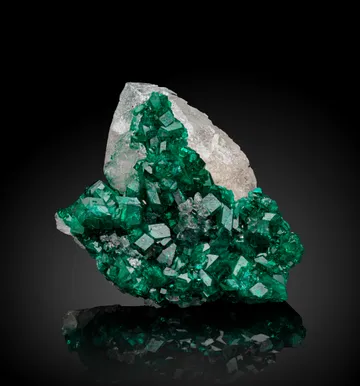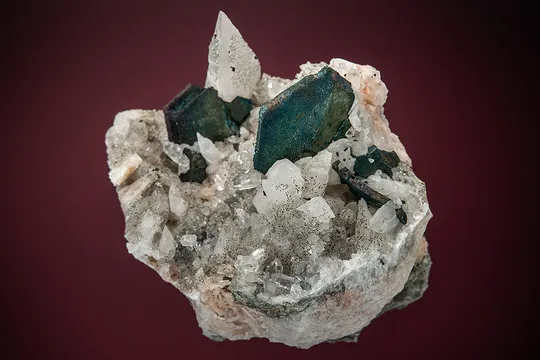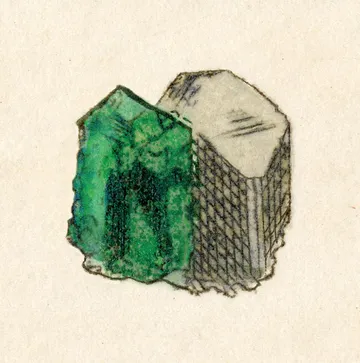
Altyn-Tyube area, Kazakhstan — type locality for dioptase; emerald-green crystals on calcite in a copper-silicate deposit, highly prized by collectors.
Key facts
Altyn-Tyube is one of the sacred names in dioptase collecting: the type locality of the species, a small copper occurrence on a low limestone hill in the open Kazakh Steppe east of Karaganda, and a place whose importance is wildly out of proportion to the modest scale of its workings. The deposit sits in the Bukhar-Zhyrau District of Karaganda Region, near the Altyn-Ssu or “Golden Stream,” in an austere grassland landscape historically labelled on older specimen tags as the Kirghiz Steppes. It is not a giant copper mine in the sense of Kazakhstan’s great industrial ore districts; its fame rests on the oxidized copper-silicate mineralization that lined fractures and cavities with emerald to blue-green dioptase on pale limestone and calcite.
The best Altyn-Tyube specimens have a look that collectors recognize instantly: sharp, glassy, intensely green trigonal dioptase crystals, often in sparkling crusts or clustered vugs, set on tan, white, or brownish limestone and calcite. Some pieces are flat plates; the better cabinet specimens rise into three-dimensional ridges, clefts, and pockets, with green crystals catching light from several directions. Calcite is the classic foil here—colourless to whitish, sometimes translucent, locally as rhombs or scalenohedral crystals—and the contrast between wet-looking calcite and saturated dioptase is the visual signature of the locality.
Historically, Altyn-Tyube is as important as it is beautiful. The green copper mineral was known long before modern mineralogy named it: the deposit has been connected with ancient pigment and copper use, with early specimens reaching the Russian and European scientific world in the late eighteenth century. The crystals were first confused with emerald, then separated as a distinct species by René-Just Haüy, who named dioptase for the visibility of internal cleavage planes through the crystals. For collectors, that makes an Altyn-Tyube dioptase not merely a pretty green copper silicate but a topotype specimen from the place that defined the mineral.
Regional View
Country View
Modern collecting interest has been sustained by intermittent specimen mining rather than ore production. The mineralogy is comparatively limited, but that narrowness is part of the appeal: Altyn-Tyube is not a locality of endless species lists; it is a locality where one species—dioptase—achieved historical and aesthetic immortality. Later work by Sergey Golomolzin and partners brought fresh material to the market, including clusters and plates that restored the locality to active collecting relevance well after many classic occurrences had become only museum names.

Photo: Wikimedia Commons
Search for specimens: View all specimens from Altyn-Tyube area, Kazakhstan
Altyn-Tyube, meaning “Golden Hill,” is a limestone knoll roughly 48 km east of Karaganda in central Kazakhstan and about 113 km west-northwest of Karkaralinsk. Older labels may place it in the “Kirghiz Steppes,” “Asiatic Steppes,” or “Karagandy Province,” while modern locality usage places the dioptase deposit in the Altyn-Tyube area, Bukhar-Zhyrau District, Karaganda Region. The site is remote even now: access is from the A-20 road and then across open steppe on a faint track, and visitors have described the final approach as an off-road drive whose difficulty changes dramatically with season.
Geologically, the dioptase occurrence is a small oxidized copper deposit developed in clay-rich Late Devonian limestones that lie discordantly on Middle Devonian andesite. The copper mineralization is associated with a nearby andesitic porphyry intrusion, and hydrothermal alteration introduced quartz, carbonate minerals, barite, and anhydrite into the limestones. In the volcanic rocks, alteration produced an epidote-chlorite assemblage. For the collector, the practical expression of that geology is simple and memorable: hard, silicified limestone cut by calcite-bearing fissures, with dioptase developed in openings where copper-bearing solutions met carbonate host rock and silica under oxidizing, arid conditions.
The primary ore suite documented from the deposit includes chalcopyrite, bornite, pyrite, and chalcocite, with rare galena and sphalerite. The visible collector suite is secondary: dioptase dominates, accompanied most characteristically by calcite, with malachite, cuprite, pseudomalachite, quartz, epidote, and native copper also recorded from the deposit. The broader Altyn-Tyube area also includes the Kanatkazgan turquoise occurrence, and turquoise has been documented from the area, including a large museum-quality specimen reportedly recovered while Sergey Golomolzin worked as a geologist at Altyn-Tyube.
Mining history here is unusually long. The locality has been connected with Neolithic pigment use and Bronze Age copper working, and it entered European mineralogical awareness in the late eighteenth century when green crystals from the deposit were taken for emerald. The first scientific controversy over the material belongs to the period when attractive green copper minerals, emerald, and early mineral names were still being untangled. Haüy’s recognition of the species gave Altyn-Tyube its enduring mineralogical status.
In more recent collecting history, Altyn-Tyube has functioned less as an ore mine than as a specimen operation. Reports from the late twentieth and early twenty-first centuries note abundant good specimens, crystals in the centimetre range, and periodic fresh production. By the early 2000s the deposit was again being worked for collector-quality material, and by 2013 the workings were permanently occupied, with drilling under way to locate new dioptase-bearing zones. Sergey Golomolzin has been repeatedly associated with modern Altyn-Tyube production, including work in partnership with Collector’s Edge Minerals.
Access today should be regarded as controlled and logistical rather than casual. This is not a roadcut or abandoned dump to wander without permission; it is a remote mine area with underground workings, active or intermittent specimen extraction, and the normal hazards of ladders, ventilation, pits, unstable rock, and weather. The steppe setting can make navigation deceptive, and even experienced visitors have emphasized the need for a guide. Collectors should assume that legitimate specimens are obtained through established dealers, mine operators, or older collections—not by unannounced field collecting.
The pockets that matter to collectors are fracture and cavity systems in limestone and calcite where dioptase had room to crystallize. Many specimens are crusts of bright green crystals over pale matrix, while the better finds show open vugs, calcite-lined clefts, and clusters with individual crystals approaching or exceeding 1 cm. Older literature and market records document crystals to about 2.7–3 cm, though such crystals are far above the norm; most cabinet-quality specimens rely on coverage, luster, transparency, and contrast rather than one isolated giant crystal.
Altyn-Tyube dioptase is the benchmark topotype material: emerald to blue-green, lustrous, transparent to translucent trigonal crystals on limestone and calcite, most commonly as drusy crusts, pocket linings, and clusters rather than freestanding singles. Typical crystals are a few millimetres to around 1 cm, with exceptional reported crystals in the 2–3 cm range; modern specimens often show crystals sprinkled or massed across tan limestone, white calcite, or glassy calcite clefts. The finest pieces from this locality combine saturated colour, sharp crystal form, high luster, minimal edge bruising, and a three-dimensional matrix that lets the green flash from multiple angles. Ordinary pieces can be attractive but flat, internally fractured, sparse, or visibly contacted; top Altyn-Tyube specimens have the historic cachet of a type locality with enough aesthetics to stand beside far newer African production.
Calcite at Altyn-Tyube is the principal display partner for dioptase rather than the main collector target in its own right. It occurs as vein and cavity calcite in the limestone, from massive or rhombic white to translucent material to sharper colourless or pale scalenohedral crystals that can host or frame dioptase. Good Altyn-Tyube calcite specimens matter when the calcite gives architecture to the piece: open clefts, sparkling rhombs, glassy translucent surfaces, or unusual larger calcite crystals with well-placed green dioptase. Calcite-only specimens are of limited locality interest, but dioptase-on-calcite pieces with clean contrast, balanced composition, and little bruising along pocket edges are among the most desirable expressions of the deposit.
Beyond dioptase and calcite, the documented Altyn-Tyube deposit suite is compact: chalcopyrite, bornite, chalcocite, pyrite, galena, sphalerite, cuprite, malachite, native copper, pseudomalachite, quartz, and epidote are recorded, with dioptase holding the single type-locality distinction. Pseudomalachite is a notable rarity in the assemblage, while malachite may appear as green secondary copper accents. Quartz has appeared on labels and in photo records, but locality specialists have cautioned that many supposed “quartz” associations are actually calcite, consistent with the deposit’s limestone and calcite-vein setting. In the broader Altyn-Tyube area, turquoise from the Kanatkazgan occurrence adds another collector-relevant copper phosphate association, but it should not be confused with the dioptase pockets of the main deposit.
Altyn-Tyube specimens are collected for three reasons at once: beauty, historical status, and topotype value. That combination makes locality accuracy important. Old labels may say Altyn-Tube, Altyn-Tyube, Altyntyube, Altyn-Tübe, Kirghiz Steppes, Karagandy Province, Qaraghandy Oblysy, or Kazakhstan; those variants can all point to the same historic source. More problematic are vague “Russia” labels on older specimens, a legacy of Imperial Russian and Soviet-era geography, and occasional labels that give Altyn Syu or “Golden Water,” a nearby lake name that has been reported as incorrect for dioptase specimens.
The chief condition issue is bruising. Dioptase has perfect cleavage and is brittle; Altyn-Tyube pieces often formed as pocket linings on hard matrix, so the edges of plates and vugs commonly show contacted or broken crystals from extraction and trimming. Inspect crystal tips and plate margins with a loupe. Minor peripheral damage is common and often acceptable on older or otherwise fine examples, but central broken crystals, muddy pocket debris, or dull, abraded surfaces reduce desirability sharply.
Colour can be difficult to judge from photographs. Altyn-Tyube dioptase often photographs bluer or darker than it appears in hand, and strong artificial lighting can distort the green. The best crystals should show high vitreous luster and a deep green body colour without looking black except in the thickest crystals. Internal fracturing is common, but well-formed crystals should still have flashes of transparency or translucency.
Mislabelling of associated minerals deserves attention. Many Altyn-Tyube pieces are accurately dioptase on calcite or limestone; some older or dealer labels call the pale matrix quartz. Quartz is recorded from the deposit, but calcite and limestone are far more characteristic in the dioptase specimens, and recent locality discussion has corrected some supposed quartz associations to calcite. A quick check with magnification, crystal habit, and, where appropriate, cautious acid testing on an inconspicuous broken chip can help resolve calcite versus quartz, though acid should never be applied to a display face.
Treatments are not a major documented issue for Altyn-Tyube dioptase in the way they are for some porous copper minerals, but stabilization or glue repairs may occur on fragile specimens. Look for resin sheen in cracks, unnatural gloss on matrix, and repaired clefts along trimmed edges. Dioptase should be kept away from hard knocks, ultrasonic cleaning, harsh acids, and aggressive washing. Calcite-bearing specimens are especially vulnerable to acids, and muddy pocket specimens should be cleaned conservatively.
Market availability is better than one might expect for such a historic type locality because modern intermittent specimen mining brought fresh pieces into circulation. Small cabinet and miniature specimens appear regularly, while large, highly three-dimensional plates with sharp, bright crystals and good calcite contrast are much less common. Compared with Tsumeb, Altyn-Tyube often remains more affordable at a given size, but the finest examples—especially old-provenance pieces, large plates, and specimens with crystals over 1 cm—are increasingly recognized as classics rather than substitutes.
The most vivid modern account of Altyn-Tyube comes from Jolyon Ralph’s 2013 visit with Kazakh mineral dealer Sergey Golomolzin. The journey itself reads like a reminder that locality names on labels can make difficult places feel deceptively tidy. After the long approach across Kazakhstan, the final run to the mine left the road and crossed open steppe on barely visible tracks. Along the way, the landscape turned unexpectedly alive: mushrooms appeared so abundantly that two large plastic carrier bags were filled in less than five minutes; wildlife included ibex, marmots, wild horses, birds of prey, and four eagles perched together on a rock before three lifted away.
At the mine, the surprise was not a romantic ruin but an inhabited specimen operation. The workings were occupied, drilling was under way to search for new dioptase-bearing ground, and the infrastructure was both rough and serious. Underground, the crew had built living quarters with bunks, a kitchen, and a storeroom. Water came from their own well, and the place was reportedly the only stop on that Kazakhstan trip where the tap water was safe to drink. Next to the underground living area was an underground sauna—an almost comic luxury in the middle of a remote steppe dioptase mine.
Guests did not sleep in the miners’ underground quarters. They stayed in a newly built guesthouse, which at that time offered a clean carpeted room, electric lighting, wide views, a telescope, and, most memorably, a trapdoor leading down into an underground dioptase mine. Ralph described Sergey descending through the trapdoor, followed by ladders, ventilation, and then the reason for the journey: green traces in the wall. Even with basic equipment, the mine crew took ventilation seriously, a detail that matters in a locality where specimen romance can obscure real underground risk.
The collecting moment was exactly what a dioptase collector would hope for. In the workings and the open pit, green crystals showed in mud and on loose rocks; pieces coated with dioptase lay along the path. Ralph found a specimen with crystals to about 1 cm—not perfect, needing trimming, but personally important because collecting his own centimetre-scale dioptase at the type locality had long been a dream. As the sun dropped, collecting had to stop. The evening ended back near the living-quarter entrance, where plans for dinner overlapped with the presence of hunters who used the mine as a base for marmot. Fresh meat dumplings were served, prompting the sort of field-camp question one learns not to ask too closely: “What meat is this?”