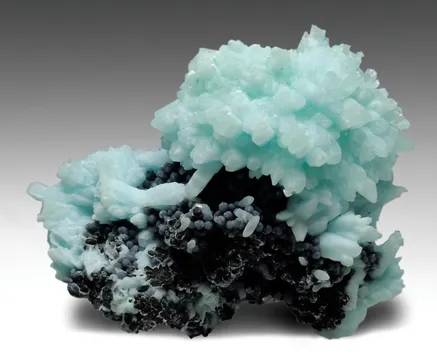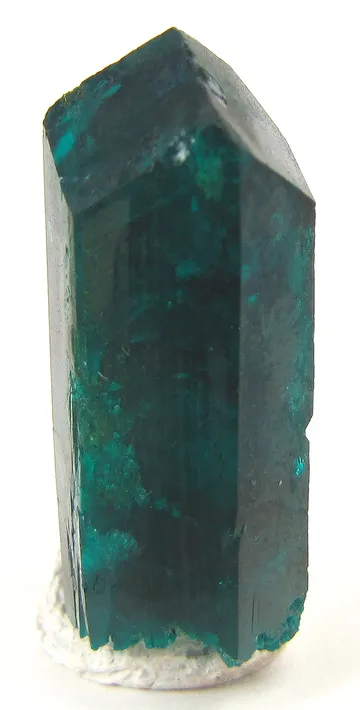
Kaokoveld Plateau, Namibia — a classic copper-mineral locality known for vivid dioptase and shattuckite, unique desert matrix, and strong collecting appeal.
Key facts
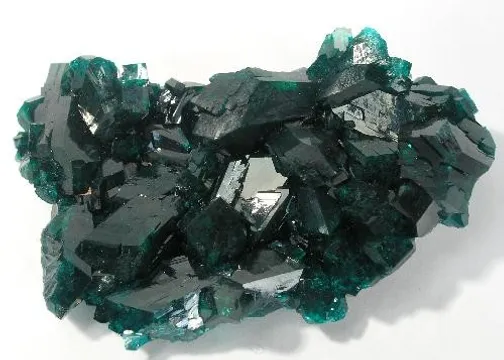
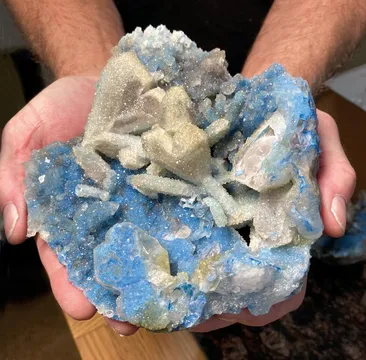
The Kaokoveld Plateau of northwestern Namibia is one of the modern classic districts for secondary copper minerals, and for collectors it occupies a very particular niche: it is not a single deep, industrial monster like Tsumeb, but a scattered belt of shallow pits, trenches, artisanal diggings, and small mines in the remote Kunene region between Opuwo and Sesfontein. Its best specimens come from oxidized copper-lead mineralization in Otavi Group carbonate rocks and associated quartz-rich breccias, where chalcocite, bornite, galena, and barite-bearing primary assemblages have weathered into a brilliant suite of copper silicates, carbonates, and lead species. The look is instantly recognizable at its best: emerald to bluish-green dioptase standing above powder-blue to royal-blue shattuckite or plancheite; malachite balls and sprays set into shattuckite-lined cavities; quartz druses frosting blue copper silicate; occasional wulfenite plates in yellow, orange, brown, or clay-coated darker tones; and sharp cerussite twins from the lead-rich portions of the system.
What makes Kaokoveld especially important is the way it reset expectations for shattuckite. The district’s radial, velvet-blue aggregates and quartz-coated pseudomorphs are among the finest known for the species, and they are not merely supporting actors beneath dioptase: many Kaokoveld shattuckites are centerpiece specimens in their own right. Dioptase gives the district its broad market appeal, however. Omaue, Okandawasi/Kandesei, Christoff, Okarvizo, and related workings have produced crystals that can be long, lustrous, and intensely colored, with a subtly bluish cast compared with much Tsumeb material. The finest pieces carry both locality identity and cabinet presence: green glass on blue velvet, or green glass on pale calcite and quartz, with a rugged desert-mine matrix that distinguishes them from the calcite-rich elegance of Tsumeb.
Regional View
Country View
Historically, the district is a late-20th- and early-21st-century collector locality. The Omaue Mine, at Camp Aussicht, became known from the 1980s onward as a specimen mine for dioptase and chrysocolla, while later discoveries at Okandawasi/Kandesei, Christoff, Van der Plas, Onderra, Okatumba, Okarvizo, and other nearby prospects broadened the assemblage dramatically. The best Kaokoveld pieces entered the international market through Namibian dealers and major show circuits rather than through a long industrial mining history; this is why labels can be imprecise, and why “Kaokoveld Plateau” is often the safest umbrella locality for older specimens whose exact pit name has been lost or deliberately obscured.

Photo: Wikimedia Commons

Photo: Wikimedia Commons
Search for specimens: View all specimens from Kaokoveld Plateau, Namibia
The Kaokoveld copper district lies in the Kunene region of northwestern Namibia, in a remote part of the Kaoko/Otavi structural domain where mineral workings are spread across rugged country rather than concentrated in one continuous mine. The main collecting and specimen-producing areas are reached from the Opuwo–Sesfontein road, with important workings including Omaue, Otuani, Onderra, Okandawasi/Kandesei, Christoff, Van der Plas, Okatumba, Otjozongombe/Kandesi, Okapanda/Otjhowe, Okarvizo, Omatapati, and Okakuyu. Older labels may use “Kaokoveld Mine,” “Kandesi,” “Kandesei,” “Okandawasi,” “Otjikotu,” or simply “Kaokoland,” and these names have not always been applied consistently by miners, operators, or dealers.
Geologically, the collector minerals are the oxidized expression of sediment-hosted copper-lead mineralization. The mineralized rocks belong mainly to carbonate and subordinate clastic units of the Otavi Group, especially the Ombombo and Abenab successions overlying older Nosib Group terrigenous sediments. The district sits within the north-south coastal arm of the Damara Orogen, a late Proterozoic to early Paleozoic rift-related belt later deformed into folds, thrusts, and fault zones. Mineralization is concentrated in three main forms: stratiform disseminated copper sulfides with pyrite and galena; stockwork quartz veins with lenticular copper sulfide pockets and galena; and fault-related quartz veining carrying chalcocite, galena, and secondary copper minerals. The carbonate host rocks mattered profoundly for specimen formation, because dolomite and limestone buffered the supergene fluids and provided cavities, fractures, and breccia spaces in which copper silicates could grow.
The ore mineralogy begins with chalcocite, bornite, galena, pyrite, minor tetrahedrite, sphalerite, and quartz-calcite-barite gangue. In the weathered zone, oxidation has produced a secondary assemblage dominated not by the classic native copper–cuprite suite alone, but by copper silicates: dioptase, shattuckite, plancheite, chrysocolla, and associated malachite. Core drilling and mine observations show that oxidation can extend to depths of at least tens of meters, and supergene enrichment at the base of the oxidation zone is a major reason for the abundance of copper-silicate specimens. The dry climate, seasonal rainfall, steep terrain, and shallow calcareous soils have preserved localized pockets rather than broad, deeply leached profiles.
Omaue is the best-known early specimen locality. It is a copper sulfide occurrence in quartz veins within Otavi limestones, famous for a well-developed oxidation zone rich in secondary copper minerals. The mine has been associated for decades with Marius Steiner and Camp Aussicht, and specimen mining there helped establish Kaokoveld dioptase as a world-class collector material. Omaue is especially valued for dioptase with plancheite, malachite, chrysocolla, quartz, honey-yellow barite, and occasional anglesite or wulfenite. The original productive area has been described as depleted, but nearby mineralized zones in the same host rocks have continued to interest prospectors and collectors.
Okandawasi/Kandesei is the other great name attached to Kaokoveld specimens. It is the largest of the district’s specimen excavations, developed around pods of chalcocite and copper-silicate mineralization in folded Ombombo and Abenab carbonate rocks. It has yielded excellent dioptase and shattuckite, and it is central to the locality-name confusion because “Kandesi,” “Kaokoveld Mine,” “Old German Mine,” and “Otjikotu” have all appeared on labels or in reports for material from this general group of workings. Good Okandawasi/Kandesei pieces often show strong blue shattuckite, plancheite, chrysocolla, malachite, dioptase, and quartz, sometimes with later coatings of hemimorphite or mottramite.
Christoff, near Okandawasi, produced an exceptional dioptase find in 2007 and has also yielded cerussite, cuprite, mottramite, beyerite, and bismuth-bearing secondary assemblages. Van der Plas became notable from 2009 onward for cerussite twins and crystal groups, as well as large but often clay-, manganese oxide-, and silica-coated wulfenites that can be extremely difficult to clean without surface damage. Onderra, a small lead-copper pit in limestone, is the district’s best-known source of wulfenite, including tabular crystals and combinations with dioptase or shattuckite. Okatumba, close to the main road near the village of the same name, has produced wulfenite and unusual shattuckite pseudomorphs, while Okarvizo is known for chrysocolla-rich breccia with pockets of small, sometimes doubly terminated dioptase.
Mining history here is a mixture of exploration, artisanal digging, specimen mining, and limited copper production. The Kunene Copper Belt has been explored for more than half a century, yet no large Tsumeb-scale deposit has emerged from the Kaokoveld specimen district. Much specimen recovery has been carried out by local Herero miners and small groups of diggers working by hand, which partly explains why delicate specimens survived: many pockets were not blasted or crushed for ore. Mechanical mining and copper-concentrate production have occurred at some operations, but the specimens most collectors know are largely the product of shallow, selective work in oxidized pockets and breccias.
Collecting access should be treated as restricted and permission-based. The workings are on active or formerly active mineral claims, communal lands, and private or operator-controlled ground, not public collecting sites. Visitors in Namibia also need to be attentive to national mineral regulations: private collectors and researchers require Ministry of Mines and Energy permission for material collected or purchased, export of minerals requires written permission/export permits, and commercial export involves additional requirements. In practical collecting terms, most serious collectors acquire Kaokoveld specimens through established dealers, miners, or local sellers with clear legal export documentation rather than attempting casual field collecting.
Kaokoveld dioptase is typically thinner and more elongated than much classic Tsumeb material, with an emerald-green color that often carries a slight bluish tone; first-generation crystals are widespread but usually small, commonly under 5 mm and rarely more than 1 cm, while later dioptase on chrysocolla produced the district’s finest crystals, more often a few millimeters to 3 cm but exceptionally reported as individual crystals to 9 cm. The strongest pieces come from Omaue, Okandawasi/Kandesei, Christoff, Okarvizo, and related workings, where dioptase occurs with shattuckite, plancheite, chrysocolla, malachite, quartz, calcite, barite, and locally wulfenite or mottramite; good specimens are sharply terminated, lustrous, undamaged, and positioned above contrasting blue copper silicate or pale calcite/quartz matrix, while ordinary examples are small, partly coated, bruised, dull, or visually lost in massive chrysocolla.
Shattuckite is one of the district’s signature minerals and the species for which Kaokoveld has few serious rivals: it forms velvet-like concentric radial aggregates, botryoidal crusts, quartz-coated blue spheres, massive breccia cement, vein fillings, and notable pseudomorphs after quartz, first-generation dioptase, and very rarely wulfenite. Color varies by mine, from pale turquoise-blue at Omaue and Kandesei to deep, saturated blue at Okandawasi, with some spherical aggregates showing darker centers and paler rims or the reverse; the best pieces combine strong blue texture, sculptural pocket form, and associations with plancheite, chrysocolla, quartz, malachite, and later dioptase, while lesser material is massive, chalky, indistinct, or overly coated by silica and chrysocolla.
Malachite is the common copper mineral of the Kaokoveld workings, occurring at essentially all major prospects, but the collector-quality material is far more selective: fine fibrous bundles, sheaf-like balls, radial clusters, and green spherical aggregates can reach about 3 cm across and are especially attractive where they sit in blue shattuckite-lined pockets or carry a thin sparkling skin of transparent quartz. Kandesei, Okapanda, Okandawasi, Okatumba, and Okarvizo have produced memorable pieces, including malachite with shattuckite, wulfenite, quartz, calcite, dioptase, and chrysocolla; the most desirable specimens show discrete, velvety or silky form and strong contrast, while ordinary examples are massive, broken, powdery, or simply green copper-ore matrix.
Quartz is the principal gangue phase in the Kaokoveld breccia and vein systems, and as a collector mineral it matters most when it interacts with the copper silicates: massive milky quartz hosts sulfides and early mineralization, while later quartz forms smaller but better developed crystals, drusy coatings, and clear to smoky or yellow-orange hematite-included terminations that can reach about 10 cm. Kandesei and Christoff have produced the better quartz crystals, including specimens with inclusions of chrysocolla, shattuckite, plancheite, and rarely dioptase; the finest examples are clean, transparent or attractively included crystals on blue shattuckite or green dioptase-bearing matrix, whereas lesser pieces are merely white vein quartz with little pocket definition.
Chrysocolla is common across the Kaokoveld specimen diggings and has been mined both as lapidary rough and, when copper prices justified it, as hand-sorted copper ore; in specimens it most often appears as massive to botryoidal turquoise-blue, blue-green, or green crusts and breccia fillings, commonly covering or replacing earlier copper silicates except where late dioptase grew on top. It is a major matrix and color component at Omaue, Otuani, Okandawasi/Kandesei, Okarvizo, Omatapati, and Okakuyu, and the best collector pieces are not massive chrysocolla alone but balanced combinations with lustrous dioptase, radial shattuckite, malachite, or plancheite, where the chrysocolla provides a saturated blue base without obscuring sharper minerals.
Plancheite is widespread but seldom the dominant visual mineral unless preserved as pale to medium blue fibrous masses, balls, or linings beneath later shattuckite and chrysocolla; much of it represents replacement of early dioptase, so the best specimens reward close inspection of paragenesis as much as color. The Okandawasi and Kandesei pits have yielded the finest plancheite-bearing pieces, while Omaue is well known for combinations of dioptase on blue plancheite with malachite or quartz; top examples show distinct blue fibrous texture and a readable relationship with later green dioptase or darker shattuckite, whereas ordinary pieces are easily dismissed as anonymous pale-blue copper-silicate coating.
Cerussite is a later-recognized but important lead-zone mineral in the district, best known from the Van der Plas Mine, where V-twins and crystal groups to several centimeters gave Kaokoveld a collectible species beyond its copper silicates. Christoff has also produced prismatic cerussite crystals, and Okatumba material is documented with massive shattuckite and malachite; the best pieces have sharp twinning, high luster, and enough transparency or metallic-looking brilliance to stand apart from the matrix, while lesser examples are small, iron-stained, embedded in massive ore, or visually overwhelmed by more colorful copper minerals.
Kaokoveld wulfenite is widespread but truly abundant only in parts of the Onderra system, with additional notable material from Van der Plas, Okatumba, Okandawasi, Omaue, and Kandesei; crystals range from millimeter plates to much larger tabular or prismatic forms, with colors from pale cream and lemon-yellow through orange, yellow-brown, and dark brown. The most attractive combinations place wulfenite with dioptase or shattuckite, especially from Omaue and Kandesei, but many Van der Plas and Onderra specimens are coated with kaolinite, goethite, malachite, mottramite, manganese oxides, or silica, making condition and cleaning history critical; the best pieces retain sharp, lustrous faces and good color without etched or corroded edges.
Calcite is common throughout the Kaokoveld workings and serves both as gangue and as a display matrix for better copper minerals; large rhombohedral crystals, sometimes carrying attractive mosaics of hematite and manganese oxide inclusions, are known from Okomunwe, Okandawasi, and Van der Plas, while Onderra has produced transparent to milky calcite with dioptase that recalls classic Tsumeb combinations. Collector interest is highest when calcite provides bright white or glassy contrast for emerald dioptase, cerussite, or blue copper silicates, and much lower when it appears only as rough carbonate matrix or iron-stained vein fill.
Beyond the headline species, the Kaokoveld Plateau is a surprisingly rich locality suite for secondary copper, lead, bismuth, silver, and vanadium minerals. Anglesite, barite, azurite, cuprite, galena, chalcocite, djurleite, bornite, goethite, hematite, hemimorphite, leadhillite, mottramite, namibite, mimetite, conichalcite, chlorargyrite, iodargyrite, lanarkite, plattnerite, scrutinyite, pyromorphite, tenorite, vanadinite, native copper, and a rare native silver wire occurrence are all documented from the district or its component prospects. The most intriguing rarities tend to be small: apachite as greenish-blue botryoidal crusts of needles on chrysocolla from Okandawasi; beyerite and bismutite in bismuth-rich assemblages with mottramite, shattuckite, malachite, calcite, and dolomite; namibite from Kandesei and Christoff-style bismuth-vanadium associations; and rare arsenates such as conichalcite and mimetite concentrated near “anomaly G,” a striking contrast to Tsumeb, where arsenates are far more prominent.
Kaokoveld specimens are generally not a treatment-heavy field, but they are very much a label-sensitive field. The biggest authenticity issue is locality precision rather than synthetic material. “Kaokoveld,” “Kaokoland,” “Kandesei,” “Kandesi,” “Okandawasi,” “Otjikotu,” “Omaue,” “Onderra,” and “Kaokoveld Mine” have all appeared on labels, sometimes correctly, sometimes as broad trade shorthand, and sometimes because exact pocket locations were intentionally kept vague. A specimen labeled simply “Kaokoveld Plateau” can be entirely legitimate; a specimen labeled to a very specific pit should ideally have a credible old label, dealer provenance, or a physical assemblage that fits the claimed source.
The most common mislabeling problem is confusion with Tsumeb dioptase. Tsumeb dioptase commonly sits on white calcite or Tsumeb-style carbonate matrix and has its own historical label ecology, while Kaokoveld material often shows blue copper silicates—shattuckite, plancheite, chrysocolla—or a more earthy, brecciated quartz-carbonate matrix. That said, Onderra calcite-dioptase specimens can look Tsumeb-like, and isolated loose dioptase crystals without matrix are difficult to place securely. For unlabeled specimens, a Kaokoveld attribution is strongest when dioptase is directly associated with shattuckite, plancheite, chrysocolla, or quartz-coated blue copper-silicate pockets.
Condition matters greatly. Dioptase has perfect cleavage and is brittle, so edge bruising, cleaved terminations, and missing crystal tips are common. Quartz-coated “sugar” surfaces can be either an attractive natural feature or a distraction, depending on whether the underlying crystal form remains readable. Shattuckite and plancheite are often fibrous or velvety and should be handled gently; do not scrub blue surfaces or use aggressive cleaning. Wulfenite from Van der Plas and Onderra may be naturally coated with clay, goethite, mottramite, manganese oxides, or silica, and attempts to remove these coatings can permanently dull or etch the crystal faces. Malachite balls and sprays are also vulnerable to abrasion, especially when the specimen has been dug from dry, friable matrix.
The market remains active because the district produced enough material to support a broad collector base, but quality is highly stratified. Small dioptase thumbnails and miniatures, blue shattuckite fragments, chrysocolla-rich pieces, and mixed copper-silicate specimens are regularly available. Fine large dioptase crystals, aesthetic dioptase-on-plancheite plates, deep-blue shattuckite pocket specimens, sharp cerussite twins, and clean wulfenite combinations are far less common and command a premium. The best pieces combine saturated color, clear species contrast, undamaged crystals, and a trustworthy locality history.
The Kaokoveld story is unusually personal for a modern mineral district because one of its best-known sources, the Omaue Mine, grew around Camp Aussicht and the long work of Marius Steiner. Travel accounts describe Steiner arriving decades ago on leased land in search of dioptase, then developing both a mine and a camp above it, a place where guests could look out over the hard Kunene landscape, visit a mine gallery, and encounter the Himba culture of the region. For collectors, that human setting is part of the charm: Omaue specimens do not come from anonymous industrial benches but from a desert-edge enterprise where mineral hunting, hospitality, and local geography became intertwined.
Field access itself shaped the way specimens came out. The district’s roads from the Opuwo–Sesfontein route lead through poor tracks and dry riverbeds; when the rains arrive, those routes can become impassable, and specimen mining traditionally pauses from early December until roughly mid-April. That rhythm matters. Kaokoveld pockets were not a year-round factory supply. They were seasonal, local, and dependent on miners working shallow oxidized zones by hand in a terrain where summer rain, heat, and distance governed what could be recovered and when it could reach the market.
A memorable specimen-market anecdote follows one large Omaue dioptase on plancheite plate, a 14 x 9 x 6 cm cabinet specimen from the Irv Brown collection. The piece was described as having large elongated dioptase crystals in a vug lined by blue plancheite and was illustrated in Ludi von Bezing’s Namibia II book. Its later dealer listing carried a wonderfully collector-world coda: at a birthday party for San Francisco-area collector Jack Halpern, attendees were asked to bring a “best Jack rock,” and when Halpern judged the table, he chose that Omaue dioptase as his favorite. It is exactly the sort of story that tells you how Kaokoveld material lives in collections—not merely as locality data, but as showpiece color and social memory.
The district also has a roadside and village-mineral culture familiar to anyone who has collected in Namibia. Mindat photographs document mineral buying in Ojikukutu village, where almost everyone in the small village was described as having minerals for sale. That image—collectors, travelers, and local sellers meeting far from the polished showrooms of Windhoek or Tucson—captures a real part of the Kaokoveld supply chain. Many pieces passed first through local hands, then to Namibian dealers, then outward to international collectors, carrying with them the locality-name uncertainty and human texture that make the district both fascinating and frustrating.