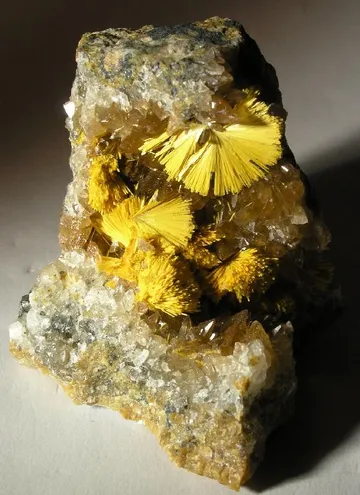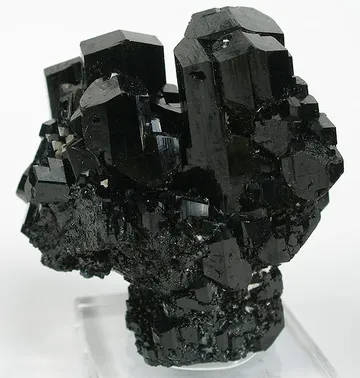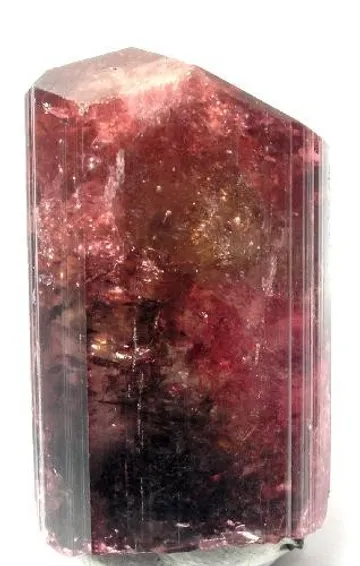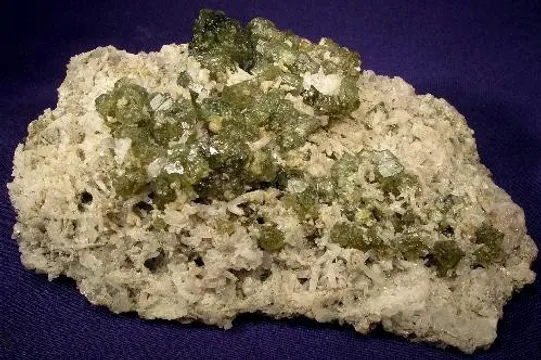
Ameib Farm 60, Namibia - Erongo’s classic jeremejevite locality, yielding slender blue to violet crystals in near-surface cavities, prized for rarity and form.
Key facts
Ameib Farm 60 sits on the south-western flank of Namibia’s Erongo Mountains, a great Cretaceous volcano-plutonic ring complex whose weathered granites, pegmatitic zones and miarolitic cavities have made the district one of Africa’s classic specimen provinces. For collectors, Ameib is not a single tidy mine so much as a private farm and historic collecting ground: granite slopes, near-surface cavities, simple pegmatite exposures, old tin history and small modern gemstone workings all overlap in the same dramatic boulder country known to tourists for Phillip’s Cave and Bull’s Party.
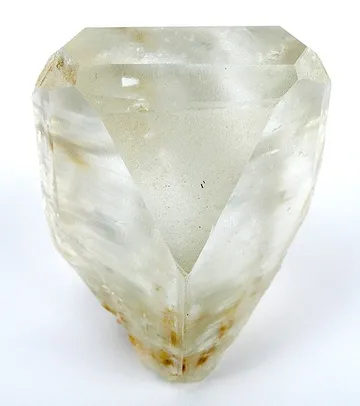
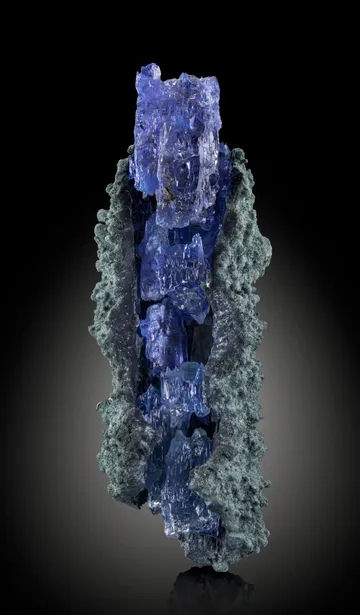
Its mineralogical fame rests above all on jeremejevite. The Ameib material transformed a species once known mostly as a mineralogical rarity into a coveted cabinet and gem-crystal mineral: slender to stout hexagonal prisms, colorless through pale blue to richer sky blue and rare violet, many transparent enough to be cut but far more important when preserved as complete crystals. The best Ameib specimens have the lean, icy elegance that advanced collectors prize—glass-bright blue prisms, sometimes etched, sometimes sharply terminated, and occasionally accompanied by black to dark-green acicular tourmaline-group crystals, feldspar, quartz, cassiterite or microcline.
The locality also belongs to the longer Erongo specimen story: aquamarine, schorl, smoky quartz, feldspar, fluorite, topaz, cassiterite and hyalite opal from small cavities and pegmatitic environments. Ameib’s older historical note is equally important: topaz was recorded from the farm under the old name Hauneib in the late 1880s, and cassiterite was first recognized in the Erongo area on Ameib in 1910. That makes the farm both a modern rare-mineral locality and one of the early landmarks in Erongo mineral prospecting.
Regional View
Country View
The Erongo setting matters to the appearance of Ameib specimens. These are not sulfide-ore minerals from a deep industrial mine; they are late-stage, volatile-rich products of granitic cavities. The best pieces show the architectural simplicity of pocket minerals: pale feldspar, smoky or colorless quartz, black tourmaline, and a rare borate crystal that can look at first glance like a tiny aquamarine until its greater scarcity, chemistry and collector consequence are understood.

Photo: Wikimedia Commons

Photo: Wikimedia Commons
Search for specimens: View all specimens from Ameib Farm 60, Namibia
Ameib Farm 60 is in the Usakos area of the Karibib Constituency, Erongo Region, on the south-western margin of the Erongo Mountains. The broader Erongo massif is a roughly 35 km diameter Cretaceous granitic complex, rising more than 1,000 m above older Damara metasediments and granites. Its geology is not simply one granite body: volcanic rocks, granitic to granodioritic intrusive phases and a weathered ring-complex architecture produced the cavities and pegmatitic environments that collectors now know from labels reading Erongo, Ameib, Davib Ost, Brabant, Hohenstein and related farm names.
The specimen-producing environment at Ameib is best understood as miarolitic cavities and pegmatitic to granitic pocket systems rather than a continuous orebody. The jeremejevite occurrence described in the early 2000s was found in granite on the eastern side of the Erongo ring complex, near the common border area of Ameib Farm with Davib Ost and Brabant. The crystals came from small miarolitic cavities and pipe-like structures, with many pieces recovered as loose singles rather than firmly attached matrix specimens. This is why fine matrix jeremejevite from Ameib is so much rarer than loose crystals, and why labels for attractive single crystals often emphasize termination, transparency and color rather than matrix association.
The ore-mineral history is older than the jeremejevite fame. Topaz was already recorded from Ameib—then referred to as Hauneib—in the late 1880s, alongside Klein Spitzkoppe as one of Namibia’s earliest noted topaz occurrences. Cassiterite was first found in the Erongo area on Ameib in 1910, and the region later saw mining for tin, tungsten, lithium, niobium and tantalum minerals in pegmatitic and related deposits. At Ameib itself, cassiterite remains part of the documented mineral suite, though the modern collector identity of the farm is far more closely tied to miarolitic gem minerals.
The great jeremejevite event began in March 2001, when small intense-blue crystals from a granite cavity were first thought to be beryl. Because many were less than a centimeter long, they did not immediately receive the attention that, in retrospect, they deserved. Georg Gebhard suspected a rarer identity and had material examined by Dr. Jochen Schlüter at Hamburg University; X-ray powder diffraction confirmed jeremejevite. Once the local miners were asked to recover more, several nearby pipe-like cavities produced a few thousand crystals before significant production ceased in July 2001.
The 2001 output was numerous only by jeremejevite standards. Contemporary reporting gave a total of roughly 3,000 to 3,500 crystals, about half of them colorless or nearly colorless and generally up to 1 cm long and 0.1 cm wide. About 500 crystals reached the 1–3 cm range; very few were up to 5 cm; and fewer than ten were known to the reporter in the 5–7 cm class. Color ranged from colorless and pale yellow through many blues to violet. Saturated blue crystals reached as much as 7 cm and 13 g, while violet examples were especially uncommon and recorded to about 4 cm. Most were loose, and many showed surface evidence suggesting former intergrowth with other crystals.
Ameib did not end with 2001. Market reports describe work resuming around January 2008 and pale-blue gemmy crystals appearing again in 2009, probably from Ameib Farm 60 between Tubussis and Usakos. A late-2010 pocket, represented in early-2011 dealer offerings, produced medium-blue, heavily etched crystals, many around 3 cm and some to 5 cm, with patches or nests of gray-green acicular tourmaline-group crystals. These later pockets are central to how collectors distinguish “classic 2001” Ameib material from the more etched, tourmaline-associated specimens of the 2008–2010 period.
Mining and prospecting at Farm Ameib have continued intermittently at the small-claim scale rather than as a large industrial mine. Namibian government and environmental records list non-exclusive prospecting licences and mining claims on Farm Ameib No. 60 through the 2000s, 2010s and 2020s, including claims or applications connected with semiprecious stones, aquamarine, topaz and tourmaline. This is consistent with the character of the district: small groups or claimholders working pockets and pegmatitic zones, not an open-pit operation aimed at bulk ore.
Collecting access today must be treated as private-land and claim-controlled access. Ameib is a guesthouse, camping area and private nature reserve landscape with established tourist trails to Phillip’s Cave, Bull’s Party and Elephant’s Head, but sightseeing access is not permission to dig minerals. Serious collectors should assume that any field collecting requires explicit landowner permission and, where claims are active, permission from the relevant claimholder and compliance with Namibian law. The old pocket areas are also geologically limited; the best jeremejevite crystals entered the market through organized local mining and dealer networks, not casual roadside collecting.
Jeremejevite from Ameib Farm 60 is the locality’s defining species: Al6(BO3)5(F,OH)3 occurring as slender needle-like to more robust columnar hexagonal crystals, most commonly loose, transparent to highly transparent, and ranging from colorless or nearly colorless through pale yellow, pale blue, saturated sky blue and rare violet. The first major pocket system in 2001 produced thousands of crystals, but the collector-grade fraction narrows quickly: many were sub-centimeter, only a minority reached 1–3 cm, very few reached 5 cm, and the exceptional blue crystals in the 5–7 cm class are major rarities. Most Ameib jeremejevites are singles rather than matrix specimens, though the best matrix or association pieces may show feldspar/quartz or dark tourmaline-group needles; later finds from the 2008–2010 period are especially noted for etched blue crystals and gray-green acicular tourmaline-group material. Good pieces from Ameib separate themselves by complete crystal form, undamaged termination, high glassy luster, visible blue body color, transparency, and honest surface character—etched or frosted examples can be excellent when the color and form remain strong, but broken, pale, wafer-thin, or badly contacted crystals are far more ordinary for the locality.
Other documented minerals from Ameib Farm 60 include beryl, aquamarine, cassiterite, elbaite, fluorapatite, fluorite, microcline, hyalite opal, quartz, smoky quartz, schorl and topaz. Foitite is a particularly interesting name on Ameib labels because it has been cited with the jeremejevite association, especially for thin black to dark-green acicular tourmaline-group crystals, but the occurrence is also treated cautiously in some databases because analytical details have been questioned. Purpurite has appeared historically in the literature for Ameib but is treated as erroneous. For collectors, the most important secondary suite is the Erongo-style cavity assemblage—feldspar, quartz, schorl, fluorite, topaz and cassiterite—because those species provide context for the jeremejevite pockets and help separate a believable Ameib paragenesis from a generic “Erongo” label.
Ameib jeremejevite is genuinely rare, but it is not rare in the same way at every quality tier. Small, pale, loose crystals exist in enough numbers that patient collectors can obtain examples; transparent blue crystals over 2–3 cm are much scarcer; clean, saturated, complete crystals approaching 5 cm or more are major specimens; and attractive matrix pieces are significantly rarer than singles. Faceted stones also exist, but the specimen collector should remember that cutting pressure has always competed with preservation, especially for deeply colored transparent crystals.
The chief authenticity issue is not a well-documented industry of fake Ameib jeremejevite; it is locality precision and species confusion. Early blue crystals were mistaken for beryl, and even today a slender pale-blue hexagonal prism can visually suggest aquamarine to a non-specialist. Conversely, some loose Erongo jeremejevite may be marketed with broad labels such as “Erongo Mountains,” “Ameib,” “Ameib Ranch,” or even nearby regional names. A high-end purchase should come with a careful provenance chain, and where the value depends strongly on the Ameib name, the label history should be as important as the crystal.
Be cautious with association names. Black or dark-green acicular tourmaline-group crystals on or near Ameib jeremejevite are often labeled foitite, but unless analysis is documented, “tourmaline group” or “foitite?” may be the more conservative wording. Mindat’s treatment of foitite from Ameib as questioned is not a trivial detail; it reflects exactly the kind of label drift that occurs when a rare mineral is associated with visually similar tourmalines and the market wants a more specific name than the evidence always supports.
Condition is everything. Many Ameib crystals were recovered loose from pocket fillings or alluvial material and may show natural etching, healed contacts, intergrowth marks, basal bruising or incomplete terminations. Do not automatically penalize natural etched surfaces; some later Ameib material is characteristically grooved, pitted or frosted. Do penalize fresh breakage, chipped tips, glued repairs, or trimming that disguises an incomplete crystal. Because many crystals are narrow, even small nicks can dominate the visual effect under magnification.
Color should be judged in daylight-equivalent lighting against a neutral background. Pale blue Ameib crystals can bleach visually under strong direct light and look nearly colorless; stronger crystals show blue down the c-axis or along thicker zones. Pleochroism and internal banding are part of the gemological character of Namibian jeremejevite, so rotate a crystal before judging it. Fine pieces often reward side-lighting more than front-lighting.
For handling, treat jeremejevite as a rare gem mineral, not as a rugged pegmatite workhorse. It has enough hardness for careful display, but long, thin crystals are vulnerable to leverage and point impacts. Avoid tight perky-box lids pressing on terminations, and do not clean etched or matrix pieces aggressively. There is no need for routine treatment or oiling; any clarity enhancement, coating, or suspiciously glossy fracture should be disclosed and treated as a serious value issue.
The best Ameib story begins with a mistake. In March 2001, miners working granite cavities on the eastern side of the Erongo ring complex recovered small, intensely blue crystals on Ameib Farm near the Davib Ost and Brabant borders. The crystals looked enough like beryl that the first reaction was muted; many were under a centimeter long, and in a district famous for aquamarine, little blue prisms did not immediately announce themselves as one of the rarest borates in the mineral kingdom.
Georg Gebhard did not let the matter rest. Suspecting that the blue prisms might be something far more unusual, he sent material to Dr. Jochen Schlüter at Hamburg University. X-ray powder diffraction supplied the answer: jeremejevite. That changed the value of the little crystals overnight. What had been overlooked as modest beryl became one of the most consequential rare-mineral discoveries in modern Namibia.
Once the identity was known, the request went back to the local miners: find more. They did. Several nearby pipe-like cavities yielded crystals of many colors—mostly colorless, but also pale yellow, blue, saturated blue and rare violet. By July 2001, the short-lived production had effectively ended, leaving behind a surprisingly precise numerical portrait: roughly 3,000 to 3,500 crystals total, about half of them colorless or near colorless and often no more than 1 cm long and 0.1 cm wide. About 500 reached 1–3 cm. Very few attained 5 cm. Fewer than ten were known in the 5–7 cm range.
The story has the strange arithmetic of rare minerals. A few thousand crystals sounds abundant until one remembers that most were tiny, pale, thin, loose, or damaged. The saturated blue crystals were the prize; violet was rarer still. The blue crystals could reach 7 cm and 13 g, but most were too narrow for large gems. Even among faceted stones from the Erongo material, only about one percent were estimated to exceed 1 ct, and stones up to 5 ct were counted in single digits. One exceptional faceted jeremejevite of nearly 13 ct stood apart from the rest.
Ameib’s later chapters are quieter but still important. Work resumed around January 2008, and by 2009 pale-blue gem crystals from Erongo were being discussed in the market with Ameib 60 as the likely source. The specimens described at the time were loose crystals from 1.3 cm to nearly 3 cm—some heavily etched, others unetched, thick, hexagonal prisms with terminal pyramid and basal pinacoid faces. The comparison to aquamarine returned, but now as an aesthetic observation rather than a mistaken identity.
Then came the late-2010 pocket reported in early 2011: lustrous, entirely gemmy, medium-blue jeremejevites, most around 3 cm and some to 5 cm. These were not the smooth little prisms of the collector’s imagination. They carried complex grooves, pitted surfaces, heavy etching and ragged terminations; on some, patches and nests of gray-green acicular tourmaline-group crystals clung to the sides. The image is wonderfully Erongo: blue borate crystals floating in a pocket filling of needles, beautiful enough that one contemporary writer winced at the thought of how many might be “slaughtered” for faceting.
Wendell E. Wilson, Christopher W. Johnston and Edward R. Swoboda, “Jeremejevite from Namibia,” The Mineralogical Record, 33(4), 289–301, 2002 — The key Namibia jeremejevite paper, covering the classic Namibian occurrences and the newly discovered Erongo material. Mineralogical Record issue listing
Georg Gebhard, “Jeremejevite from the Erongo Mountains, Namibia,” Gems & Gemology, Gem News International, Fall 2002 — The most useful contemporary account for Ameib collectors, with the March 2001 discovery, X-ray identification, crystal counts, color range, sizes, gem data and production end date. GIA PDF
Bruce Cairncross and Uli Bahmann, “Famous mineral localities: The Erongo Mountains, Namibia,” The Mineralogical Record, 37(5), 361–470, 2006 — The major collector reference for Erongo geology, localities, mining history and specimen minerals, including Ameib. Mindat reference record
Steffen Jahn, “Blue Beauties – Jeremejewit-Neufund auf der Farm Ameib, Namibia,” Mineralien-Welt, 21(4), 31–33, 2010 — The specific German-language article tied to the later Ameib jeremejevite find and the much-discussed dark acicular tourmaline-group association. Mindat occurrence reference
Kenneth Scarratt, Donna Beaton and Garry DuToit, “Jeremejevite: A Gemological Update,” Gems & Gemology, 37(3), 206–211, 2001 — A gemological baseline for jeremejevite, including Namibian material, optical constants, spectra and internal features useful for gem and crystal authentication. GIA article page
Geological Survey of Namibia, “Erongo” roadside geology sheet — Concise official geological context for the Erongo complex, its age, ring-complex setting and specimen-mineral importance. Geological Survey PDF
Mindat: Ameib Farm 60, Usakos, Karibib Constituency, Erongo Region, Namibia — Core locality page with mineral list, alternate historical name Hauneib, references and locality hierarchy.
Mindat: Jeremejevite from Ameib Farm 60 — Occurrence page focused on Ameib jeremejevite, with formula, association data, photo counts and references.
Mindat: Foitite from Ameib Farm 60 — Useful for understanding why the foitite association on Ameib jeremejevite labels should be treated cautiously unless analyzed.
GIA Fall 2002 Gems & Gemology PDF — Contains Georg Gebhard’s detailed Gem News International report on the 2001 Erongo/Ameib jeremejevite production.
Mineralogical Record: July–August 2002, Vol. 33 No. 4 — Issue listing for Wilson, Johnston and Swoboda’s “Jeremejevite from Namibia.”
Mineralogical Record: Erongo! September–October 2006, Vol. 37 No. 5 — The major Erongo issue, anchored by Cairncross and Bahmann’s famous-locality article.
Mineralogical Record: October 2009 What’s New in the Mineral World — Market note describing probable Ameib 60 jeremejevite from work resumed in 2008.
Mineralogical Record: March 18, 2011 What’s New in the Mineral World PDF — Market report on the late-2010 medium-blue etched jeremejevites attributed to Ameib Ranch/Ameib 60.
Wikimedia Commons: Minerals of Ameib Farm — Freely licensed photographs of Ameib jeremejevite specimens.
Geological Survey of Namibia: Erongo roadside geology sheet — Official geological overview of the Erongo complex and its mineralization.
Ameib Guesthouse & Camping: Attractions — Current access context for the private farm’s tourist sites, including Phillip’s Cave, Bull’s Party and Elephant’s Head.
Namibia EIA portal: Mining Claim 72775–72776 at Farm Ameib — Official environmental-clearance record for small-scale mining of aquamarine, topaz and tourmaline at Farm Ameib.
Environmental Information Service Namibia: Mining Claim No. 68679 at Farm Ameib — 2024 EIA record for semiprecious-stone mining activity at Farm Ameib.