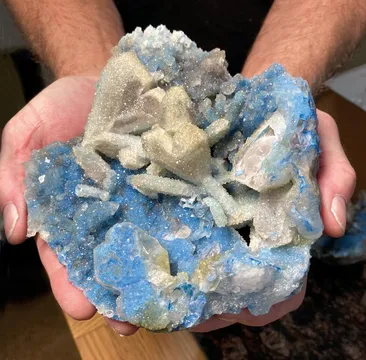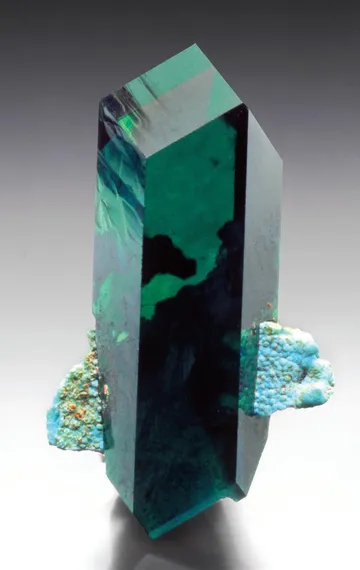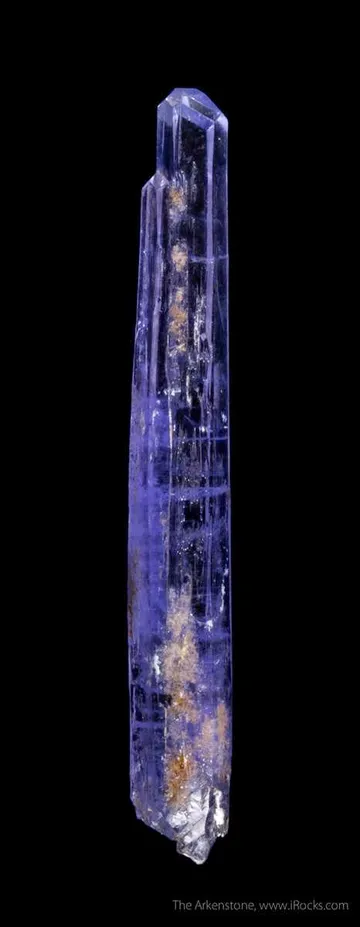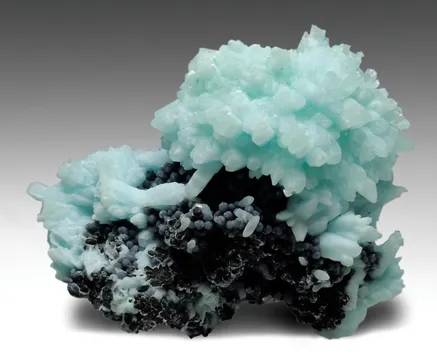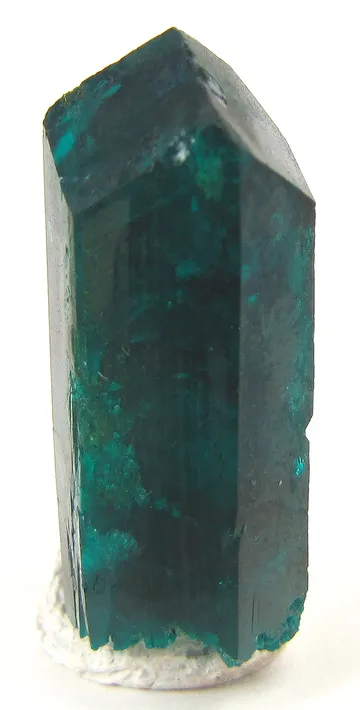
Omaue Mine, Namibia — emerald-green dioptase in copper-silicate vugs with blue planchéite and shattuckite; a flagship Kaokoveld locality prized by collectors.
Key facts
Omaue Mine is one of the defining specimen localities of the Kaokoveld copper district in northwestern Namibia: a small, remote copper-silicate occurrence whose fame rests not on tonnage, but on the extraordinary preservation of secondary copper minerals. The mine lies in the rugged country between Opuwo and Sesfontein, at Camp Aussicht, where quartz veins and copper sulfide mineralization cut carbonate rocks of the Otavi Group. Oxidation of chalcocite-, galena-, bornite- and pyrite-bearing mineralization produced a rich copper-silicate suite, and Omaue became celebrated above all for dioptase: transparent to translucent emerald-green crystals, commonly a little bluer in tone and more elongated than classic Tsumeb material, set against pale chrysocolla, blue planchéite, shattuckite, malachite, quartz, honey-yellow barite, and locally anglesite or wulfenite.
The best Omaue specimens have a look that is instantly Namibian but not Tsumeb-like. Rather than dioptase sprinkled over white calcite from a deep polymetallic pipe, Omaue pieces often show vugs in chalky to pale-blue copper silicate matrix, with glassy green prisms projecting from blue planchéite or chrysocolla, or lining pockets with velvety shattuckite and malachite. The most memorable examples are small cabinet and cabinet pieces with a strong color contrast: saturated green dioptase against powder blue to turquoise copper silicates, sometimes with a rare amber-tan anglesite crystal tucked into the vug.
Regional View
Country View
Historically, Omaue is important because it helped prove that Namibia’s post-Tsumeb collector story was not finished. In the late twentieth century and early twenty-first century, Kaokoveld localities supplied a new generation of world-class secondary copper specimens, and Omaue was the long-running flagship for dioptase. Specimen mining here was hand-oriented and collector-focused, which helped preserve crystal pockets that would likely have been destroyed in conventional ore mining. The locality is also closely tied to Marius Steiner and Camp Aussicht, the hilltop rest camp that grew around the mine and became a practical base for mineral travelers in the Kaokoveld.

Photo: Rob Lavinsky, iRocks.com / Wikimedia Commons

Search for specimens: View all specimens from Omaue Mine, Namibia
Omaue Mine is in the Opuwo Rural area of Kunene Region, on the Kaokoveld Plateau of northwestern Namibia, close to Camp Aussicht and roughly in the belt of mineral localities between Opuwo and Sesfontein. The locality is part of the broader Kaokoveld copper district, where shallow workings exploit oxidized copper and lead mineralization hosted by Neoproterozoic carbonate sequences. The district sits in the coastal arm of the Damara Orogen, where Otavi Group carbonates overlie older clastic rocks. In the mineralized area, the relevant host sequence includes limestones, dolomites, slates and shales of the Ombombo Subgroup, the Chuos Formation, and carbonate rocks of the Abenab Subgroup. These units are folded, faulted, locally brecciated, and cut by quartz, quartz-chlorite-carbonate, calcite and barite-bearing veins.
The deposit is best understood as a small sediment-hosted copper occurrence with strong structural control and intense supergene overprint. The district contains stratiform disseminated copper sulfides, stockwork-style quartz veins with lenticular copper sulfide pockets, and fault-related quartz veins carrying chalcocite, galena and secondary minerals. At Omaue specifically, collector-quality mineralization is associated with copper sulfide-bearing quartz veins in limestone, with a well-developed oxidation zone rich in secondary copper minerals. The oxidation is crucial: it transformed comparatively unshowy primary sulfides into the copper silicates and carbonates that made the locality famous.
The ore minerals and gangue minerals set the stage for the specimens. Chalcocite is the dominant sulfide in the district, accompanied in places by bornite, galena, pyrite, tetrahedrite and sphalerite. Quartz, calcite, chlorite and barite form much of the vein and breccia matrix. In the oxidized zone, copper moved into silicate and carbonate assemblages rather than producing abundant native copper and cuprite. That is why Omaue’s best pieces are dioptase-, chrysocolla-, planchéite-, shattuckite- and malachite-rich rather than classic gossan specimens of cuprite and copper.
Mining at Omaue is unusual in that it has long been directed toward mineral specimens rather than bulk metal production. The mine has been associated with Marius Steiner since the late 1980s and was developed as a specimen-mining deposit, first from surface workings and later through underground galleries. Mineralatlas records the locality as having been worked through five galleries, and also records 3,510 kg of dioptase production between 1985 and 1996. A separate popular account places the best dioptase harvesting period broadly from the mid-1980s into the early 2000s. By 2013, the original Omaue workings were already described as depleted, although new zones in the same host rocks had been identified and remained of interest for additional dioptase pockets.
The mine is not an open public collecting locality in the casual sense. It is on an active mineral property associated with Camp Aussicht, and collecting in Namibia also carries legal requirements: private collectors and researchers need permits for collected or purchased material, and commercial export requires additional authorization. For visiting collectors, the practical route has historically been through Camp Aussicht and its owner/operator, not independent wandering through the workings. The mine’s setting in rugged, dry country also matters. Roads in the Kaokoveld mineral area are poor in places, much access follows dry riverbeds, and specimen mining in the district typically stops during the summer rainy season and resumes after the wet months.
The pockets that gave Omaue its reputation are small, color-rich, and strongly zoned. Classic pieces show second-generation dioptase on chrysocolla or planchéite, with malachite and shattuckite adding blue-green contrast. Some pockets yielded dioptase with honey-yellow barite, yellow anglesite, or wulfenite, combinations far scarcer than ordinary green dioptase on blue copper-silicate matrix. The best specimens preserve open vug architecture: crystals standing clear rather than buried in chalky chrysocolla, with the dioptase lustrous, translucent, undamaged, and in obvious association with the blue secondary silicates that identify the Kaokoveld style.
Omaue dioptase is the locality’s signature mineral and among the most desirable Kaokoveld habits: transparent to translucent emerald-green prisms, often with a slight bluish cast and a thinner, more elongated form than typical Tsumeb crystals. First-generation dioptase in the district is usually small, commonly under 5 mm and seldom over 1 cm, but the later generation that made Omaue famous occurs on chrysocolla and planchéite, commonly with malachite, shattuckite, quartz, honey-yellow barite and, more rarely, anglesite or wulfenite. Typical collectible crystals range from a few millimeters to several centimeters; the finest Kaokoveld second-generation crystals from the producing localities have reached exceptional sizes, but Omaue is most admired for balanced vugs and color contrast rather than sheer size. Good Omaue dioptase has glassy luster, open pocket exposure, sharp terminations, minimal bruising, and a natural blue copper-silicate matrix that frames the green rather than swallowing it.
At Omaue, malachite belongs to the same oxidized copper-silicate system as the dioptase and shattuckite, and it appears most often as fibrous to radial green aggregates, massive-to-radial intergrowths, coatings, and pocket linings rather than as freestanding show crystals. In the broader Kaokoveld district, malachite is the commonest copper mineral and forms fibrous bundles and sheaf-like spherical aggregates that may reach several centimeters; Omaue specimens are strongest when the malachite is not merely a green filler but contributes texture and contrast beside dioptase, shattuckite, planchéite, chrysocolla and quartz. The better pieces show crisp fibrous structure, saturated color, and stable matrix, while ordinary examples are massive, chalky, or visually overwhelmed by chrysocolla. Malachite-dioptase combinations from Omaue are especially attractive when lustrous green dioptase crystals emerge from or sit beside radial malachite, giving the specimen both sparkle and velvety depth.
Omaue shattuckite is part of the celebrated Kaokoveld shattuckite story, though the deepest, richest blues are more typical of some neighboring pits; Omaue material is commonly pale turquoise-blue to blue, forming velvety radial aggregates, botryoidal pocket linings, breccia cement and vein fillings with quartz, calcite, malachite, chrysocolla and planchéite. In the paragenesis, shattuckite commonly follows planchéite and precedes the late dioptase that makes the best combinations, so fine Omaue pieces often show emerald-green dioptase perched on or beside blue shattuckite. Strong specimens have intact, velvety spherical or radial surfaces, clean blue color, and clear association with dioptase or malachite; lesser pieces are massive, abraded, or partly obscured by earthy coatings. Small vugs with royal-blue shattuckite spheres and bright green dioptase are among the most appealing Omaue miniatures and toenails.
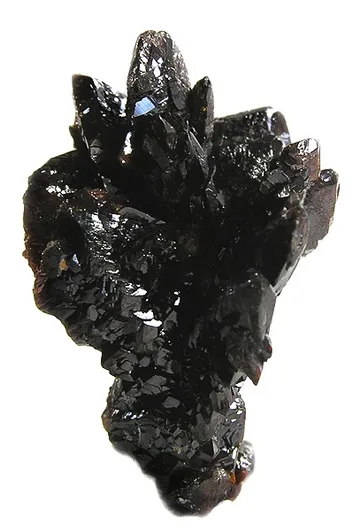
Other minerals documented from Omaue include chrysocolla, planchéite, quartz, calcite, chalcocite, cuprite, tenorite, azurite, anglesite, baryte, wulfenite, mottramite, and a reported occurrence of chenevixite. Omaue is not important as a type locality in the way Tsumeb is; its mineralogical importance lies in specimen quality and in rare, aesthetically strong associations. Yellow anglesite from Omaue is especially notable, with terminated crystals reported from the 1998–2002 period, and well-formed anglesite on dioptase is one of the prized rarities. Barite is also significant, particularly honey-yellow crystals with late dioptase. Tenorite has been described from Omaue as thin, dull black crusts with iron oxides, and chenevixite is noteworthy because arsenates are scarce in the Kaokoveld copper-silicate assemblages compared with Tsumeb.
The major authenticity problem with Omaue specimens is not widespread treatment but locality precision. Kaokoveld copper specimens have circulated under overlapping or generalized names, and labels such as “Kaokoveld,” “Kandesei,” “Otjikotu,” “Okomunwe,” “Christoff,” and “Omaue” have not always been used consistently by miners, dealers, or older collections. A piece simply labeled “Kaokoveld” may be entirely legitimate but not safely assignable to Omaue without old labels, acquisition history, matrix style, or a well-documented dealer chain. Conversely, Omaue-labeled dioptase with blue chrysocolla, planchéite or shattuckite matrix can be plausible, but the label should still be judged against specimen style and provenance.
Omaue dioptase is often recognizable by the combination of elongated green prisms with pale-blue copper silicate matrix, but it can be confused with other Kaokoveld localities and, less often, with Tsumeb. Tsumeb dioptase more commonly occurs in a different carbonate-hosted polymetallic context and often has shorter prismatic crystals, whereas Kaokoveld dioptase tends toward longer crystals and blue copper-silicate associations. That said, habit alone is not proof. For important specimens, prefer pieces with older labels, named collections, publication history, or a credible chain back to Namibian or specialist dealers.
Condition is central to value. Dioptase has perfect cleavage and is brittle, so exposed crystals chip easily at terminations and edges. The best Omaue pieces are open vugs, but that openness makes them vulnerable. Examine crystals under magnification for bruised tips, tiny conchoidal chips, and glued repairs along pocket margins. Shattuckite and malachite surfaces can be velvety and fibrous; rubbing, aggressive washing, and ultrasonic cleaning can flatten or scar them. Powder-blue chrysocolla and planchéite-rich matrix may be porous or friable, and some specimens shed minor dust from the matrix even when the crystals are sound.
Quartz coatings can be both a blessing and a complication. Some Kaokoveld dioptase, shattuckite and malachite was partly coated by later quartz or hemimorphite, producing a “sugar-coated” appearance. On a fine piece this can be attractive and natural, but it may also obscure the copper minerals and reduce luster. Avoid over-cleaned specimens where attempts to remove clay, oxides, or silica have etched soft copper silicates or dulled malachite fibers.
Fluorescence is not a selling point for Omaue’s core suite. Dioptase, shattuckite, malachite, chrysocolla and planchéite are collected for color, habit and association, not response under ultraviolet light. Store pieces dry, avoid acids and prolonged soaking, and keep them away from harder specimens that can abrade the copper silicate matrix. Cabinet pieces with sharp, undamaged dioptase on vivid blue matrix remain scarce; small thumbnails and miniatures appear more often, while large, highly aesthetic Omaue combinations with old provenance are much harder to replace.
Omaue is inseparable from Camp Aussicht, a place whose name—“camp with a view”—is literal. The mine sits in remote hill country where the camp grew out of Marius Steiner’s search for dioptase. Travel accounts describe the approach as rough enough that four-wheel drive is strongly recommended, and mineral travelers remember the site as both a mine and a base camp: simple rooms, widely spaced campsites, bucket showers, big views, and the sense that the collecting locality and the lodging are part of the same handmade project.
A vivid Dutch field account in Geonieuws captures the collector’s version of Omaue: arrival from Opuwo, a dramatic climb up the road to Camp Aussicht, help from South African fellow campers hauling a trailer up the hill, and then a mine visit with Marius. The day’s mineral memory was not an abstract “collecting opportunity” but the physical pleasure of hammering on the blue dump under the warm sun, choosing pieces, wrapping them carefully, and ending the evening with a bush shower and a meal on Marius’s terrace. The phrase that lingers is the “blauwe storthoop”—the blue dump—because it is exactly the kind of detail a collector understands: oxidized copper minerals visible not as a geology diagram, but as color underfoot.
Several travel sources also preserve the unusual hybrid nature of the place. Omaue was built as a dioptase mine, but Camp Aussicht became a meeting point for mineral collectors, overlanders, birders, and travelers interested in Himba villages. Marius Steiner is repeatedly described not merely as a mine owner but as a host and guide with deep local connections. The same day might involve looking for dioptase, watching hornbills and lovebirds around the camp, and hearing about the surrounding Himba and Herero communities. For collectors, that matters: Omaue specimens are not anonymous output from a giant mine. They come from a small, personal, difficult-to-reach locality where the owner, the camp, the mine entrance, and the blue dumps are all part of the specimen’s provenance.