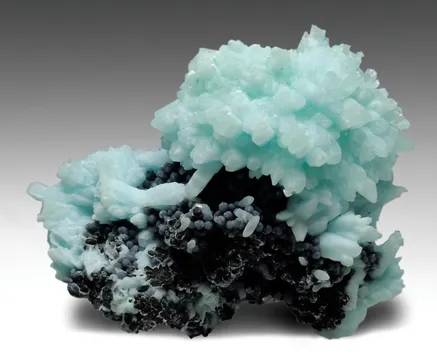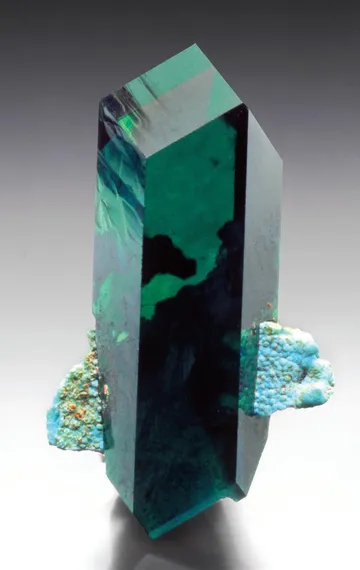
Christoph Mine, Namibia — renowned for elongated blue-green dioptase crystals; remote copper-silicate locality with rare mottramite coatings, prized by collect…
Key facts
Christoph Mine is one of the modern Kaokoveld localities that changed the collector’s idea of Namibian dioptase. Instead of the famous calcite-rich, deep-mine assemblages of Tsumeb, Christoph belongs to the remote copper-silicate and copper-lead-barite mineralization of northwestern Namibia’s Kunene Region, in the Kaokoveld district between Opuwo and Sesfontein. Its specimens are products of shallow, strongly oxidized copper-lead mineralization in carbonate rocks and breccias of the Damara-age succession, where quartz, chrysocolla, shattuckite, planchéite, malachite, cerussite, mottramite and rare bismuth-bearing species accompany the copper silicates.
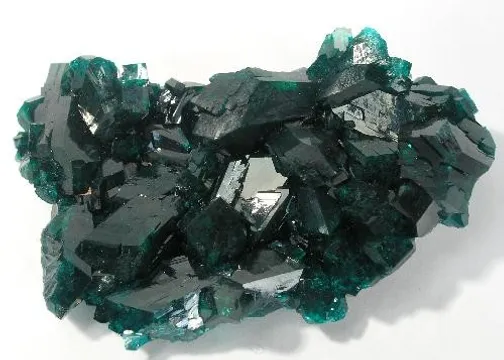
For collectors, the mine’s fame rests above all on elongated, glassy, blue-green to emerald-green dioptase crystals. The best Christoph pieces are instantly recognizable: slender, freestanding prisms rather than squat Tsumeb-style crystals, often with vivid translucency or true gemminess, sometimes perched on quartz or smoky-gray cerussite. The finest examples from the early finds carried the excitement of a new locality—crystals large enough to astonish experienced dioptase collectors, yet with a different personality from Tsumeb, Altyn-Tyube, or Congo. The mine also produced rare and memorable combinations of dioptase with cerussite twins, plus less showy but mineralogically important coatings and microcrystals of mottramite, beyerite and namibite.
Historically, Christoph belongs to the post-Tsumeb era of Namibian specimen mining. The Kaokoveld workings were not famous old industrial mines that happened to preserve specimens; they were largely shallow prospects and pits where artisanal miners, local workers, prospectors and specialist dealers recovered crystals specifically as mineral specimens. Christoph’s major reputation dates from the late 2000s, especially the 2007 dioptase haul and the international appearance of fine pieces at shows soon afterward.
Regional View
Country View
The locality name appears in the literature and on older specimen labels in two closely related spellings: Christoph Mine and Christoff Mine. Serious labels should also place it in the Kaokoveld Plateau or Opuwo Rural area of Kunene Region, Namibia, because “Kaokoveld” alone can hide several different dioptase localities with overlapping mineral assemblages and very different collecting histories.


Search for specimens: View all specimens from Christoph Mine, Namibia
Christoph Mine lies in the Kaokoveld mining district of northwestern Namibia’s Kunene Region, within the broader Kunene Copper Belt. The main Kaokoveld mineral areas are reached from the road between Opuwo and Sesfontein, but the field is not a single neat mine complex. It is a chain of shallow pits, trenches and prospects distributed across rugged carbonate terrain, with names that have shifted between operators, dealers and local usage. Christoph is close to the Okandawasi pit on Okomunwe Hill, one of the major specimen excavations in the district, and both Christoph and Okandawasi have at times been confused with or described as the “Old German mine” in specimen and exploration contexts.
Geologically, the Kaokoveld copper occurrences sit in the coastal arm of the Damara Orogen. The host sequence includes clastic rocks of the Nosib Group and carbonate rocks of the Otavi Group, notably the Ombombo and Abenab carbonate units. In the mining district, lower Ombombo rocks host the known copper occurrences, while Abenab dolomite and limestone are important as competent, reactive carbonate hosts. Folding, faulting, silicification, argillization and hydrothermal alteration shaped the ore zones, and later oxidation created the colorful secondary mineral assemblage that collectors know.
The ore setting is not a simple vein system. The district contains stratiform disseminated copper sulfides with pyrite and galena; quartz-vein stockworks with pockety copper sulfides and galena; and fault-related quartz veining with chalcocite, galena and secondary minerals. The primary ore is chiefly chalcocite, with bornite, galena and pyrite locally present. Oxidation extends deeply enough in places to have transformed much of the collector-grade material into copper silicates and lead carbonates rather than the cuprite-native copper supergene suite collectors might expect from some other copper deposits. This is why Christoph specimens are dominated by dioptase, quartz, planchéite, shattuckite, chrysocolla, malachite, cerussite and mottramite rather than by bright primary sulfides.
Christoph Mine itself is best understood as a shallow open-pit specimen locality in this oxidized copper-lead system. It was mined by the Kaokoland Mining and Exploration Company in the period when the Kaokoveld localities were becoming internationally known. The major published account notes that the Christoph pit, close to Okandawasi, produced an exceptional haul of dioptase crystals in 2007 and also yielded fine cerussite, cuprite and mottramite specimens. That single statement understates its later collecting importance: the pieces that moved through the market after the 2007–2010 period made Christoph one of the essential modern dioptase names.
The broader district was explored for copper for more than half a century, but it did not develop into a giant industrial copper camp. Instead, its lasting mineralogical value came from shallow specimen pockets. Some operations produced copper concentrate, especially chalcocite-malachite ore, but many of the crystal finds were hand-mined or carefully extracted by people working for specimens. That mode of recovery matters: elongated dioptase crystals, cerussite twins and friable quartz-lined pockets would not have survived well under heavy blasting.
Access today should not be treated as casual open collecting. The area includes active or historically active mining claims, communal land, conservancy interests, local workers and named operators. The roads are remote, seasonal and often follow dry riverbeds that can become impassable in the wet season. Any collecting visit requires current permission from the relevant claimholder or operator and local authorities; buying well-documented specimens from established sources is the normal route for most collectors.
The notable finds are best grouped by their mineral character. The 2007 Christoph dioptase production introduced large, slender, gemmy crystals and clusters, including loose or matrix-mounted prisms and dioptase on quartz. By 2009 fine pieces were being offered internationally, including by Charles Key and his team at the Denver show. Later finds added dramatic dioptase-cerussite combinations, where emerald-green trigonal prisms sit against gray-brown, waxy to smoky cerussite twins. In 2010 zoned dioptase from Christoph appeared at Munich: radial sprays of prismatic crystals to about 2 cm with green and blue color zoning on limonite-like matrix. Additional good dioptase specimens, including crystals reportedly to 6 cm, emerged in 2012 and 2014.
Dioptase from Christoph Mine is the locality’s signature species and one of the great modern alternatives to Tsumeb. Its crystals are typically elongated trigonal prisms with a slightly bluish cast to the emerald-green color, and the best specimens show exceptional luster, transparency and free-standing geometry. District-wide, first-generation dioptase is commonly small, often less than 5 mm and sometimes quartz-coated, while the later generation—especially important at Christoph, Okandawasi, Kandesei, Okarvizo and Omaue—produced the prized larger crystals, usually from a few millimeters to about 3 cm and locally much larger. Christoph pieces occur on quartz, with planchéite or chrysocolla, and most distinctively with gray-brown cerussite; the finest examples are those with undamaged terminations, transparent tips, sculptural exposure from the matrix, and sharp contrast against white quartz or smoky cerussite rather than massive green crusts with only isolated broken crystal ends.
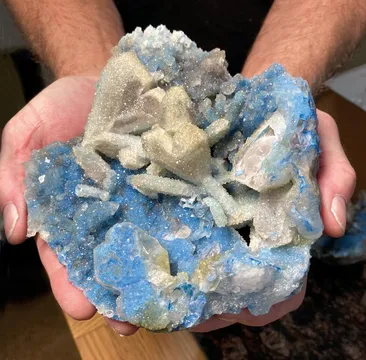
Quartz at Christoph Mine is both gangue and display stage. In the Kaokoveld breccia mineralization, quartz occurs as an early massive milky generation that hosts sulfides and as a later, better-crystallized generation of terminated crystals, including smoky and yellow-orange hematite-included examples; the best quartz crystals in the district have been recorded from Kandesei and Christoph, with second-generation quartz reaching as much as 10 cm in the broader field. For Christoph collectors, quartz matters most when it sets off dioptase—white to colorless or lightly smoky crystal groups carrying sharp green prisms—or when it encloses or accompanies chrysocolla, shattuckite, planchéite and rare dioptase inclusions. Superior quartz-bearing Christoph specimens have clean crystal faces, open architecture and strong color contrast; ordinary examples are simply massive white gangue with scattered dioptase or copper-silicate coatings.
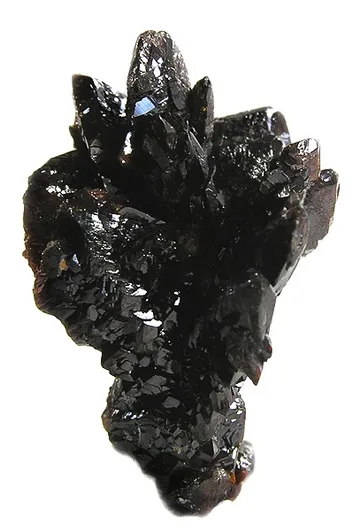
Cerussite from Christoph Mine is scarcer on the market than the dioptase and is most valued as an association mineral. The locality produced fine cerussite in the same oxidized copper-lead system, including prismatic crystals and smoky to gray-brown twins that form dramatic pedestals or matrix for dioptase. Small V-shaped or reticulated cerussite groups with gemmy green dioptase are among the most distinctive Christoph combinations, and the best examples show translucent cerussite, strong three-dimensional form, minimal contact damage, and dioptase crystals that are attached naturally rather than merely resting in a recess. Stand-alone cerussite twins from Christoph are much harder to find than equivalent Moroccan or Tsumeb pieces, so locality-confirmed examples with older provenance deserve attention even when they are thumbnails.
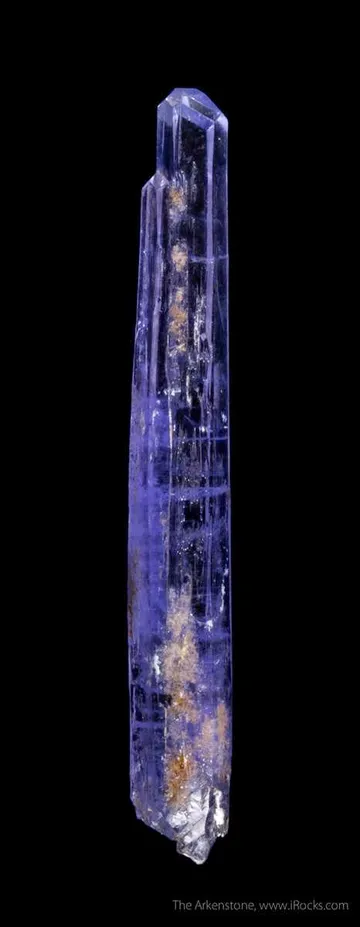
Other documented Christoph minerals include planchéite, shattuckite, chrysocolla, malachite, cuprite, mottramite, beyerite, namibite, barite and carbonate gangue. The locality is not celebrated as a type locality in the way Tsumeb or Mesopotamia 504 Farm are, but it is important for rare secondary bismuth and vanadium-bearing phases in the Kaokoveld assemblage. Beyerite occurs as tiny adamantine rosettes, spherules and radial fibers associated with mottramite, shattuckite, malachite, calcite and dolomite. Mottramite, including bismuth-rich material, can partially coat dioptase and is a key reason some Christoph pieces have a mineralogical interest beyond cabinet aesthetics. Namibite has been identified as bright green complex crystals with beyerite, bismuth-rich mottramite and chrysocolla. Cuprite is present but uncommon as collectible crystals, generally massive with chrysocolla and malachite, though small cubes and octahedra are known in the district.
Christoph Mine dioptase is a locality where attribution matters. Labels reading only “Kaokoveld,” “Kaokoland,” “Kunene,” “Otjikotu,” or “Namibia” may not be enough, because several Kaokoveld prospects produced elongated dioptase on quartz, chrysocolla, planchéite or shattuckite. Christoph attribution is strongest when supported by old dealer labels, provenance to the early Denver or Munich-era material, the Christoph/Christoff spelling, associated cerussite, or photographs and descriptions traceable to the known finds.
No widespread, locality-specific treatment industry is documented for Christoph specimens, but the usual dioptase cautions apply with extra force. Dioptase has perfect cleavage and is brittle, so edge wear, cleaved terminations and repaired single crystals are serious value issues. The freestanding Christoph habit makes crystals visually spectacular but vulnerable; many pieces have one superb crystal rising from a more massive or bruised dioptase base. Do not dismiss a specimen automatically for damage in the massive green undergrowth, but inspect every termination and side face of the principal crystals under magnification.
The most credible authenticity concern is assembly or repair, not dyeing. Some Christoph pieces look almost implausible because transparent green prisms stand out from quartz or cerussite as if placed there by hand. That is a natural style of the best pockets, but it also means buyers should examine attachment points carefully. Yellowish resin, unnatural wet-looking halos, fluorescence at joints, or glue crossing onto crystal faces are warning signs. A clean, natural contact should show mineral continuity, matrix texture and no glossy adhesive meniscus.
Cerussite associations deserve a second level of inspection. Cerussite is soft and easily bruised, and smoky or gray-brown twins may show contacted backs or broken bases. On combination pieces, a minor hidden contact on the cerussite can be acceptable if the dioptase is pristine and the composition is strong; a broken or reattached main dioptase crystal is far more serious. Because good dioptase-on-cerussite Christoph pieces are uncommon, intact examples command a premium.
Cleaning should be conservative. Quartz coatings and “sugar-coated” appearances are part of the Kaokoveld paragenesis, not always dirt. Mottramite and beyerite coatings can also be mineralogically meaningful. Avoid aggressive acids or prolonged ultrasonic cleaning unless the specimen has been evaluated by someone experienced with Kaokoveld copper silicates; the assemblage may include soft, porous chrysocolla, delicate cerussite, thin mottramite coatings and brittle dioptase edges.
Market availability is intermittent. Ordinary small Christoph dioptase specimens appear from time to time, but the best early pieces—large gemmy single crystals, pristine doubly terminated thumbnails, dioptase on quartz, and dioptase on cerussite—are already dispersed into advanced collections. The locality has enough production to be recognizable in the modern market, but not enough for top material to be routine. Expect fine thumbnails and miniatures to trade strongly when they have sharp crystals, provenance, and an unambiguous Christoph label.
The Christoph story begins with the geography of remoteness. The Kaokoveld mines lie off the Opuwo–Sesfontein road, reached by rough tracks that can become unusable when the dry riverbeds run in the rainy season. Specimen mining in the district traditionally stops around early December and resumes only after the rains, commonly in mid-April. This rhythm shaped the supply: not continuous industrial output, but seasonal episodes, pockets, and sudden appearances at international shows.
The 2007 find is the essential episode. At Christoph, copper mineralization exposed in the bottom of the pit gave up what the Mineralogical Record later called an “exceptional haul” of dioptase crystals. That language is restrained, but the surviving specimens explain the excitement: elongated green prisms, many with a blue cast and far more transparency than collectors expected from a new Kaokoveld pit. Some crystals stood so cleanly from quartz or massive dioptase that later descriptions compared them to being glued onto the matrix—not as an accusation, but as a measure of how unlikely the geometry looked.
By 2009 the mine had entered the international collector circuit. Charles Key and his team brought some of the first Christoph dioptase specimens to the Denver show, introducing a new Namibian locality to collectors who had grown up judging the species through Tsumeb. The crystals were prismatic and large, reportedly reaching 6 cm, with tips ranging from translucent to transparent. This was not another locality producing a little green sparkle on rock; it was a new source of major dioptase crystals with its own habit.
Then came the cerussite combinations. The gray-brown, V-shaped cerussite twins gave the Christoph material a look that collectors remembered immediately: green dioptase rising from smoky, waxy lead carbonate geometry. Some pieces were thumbnails, but they had the drama of much larger specimens because the contrast was so exact—emerald prisms against lead-gray twins, hard glassy brilliance against softer cerussite luster. These combinations remain among the most desirable Christoph pieces because they tie together both sides of the ore system, copper silicate and lead carbonate, in one sculptural specimen.
Munich in 2010 added another chapter. Zoned Christoph dioptase appeared there for the first time: radial sprays of prismatic crystals to about 2 cm, showing green and blue color zones on limonite-like matrix. That detail matters because it separated Christoph not only from Tsumeb but also from the other Kaokoveld prospects. The mine was not producing one repetitive style; it had pockets capable of gemmy singles, quartz plates, cerussite combinations and zoned radial sprays.
The later years kept the locality alive without making it common. Good dioptase specimens were recovered again in 2012 and 2014, including crystals to 6 cm according to later collector summaries. By then, Christoph had moved from “new find” to modern classic. Collectors had learned to watch for the spelling variants, the Kaokoveld label traps, the vulnerability of the long crystals, and the rarity of genuinely fine dioptase with cerussite. A decade later, when old Charlie Key pieces and early Arkenstone specimens reappeared, they carried the aura of a find that had already passed into locality history.