A collector's guide to Imiter mine, Morocco: its geology, mining history and notable minerals, illustrated with the 228 specimens documented from this locality on EarthWonders.
Key facts
Imiter is one of the modern classic silver localities: a working Ag-Hg mine on the northern flank of Jbel Saghro in the eastern Anti-Atlas, where Neoproterozoic black shales, greywackes, volcaniclastic rocks, faults, and late felsic magmatism combined to make a silver system of world rank. For collectors, its importance rests on two overlapping reputations. The first is economic and geological: Imiter is a giant Precambrian epithermal silver deposit, famous for native silver and silver-mercury mineralization rather than the more usual silver-bearing galena ores. The second is specimen-focused: it has produced some of the best modern acanthite paramorphs after argentite, wiry and arborescent native silver, fine ruby-red proustite, and an unusually rich suite of silver sulfosalts and Ag-Hg species.
The look of Imiter specimens is instantly recognizable. The best acanthites are charcoal-black to metallic grey, sculptural, pseudo-octahedral crystals and crystal groups, often with the high-temperature argentite form preserved as acanthite. Silver specimens range from thick, curling nests of bright wires rising from black acanthite to arborescent sprays and metallic masses exposed from carbonate gangue. Proustite brings the opposite color note: dark red to blood-red, lustrous crystals scattered in vugs with quartz, acanthite, imiterite, xanthoconite, polybasite, galena, calcite, or siderite. Even the matrix is part of the locality’s visual identity: black shale, vuggy quartz, pink dolomite, calcite, and dense sulphide-rich ore.
Regional View
Country View
Imiter’s scientific significance is just as strong as its specimen reputation. Work by Cheilletz, Levresse, Gasquet and collaborators established the deposit as a Neoproterozoic epithermal precious-metal system, genetically linked to late felsic volcanism dated around 550 Ma and localized by a major E-W to ENE-WSW fault corridor. That makes Imiter not merely a prolific silver mine, but a key reference point for understanding how epithermal-style precious-metal systems operated near the Precambrian-Cambrian transition.
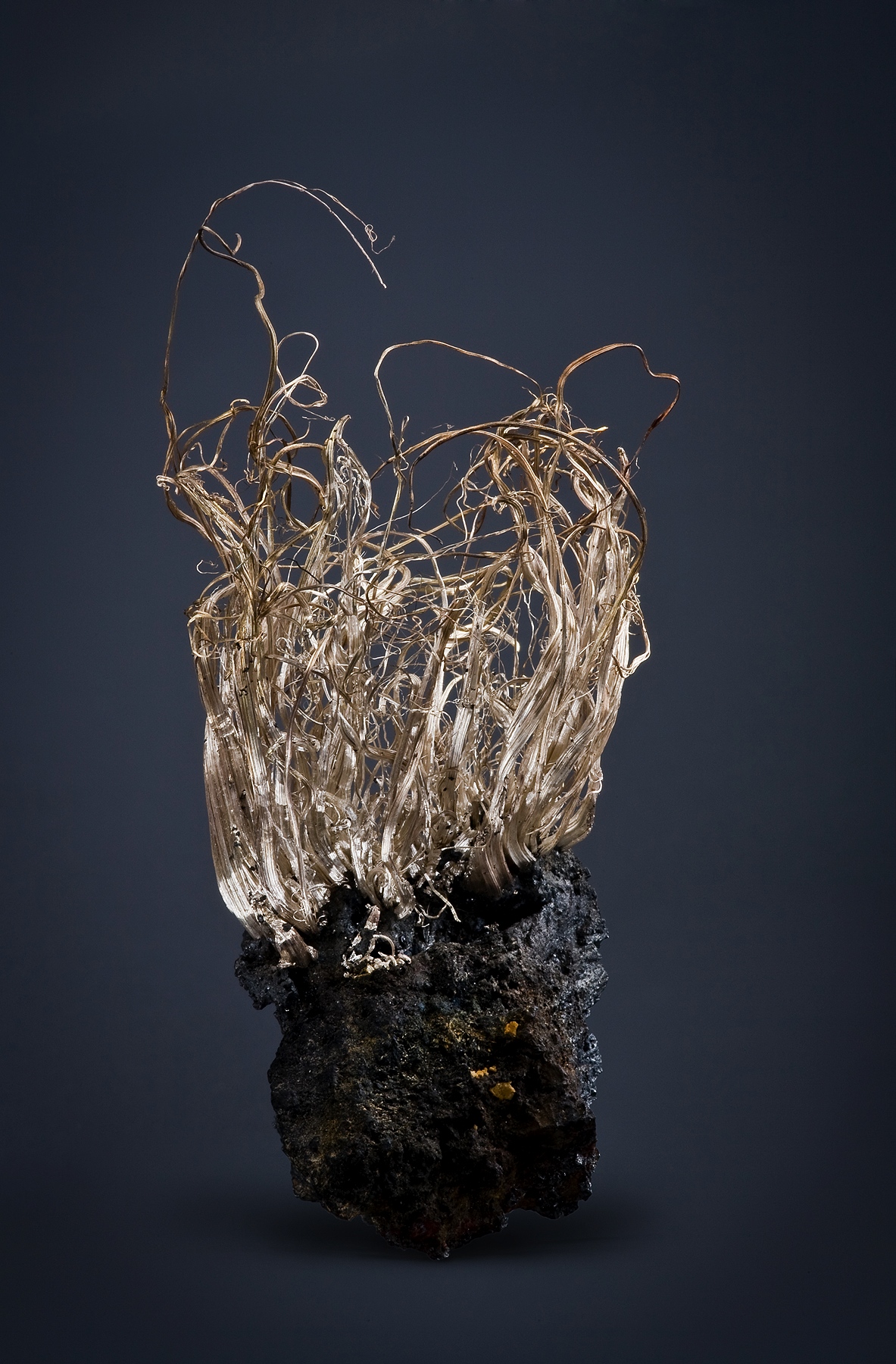
Photo: Wikimedia Commons

Photo: Wikimedia Commons
Search for specimens: View all specimens from Imiter mine, Morocco
The Imiter mine lies near the village of Imiter, between Boumalne Dadès and Tinghir, in the Jbel Saghro part of the eastern Anti-Atlas. The district is high, dry, and austere, around 1500-1600 m elevation, and the mine sits in a Precambrian inlier where older black shales and greywackes are overlain by late Neoproterozoic volcanic and volcaniclastic rocks of the Ouarzazate Group. The silver mineralization is not a simple vein-in-one-rock story. It is controlled by a long fault corridor along the contact between the lower sedimentary complex and the upper volcanic complex, with ore bodies developed in steep veins, flatter structures, breccias, stockworks, and reactivated shear zones.
Geologically, Imiter is best treated as a giant Ag-Hg epithermal vein and breccia system. The main silver stage is associated with quartz, adularia, and carbonate gangue, especially pink dolomite, and with silver-bearing phases such as Ag-Hg amalgam, native silver, argentite-acanthite, proustite-pyrargyrite, polybasite-pearceite, freibergite/tetrahedrite-tennantite group minerals, imiterite, galena, sphalerite, chalcopyrite, arsenopyrite, and pyrite. Later alteration dissolved carbonate in places, opened cavities, left earthy iron oxides, and locally enriched native silver. This history is why collectors see both primary-looking sulphide and sulfosalt specimens and dramatically exposed secondary native silver.
The mine’s structural vocabulary is important for understanding specimen labels and old collection notes. Published work describes the Imiter fault corridor as an E-W to ENE-WSW system with N060-N070°E relays and pull-apart geometries. In the underground workings, Imiter I includes structures such as F0, F0 north, and F0 south, while Imiter II includes R6, R7, and B3. The richest mineralized structures have been linked to an early quartz ± dolomite stage in transpressive relays; later dolomite-rich reopening was widespread but less economically important. These named structures rarely appear on specimen labels, but they explain why different Imiter pieces can look so different: dense black acanthite clusters, silver wires in carbonate, red silver minerals in quartzy vugs, and rarer Ag-Hg phases all came from a structurally compartmentalized ore system rather than a single uniform pocket zone.
Mining at Imiter is unusually deep in history. Written and archaeological evidence ties silver exploitation in the district to early medieval activity, with references around 840 AD and major work between the 7th and 9th centuries. The earliest miners probably worked the richest upper zones where plates of native silver were visible, stopping when water inflow at the water table made further mining impractical. Archaeological remains recorded from the old workings include melting pots, granite millstones, chisels, pottery, human bones, large ancient dumps, and the striking excavation known as the “carrière des anciens.”
The modern mine history began in 1951 with aerial prospecting. The Société Minière de l’Atlas Marocain, linked to Peñarroya, explored from 1951 to 1956, and BRPM later resumed work. A telling episode came in 1963, when drilling at B3 Hill cut ore assaying 5150 g/t Ag, yet exploration was abandoned because the deposit was misread as a shallow supergene cementation body with no deep future. At the same time, old dumps were estimated at about 650,000 tonnes averaging 300 g/t Ag, enough to justify renewed treatment. The Société Métallurgique d’Imiter, SMI, was created in 1969 to work the silver-bearing ancient dumps, and subsequent exploration revealed the deeper Imiter I and Imiter II ore bodies. Underground mining followed in the late 1970s; later expansions and discoveries included Imiter II in 1995, Igoudrane acquired in 1998 and brought into production in the Imiter Est sector, Imiter Sud reserves in the 2000s, new shafts, and treatment-plant expansions under Managem.
Collectors should understand that Imiter is an active industrial mine, not a casual collecting locality. Modern specimens have generally reached the market through mine production, Moroccan mineral networks, dealer lots, older collections, and occasional notable finds, not through open public field collecting. Access to workings, dumps, and mining infrastructure is controlled, and the realities of a producing silver operation mean that collecting opportunities are opportunistic and dependent on mining, trimming, preparation, and local permissions.
Several finds have become part of the collector lore of the mine. The mid-2000s produced sharp octahedral acanthite forms that transformed Imiter into one of the world’s important modern acanthite localities. A 2005 find supplied many of the sharp, pseudo-octahedral crystals now seen in collections, and 2008 material became especially associated with showy silver wires on acanthite. Fine proustite specimens have appeared more sporadically; good pieces tend to be vuggy and are prized when the red crystals are free-standing, lustrous, and not merely tiny scattered grains. A few late-2010s specimens combined proustite with silver, acanthite, and quartz in unusually open vugs, including examples where silver wires were coated or accompanied by red proustite.
Imiter acanthite is the species by which many collectors first recognize the locality: black to steel-grey, metallic, pseudo-octahedral crystals that commonly preserve the cubic argentite habit as low-temperature acanthite, with individual crystals ranging from small thumbnails to robust pieces around several centimeters and, in exceptional examples, sculptural cabinet-size groups. The classic material from the 2005 and 2008 finds may occur as sharp single octahedra, compound parallel-growth crystals, stacked three-dimensional clusters, or black acanthite matrix carrying bright native silver wires; calcite, quartz, dolomite, proustite, xanthoconite, imiterite, galena, and polybasite are possible associates. The finest Imiter acanthites are judged by sharpness of the original argentite form, metallic luster, isolation of crystals, freedom from bruising, and sculptural balance; ordinary pieces are duller, massive, incomplete, or lack the crisp pseudo-octahedral geometry that made the mine famous.
Native silver from Imiter occurs as wires, curls, arborescent sprays, plates, masses, and Ag-Hg amalgam-rich ore, and the locality is remarkable because silver has been mined here as native silver and amalgam rather than merely as a by-product locked in lead ore. Collectible pieces most often show bright to tarnished metallic silver emerging from acanthite, quartz, calcite, or dolomite, with the most dramatic specimens displaying tangled wire nests on black acanthite or branching silver released from carbonate gangue; published accounts of the ore describe large plates of native silver from the mine, far beyond specimen scale. Good collector examples have strong contrast, natural-looking wires or plates, sturdy attachment, and minimal crushing; weaker pieces are merely rich ore fragments, acid-etched curiosities without form, or dense masses with little display character.
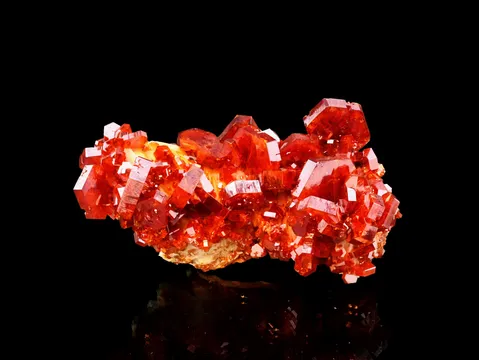
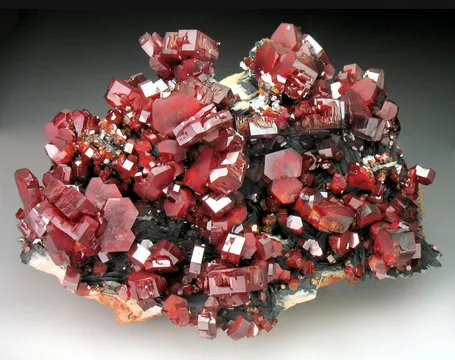
Imiter proustite is the mine’s great red accent, occurring as dark cherry-red to blood-red, lustrous crystals and crystal groups in vugs or on sulphide-rich matrix, commonly with xanthoconite, acanthite, imiterite, quartz, galena, pyrargyrite, polybasite, fettelite, calcite, siderite, chalcopyrite, and native silver. Most crystals are small to miniature in scale, but fine specimens can show rich scattering across a hand specimen or sharp individual crystals large enough to display the classic ruby-silver glow under careful lighting; some Imiter proustite is reported as Sb-bearing, reflecting the proustite-pyrargyrite chemical neighborhood in the ore. The best pieces have undamaged, lustrous, translucent-to-gemmy red crystals that stand free in a protected vug, ideally with attractive black acanthite or pale quartz contrast; ordinary examples are micromount material, darkened, bruised, or visually lost on a dark matrix.
At Imiter, “argentite” on labels usually points to the high-temperature cubic Ag2S form whose outward octahedral or cubic morphology has been preserved after inversion to monoclinic acanthite; at room temperature, the collector specimen is acanthite retaining the argentite habit rather than stable argentite in the strict structural sense. The mine’s celebrated pseudo-octahedral crystals, especially from the mid-2000s finds, are the practical collector expression of this argentite-acanthite relationship, and they may be associated with native silver, calcite, quartz, dolomite, proustite, polybasite, and galena. Top examples are crisp, metallic, undamaged paramorphs with readable octahedral geometry and good three-dimensional composition; pieces sold simply as “argentite” without clarification deserve careful labeling, because the scientifically accurate specimen name is generally acanthite after argentite or acanthite paramorph after argentite.
Calcite at Imiter is not the headline species, but it is an important gangue and specimen partner in the silver assemblage, appearing as pale carbonate matrix, small crystals, and vug fillings with silver, acanthite, proustite, imiterite, and other sulphides and sulfosalts. For collectors, its value is usually contextual rather than as a stand-alone calcite locality: calcite can frame native silver wires, contrast with black acanthite, or preserve delicate silver growths until preparation exposes them. The best calcite-bearing pieces from Imiter are those where carbonate provides clean contrast without overwhelming the silver minerals; routine examples are massive or etched carbonate with sparse sulphides, and over-prepared pieces can lose the natural pocket texture that tells the story of the original vug.
Beyond the five featured species, Imiter is especially important for imiterite, Ag2HgS2, the Ag-Hg sulphide named for the mine and documented as a type-locality species. Imiterite occurs with minerals such as chalcopyrite, sphalerite, acanthite, polybasite, galena, arsenopyrite, proustite, dolomite, calcite, cinnabar, and xanthoconite, and good crystals are significant even when small. The mine is also known for xanthoconite, pyrargyrite, polybasite, pearceite-series minerals, fettelite, cinnabar and metacinnabar, dyscrasite, kongsbergite-bearing silver, galena, sphalerite, chalcopyrite, arsenopyrite, pyrite, pyrrhotite, siderite, dolomite, quartz, azurite, malachite, smithsonite, anglesite, wulfenite, and a suite of rare or micromineral species that reflects both the primary Ag-Hg-As-Sb-Pb-Zn-Cu system and later oxidation.
Imiter specimens are abundant enough to be familiar on the market, but truly fine pieces are far scarcer than the locality name suggests. Ordinary acanthite thumbnails, small proustite-rich micromounts, and silver-bearing ore fragments appear regularly; sharp, undamaged acanthite paramorphs after argentite, well-composed silver-on-acanthite pieces, and open vugs with red proustite are much less common and command a strong premium.
Label accuracy matters. Many Imiter acanthites have long been sold as “argentite,” “acanthite ps. argentite,” or “acanthite after argentite.” The collector intent is understandable because the crystals preserve the high-temperature argentite morphology, but a precise modern label should identify the specimen as acanthite, commonly with the note “paramorph after argentite” or “retaining argentite habit.” This is not pedantry: it separates the visual habit from the actual room-temperature mineral species.
Silver specimens deserve preparation scrutiny. Some Imiter silver has been exposed by dissolving calcite or carbonate matrix, and tasteful acid preparation can reveal attractive arborescent growths that were genuinely present in the rock. However, the buyer should look for disclosure when a specimen has clearly been etched, because acid work changes the surface, removes context, and can leave wires looking unnaturally isolated. Be cautious with implausibly abundant hairlike silver on black sulphide matrix, especially if the wires look freshly grown, weakly attached, or inconsistent with pocket surfaces; heated or otherwise manipulated silver-sulphide material has been discussed in the collector community, and Imiter’s silver-acanthite assemblage is exactly the kind of material that invites “improvement.”
Condition issues are species-specific. Acanthite is soft and dense; points and edges bruise easily, and black metallic surfaces show rubs, compression marks, and old trimming damage. Silver wires bend and break, especially on specimens that were packed in cotton or handled too often. Proustite is both fragile and photosensitive: the best red color should be protected from strong display lighting and direct sunlight, and specimens should be stored or displayed under low, controlled light. Fresh proustite can darken over time, so rich old pieces with surviving red translucency are especially desirable.
Handling should be conservative. The Imiter assemblage includes mercury-bearing phases such as native Ag-Hg amalgam and imiterite, plus arsenic-bearing sulfosalts and arsenopyrite. Normal display specimens are not a casual handling hazard if left intact, but avoid grinding, sawing, acid-cleaning without expertise, or creating dust. Wash hands after handling friable ore, keep micromount debris contained, and do not heat questionable silver-sulphide specimens.
The oldest story at Imiter is not a pocket story at all, but a mining landscape story. Early workings followed visible native silver in the upper part of the deposit, where plates of metal could be seen before groundwater stopped the miners. Later archaeological descriptions read like an inventory from a vanished industrial village: melting pots, granite millstones, chisels, pottery, human bones, ancient dumps, and a spectacular old excavation known as the “carrière des anciens.” The mine’s silver was tied to the prosperity and coinage networks of early Islamic Morocco, including Idrissid and Abbasid trade connections and the Almoravid period, when Imiter stood near routes linking the Anti-Atlas to trans-Saharan exchange.
Modern Imiter has its own almost unbelievable episode. In 1963, drilling at B3 Hill cut a structure running 5150 g/t silver. In many districts that would have ignited development immediately. At Imiter, exploration was abandoned because the deposit was interpreted through the wrong model: a shallow supergene cementation system with no meaningful depth extension. The mine’s later history proved the opposite. What was dismissed as shallow became one of the world’s great silver systems, worked in open pit and underground operations, with deep ore, newly discovered centers, and decades of production.
The specimen side has a more intimate collector rhythm. The 2005 acanthite find changed the way Imiter appeared in cabinets. Dealers began showing dark, metallic, pseudo-octahedral crystals that looked like old European classics but came from a living Moroccan mine. Some were sharp thumbnails; others were sculptural small cabinets with several stacked octahedra. A few collectors and dealers who traveled in Morocco at the time selected from the early lots, and those pieces now form the core of many high-end Imiter suites.
Then came the silver-on-acanthite material, including the 2008 lots that produced dense sprays of native silver rising from black acanthite matrix. The best examples are almost theatrical: bright wires curling upward like metallic grass, curlicues at the base, black sulphide providing a natural stage. These are the pieces that made Imiter familiar even to collectors who had never studied Ag-Hg ore deposits: silver that looked alive, but seated in a matrix that tied it unmistakably to one of Africa’s great silver mines.
The mine is also central to a modern social story. In August 2011, residents of Imider climbed Mount Alebban and shut a valve on a water pipeline serving the silver mine. Their protest camp, Amussu xf Ubrid n ’96, became a long-running occupation on the mountain, associated with claims about groundwater depletion, pollution, arrests, and the village’s right to land and water. The documentary Amussu presents that struggle through songs, poetry, theatre, farming, and protest, reminding collectors that a great locality is not only a mineral source. It is also a lived landscape where geology, industry, water, and community meet.