






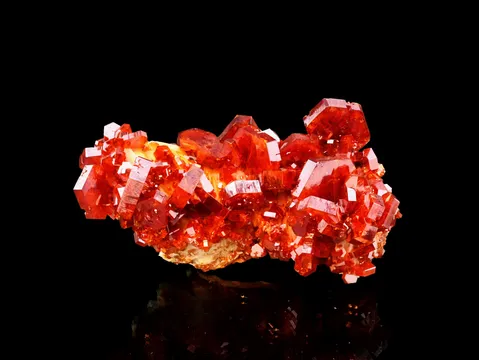
Imilchil Cercle, Morocco — High Atlas locality for titanite, prehnite, fluorapatite, rutile, and magnetite; prized for vivid textures and a label history.
Key facts
Imilchil Cercle sits in Morocco’s central High Atlas, a high, dry mountain country where Jurassic carbonate and red-bed basins have been invaded by small alkaline intrusions, mafic dykes, albitite veins, and locally pegmatitic or metasomatic pockets. For mineral collectors, “Imilchil” has long been more than a town name: it is a market and label-name for a suite of High Atlas specimens, some from within Imilchil Cercle proper and some from nearby passes and villages historically grouped under the same collecting label. The best-known material is not a conventional ore-mine product but specimen-pocket mineralization tied to alkaline intrusive activity: titanite, microcline, apatite-group minerals, prehnite, quartz, rutile, ilmenite, magnetite, amphiboles, epidote, zeolites, and a handful of rarer accessories.
The locality matters because it brings together three things serious collectors prize: vivid aesthetics, complex replacement textures, and a label history that rewards careful documentation. The early-2000s green titanites on pale feldspar made Imilchil recognizable; later, the 2016 titanite-rutile-ilmenite replacement pieces gave the district a distinctive mineralogical signature; subsequent pockets added pale to deep green prehnite, yellow-green and pink-green fluorapatite, titanium-bearing magnetite, analyzed chlorapatite, and sharp microcline specimens. At their best, Imilchil specimens are architectural: wedge-shaped titanite flashing yellow-green on blocky white feldspar, rutile pseudomorphs preserving platy ilmenite outlines under a glittering coat of titanite, pistachio prehnite hemispheres perched on dark ophitic matrix, or lustrous octahedral magnetite partly dressed with quartz and microcline.
Regional View
Country View
Collectors should approach the name “Imilchil” with precision. The administrative locality Imilchil Cercle, Midelt Province, Drâa-Tafilalet Region, is real; so is the broader mineral-market usage of “Imilchil area,” which has historically absorbed several High Atlas occurrences up to many tens of kilometres from the town. Modern labels increasingly separate Imilchil, Takat, Bou Azmou, Anemzi, Tirrhist, Tizi-n-Inouzane, and related High Atlas occurrences. Older labels often do not. That ambiguity is part of the locality’s collecting history, but it also means that good specimens deserve good paperwork.

Photo: Rob Lavinsky, iRocks.com via Wikimedia Commons

Search for specimens: View all specimens from Imilchil Cercle, Morocco
The Imilchil collecting district belongs to the Central High Atlas, an inverted Mesozoic rift belt whose present relief was built by later Alpine compression. Its specimen-producing rocks are associated with the Imilchil alkaline province: a Jurassic to Cretaceous assemblage of mafic and felsic intrusions expressed as dykes, sills, laccoliths, syenitic to monzonitic rocks, dolerites, gabbroic bodies, basaltic flows, and albitite veins. The “Plateau des Lacs” around Lakes Tislit and Isli is especially instructive geologically, because mafic dykes there form a radial to stockwork-like system around small subvolcanic centres, and some mafic bodies carry whitish to pinkish albitite veins. In the wider Imilchil-Anemzi-Tirrhist belt, alkaline feldspar-rich veins and pockets cut or border small intrusions, and hydrothermal fluids have overprinted primary igneous minerals with prehnite, epidote, quartz, zeolites, chlorite, and titanium-oxide replacement assemblages.
The important collector mineralization is best thought of as small-pocket alkaline-intrusive and hydrothermal mineralization rather than a single mine. Feldspar-dominant pegmatitic or albititic zones provide the pale matrix for titanite, fluorapatite, magnetite, quartz, and amphiboles. Mafic or ophitic rocks host dark matrices with prehnite, epidote, amphibole, quartz, and hematite. The celebrated 2016 titanite-rutile-ilmenite specimens record a replacement sequence in which platy ilmenite crystals were pseudomorphed by rutile and then overgrown by sharp titanite; the resulting pieces preserve the broad, irregular tabular ilmenite outline but have the sparkle and yellow-green pleochroism of titanite on the surface. Later titanium-bearing magnetites show octahedral crystals in parallel growths, again suggesting replacement after larger ilmenite forms. Zeolite-bearing cavities at Takat and nearby Imilchil-labelled occurrences add chabazite-Ca, stilbite-Ca, stellerite, calcite, and quartz to the locality’s personality.
There is no well-documented large industrial mining history here comparable to Morocco’s classic lead, cobalt, or manganese districts. The specimen history is instead a story of small workings, local diggers, and dealer-driven discoveries. High Atlas mineral hunters have worked shallow pits, small trenches, and weathered pocket zones in hard mountain terrain. Important marketed waves include green titanite on feldspar around 2005, fluorapatite and prehnite material that reached major European shows around 2013, titanite on rutile after ilmenite in 2016, unusual pink-to-green fluorapatite in prehnite nodules in 2017, a new morphology of spheroidal prehnite in 2019, titanium-bearing magnetite with microcline and quartz in late 2020, chlorapatite with ferro-actinolite, microcline, and titanite in 2021, and additional microcline, quartz, hematite, zircon, pyrochlore-group, and related pocket assemblages around 2022.
The most important practical fact for collectors is that access and locality names are not simple. The town of Imilchil became the trade hub and shorthand, while some specimen-producing outcrops are far from the town and, in certain cases, outside Imilchil Cercle in neighbouring administrative units. Mindat’s modern locality structure explicitly treats several “Imilchil” market labels as belonging to the broader Imilchil area rather than to the town itself. For a cabinet specimen, “Imilchil Cercle” may be acceptable when that is the best available historical label; for a systematic collection, it is worth preserving every older tag and any dealer note that mentions Anemzi, Tizi-n-Inouzane, Tirrhist, Takat, Bou Azmou, Asif Melloul, or a collection date.
Collecting today is best approached through established Moroccan dealers, known local diggers, and documented show material rather than by casual self-collecting. The occurrences are scattered, pockets are localized, and access can involve village lands, small claims, active diggings, steep terrain, and changing local arrangements. The specimens that reach the market are usually hand-recovered pocket pieces, so condition varies from superb undamaged miniatures to contacted, etched, repaired, or partly weathered crystals. Documentation, analysis, and exact provenance add real value here because several species—especially apatite-group minerals, feldspars, amphiboles, titanium oxides, and garnets—have been reidentified as the locality has been studied more carefully.
Titanite is the signature display mineral of the Imilchil suite, occurring in two distinct collector generations: the earlier green to yellow-green wedge-shaped crystals perched on white feldspar or albite-rich matrix, and the later 2016 material in which very sharp titanite crystals coat rutile pseudomorphs after platy ilmenite, commonly with microcline. The best titanites are isolated enough to show their classic wedge form, transparent to translucent, glassy, and strongly pleochroic, flashing yellow under LED lighting and greener in daylight; ordinary pieces tend to be crowded, dull, partially buried in feldspar, or chipped along thin edges. Sizes range from small thumbnails with millimetric titanites to small-cabinet and cabinet pieces carrying titanite crystals around 1 cm or a little more, with the most desirable examples combining sharpness, colour change, and a clearly readable rutile-after-ilmenite architecture.
Microcline from the Imilchil collecting circuit is usually a matrix and association mineral, but good specimens can stand on their own: cream-white to pink feldspar crystals in blocky, tabular, elongated, or twinned groups, sometimes showing Carlsbad or Baveno-law forms, geometric dissolution channels, quartz microcrystal coatings, hematite dusting, stilbite-Ca, magnetite, or titanite. The best pieces have lustrous, well-profiled feldspar faces, attractive pink colour or clean ivory contrast, minimal bruising on exposed edges, and a balanced association with darker magnetite or green-yellow titanite; lesser examples are massive feldspar chunks with only vague crystal outlines. Some analyzed microcline associated with titanium-bearing magnetite has been reported as weakly to distinctly fluorescent under short-wave UV, which gives certain otherwise subdued feldspar specimens extra collector interest.
Rutile at Imilchil is most important as a replacement mineral rather than as free-standing red prismatic crystals. In the 2016 titanite-rutile-ilmenite pockets, rutile pseudomorphed tabular ilmenite crystals with irregular outlines, preserving platy forms that are then coated by sharp titanite and partly by microcline. Fine pieces let the viewer read all three generations at once: the broad black to dark substrate shape of the former ilmenite, the rutile replacement texture, and the lustrous titanite overgrowth. The best specimens are those where the pseudomorph is complete, the platy habit is unmistakable, and the titanite coating is bright but not so dense that it erases the underlying replacement story.
Ilmenite is central to the locality’s most distinctive specimens even when little original ilmenite remains. The classic material consists of lamellar or platy ilmenite crystals with irregular contours, subsequently replaced by rutile and overgrown by titanite; in related late-2020 material, titanium-rich magnetite aggregates also suggest pseudomorphic development after ilmenite-like precursors. Collectors should prize specimens that preserve the flat ilmenite habit as a strong visual “ghost,” because that morphology is what separates Imilchil replacement pieces from ordinary titanite-on-feldspar specimens. Complete plates, sharp edges, clear pseudomorphic texture, and confirmed association with rutile, titanite, microcline, quartz, or magnetite are far more important than size alone.
Prehnite from Imilchil is a surprisingly varied and attractive part of the locality, found as pale to deeper green spheroidal aggregates, radiating groups, globular clusters of short prismatic crystals, and microcrystalline nodules that may host fluorapatite. The 2019 material was notable for individualized spheroidal growths and parallel crystal aggregates with translucent, lustrous faces, commonly on dark ophitic matrix sprinkled with epidote, ferro-actinolite, quartz, or feldspar; other pieces show white radial prehnite with actinolite and analcime, or larger skein-like globules partly coated by quartz. The best prehnites are not merely green balls: they show crisp individual crystal faces, a balanced matrix, good translucency, and lively colour zoning from whitish edges to stronger green interiors, while ordinary examples are compact, dull, or bruised around the delicate curved surfaces.
Quartz is a frequent companion in Imilchil specimens rather than the locality’s headline mineral. It appears as small transparent to milky crystals with microcline and titanium-rich magnetite, coatings on microcline with hematite, small crystals on prehnite, and pale pseudomorphic-looking groups in some 2022 feldspar pockets where quartz appears to have replaced an earlier species. In the broader High Atlas “Imilchil area,” quartz crystals have been reported from feldspar-amphibole pockets and may reach cabinet scale, but the collector value in Imilchil-labelled specimens usually lies in how quartz sharpens the assemblage: bright little points on dark magnetite, glittering crusts on pink microcline, or clean accents on green prehnite. The best quartz-bearing pieces keep the quartz from becoming visual clutter and instead use it as sparkle and contrast.
Magnetite from Imilchil is most collectible in the titanium-bearing late-2020 style: lustrous black octahedral crystals in parallel growths or drusy aggregates, commonly with microcline and quartz, and in some cases with a compound habit suggesting replacement after ilmenite. Specimens are generally miniatures to small-cabinet pieces, but the visual impact can be high because the black magnetite sharply contrasts with pale feldspar and quartz. Fine examples have crisp octahedral form, bright metallic lustre, fine growth striations, readable replacement geometry, and verified association with analyzed microcline; lesser pieces are simply dark granular magnetite masses without crystal definition or with excessive feldspar covering the best faces.
“Feldspar” on Imilchil labels usually refers to K-feldspar or albite-rich matrix in alkaline-intrusive pocket assemblages, and older specimens may use orthoclase, microcline, albite, or generic feldspar in ways that later analysis can refine. Feldspar forms the pale scaffolding for many of the district’s best titanite, apatite, magnetite, and quartz pieces: blocky white crystals under green titanite, pink to cream microcline groups with quartz and hematite, and feldspar-rich pockets with amphibole or zeolite overgrowths. Good feldspar specimens from this area are sharply crystallized, lustrous, well-composed, and mineralogically documented; ordinary ones are feldspar matrix pieces whose value depends entirely on the associated species.
Fluorapatite is one of the minerals that made the broader Imilchil-Anemzi High Atlas district famous with collectors. The classic crystals are lustrous, transparent to translucent, yellowish green to greenish yellow, usually prismatic with pinacoid and dipyramidal faces, often on feldspar-rich or pegmatitic matrix; documented crystals commonly fall in the 2–4 cm range, with better examples doubly terminated or strongly glassy. A particularly coveted 2017 style from Anemzi consists of elongated pink to polychrome fluorapatite enclosed in or emerging from microcrystalline prehnite nodules, with greenish terminations that make some crystals look deceptively like tourmaline. The best fluorapatites combine sharp form, transparency, saturated colour, intact terminations, and meaningful matrix, while repaired crystals and incomplete backs are common enough that condition should be checked carefully.
Albite occurs in the feldspar-rich, albitite, and pegmatitic portions of the Imilchil suite and is especially familiar as the white to off-white matrix for earlier green titanite specimens. It is usually present as blocky to cleaved feldspar crystals rather than as the delicate alpine-style albite plates known from some other localities. In good Imilchil pieces, albite’s value is aesthetic and geological: it gives pale contrast to green titanite, yellow-green apatite, or dark amphibole and signals the sodium-rich alteration and albitite association documented in the central High Atlas intrusions. The best albite-bearing specimens have clean, sharply crystallized feldspar with minimal iron staining and enough open space to display associated titanite or apatite rather than burying it.
Apatite on Imilchil labels should be treated carefully because the apatite supergroup is represented by multiple compositions in the region, with fluorapatite dominant in the well-known gemmy collector material and chlorapatite also reported and analyzed from later finds. As a collector category, Imilchil apatite ranges from yellow-green prismatic fluorapatite on feldspar or amphibole-bearing matrix to pale yellow chlorapatite crystals associated with ferro-actinolite, microcline, titanite, and ilmenite. Good apatite specimens are lustrous, transparent, sharply terminated, and correctly identified; ordinary or problematic pieces may be generic “apatite” without analysis, abraded, repaired, or mislocalized from the broader High Atlas trade circuit. For systematic collections, the best label is one that preserves both the historical Imilchil name and the analyzed species name.
Other documented or widely reported minerals from the Imilchil collecting district and adjacent “Imilchil area” include chlorapatite, ferro-actinolite, actinolite, epidote, hematite, pyrite, sphalerite, calcite, analcime, chabazite-Ca, stilbite-Ca, stellerite, kaolinite, titanium-bearing andradite or melanite-like garnet, aegirine, arfvedsonite, zircon, fluorcalciopyrochlore, chamosite, and ilvaite. No well-established type-locality mineral species is presently associated with Imilchil Cercle in the mainstream mineralogical literature, but the area has produced noteworthy rarities for Morocco, particularly analyzed chlorapatite, titanium-bearing garnet, ilvaite reported from High Atlas feldspar-amphibole pockets, and the recent zircon-pyrochlore assemblages from Tizi-n-Inouzane.
The single greatest authenticity issue is locality precision. “Imilchil” is both a town and a long-running trade label, and many specimens historically sold under that name came from a constellation of High Atlas occurrences, some in neighbouring administrative areas rather than within Imilchil Cercle proper. A specimen labelled only “Imilchil, Morocco” is not necessarily wrong in market terms, but it is incomplete for serious locality collecting. Preserve old labels, dealer codes, show tags, dates, and any mention of Anemzi, Takat, Bou Azmou, Tirrhist, Tizi-n-Inouzane, Asif Melloul, or “Imilchil area.”
Species identification also deserves attention. Orthoclase versus microcline, albite versus generic feldspar, fluorapatite versus chlorapatite, actinolite versus ferro-actinolite, and rutile-after-ilmenite versus magnetite-after-ilmenite are all distinctions that have mattered in documented specimens. The 2016 titanite-rutile-ilmenite pieces and the late-2020 titanium-rich magnetites are best bought with analytical provenance when available. Likewise, apatite-group specimens should not automatically be called fluorapatite unless that identification is supported by analysis, fluorescence behaviour, or a reliable published/dealer record.
No widespread manufactured fake style is well documented for Imilchil in the way that some classic Moroccan localities have imitation problems, but repairs, reattachments, cleaning, and incomplete crystals occur. Fluorapatite is brittle and commonly repaired; elongated pink-green crystals in prehnite should be examined for glue lines at the base or along healed-looking breaks. Titanite has thin edges and exposed terminations that abrade easily. Prehnite globules chip and bruise along their curved crystal faces, and quartz coatings can hide small impact points. Microcline and albite matrices may be iron-stained, etched, or partly cleaved, which can be either natural pocket texture or later damage depending on the piece.
Fluorescence is a useful but not definitive clue. Some Imilchil-area fluorapatites and microcline-bearing specimens are reported as fluorescent under short-wave UV, with occasional minor long-wave response, while chlorapatite and hydroxylapatite are not expected to behave the same way. Do not use fluorescence alone as a species determination, but do record it when present, because it can support a label history and adds interest to display specimens.
Market availability is episodic. Common small pieces of feldspar, prehnite, quartz, and apatite appear regularly, but the better 2016 titanite on rutile after ilmenite, sharp titanium-bearing magnetite with microcline and quartz, aesthetic pink-green fluorapatite in prehnite, and well-composed early titanite-on-albite specimens are much less abundant than casual “Imilchil” labels might suggest. The best values are specimens with a specific find date, analysis, and a clean old-new label chain.
A useful field truth about Imilchil comes from a mineral trip account by Tomasz Praszkier of Spirifer Minerals: the collectors drove into the “heart of High Atlas – Imilchil,” spent a day photographing, and then began visiting localities around the town. What they found was not one mine but a geographic shorthand. “All localities in High Atlas are called ‘Imilchil,’” he wrote, noting that the closest was about 15 km from town and some were about 100 km away. That one sentence explains decades of confusing labels. A specimen bought as “Imilchil” may have passed through the town, the dealer network, or the show circuit without coming from the market town itself.
On the same trip, the party walked from the village of Thirrist toward Jebel Ewargizen, where arfvedsonite-bearing pockets were being worked on slopes in nepheline syenite. The vein was not a grand pegmatite by Brazilian standards: its thickness varied from a few tens of centimetres to a little more than a metre, and the pockets were small enough that crystals were often only partly free-growing. The rock was weathered in the superficial workings, and many crystals simply fell apart. Yet the locality produced arfvedsonite crystals over 12 cm, feldspar, quartz to 15 cm, orange zircon of a few millimetres, green blade-like epidote, and octahedral magnetite to about 1 cm. Praszkier collected metallic prismatic crystals that looked like rutile; analysis reportedly showed ilvaite, probably the first Moroccan report known to him at the time. The lesson is pure High Atlas: small pocket, modest exposure, surprising chemistry.
The Anemzi episode is equally telling. The village lay on a route where many tourists passed through without knowing that the surrounding mountains held one of Morocco’s most distinctive apatite localities. At Anfgou, the group saw apatite on matrix associated with etched scalenohedral calcite and bladed hematite. The apatite crystals were lustrous, gemmy, yellowish green, and commonly 3–4 cm—less spectacular in colour than the finest Tizi-n-Ouazane crystals, but important because they sat well on matrix. The workings were extensive, set in a very small intrusion cutting Triassic sedimentary rocks, with a contact the observers found “well visible and quite spectacular.” That image—bright apatite from a small intrusion piercing red sedimentary country rock—captures why the locality is more than just a dealer label.
Another chapter unfolded not in the mountains but on the show table. Around Sainte-Marie-aux-Mines 2016, a new Imilchil style appeared: tabular ilmenite forms, replaced by rutile and sparkling with sharp titanite. Dealers immediately recognized that the material did not match the earlier titanite-on-feldspar specimens. The pieces needed analysis because their identity was not obvious from a casual look: were the dark plates ilmenite, rutile, or something else? The resulting specimens became especially attractive because they were both beautiful and explanatory—one could hold a hand specimen and see hydrothermal replacement frozen in three dimensions.
Then came the late-2020 and 2021 surprises: titanium-bearing magnetite with microcline and quartz, and analyzed chlorapatite with ferro-actinolite, microcline, and titanite. These were not merely more examples of familiar Moroccan show minerals. They showed that the Imilchil suite was still changing in the market, still being refined analytically, and still producing combinations that forced collectors to rewrite labels. One dealer comment on a 2022 microcline specimen put it plainly: “Imilchil constantly offers new things.”

_1.JPG)