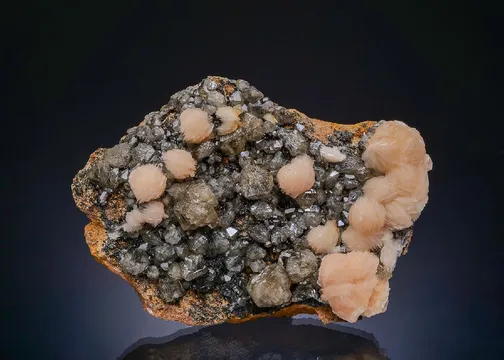
Aouli, Morocco - Classic locality for fluorite; distinctive yellow honey fluorite cubes on white quartz or barite, with galena and azurite, prized by collector…
Key facts
Aouli is one of the classic names of Moroccan mineral collecting: a hard-rock lead district in the Upper Moulouya country northeast of Midelt, where veins cut the Paleozoic Aouli inlier and the surrounding Triassic cover at the junction of the Middle Atlas and High Atlas domains. In the collector’s cabinet, “Aouli” means two overlapping things. Strictly, it is the abandoned Aouli mine and vein system along the Moulouya valley; in older trade usage it often covers the broader Aouli–Mibladen–Sidi Ayad–Sidi Saïd mining country, the source of many Moroccan fluorite, barite, galena, azurite, malachite, cerussite, wulfenite and vanadinite specimens.
Geologically, the district is a fault-and-vein province rather than a single pocket locality. The best-documented Aouli veins are steep, structurally controlled Pb-Zn-Ba-F-Cu-Ag hydrothermal bodies hosted mainly by Cambro-Ordovician schists and Variscan granitoids, with some veins cutting Upper Triassic detrital rocks and basalts. The gangue minerals that matter most to collectors are quartz, barite and fluorite; the principal ore mineral was galena, commonly accompanied by sphalerite, chalcopyrite and pyrite, and then by a lively supergene suite of cerussite, anglesite, malachite, azurite, iron oxides and manganese oxides.
The best Aouli fluorites are not huge, but they have a look that is immediately recognizable: yellow to golden honey cubes, commonly 1–3 cm and occasionally larger, perched on bright white quartz or barite, sometimes accompanied by galena, siderite, pyrite, azurite or malachite. The finest examples have a “lit-from-within” yellow body color, sharp cube edges, and enough contrast from the white gangue to make the small size irrelevant. Barite is less often the headline mineral here but is essential to the district’s aesthetic, occurring as white, cream, pinkish or crested blades and as massive to brecciated gangue with quartz and fluorite. Quartz ranges from vein-filling massive material to sparkling druses and uncommon included crystals carrying hematite and chalcopyrite. Vanadinite, while a genuine glory of the neighboring Mibladen part of the same mining landscape, should be treated carefully on labels: Aouli-labeled vanadinites usually belong to the Mibladen carbonate-hosted system rather than to the Paleozoic Aouli veins proper.
Regional View
Country View

Photo: Wikimedia Commons
Aouli’s historical importance lies in its transition from industrial lead camp to specimen province. The mines were worked by French interests, including the Société des Mines d’Aouli and Peñarroya-associated operations, through much of the twentieth century; modern geological papers cite total Aouli production from 1926 to 1983 at about 9.56 million tonnes of ore averaging roughly 5.3 wt% Pb. That industrial scale explains why specimens still emerge from dumps and old workings: the district contains many veins, many levels, and many generations of broken ground. It also explains the central collector problem here. “Aouli” can be an honest old label, a broad district label, or a lazy dealer shorthand. Fine specimens deserve more precise attribution whenever possible: Aouli vein system, Sidi Ayad, Sidi Saïd, Ansegmir, Poulet, Mibladen, Coud’a/ACF, or another named working.
Search for specimens: View all specimens from Aouli, Morocco
Aouli lies about 25–28 km northeast of Midelt in central Morocco, in the Upper Moulouya mining district of Midelt Province, Drâa-Tafilalet Region. The abandoned mine village sits in rugged semi-arid country along the Moulouya River, with old inclines, rail remnants, galleries, processing ruins and workers’ quarters still visible in the landscape. The collecting locality belongs to the greater Mibladen commune area, but the mineralogical usage of “Aouli” is historically broader than the village itself and is often extended by dealers to adjacent workings that supplied the same Midelt specimen trade.
The deposit is best described as a vein-type Pb-Zn ± Ba ± F ± Cu ± Ag system. The principal host rocks are Paleozoic schists, quartzites and metavolcanic rocks of the Aouli inlier, intruded by the Late Variscan Aouli granitoids, with Permo-Triassic to Mesozoic sedimentary and volcanic cover resting unconformably above. Geological mapping and structural work divide the Aouli district into five vein systems: Ansegmir, Aouli, Poulet, Sidi Ayad and Sidi Saïd. Individual veins include names familiar from old labels and field reports: Bou Adil, Electrique, Engil, Entre 2 Ponts, Henri, Ouart, Sidi Imider, Georges, Baroud, Marteau, Chameaux, El Hassir, Marabout, South El Hassir, Ti Sidi Ouine and the numbered Sidi Saïd veins.
The largest Aouli veins are impressive by any hard-rock standard. Published structural studies describe vein lengths from a few hundred meters to several kilometers, with ordinary vein thicknesses of 1–4 m and exceptional swelling to around 40 m in the Georges and Henri veins. Mindat’s locality summary gives the Aouli deposit as comprising large NE-SW sulphide-dominated veins up to 40 m thick and 13 km long, plus smaller barite-fluorite-dominated veins up to 10 m thick. The veins occupy steep normal faults, strike-slip-modified faults and tension-gash arrays trending mainly NNE-SSW to NE-SW, ENE-WSW to E-W, and WNW-ESE. The tectonic setting is tied to Upper Triassic to Early Liassic extension during Atlas rifting and the broader Pangea/Central Atlantic opening system.
The primary ore assemblage is dominated by galena ± sphalerite, with fluorite, barite, quartz, chalcopyrite, pyrite and silver-bearing minerals. Galena was the economic target, not fluorite; published work records silver-bearing galena, and the Aouli district is repeatedly treated in metallogenic studies as part of Morocco’s major Pb-Zn ± fluorite ± barite argentiferous vein province. Quartz and barite form much of the gangue, and fluorite becomes notably more important near the granitic bodies. Supergene alteration added many of the colorful collector species: cerussite after galena, anglesite, malachite, azurite, iron oxides, manganese oxides, occasional cuprite, chalcocite, covellite, native copper, native silver, native bismuth and wulfenite.
Several vein systems have specimen significance beyond their ore role. The Aouli system proper, at the eastern end of the inlier, includes Bou Adil, Electrique, Henri, Ouart and Sidi Imider on the southern bank of the Moulouya River, with Engil, Frédéric and parts of Entre 2 Ponts and Virgil on the northern side. Henri is notable geologically for its great thickness and collectors know Aouli-system material for galena, quartz-barite gangue, copper carbonates and occasional fluorite. Sidi Ayad, north of the Aouli inlier, includes Marabout, El Hassir, South El Hassir and Ti Sidi Ouine; Marabout is especially important in fluorite discussions because of fluorite with azurite and malachite. Sidi Saïd, in the southern part of the inlier, is documented for quartz, barite and fluorite with subordinate galena, pyrite and chalcopyrite, and is a source of crested barite. Ansegmir, in the southwest, has quartz-fluorite-barite-sulphide veins in Variscan biotite granites and has produced fluorite and barite material that is sometimes folded into the Aouli trade name.
Industrial work at Aouli began in the early twentieth century. Mindat summarizes French company operation from 1923 to 1960, while structural-geology literature cites production by Société des Mines d’Aouli over roughly 60 years and gives the production interval 1926–1983. ONHYM’s historical note for the Aouli–Mibladen mines records 2.93 million tonnes of lead concentrates produced between 1973 and 1983. Local and collector histories also link Aouli and Mibladen to Peñarroya, to a 1928 hydroelectric installation serving the mining camps, and to final closures around 1980–1983 depending on which shaft or operation is meant. The safest way to read the dates is that early French development and underground mining began in the 1920s, major industrial lead production continued through the mid-twentieth century, and later Moroccan-era operations and closure phases extended into the early 1980s.
Collecting today is not a casual rockhound proposition. Much of the district consists of old underground workings, unstable stopes, shafts, dumps and private or formerly permitted ground. Mindat’s locality discussion notes that small local operations sometimes resume in abandoned or cleaned-out workings, but also that work in the old veins is dangerous and that permits belong to private companies. Atlas Obscura and Moroccan environmental-planning documents describe present-day freelance or clandestine miners entering old galleries to recover lead, zinc, fluorite, quartz and collector minerals using rudimentary tools. For collectors, that means two things: specimens continue to reach the market, but direct collecting access should be approached with local permission, extreme caution, and respect for active local livelihoods and legal restrictions.
The notable specimen finds are scattered rather than tied to one famous “pocket.” Fluorite has come from dumps and underground workings throughout the broader Aouli field, especially Sidi Ayad, Sidi Saïd, Ansegmir and selected Aouli veins such as Bou Adil. Older collectors reported 1960s–1970s yellow fluorite from Sidi Ayad, Sidi Saïd and Ansegmir; a Mindat forum account records a lot of roughly 300 yellow Bou Adil fluorites obtained underground in the 1970s, with crystals mostly 1–3 cm. Another collector discussion records a late-1990s find of dark violet fluorite crystals to about 3 cm in Aouli veins. Modern dealer and Mindat photo records show later yellow fluorites collected around 2002–2003 and fine cabinet specimens with 2–2.6 cm cubes on quartz or matrix. These are the pieces that define Aouli for fluorite specialists: modestly sized, intensely colored, sharply cubic, and far scarcer in high aesthetic quality than the abundance of yellow Moroccan fluorite labels might suggest.
Aouli fluorite is the district’s signature collector mineral, typically forming transparent to translucent cubes in clear, pale yellow, lemon-yellow, honey, golden-amber, pale green, pale violet and rare darker violet tones; most collectible crystals are 1–3 cm, with reported maxima around 7–10 cm but far fewer surviving as undamaged cabinet specimens. The classic habit is intergrown yellow cubes on white quartz or barite, sometimes with galena, siderite, pyrite, azurite or malachite; Sidi Ayad, Sidi Saïd, Ansegmir and certain Aouli veins such as Bou Adil account for many of the better pieces historically sold under the Aouli name. The finest examples have saturated yellow color without muddy brown tones, sharp cube edges, transparency at the corners, clean contrast on bright quartz or bladed barite, and minimal bruising, because extraction from entangled vein fillings commonly leaves chipped corners or contact marks.
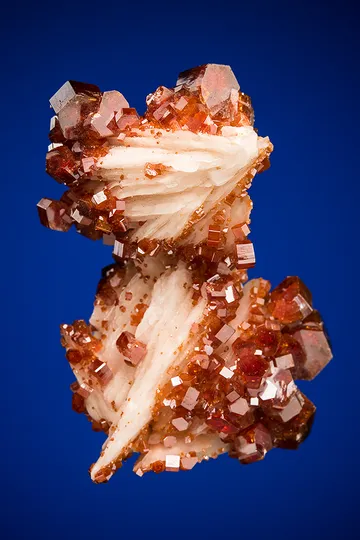
Barite at Aouli is both a gangue mineral and a display species, occurring as massive and brecciated barite with quartz in veins such as Ansegmir 3, as crested aggregates documented from Sidi Saïd 2, and as white to cream, locally pinkish blades associated with yellow fluorite, quartz, galena and supergene copper minerals. Collector-quality barite from the broader Aouli field is usually valued less for isolated perfection than for architecture: bladed or crested sprays that lift fluorite or vanadinite into relief, pale blades contrasting with yellow cubes or red hexagons, and undamaged terminations on otherwise fragile plates. Ordinary Aouli barite is common as broken white vein material; better specimens show distinct crystal form, pleasing spacing, clean surfaces and a believable sublocality within Sidi Saïd, Sidi Ayad, Ansegmir or the Aouli vein system.
Quartz is the structural backbone of many Aouli specimens: a major vein-filling gangue with barite and sulphides, a bright drusy matrix for yellow fluorite, and occasionally a collectible species in its own right. Published field descriptions note galena encased in massive quartz in the Henri vein, brecciated quartz-barite textures in Ansegmir, and quartz with galena, chalcopyrite and malachite in Aouli-system veins; modern specimen records also show uncommon water-clear quartz crystals included by orange to brick-red hematite and tiny chalcopyrite, a distinctive style for an otherwise ore-district quartz. Good Aouli quartz is therefore not judged like Alpine quartz; the best pieces are those that carry sharp, sparkling, undamaged crystals with meaningful associations—fluorite cubes, galena, barite, hematite inclusions or copper secondaries—rather than plain massive white vein quartz.
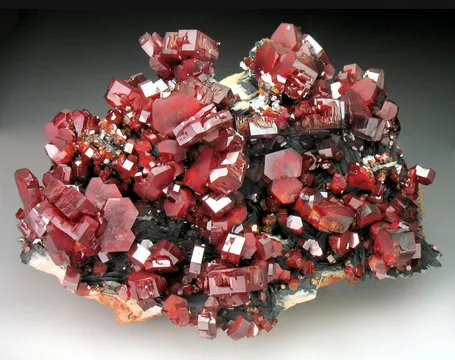
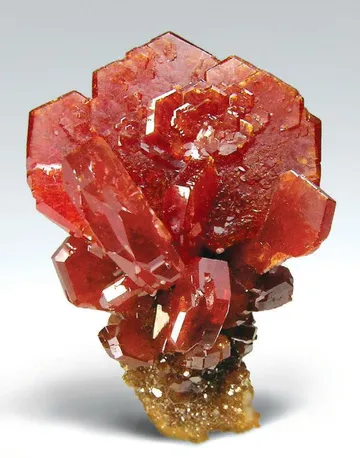
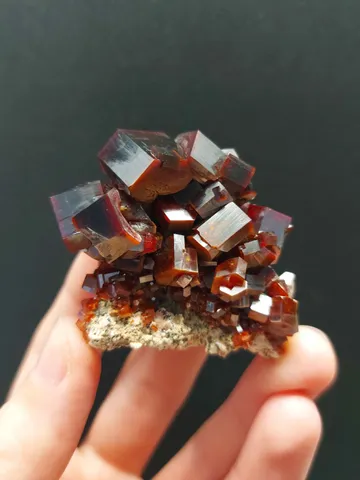
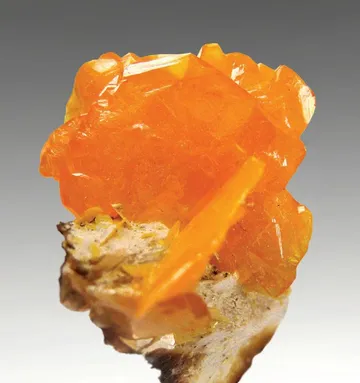
Vanadinite labeled “Aouli” should be understood in the broad Midelt/Aouli–Mibladen trade sense unless a precise sublocality proves otherwise: the celebrated vanadinite of the area is characteristically from the Mibladen carbonate-hosted workings, especially barite-rich horizons and cavities, rather than from the Paleozoic Aouli lead veins. These specimens show red to ruby, orange-red or garnet-red hexagonal prisms and barrels on white, cream, tan or iron-stained barite, with individual crystals commonly millimetric to around a centimeter and the best plates displaying rich color, glassy luster, thick undamaged crystals and strong contrast against bladed barite. The most desirable “Aouli/Mibladen” vanadinites avoid dull brown coatings, crushed crystal edges, excessive glue or repair, and vague labels that hide whether the piece is from Mibladen, Coud’a/ACF, another named working, or merely the wider Midelt district.
Beyond the four featured species, Aouli has a substantial documented assemblage for collectors of lead, copper and oxidation-zone minerals. Galena is historically and economically central, occurring with quartz-barite gangue and locally with sphalerite, chalcopyrite and pyrite; its alteration produces cerussite and anglesite, while copper-bearing zones yield azurite, malachite, cuprite, chalcocite, covellite and rare native copper. Mindat and published mineral lists also record ankerite, dolomite, calcite, siderite, hematite, goethite, marcasite, arsenopyrite, bornite, native bismuth, native silver, nickeline, tetrahedrite-group minerals, tourmaline, wulfenite and agate/chalcedony attributed to the broader area. No valid type-locality mineral is securely tied to Aouli itself in the sources used here; the district’s mineralogical importance rests instead on its vein-system geology, historic Pb-Ag production, and attractive suite of fluorite, barite, quartz, galena and secondary copper/lead minerals.
The most important authenticity issue is locality precision. “Aouli” appears on labels for material from the abandoned Aouli mine village, the Aouli vein system, the Aouli mining company’s historical district, Sidi Ayad, Sidi Saïd, Ansegmir, Poulet and sometimes the neighboring Mibladen vanadinite workings. This is not always fraud; older labels often used Aouli as a district name. But high-value specimens should be scrutinized. A yellow fluorite on quartz may honestly be Aouli, Sidi Ayad, Sidi Saïd or Ansegmir; a red vanadinite on white barite is far more likely to be Mibladen-area material; and specimens simply marked “Aouli, Morocco” are less desirable than those preserving a named vein, shaft or collection provenance.
For fluorite, condition is everything. Aouli cubes are commonly intergrown and extracted from vein cavities or old broken workings, so chips on cube corners, bruised faces, cleaved side crystals and contacts on the underside are normal. Fine pieces should be examined under strong side light: repaired cube corners, glued joins between fluorite and quartz, and rubbed luster on exposed cube faces can be hard to see in frontal photographs. A bright yellow cube cluster on white quartz with only minor peripheral contacts is considerably scarcer than an average loose cluster of amber cubes.
For barite, watch for cleavage and compression damage. White blades can be bruised or cleaved along edges, and iron/manganese staining may be natural but can also make damage harder to read. Barite associated with vanadinite is especially vulnerable because the vanadinite crystals break easily from the blade surfaces. Avoid soaking barite-rich specimens; many pieces include porous iron oxides, soft clayey matrix or unstable old-dump material.
Quartz from Aouli is generally durable, but the matrix may not be. Included quartz specimens with hematite or chalcopyrite are unusual and should retain a credible old-collection or dealer history; ordinary quartz points with no characteristic association are not especially diagnostic of Aouli. Quartz-fluorite combinations are more localizable and more collectible when the quartz is bright, the fluorite is sharply cubic, and the labels preserve a vein-system attribution.
Vanadinite from the Aouli/Mibladen trade is widely available compared with good Aouli fluorite, but the top tier is still selective. Look for thick, lustrous, undamaged hexagonal crystals, strong red to ruby color, natural distribution on barite, and a matrix that has not been artificially trimmed into a suspiciously neat base. Repairs are not unusual on larger Moroccan vanadinite plates; they should be disclosed. A precise “Mibladen” or named Mibladen working label is usually preferable to a vague “Aouli Mine” label for vanadinite.
Fluorescence can add interest. At least one documented Aouli yellow fluorite specimen shows different ultraviolet responses under shortwave and longwave light, including creamy-white shortwave fluorescence and saturated blue longwave fluorescence. Fluorescence should be treated as a bonus, not a locality proof, because fluorite from several Moroccan localities can respond under UV.
Market availability is uneven. Aouli-labeled vanadinite and barite are common in the broader Moroccan trade, but genuinely fine Aouli fluorite is much less common than casual listings imply. Older yellow fluorites from the 1960s–1970s, late-1990s violet material, and early-2000s yellow cube clusters with strong color and good condition are worth premium attention. Provenance from older European collections, named Midelt-area dealers, or documented collections such as Dr. Erika Pohl-Stroher, Wayne Thompson, Tim Sherburn or other recorded owners can materially improve confidence.
Field collecting is hazardous and legally complicated. Old Aouli and Mibladen workings include open shafts, unstable stopes, flooded levels, rotten ladders, bad air risks, loose rock, and active informal mining. Many veins are under private or historical permit constraints. Specimen buyers should respect the people who still work these deposits and favor sellers who can explain source, access and handling clearly.
Aouli is one of those districts where the ruins are nearly as mineralogical as the specimens. The road from Midelt drops into the Moulouya valley and the old workings appear not as a single mine mouth but as an industrial landscape: rail inclines on steep slopes, broken processing buildings, bridges over the river, roofless stone huts, and workers’ quarters sliding toward abandonment. Atlas Obscura’s field account describes the main tunnel splitting after roughly 1.5 km, with narrow shafts running off in several directions, ladders and pulleys connecting levels, and larger chambers still holding disused trolleys, tools and even basic amenities such as a makeshift shower. One image from the account lingers: an ominous red metal door, locked with heavy padlocks, behind which dynamite was reportedly stored in the French mining period.
The afterlife of the mine is just as vivid. Freelance miners still enter the old workings, recovering lead, zinc, fluorite and quartz with rudimentary tools rather than modern underground equipment. Atlas Obscura describes stripped-down bicycles loaded with as much as 100 kg of minerals per trip, pushed over muddy, uneven ground. The same pattern appears in Moroccan planning documents, which treat Zaida–Mibladen–Aouli as a mineral heritage resource but also acknowledge that present extraction is often illicit, unstructured and dangerous. To the collector, a bright yellow fluorite or red vanadinite may look like a clean cabinet object; at Aouli it often begins as hard labor inside a nineteenth- and twentieth-century industrial ruin.
Local mineral culture has its own language. A 2007 Midelt blog post called Aouli–Mibladen the “capital of vanadinite,” contrasting Midelt’s semi-desert landscape with the underground colors of the district: the red of vanadinite, the green of malachite, the blue of azurite, the yellow of wulfenite, the white of gypsum and calcite. The author wrote that local children might not know the names of flowers but were skilled “mâallemine” in collectible stones, and that many carried those crystals to mineral fairs around the world. It is a revealing portrait of Midelt’s specimen economy: part geology, part family trade, part risk, and part local pride.
One of the liveliest modern stories belongs to the famous La SIF gallery in the Mibladen vanadinite sector, sometimes distorted on labels to ACF. A French field note records that in the 1980s the BRPM opened a 125 m decline at Adeghoual, west of Mibladen, to test a mineralized level. That gallery went on to produce some of the finest vanadinite specimens of the district. The same account says the gallery could still be visited by asking the miners on site and bringing a strong lamp, though it bluntly warns against the visit for anyone claustrophobic or particular about safety. The miners’ folklore includes a classic mineral-world tale: a man who supposedly found a museum piece 20 m underground, sold it for 200,000 euros to a wealthy American, and then squandered the money in the hotels of Marrakech and Agadir. Whether legend or moral fable, it has the ring of many great specimen districts: one pocket can change a life, but not always for long.
Aouli’s fluorite locality debate is almost a story in itself. In a 2012 Mindat discussion, one participant insisted that the yellow fluorites sold as Aouli were really from Sidi Ayad, while another collector, Peter Seroka, pushed back with a broader historical definition of Aouli as an ore province named for the Aouli schist massif and not just one village or company. He listed a roll call of veins—Bou Adil, André, Edmont, Henri, Engil, Frédéric, Electrique, Virgile, Ouart, Entre-deux-ponts, Ou-Berri and La Centrale for Aouli; Georges, Poulet, Baroud, Marteau and Chameaux for Poulet; El Hassir, Ti-Sidi-Ouine and Marabout for Sidi Ayad; numbered veins for Sidi Saïd-Outat and Ansegmir—and argued that after mining stopped it became harder to know exact origins because specimen miners recovered material from water-filled or abandoned levels. In the same discussion, another collector recalled obtaining nearly 300 yellow Bou Adil fluorite specimens underground in the 1970s, mostly with 1–3 cm crystals. That exchange is a useful cautionary tale for anyone buying Aouli: the district is real, the labels are complicated, and the best specimens deserve more than a one-word locality.