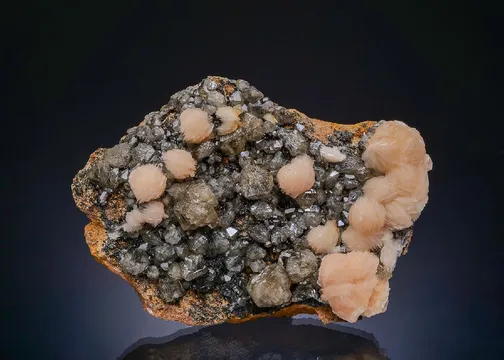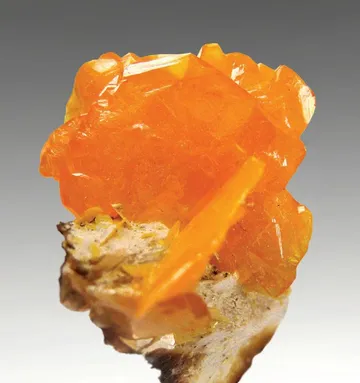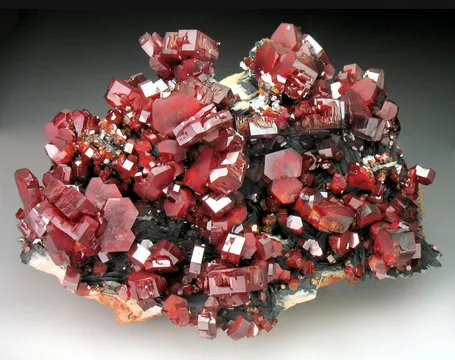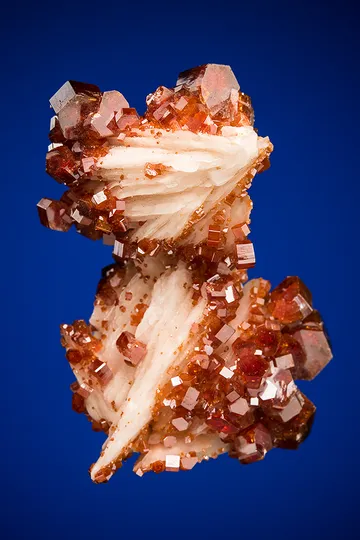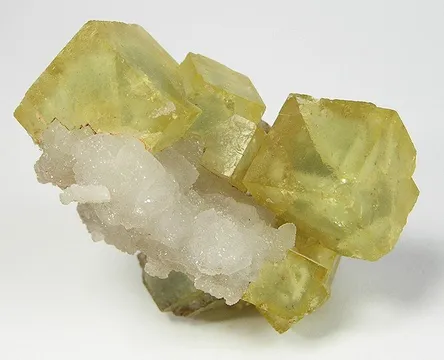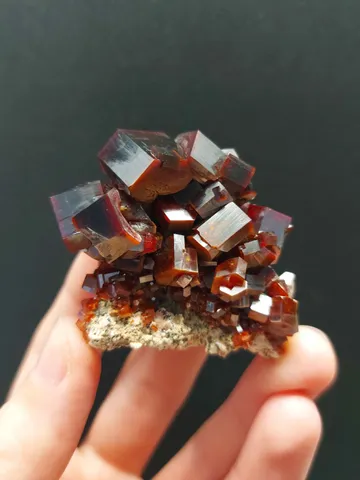
Mibladen Mining District, Morocco — renowned for red vanadinite perched on baryte, with cerussite and wulfenite; a historic, collector-favorite locality.
Key facts
Mibladen is one of the defining mineral-specimen localities of Morocco and, for many collectors, the locality that fixed the modern image of Moroccan vanadinite: red to orange-red hexagonal crystals perched on snowy or honey-colored baryte, sometimes backed by dark manganese-oxide-coated matrix. The district lies on the high Upper Moulouya plateau near Midelt, between the Middle Atlas and High Atlas domains, where old lead workings cut stratabound carbonate-hosted mineralization in Liassic limestones, dolomites, and marly carbonates. The primary ore story is a lead-barium system—galena and baryte in a carbonate host—but the collector story is written in oxidation: cerussite, vanadinite, anglesite, wulfenite, mottramite, pyromorphite, and related secondary species developed as near-surface fluids altered and remobilized the lead ore.
Historically, Mibladen belongs with Aouli and Zeïda as part of the High Moulouya lead district. Aouli was the vein-mining center, Zeïda the red-bed lead deposit, and Mibladen the stratiform to karstic carbonate-hosted member of the trio. Industrial lead mining made the district important in the twentieth century, but the closure of the formal mines did not end Mibladen’s mineral life. Local miners continued to work old rooms, dumps, shallow pockets, and hand-dug shafts for specimens, turning a former ore camp into a long-running source of collector minerals.
The best Mibladen specimens are instantly recognizable but not monotonous. Classic vanadinite from the ACF and Coud’a areas forms thick, lustrous, tabular to short-prismatic crystals, commonly red, orange-red, brownish red, or, in rarer habits, pale orange to cream with internal color banding. Baryte may form white lamellar books, crested cockscomb plates, salmon to pink blades, or honey-toned tabular masses. Cerussite comes as colorless, cream, honey-yellow, smoky, and twinned crystals on baryte and galena; wulfenite is far scarcer, usually as orange to yellow tabular crystals in the lead-oxidation assemblage. A fine Mibladen piece is not simply “red on white”: it has three-dimensional architecture, undamaged crystal edges, luster that survives close inspection, and a matrix that tells the geology rather than just serving as a stage.
Regional View
Country View
The district’s collecting fame rests above all on the sustained quality of its vanadinite production. Many localities have produced attractive vanadinite; very few have produced such a range of cabinet-quality specimens over so long a period, from old Bou el Maden and Assif-style material to the ACF classics of the 1990s, the Coud’a rush, and later specialty finds from deeper or more difficult workings. For the serious collector, sublocality matters: “Mibladen” is useful, but “ACF Mine,” “Coud’a,” “Bou el Maden,” “Les Dalles,” “Les O,” or “Adeghoual” can sharpen both the mineralogical story and the market identity of a specimen.
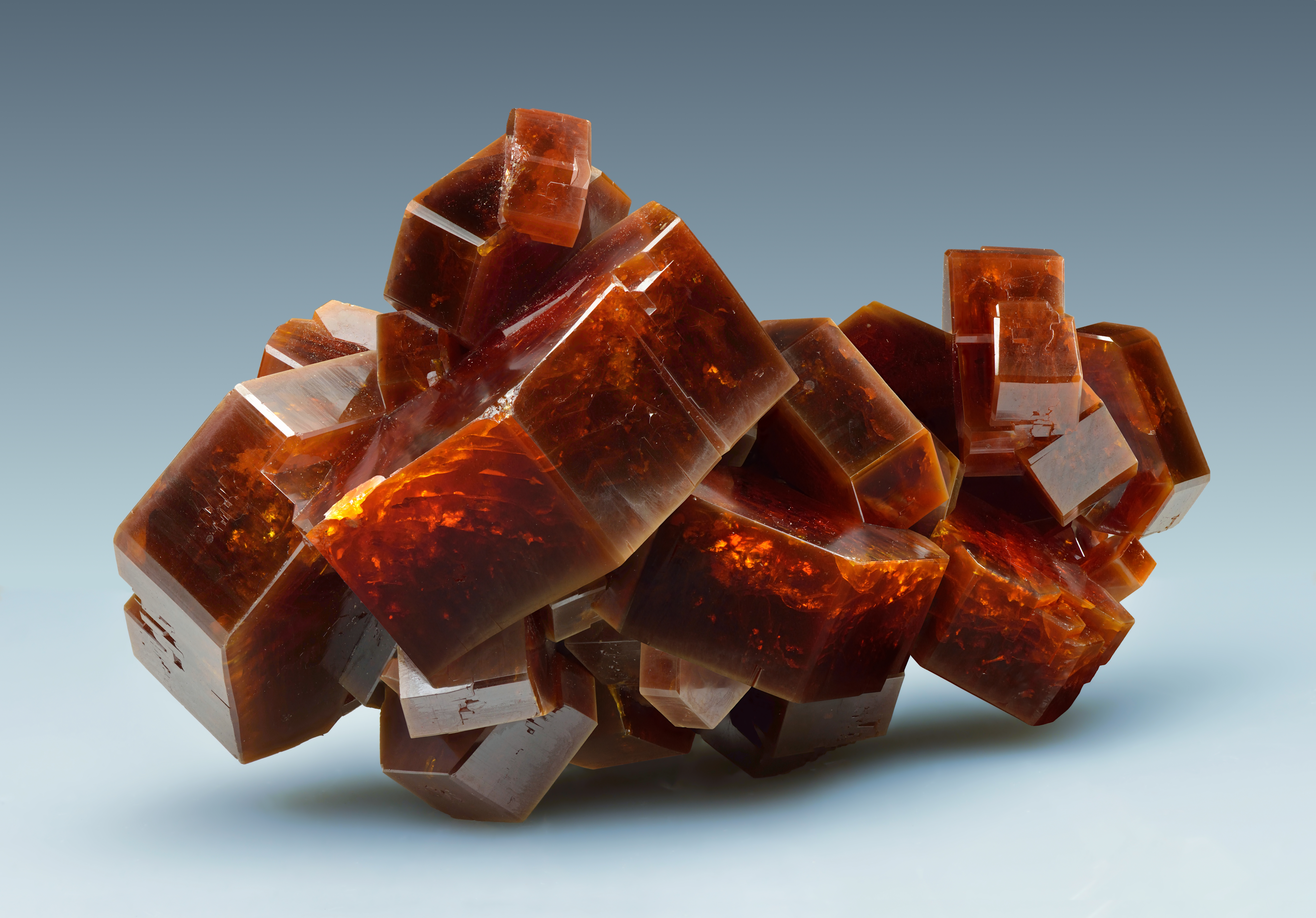

Search for specimens: View all specimens from Mibladen Mining District, Morocco
Mibladen lies roughly northeast of Midelt in central Morocco, at about 1400 meters elevation in the Upper Moulouya basin. In the regional mining literature it is grouped with Aouli and Zeïda as the High Moulouya lead district: Aouli is a vein-type lead-zinc-barium system in Paleozoic basement rocks, Zeïda is a Triassic red-bed-hosted lead deposit, and Mibladen is the carbonate-hosted stratabound member of the district. The geological contrast is important for collectors because it explains why the specimen styles differ so strongly over short distances: Aouli is better known geologically for veins, fluorite, baryte, and galena; Mibladen for stratiform lead-baryte ore and its spectacular oxidation minerals.
The Mibladen ore bodies occur as subhorizontal masses in Middle Liassic carbonate and dolomitic formations. Geological guide descriptions place the mineralization in two carbonate packages, a lower series about 10 meters thick and an upper series about 25 meters thick. The exploited ore averaged around 5 percent lead and consisted chiefly of galena and secondary cerussite in a gangue of dolomitic limestone and baryte, with pyrite distributed even through weakly mineralized rock. The secondary suite—vanadinite, wulfenite, anglesite, cerussite, and related minerals—formed from oxidation and remobilization of that lead-bearing system.
The deposit is generally treated as Mississippi Valley-type or MVT-like mineralization: low-temperature brines moving through carbonate rocks, depositing galena and baryte where permeability, structure, and reactive carbonate host rocks allowed ore to form. Later oxidation produced the collector minerals. Isotope work on galena from the Upper Moulouya district distinguishes Mibladen from Aouli-Zeïda in sulfur and lead signatures, supporting a more complex, multi-stage history rather than a single uniform mineralizing event. For collectors, that complexity is visible in the specimens: galena-baryte-cerussite pieces from older lead workings, red vanadinite on baryte from younger specimen shafts, and rare wulfenite or mottramite-bearing examples from chemically distinct oxidation niches.
Mining history at Mibladen is layered. Early lead indications in the Aouli-Mibladen area were identified in the 1920s, infrastructure and formal operations expanded under French-linked companies, and Peñarroya’s technical control after the mid-1940s helped develop the district. The broader Aouli-Mibladen operation was highly active again in the 1970s after renewed research and development work, before the industrial mines finally closed in 1983. Geological guide figures record average production in the very active years as around 300,000 tonnes per year of lead concentrate at about 3 percent, and note that between 1973 and 1983 the Aouli-Mibladen mines produced 2,930,000 tonnes of lead concentrate.
The older Mibladen mining landscape was divided into named workings, commonly called quartiers or chantiers in French. Locality names encountered on specimen labels include Les A, Les AB, Les S, Les O, Les R, Les T, Les Dalles, Anne-Marie, 2em Horizon, Bou el Maden, Marguerite, Adeghoual, ACF Mine, and Coud’a. These names are not trivial label decoration. Les Dalles and Les O are especially relevant for cerussite, baryte, galena, and wulfenite-style specimens; ACF and Coud’a are central to the great modern vanadinite output; Bou el Maden and Assif appear in older collector literature as important vanadinite sources.
Formal industrial lead mining has ceased, but mineral-specimen recovery continues through small-scale and artisanal work. In the old mines, local miners and collectors explore abandoned rooms, pillars, shallow workings, and dumps for baryte, cerussite, wulfenite, and related species. In vanadinite areas, miners have been known to dig narrow vertical shafts from the surface down to productive horizons, then follow small cavities by hand. The work is slow, selective, and dangerous, and access should never be assumed: old rooms, unsupported pillars, hidden shafts, unstable roof rock, and oxygen-poor or flooded workings make Mibladen a professional local-miner locality rather than a casual collecting stop. Most collectors today encounter Mibladen material through Moroccan dealers, international mineral shows, and established specimen dealers rather than by self-collecting.
The most consequential modern collecting chapter began with the late-1990s and early-2000s development of the Coud’a sector and the sustained output of the ACF area. Fine ACF material from the 1990s includes thick orange-red to red tabular vanadinite on white lamellar baryte, while later Coud’a and ACF-area finds supplied vivid red tabular crystals, deep-colored floaters, and occasional unusual habits. Documented specimens include 2014 material reportedly recovered from about 200 meters depth in the old ACF shafts, with pale orange to cream doubly terminated vanadinite showing dark central color bands, and 2020 ACF-area finds of elongated to acicular vanadinite crystals in bright red-orange to yellowish orange tones on thin platy baryte.

Mibladen vanadinite is the district’s signature mineral and one of the world standards for Pb5(VO4)3Cl as a display specimen: the classic habit is thick tabular to short-prismatic hexagonal crystals, commonly lustrous red, orange-red, brownish red, or reddish brown, with the finest crystals sharply edged and perched on white to cream lamellar baryte, dark manganese-oxide-coated matrix, or dolomitic limestone. Most market specimens show crystals in the millimeter to centimeter range; high-grade miniatures and small cabinets may have isolated crystals around 1–2 cm, and exceptional documented pieces from the ACF area have crystals approaching or exceeding that range, with some notable references citing prisms to several centimeters. ACF, Coud’a, Bou el Maden, Assif, and related workings dominate the collector record, with ACF famous for red tabular crystals on white baryte and later pockets producing unusual elongated, acicular, pale orange, cream-banded, and doubly terminated habits. What separates a great Mibladen vanadinite from an ordinary one is not size alone but complete geometry, glassy to resinous luster, saturated color, undamaged crystal rims, open spacing, and a matrix that gives contrast without hiding damage.
Barite from Mibladen is not merely a support for vanadinite; it is one of the district’s essential gangue and specimen minerals, occurring as white lamellar books, crested cockscomb aggregates, salmon-pink to orange blades, honey to cream plates, and barytic masses intergrown with galena and cerussite. In the vanadinite pockets, barite is most admired when it forms bright white, open, bladed matrix that gives red crystals maximum contrast, especially in ACF and Coud’a-style pieces. In the older lead workings, including Les Dalles and related rooms, it more often appears in warm pinkish, salmon, or tan bladed groups with cerussite, galena, and occasionally wulfenite. Good barite-dominant pieces from Mibladen have clean, uncrushed blades, attractive radial or book-like architecture, and enough associated lead minerals to anchor the specimen to the district’s ore story; ordinary examples are massive, iron-stained, bruised, or serve only as a broken matrix for scattered vanadinite.
Baryte is the official mineral name for BaSO4 and, at Mibladen, the spelling “baryte” is especially appropriate in the European and Moroccan specimen tradition, where labels often use barytine, baryte, or barite interchangeably. Mibladen baryte forms the physical architecture of many of the district’s best specimens: snow-white lamellar plates typical of classic ACF vanadinite, salmon-orange bladed books carrying cerussite, and cockscomb to sheaf-like groups that can be aesthetic even when vanadinite is absent. It is also a key guide to sublocality style: white lamellar baryte with sharp red vanadinite suggests ACF/Coud’a-type material, while pink to orange baryte with cerussite and galena is more characteristic of older lead-mine assemblages such as Les Dalles. The best baryte pieces show crisp blade edges, attractive color contrast, and natural three-dimensional openness; lesser pieces are common and heavy, with cleaved edges, clay-filled openings, or baryte so massive that the associated species are lost visually.
Cerussite from Mibladen belongs to the district’s lead-mine assemblage rather than the red-on-white vanadinite stereotype: it occurs as colorless, cream, honey-yellow, smoky, and translucent to transparent PbCO3 crystals on baryte, galena, and oxidized matrix, commonly in twinned, dipyramidal, cyclic, reticulated, or radial groups. Les Dalles, Les O, Les R, Les S, Marguerite, Adeghoual, and ACF-area labels are seen on credible Mibladen cerussites, with Les Dalles especially familiar for cerussite with baryte and galena. Fine cabinet pieces may carry cerussite crystals in the 1–3 cm range, while selected documented examples show larger or unusually arranged twins; a noteworthy Fabre reference describes radial twins as unusual for Mibladen, where dipyramidal twins are more typical. Top specimens combine sharp twinning, brightness, transparency, warm color, and balanced placement on salmon or white baryte; ordinary pieces are opaque, bruised, heavily included, or visually confused by broken baryte blades and massive galena.
Mibladen wulfenite is a much scarcer collector target than vanadinite, usually appearing as yellow, orange, or occasionally more intensely colored tabular PbMoO4 crystals in the oxidized lead assemblage with baryte, cerussite, and galena. Les Dalles is one of the recurring labels for wulfenite-bearing pieces, while Adeghoual/Coud’a material has also been documented, including isolated red wulfenite crystals on baryte that differ from the more expected locality style. Crystals are generally modest in size compared with classic wulfenite localities, often millimetric to around a centimeter on the better pieces, and many specimens are valued more for the complete association than for a single dominant crystal. The best Mibladen wulfenites have bright color, undamaged thin tabs, visual separation from baryte or galena, and a credible sublocality; the weakest are broken orange specks on battered baryte, or pieces optimistically sold as rare because they contain only microscopic or questionable wulfenite.
Galena is the primary ore mineral that made Mibladen an industrial lead district, but as a display species it is usually secondary in importance to the oxidation minerals derived from it. It occurs in stratiform carbonate-hosted ore with baryte and dolomitic limestone, and in specimens it commonly appears as lead-gray masses, cleavable patches, cubic remnants, or corroded cores partly altered to cerussite, anglesite, and other secondary lead species. The most collectible Mibladen galena pieces are association specimens: galena supporting sharp cerussite, baryte books, or wulfenite crystals, especially from older room-and-pillar lead workings such as Les Dalles. Stand-alone galena from Mibladen rarely competes aesthetically with classic galena localities; its value lies in context, provenance, and mineral paragenesis, so collectors should favor pieces where galena is clean enough to read as ore yet stable and balanced enough not to dominate or crumble.
Fluorite is not a signature Mibladen species in the way it is for nearby Aouli and Sidi Ayad-style vein systems, but it is part of the broader Upper Moulouya lead-barium-fluorine metallogenic environment and appears in small numbers on Mibladen-labeled specimens. Collectors should treat Mibladen fluorite with locality discipline: attractive fluorite from the Midelt-Aouli region may be correctly Moroccan and geologically related, yet not necessarily from the stratiform Mibladen carbonate workings. When genuinely tied to Mibladen, fluorite is generally an accessory or association mineral rather than the centerpiece, likely to be valued for its occurrence with baryte, galena, cerussite, or other lead minerals. A good Mibladen fluorite specimen therefore needs more than color or transparency—it needs reliable provenance, a convincing matrix, and an association consistent with the district; vague labels such as “Midelt” or “Aouli-Mibladen” should be clarified before assigning specimen significance.
Other documented Mibladen minerals include anglesite, pyromorphite, mottramite, gypsum, anhydrite, calcite, azurite, malachite, phosgenite, manganese oxides, and rare secondary carbonates and vanadates. The district is also the type locality area for grguricite, CaCr2(CO3)2(OH)4·4H2O, described from the Adeghoual Mine as lilac crusts of extremely fine-grained crystalline aggregates in Pb-Ba-V mineralization. That type-mineral status gives Mibladen importance beyond cabinet aesthetics: it is not only a prolific source of market classics but also a locality where careful microanalysis of crusts and alteration products continues to add new mineralogical information.
Mibladen vanadinite is abundant enough that beginner specimens remain easy to find, but genuinely fine pieces are much less common than the market volume suggests. Small crystals on baryte, dark matrix, or broken plates are common; sharp, lustrous, saturated, undamaged, well-composed miniatures and cabinets are selective; large cabinet plates with clean baryte, excellent coverage, and damage-free red crystals are premium specimens. The same pattern holds for cerussite and baryte: there is plenty of material, but far fewer pieces with fine crystal development, attractive color, and strong three-dimensional form.
The main condition issues are mechanical. Vanadinite is soft, brittle, and easily chipped on crystal edges and pinacoid faces; baryte cleaves and bruises; cerussite is heavy, brittle, and prone to edge damage on exposed twins. Examine specimens under magnification for rubbed crystal rims, truncated corners, freshly broken baryte blades, repaired matrix seams, clay hiding damage, or detached crystals reattached into convenient positions. Many Mibladen specimens are mined by hand in cramped workings and travel through a long chain of trimming, cleaning, packing, and export, so minor bruising is normal; the question is whether the price reflects it.
No major, well-documented tradition of synthetic or manufactured Mibladen vanadinite dominates the specialist literature, and the geometry of real Mibladen vanadinite can look almost artificial to new collectors because the hexagonal tablets are so regular. The realistic problems are more ordinary: vague “Morocco” labels upgraded to “Mibladen,” Mibladen-style vanadinite confused with Taouz or Touissit material, repaired or glued baryte matrix, overcleaned surfaces, exaggerated color in photographs, and specimens represented as ACF or Coud’a without supporting provenance. For higher-value pieces, ask for old labels, dealer history, collection history, or published references; “Mibladen district” is acceptable for many specimens, but a premium sublocality claim should be credible.
Mislabelling also occurs within the associated species. Pale yellow vanadinite can be mistaken for mimetite or wulfenite, and small orange wulfenite can be overcalled when the specimen really carries only vanadinite on baryte. Baryte and barite are the same mineral, but label spelling may vary; “baryte” is the official IMA spelling, while “barite” is widely used in North American commerce. Fluorite deserves special caution because the larger Midelt-Aouli region includes fluorite-bearing vein localities that are not necessarily Mibladen in the strict specimen-locality sense.
Cerussite from Mibladen can fluoresce, and some documented pieces show yellow response under longwave and shortwave ultraviolet light, but fluorescence varies and should not be assumed. Vanadinite contains lead and vanadium; normal display handling is not dangerous if treated sensibly, but avoid inhaling dust, do not cut or grind specimens, keep pieces away from children, wash hands after handling, and store friable specimens where small crystals cannot shed into drawers. Color stability is another practical concern: as with many lead-vanadate specimens, prolonged direct sunlight and heat are best avoided, especially for bright red or orange pieces intended for long-term display.
Market availability remains strong. Mibladen is still represented in Moroccan dealer stock, European and American shows, online auctions, and high-end dealer inventories. Entry-level pieces can be inexpensive; good miniatures with sharp crystals and attractive baryte command stronger prices; old, published, sublocality-specific, or unusually large and undamaged pieces are increasingly treated as classics rather than bulk Moroccan supply. A serious Mibladen suite should ideally include at least one red vanadinite on white baryte, one darker manganese-oxide-associated vanadinite, one cerussite-baryte-galena piece from the old lead workings, and—if patience and budget allow—a credible wulfenite or grguricite-related micromount association.
In the collector literature, Mibladen often appears first as a place of statistics: lead percentages, shaft counts, production tonnages. But the field stories are more human and much more memorable. Victor Clay Yount’s 1985 Tucson symposium abstract reads like a dispatch from the early golden age of Moroccan vanadinite collecting. By then he had made 58 trips to the area and still counted only three major vanadinite strikes. He named Bou el Maden as the largest producer of vanadinite at Mibladen, but not always the most brilliant: its crystals commonly sat on tan dolomitic marble, while the most prized Assif-style material was celebrated for the striking contrast of white baryte and fine red vanadinite. One major Bou el Maden strike ran from October 1975 through January 1976 and was credited to the miner Moha Ben-Ali, who recovered a large quantity of brilliant red crystals.
The modern field scene described by collectors is just as vivid. During a Mindat-related Morocco trip recounted by David Joyce, the people of Mibladen staged a mineral and craft show for visiting collectors, complete with local dealers, bargaining, and a large Berber tent set up in the middle of the event. The hospitality did not stop at lunch. On another night the visitors were taken to a “secret” spot that turned out to be an abandoned room-and-pillar mine near Mibladen. Local hosts had transformed the mine into a banquet hall: coarse rocks removed, gravel spread into a smooth floor, carpets laid down, tables and chairs brought underground, and a several-course meal served with music and dancing in the old workings.
The same account captures the contrast between romance and labor. At the ACF workings, the vanadinite-bearing layers were described as about 10 meters below the surface, with no old industrial openings to use. Miners had to chisel a vertical shaft straight down until they reached the productive layer—a process said to take about two months—then hand-chisel laterally until they broke into vugs. Small shelters at the shaft collars served as sleeping places when miners had found something promising and did not want to leave it unattended. Joyce and Raymond McDougall descended with the miner Abdellah and spent a couple of hours hand-chiseling; they found only small vanadinite crystals, then came back to the surface, tipped their host, and bought specimens from him.
The old lead mines offered a different sort of collecting. Instead of narrow freshly dug vanadinite shafts, visitors entered room-and-pillar workings where the remaining pillars still contained veins and seams of galena, vanadinite, baryte, cerussite, and wulfenite. The work was not delicate showroom romance: collectors walked through portals, searched promising areas, and chiseled at pillars and boulders in hopes of opening crystal-lined cavities. Cerussite and baryte were the common rewards. Joyce recorded finding a nice yellow wulfenite at Les Dalles—only to lose it somehow on the way home, a small tragedy any field collector can understand.
The district even crosses into paleontology. Near the mine entrances visited during the 2012 conference trip, dinosaur tracks were noted in slabs above the workings, a reminder that Mibladen’s Liassic and younger sedimentary cover is not merely a container for lead ore. Scientific work has since treated the Mibladen mine area as an important mid-Cretaceous footprint locality in the High Moulouya region. That juxtaposition is very Mibladen: red vanadinite and lead carbonate crystals below, dinosaur traces in the surrounding strata above, and a village economy in which mineral specimens, fossils, and hospitality have become inseparable from the landscape.