






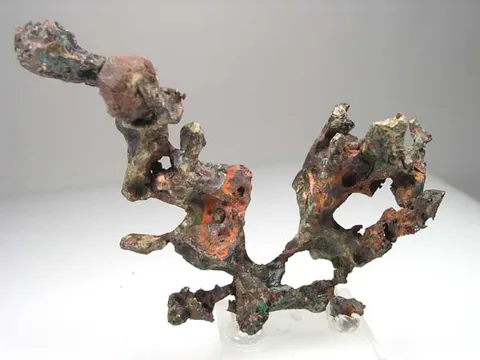
Houghton County, USA — a premier copper ore and mineral-specimen locality on Michigan’s Keweenaw, noted for native copper forms, silver, and calcite.
Key facts
Houghton County is the specimen heart of Michigan’s Copper Country: a long, basalt-and-conglomerate mining belt on the Keweenaw Peninsula where native copper was not a curiosity in cracks, but the ore itself. The county’s classic mines—Calumet & Hecla, Quincy, Osceola, Franklin, Isle Royale, Pewabic, Baltic, Kearsarge, Wolverine, Tamarack, Centennial, Laurium, Atlantic, Champion, Trimountain, Winona, and many smaller workings—cut Mesoproterozoic Portage Lake Volcanics, a thick lava pile of the Midcontinent Rift. Copper-bearing fluids moved through permeable basalt flow tops, amygdaloids, breccias, conglomerate beds, and fissures, leaving native copper with native silver, calcite, quartz, prehnite, epidote, pumpellyite, datolite, microcline, analcime, laumontite, chlorite, and a suite of later oxidation minerals.
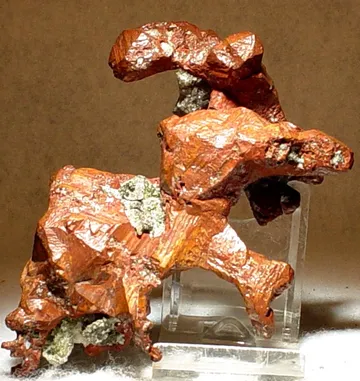
Collectors prize Houghton County because it is both an ore district and a mineral-specimen district of the first rank. Its best coppers are not merely lumps of metal: they may be sharp dodecahedra from Quincy, reticulated and arborescent groups from Baltic and Wolverine, cubic aggregates from Calumet & Hecla and the Moyle quarry at Houghton, delicate wire copper from Osceola, sheet copper from Osceola and Tamarack, hollow “shell” copper around former boulders, and the unforgettable “skulls” where copper formed around rhyolite cobbles in conglomerate. Silver occurs as lustrous curved crystals, herringbone growths, nuggets, and copper-silver intergrowths. Calcite brings the county into another collecting category entirely, with pale wine-yellow, colorless, gray-lavender, and pink copper-included crystals, many complexly twinned and many showing phantoms. Quartz is usually a gangue mineral here, but the Red Jacket Shaft of Calumet & Hecla produced some of Michigan’s finest colorless quartz crystal groups. Agate becomes uniquely local when copper selectively replaces its bands inside small amygdules from Wolverine No. 2, Calumet & Hecla No. 21, and the St. Louis mine.
Regional View
Country View
The county’s historical importance is inseparable from the specimens. The Michigan Copper Country mined native copper industrially from the mid-1840s into the twentieth century, and the richest, most productive lodes of the central district lay in Houghton County. Calumet & Hecla transformed the Calumet Conglomerate into one of the great copper fortunes of the nineteenth century; Quincy, “Old Reliable,” became a byword for regular dividends and technological endurance; and the mine dumps, museum collections, and old labels from these companies still define what “Michigan copper” means in the mineral market.
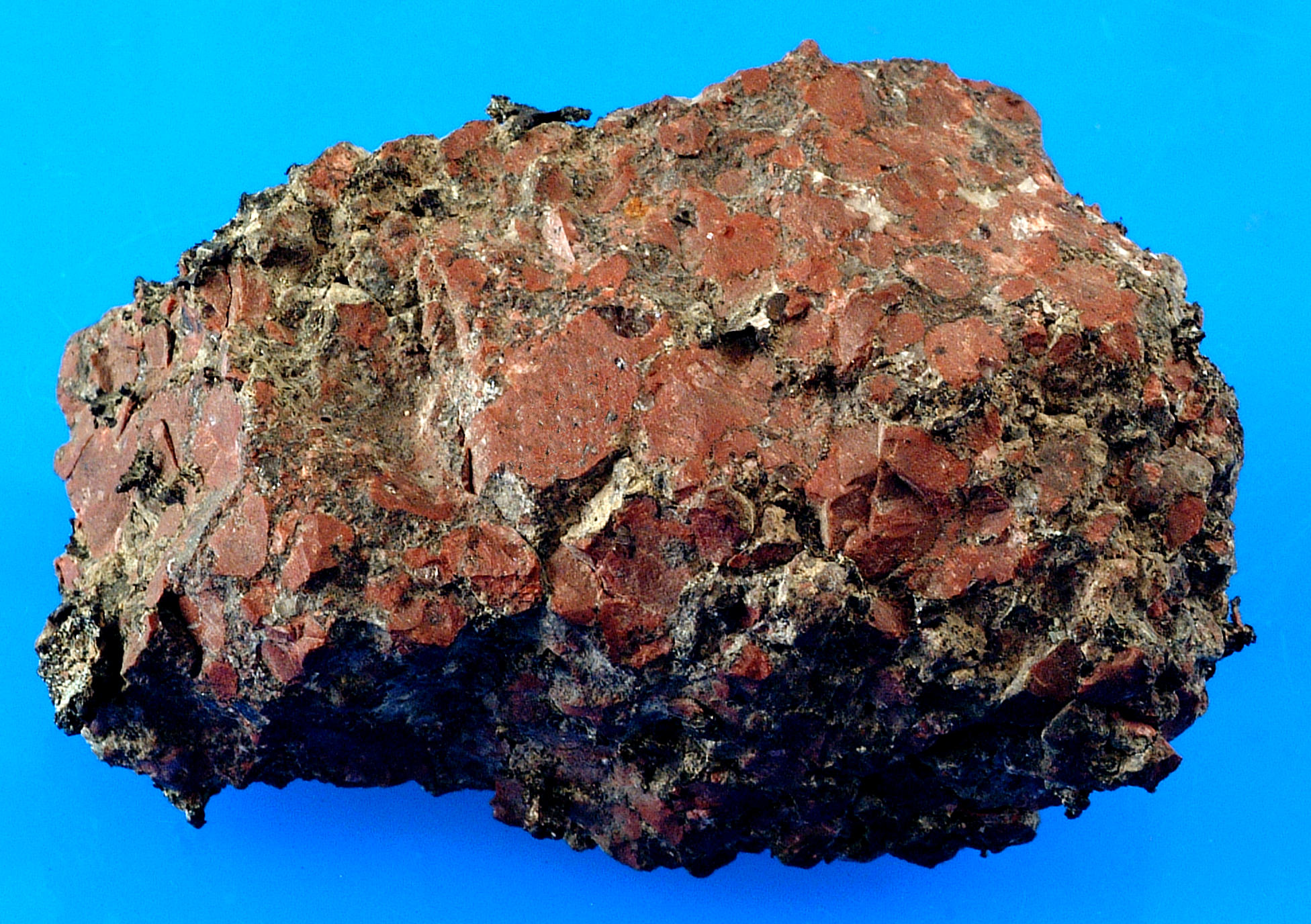

Photo: Wikimedia Commons
Search for specimens: View all specimens from Houghton County, USA
Houghton County occupies the central and most productive part of the Lake Superior native copper district. The deposit type is a world-class stratabound native-copper system hosted chiefly by Mesoproterozoic basalt flows and interbedded conglomerates of the Portage Lake Volcanics, part of the Midcontinent Rift. In the old miners’ vocabulary, the important ore bodies were “lodes,” and the two principal lode types were amygdaloid lodes and conglomerate lodes. Amygdaloid lodes are copper-bearing, vesicular or brecciated tops of basalt flows; conglomerate lodes are copper-bearing clastic beds between lava flows, commonly made of felsitic pebbles and finer rock matrix. Fissure deposits also occur, but in Houghton County the great sustained production came from the stratiform lodes rather than from narrow fissures.
The productive sequence includes, from lower to higher parts of the classic section, the Baltic amygdaloid, Isle Royale amygdaloid, Kearsarge amygdaloid, Osceola amygdaloid, Calumet & Hecla Conglomerate, Allouez Conglomerate, Pewabic amygdaloid, and Ashbed amygdaloid. The Calumet & Hecla Conglomerate was the legendary ore bed of Calumet, where copper replaced the finer matrix of the conglomerate and in places cemented the rock so thoroughly that the lode behaved as a hard copper-bearing breccia-conglomerate. In the amygdaloids, copper occupies vesicles, breccia openings, replacement zones, and fractures, commonly with chlorite, feldspar, epidote, and pumpellyite earlier in the sequence; quartz, calcite, prehnite, and datolite locally with the copper; and zeolites such as laumontite and analcime later. This paragenesis is why good Houghton County specimens so often combine copper with calcite, prehnite, epidote, pumpellyite, adularia, quartz, and datolite rather than with the sulfide assemblages familiar from many other copper districts.
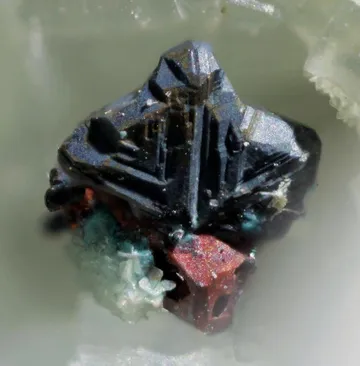
The principal ore minerals are native copper and native silver. Sulfides and arsenides are present locally—chalcocite, domeykite, algodonite, mohawkite, and related phases occur in parts of the district—but they are subordinate in the classic Houghton County native-copper lodes. Supergene and late alteration minerals add color and scientific interest: cuprite, tenorite, malachite, chrysocolla, azurite, paramelaconite, olivenite, tyrolite, paratacamite-group minerals, anthonyite, calumetite, and centennialite have all been tied to the district or to specific Houghton County mines. In some places those alteration minerals formed as coatings on or replacements of native copper; in others they occupy small basalt pockets, fracture fillings, or calcite veins. The Centennial mine near Calumet is especially important for blue and green copper chlorides.
The county’s mining history begins within a much older human copper story. Native copper had been found and worked in the Lake Superior region long before industrial mining, and nineteenth-century prospectors repeatedly recognized that ancient pits and caches could point toward copper-bearing rock. The industrial era accelerated after Douglass Houghton’s 1841 report and the mining rush of the 1840s. Quincy Mining Company was founded in the 1840s and became one of the great early Houghton County producers, working the Pewabic amygdaloid and later becoming famous as “Old Reliable” because of its remarkably steady dividends. Quincy’s mine at Hancock remained active for decades; today its shaft-rockhouse, hoist, tram, and underground tour are among the best-preserved physical introductions to Copper Country mining.
Calumet & Hecla was the county’s giant. Edwin J. Hulbert’s discovery of the Calumet Conglomerate in the 1860s led to the Calumet and Hecla companies, and in 1871 the two combined into Calumet & Hecla Mining Company. Under Alexander Agassiz, the company became the dominant copper producer of the Keweenaw and, for a period, a producer of national and world significance. Its shafts, rockhouses, stamp mills on Torch Lake, smelters, railroads, company housing, and the growth of Red Jacket—now Calumet—turned the locality into both an industrial landscape and a collecting province. Osceola, Tamarack, Centennial, Laurium, Franklin, Kearsarge, Wolverine, Baltic, Champion, Isle Royale, and other Houghton County mines filled out a complicated mining geography in which individual lodes and individual shafts developed distinctive specimen reputations.
Specimen production came from underground pockets, vugs, amygdules, fissures, rich lode zones, wallrock cavities, mine skips, and later from dumps and prepared collecting piles. Atlantic produced copper and silver where a large calcite vein cut the amygdaloid. Baltic is noted for fine elongated and reticulated copper crystals. Calumet & Hecla produced boulder cases, replacements, feldspar pseudomorphs, shot copper, and skull-like copper forms around rhyolite cobbles. Centennial produced brick copper replacing sandstone, microcrystals, large crystals, skulls, leaf copper, and rare copper chlorides. Osceola is a key locality for very fine copper crystals, wire copper, sheet copper, and perfect small crystals in vugs. Quincy is a classic source of dodecahedral copper crystals, copper microcrystals in amygdules, silver on prehnite, and copper-included calcite. Wolverine is highly regarded for copper, silver, epidote, quartz, and copper-banded agate.
Collecting access today must be approached carefully. Many old mine dumps and mine lands are private, reclaimed, unstable, protected, or within heritage landscapes where specimen removal is not permitted. Underground entry into abandoned workings is dangerous and should not be attempted. The responsible collector’s route is through organized events, explicit permission, fee collecting where offered, or legally open surface material. Keweenaw Mineral Days and similar organized programs have obtained permission to prepare old mine rock piles for surface collecting, and those events emphasize eye protection, surface-only collecting, realistic expectations, and the fact that native copper is much more common than native silver. For visitors, the A. E. Seaman Mineral Museum in Houghton and the Quincy Mine at Hancock are essential stops: one gives the mineralogical standard of comparison; the other gives the scale, engineering, and setting behind the specimens.

Photo: Wikimedia Commons
Copper from Houghton County ranges from tiny sharp crystals in basalt amygdules to heavy masses, sheets, wires, reticulated groups, arborescent sprays, copper “skulls,” boulder casings, brick copper replacing sandstone, and pseudomorphs after calcite, quartz, laumontite, and feldspar. The best crystallized pieces are judged by sharpness, three-dimensional openness, visible crystal form, minimal bruising, and strong contrast with calcite, prehnite, epidote, quartz, pumpellyite, datolite, or pale basalt matrix; ordinary pieces are massive, rounded, dark, or freshly acid-brightened without form. Quincy is admired for dodecahedral crystals and microcrystals in amygdules, Osceola for wire and sheet copper, Baltic for elongated reticulated crystals, Calumet & Hecla for boulder replacements and skulls around rhyolite cobbles, Centennial for brick copper, leaf copper, and large crystals, Wolverine for excellent crystals and shot copper, and the Houghton Moyle Construction quarry for branching aggregates of cubic crystals.
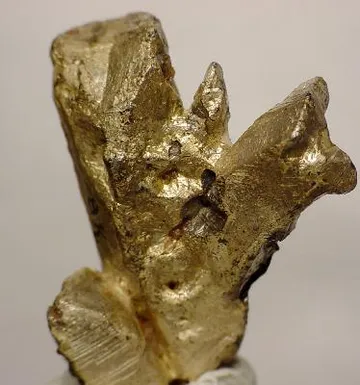
Silver from Houghton County is the elegant counterpoint to copper: less common, more often hidden until cleaned, and at its best occurring as bright curved crystals, herringbone or spike-like aggregates, dendritic growths, small crystalline clusters, and copper-silver intergrowths. It is intimately associated with native copper and commonly sits in vugs or jagged depressions in copper, on prehnite, with quartz and calcite, and in lodes such as the Kearsarge and Pewabic amygdaloids. The Kearsarge and Wolverine mines are credited with especially fine silver specimens; Quincy and the Pewabic shaft produced silver with rounded dodecahedral copper crystals, including classic prehnite-mounted aggregates; Isle Royale yielded fine micromount material and crystals in copper depressions; Baltic produced crystalline aggregates on copper; and Calumet & Hecla is represented by crystals and halfbreed material. Superior Houghton County silver has crisp form, clean separation from copper, old surface character, and a trustworthy mine attribution; many flattened nugget-like “halfbreed” pieces in the broader market are stamp-mill products rather than natural pocket specimens.
Calcite from Houghton County is a major collector mineral in its own right, not just a gangue mineral around copper. In the Keweenaw native-copper lodes it occurs in cavities, veins, fissures, amygdaloids, and conglomerates, and the county’s best crystals are colorless, pale wine-yellow, gray-lavender, or pink to reddish from native copper or cuprite inclusions; finely divided copper can give an aventurescent glow. Quincy is the classic locality for remarkably perfect complex crystals, many negative-scalenohedral and many twinned, including copper-included examples and fissure veins of calcite reported at 0.5 to 1 meter wide. Franklin produced large gray-lavender and copper-included crystals, Isle Royale produced fine scalenohedra with quartz and barite and some with copper or silver inclusions, Centennial produced copper-bearing and basal-twinned crystals, and Tamarack yielded attractive crystals. The best calcites show complete terminations, undamaged faces, visible phantoms or twinning, and natural copper inclusions distributed inside the crystal rather than merely stuck to broken surfaces.
Quartz in Houghton County is chiefly a copper-lode mineral, forming veins, vesicle fillings, and replacements in the native-copper deposits. It is most abundant in the Isle Royale lode, plentiful in the Baltic and Pewabic lodes, and locally present in the Osceola and Kearsarge lodes; chalcedony appears as vug linings in the Pewabic lode and as amygdule fillings in the Kearsarge lode. Franklin produced centimeter-sized quartz crystals with prehnite; Tamarack produced colorless, white, and pale green crystals, the green color in some specimens being due to frosted prehnite coatings; Isle Royale yielded colorless crystals to 5 cm with calcite and barite as well as massive quartz veins; Osceola quartz occurs with prehnite; Wolverine quartz is tied to copper-banded agate; Laurium has colorless prismatic quartz with epidote, pumpellyite, and calcite in basalt amygdules and rarely blue quartz colored by kinoite inclusions; and the Red Jacket Shaft of Calumet & Hecla produced superb lustrous colorless groups to 5 cm, some with epidote, pumpellyite, or chlorite inclusions, among the finest quartz specimens known from Michigan.
Agate from Houghton County matters most when it is copper-banded: small amygdule-filling agates in which native copper selectively replaced earlier chalcedony bands. Documented occurrences include the Wolverine No. 2 mine at Kearsarge, the Calumet & Hecla No. 21 shaft at Calumet, and the St. Louis mine at Laurium, with amygdules commonly in the 1–10 cm range and many around 2–3 cm; colors include gray, beige, and pink, sometimes with small agate “eyes” near the outer margins. The Wolverine material is especially prized by both mineral collectors and lapidaries because it combines the pattern language of Lake Superior agate with the unmistakable metallic flash of the native-copper district. Good pieces show continuous band replacement, attractive concentric or eye-like patterning, solid polish potential if cut, and enough copper to be visually integral rather than merely a spot or stain.
Other documented Houghton County minerals broaden the locality far beyond the five collector staples. Datolite nodules, prehnite, pumpellyite, epidote, microcline/adularia, analcime, laumontite, chlorite, barite, dolomite, hematite, chalcocite, domeykite, algodonite, mohawkite, cuprite, tenorite, malachite, chrysocolla, azurite, olivenite, tyrolite, and powellite all belong to the county’s mineralogical story. Houghton County also has genuine type-locality importance: anthonyite and calumetite were described from the Centennial mine near Calumet, centennialite is named for the same mine, and pumpellyite has its classic type-locality roots in the Calumet & Hecla mine area. Kinoite is not a Houghton County type mineral, but its Calumet/Laurium occurrence is an important non-skarn occurrence and a favorite micromount association with quartz and pumpellyite.
The greatest authenticity issue in Houghton County material is not whether native copper is real—it usually is—but whether the form, surface, association, and locality label are what they claim to be. Many copper specimens from the district were acid-cleaned, tumbled, polished, lacquered, or artificially brightened to appeal to tourists. A natural old surface may be reddish brown, chocolate, blackened, or lightly green from secondary copper minerals; a harshly stripped surface can look unnaturally pink-orange, granular, or etched. Bright copper is not automatically bad, but serious collectors should ask whether the specimen was chemically cleaned and whether delicate matrix minerals such as calcite, prehnite, datolite, or zeolites have been sacrificed.
“Halfbreed” copper-silver specimens require extra scrutiny. Natural copper-silver intergrowths do occur in the Keweenaw native-copper deposits, and Houghton County mines produced excellent crystallized silver with copper. However, many nugget-like, rounded, flattened, or mashed copper-silver pieces in the market are products of stamp mills, where copper and silver were crushed together and mechanically amalgamated in a broad sense. Such pieces may still be historic and collectible, but they should not be sold or valued as delicate natural pocket intergrowths unless their texture supports that interpretation. Look for intact silver crystals, silver perched on copper or prehnite, old labels, and specific mine provenance; be cautious with vague “Michigan halfbreed” labels.
Locality precision matters. “Houghton County” is acceptable for older material with lost mine attribution, but a specimen labeled Quincy, Calumet & Hecla, Osceola, Wolverine, Baltic, Centennial, Franklin, Isle Royale, or Laurium carries more scientific and market value when the label is credible. Mislabeling between Houghton, Keweenaw, and Ontonagon counties is common, especially for old Copper Country specimens, because the three counties share related geology and many specimens were sold simply as “Lake Superior copper.” Copper skulls, copper in agate, Red Jacket quartz, Quincy calcite, and Centennial copper chlorides are all locality-sensitive materials; a good old collection label can be as important as the specimen.
Condition problems are predictable. Copper is malleable and tough, so it bends rather than cleaves, but exposed crystals can be bruised, flattened, polished on high points, or clipped during trimming. Calcite is much more vulnerable: copper-included Quincy and Franklin calcites often show cleaved tips, bruised scalenohedral edges, internal cracks, or iron staining. Quartz groups from Calumet & Hecla and related mines should be checked for broken terminations, old repairs, and contact damage. Agate with copper bands is often best appreciated cut and polished, but lapidary preparation must be disclosed; rough nodules with intact rind and visible copper bands are scarcer than ordinary Lake Superior agate pebbles.
Fluorescence is not the main attraction of Houghton County specimens, though some calcites from Michigan localities are fluorescent or phosphorescent. The more practical handling concern is chemistry: delicate copper chlorides and post-mining alteration products can be unstable, and anthonyite in particular is noted as sensitive in dry air. Rare blue-green Centennial mine chlorides should be kept dry, handled minimally, and stored without aggressive cleaning. Laumontite-bearing specimens can dehydrate or become chalky. Avoid prolonged soaking, vinegar experiments, household acids, and abrasive brushing on complex copper-calcite-prehnite specimens.
Market availability is broad but strongly tiered. Massive copper, small copper-in-basalt pieces, and undistinguished county-level specimens remain common. Good crystallized copper from named Houghton County mines is much scarcer, and high-end pieces with open crystallization, old labels, attractive matrix, or unusual habits—wire copper from Osceola, dodecahedral Quincy crystals, Calumet & Hecla skulls, Wolverine copper-banded agate, copper-included calcite, and crystallized silver—are genuinely competitive. Museum-grade copper-silver, fine Red Jacket quartz, classic Quincy calcite, and rare Centennial chlorides are not everyday marketplace items; when they appear, provenance and condition drive the price as much as size.
Edwin J. Hulbert’s discovery of the Calumet Conglomerate is the kind of Copper Country story that still feels half-prospecting tale, half-industrial myth. In the 1850s and 1860s, old Native copper workings were more than archaeological curiosities to prospectors; they were clues. Hulbert found an ancient copper cache that led him to the mineralized Calumet Conglomerate, a hard breccia-conglomerate later described as cemented by copper. He organized the Calumet Mining Company in 1865, and the Hecla Company followed in 1866. But finding a great lode and making a great mine were different arts. Hulbert had the discovery and the ambition; Alexander Agassiz brought the ruthless administrative skill. After Agassiz arrived, the mine’s fortunes changed. Hecla paid its first dividend in 1868, Calumet in 1869, and in 1871 the two companies merged as Calumet & Hecla. Within a generation, the village of Red Jacket and the mines of Calumet had become one of the defining copper landscapes in the world.
The Calumet & Hecla lode did not behave like a polite vein in a textbook. It was hard, stubborn, and astonishingly rich. Early miners found the conglomerate so difficult to drill by hand that some contracts reportedly paid by inches of shot-hole rather than feet. The company eventually sank a close-spaced line of shafts along the lode; by the 1871 consolidation, plans called for sixteen inclined shafts, an extraordinary concentration of work for one property. The mine swallowed timber, too. The hanging wall demanded constant support, and the company was said to bury “a forest” of timber underground each year. To the mineral collector, those old stopes matter because they were not simply extracting copper; they were opening the cavities, fractures, cobble casings, and mineralized seams that would become the old-time Calumet & Hecla copper specimens now bearing nineteenth- and early twentieth-century labels.
Silver in Houghton County has always had a slightly illicit glamour. Company records could count copper, but silver had a way of becoming personal property before it ever reached a ledger. In the Keweenaw mines it was the ultimate high-graded mineral. Newly hired miners were reportedly told by managers to “just set aside the white copper for me and I’ll pick it up later.” In bars, miners paid for drinks with silver specimens. Others melted native silver and sold it to jewelers. A Wolverine mine superintendent supposedly quipped that the automobiles in Gay should have belonged to Calumet & Hecla, because they had been paid for with high-graded silver. Behind the humor is a practical warning for collectors: surviving fine silver specimens are the minority of what the mines once revealed, because much of the silver vanished into pockets, bars, melting pots, or the stamp mills.
One of the most vivid mineralogical discoveries in the county came not from a celebrated cabinet pocket but from the Centennial mine’s ordinary flow of ore. In 1963, Robert H. Dean brought Sidney A. Williams a blue mineral specimen from Centennial near Calumet that he did not believe was azurite. Williams, Dean, and others made later visits and found a wealth of blue and green copper minerals, many not readily identifiable. Underground collecting was impossible at the time, so the material was gathered by hurriedly examining skips of ore in the headframe just before the ore was dumped. From that scramble came anthonyite and calumetite, both found in cavities and fractures in basalt wallrock with native copper, cuprite, paratacamite, quartz, epidote, capillary tremolite, monazite, and other copper chlorides. The new minerals apparently came from several zones between the 4000- and 5000-levels—a reminder that some of Houghton County’s most delicate species were rescued in moments from material otherwise headed straight to the mill.
Houghton County also has a memorable float-copper episode: a 220 kg mass found on the John Gaspardo farm about 4 km northwest of the Franklin mine. The piece measured roughly 80 x 105 x 15 cm, showed glacial striations, and bore evidence of partial working by Native Americans. It eventually entered the Mineralogical Collection of the University of Michigan. It is the sort of object that bridges every era of the district—geologic concentration in the ancient rift, glacial transport, Indigenous use, nineteenth- and twentieth-century collecting, and museum preservation.
Even the museum in Houghton has a Copper Country twist. The A. E. Seaman Mineral Museum moved into a permanent building on Sharon Avenue in 2011, and the new museum building was unexpectedly constructed on top of a past-producing native-copper mine, the Mabbs Vein. That fact feels almost too perfect: Michigan’s official mineral museum, keeper of the finest public Michigan mineral collection, standing directly over one of the veins that made the region famous.
Butler, B. S., and Burbank, W. S. (1929), “The Copper Deposits of Michigan,” U.S. Geological Survey Professional Paper 144 — The foundational geologic treatment of the Michigan native-copper deposits, including the distinction between conglomerate lodes, amygdaloid lodes, and fissure deposits, and the classic lode sequence of the district.
Bornhorst, T. J., Paces, J. B., Grant, N. K., Obradovich, J., and Huber, N. K. (1988), “Age of native copper mineralization, Keweenaw Peninsula, Michigan,” Economic Geology, 83, 619–625 — Important age work on native-copper mineralization in the Keweenaw Peninsula, tying the mineralization to the Mesoproterozoic history of the Portage Lake Volcanics.
Bornhorst, T. J., and Robinson, G. W. (2002), “Precambrian supergene alteration of native copper deposits in the Keweenaw Peninsula, Michigan,” Geological Society of America Abstracts with Programs — Concise summary of supergene alteration minerals in the district, including cuprite, tenorite, malachite, chrysocolla, azurite, paramelaconite, copper chlorides, and arsenate minerals.
Williams, Sidney A. (1963), “Anthonyite and calumetite, two new minerals from the Michigan copper district,” American Mineralogist, 48, 614–619 — Original description of anthonyite and calumetite from the Centennial mine near Calumet, Houghton County.
Crichton, Wilson A., and Müller, Harald (2017), “Centennialite, CaCu3(OH)6Cl2·nH2O, n ≈ 0.7, a new kapellasite-like species, and a reassessment of calumetite,” Mineralogical Magazine, 81, 1105–1124 — Description of centennialite from cotype specimens originating at the Centennial mine, with reassessment of calumetite.
Ruotsala, A. P., and Wilson, M. L. (1977), “Kinoite from Calumet, Michigan,” American Mineralogist, 62, 1032–1033 — Documents kinoite from the Calumet/Laurium area of Houghton County in an unusual native-copper district setting.
Robinson, G. W. (2004), Mineralogy of Michigan by E. W. Heinrich, updated and revised, A. E. Seaman Mineral Museum, Houghton, Michigan — The modern collector’s backbone reference for Michigan minerals, including Houghton County Copper Country species.
A. E. Seaman Mineral Museum, “Copper” species account — Detailed Michigan copper locality notes, including Houghton County mines such as Atlantic, Baltic, Calumet & Hecla, Centennial, Osceola, Quincy, Tamarack, Wolverine, Champion, Pewabic, Franklin, Laurium, and Trimountain.
A. E. Seaman Mineral Museum, “Silver” species account — Key account of Michigan native silver, halfbreed terminology, high-grading history, and Houghton County silver occurrences.
A. E. Seaman Mineral Museum, “Calcite” species account — Essential source on Copper Country calcites, including Quincy, Franklin, Isle Royale, Centennial, and Tamarack crystals.
A. E. Seaman Mineral Museum, “Quartz” species account — Documents quartz in Houghton County copper deposits, including Isle Royale, Baltic, Pewabic, Franklin, Tamarack, Osceola, Wolverine, Laurium, Centennial, and the Red Jacket Shaft of Calumet & Hecla.
A. E. Seaman Mineral Museum, “Agate” species account — Directs agate treatment to quartz, where Houghton County copper-banded agates are described.
A. E. Seaman Mineral Museum, “Calcite with native copper inclusions, Quincy Mine, Houghton County, Michigan” — Museum collection page for a classic copper-included calcite from Quincy.
A. E. Seaman Mineral Museum, “Silver, prehnite and copper, Quincy Mine, Houghton County, Michigan” — Museum collection page illustrating the classic silver-prehnite-copper association from Quincy.
A. E. Seaman Mineral Museum, “Copper in Agate, Wolverine #2 Mine, Houghton County, Michigan” — Museum collection page for the copper-banded agate association that makes Wolverine No. 2 distinctive.
Mindat: Houghton County, Michigan, USA — Broad locality index for Houghton County mineral occurrences and mine-specific sublocalities.
Mindat: Centennial Mine, Centennial Heights, Calumet Township, Houghton County — Important locality page for Centennial mine copper minerals, including type-locality anthonyite and calumetite.
Keweenaw National Historical Park: Timeline of Michigan Copper Mining, 1851–1900 — Clear historical timeline covering Quincy, Edwin Hulbert, the Calumet Conglomerate, and Calumet & Hecla.
National Park Service: Quincy Mine — Practical visitor and historical information for the Quincy Mine at Hancock.
National Park Service: The No. 2 Quincy Shaft-Rockhouse — Accessible interpretive article on Quincy’s engineering, production, and deep-mine history.
Michigan Tech Keweenaw Geoheritage: Alexander Agassiz — Concise account of Hulbert, Agassiz, and the rise of Calumet & Hecla.
Michigan EGLE: Michigan’s Copper Country — Readable historical overview of the Copper Country and the dominance of Calumet & Hecla.
U.S. Geological Survey: Age of native copper mineralization, Keweenaw Peninsula, Michigan — Primary bibliographic entry for the Economic Geology age study of native-copper mineralization.
U.S. Geological Survey: Geology and mineral deposits of the Keweenaw Peninsula and vicinity, Michigan — Geologic framework for the Keweenaw Peninsula and its mineral deposits.
A. E. Seaman Mineral Museum: Museum overview — Essential museum stop in Houghton, with the world-class Michigan mineral collection and Copper Country exhibits.
A. E. Seaman Mineral Museum: Great Lakes Minerals — Gateway to the museum’s Michigan mineral species PDFs, including copper, silver, calcite, quartz, and rare copper minerals.
Keweenaw Mineral Days: Mineral collecting in the Copper Country — Practical guidance on organized, permission-based collecting of Copper Country mine rock piles.
Wikimedia Commons: Native copper from Michigan — Useful image category for comparing Michigan copper habits, including Houghton County specimens.
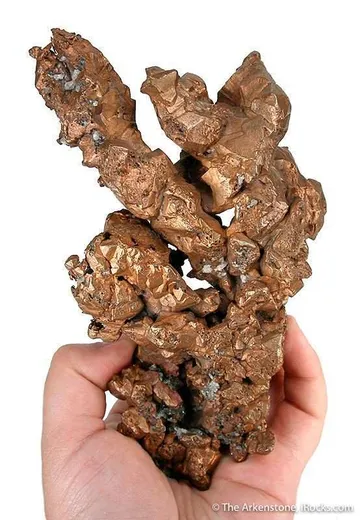
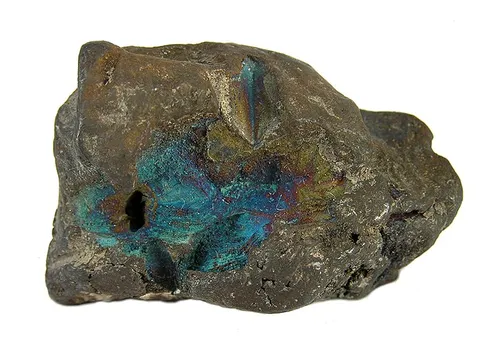
_2_(16704149284).jpg)
