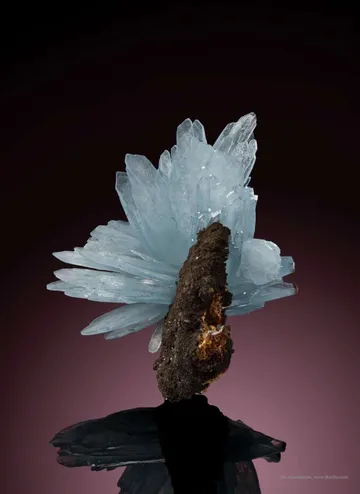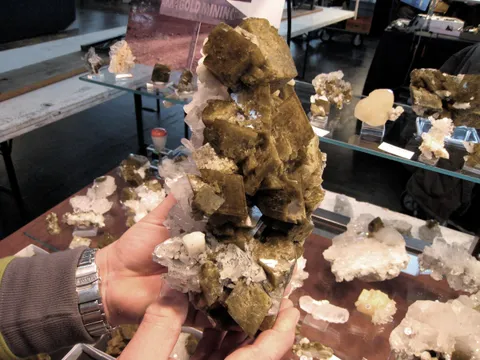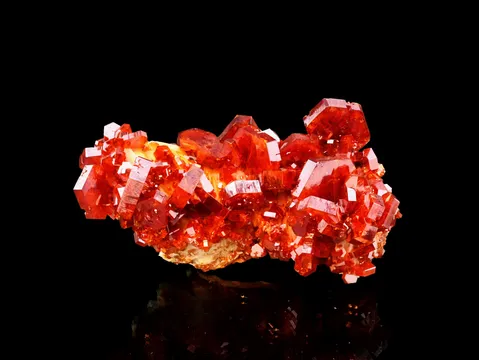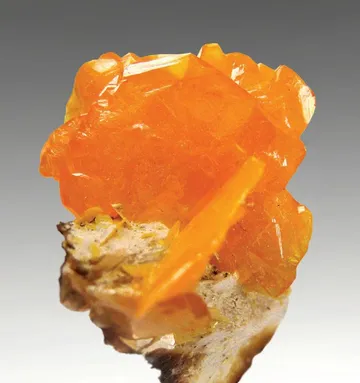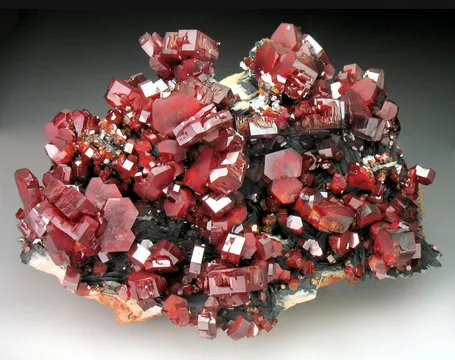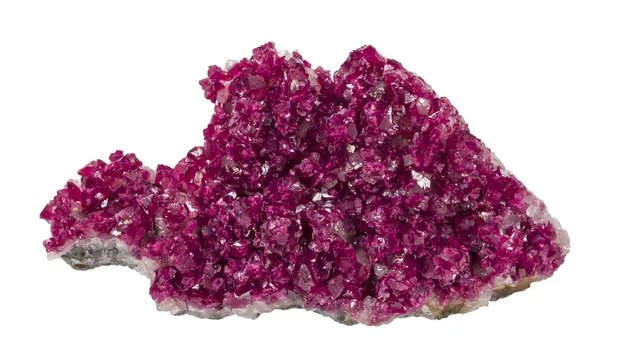
High Atlas Mountains, Morocco — renowned locality for quartz-lined basalt geodes, agates and chalcedony nodules, calcite and fluorite.
Key facts
The High Atlas is not a single mine locality in the collector’s sense, but a long, mineralized mountain province whose specimen character is unusually consistent: quartz-lined basalt geodes, agates and chalcedony nodules from volcanic horizons; calcite, barite and fluorite in veins and cavities; iron-oxide overprints that put black, brown, red and amber tones into otherwise pale silica; and, in the ore districts, classic Moroccan combinations of carbonate-hosted lead-zinc-barite mineralization, manganese oxides, copper secondaries and skarn minerals. For collectors, its fame rests especially on the material traded from the Marrakech–Tizi n’Tichka–Ouarzazate corridor and adjacent valleys: amethystine to colorless quartz geodes, quartz pseudomorphs after calcite or barite, goethite-included quartz, sprays and balls of lustrous goethite, and the occasional barite crystal group of real distinction.
Geologically, the High Atlas is a superb specimen-producing expression of an inverted rift belt. Paleozoic schists, quartzites, limestones and volcanic rocks form parts of the older basement; Triassic to Jurassic extension opened basins, emplaced basaltic rocks and evaporitic sequences, and created the voids, faults and permeable horizons later exploited by silica-rich and metal-bearing fluids. Later Cenozoic compression raised and folded the range, exposing the veins, basalt geode zones and carbonate-hosted ore bodies now familiar to mineral collectors and dealers. The resulting specimens often show the landscape in miniature: quartz sparkling over oxidized red-brown crusts, white barite or calcite forms partly replaced by silica, and needle-like goethite trapped inside clear quartz or standing freely as black to brown radial sprays.
Regional View
Country View
The best High Atlas pieces have a rugged, unmistakably Moroccan look. Rather than the highly polished perfection of a single famous mine, they record a chain of small workings, roadside collecting districts, old metal mines and basalt-hosted geode pockets. Amerzgane and Ikiss pieces are valued for quartz geodes with goethite inclusions or discrete goethite sprays; Ourika Valley specimens are sought for sculptural pseudomorphs in which sparkling quartz preserves the geometry of earlier calcite, barite or fluorite; Sidi Rahal and the Tizi n’Tichka–Asni belt have supplied agates and chalcedonies whose red, pink, gray, blue-gray and brown banding reflects iron-rich growth zones and later hydrothermal overprinting.

Search for specimens: View all specimens from High-Atlas Mountains, Morocco
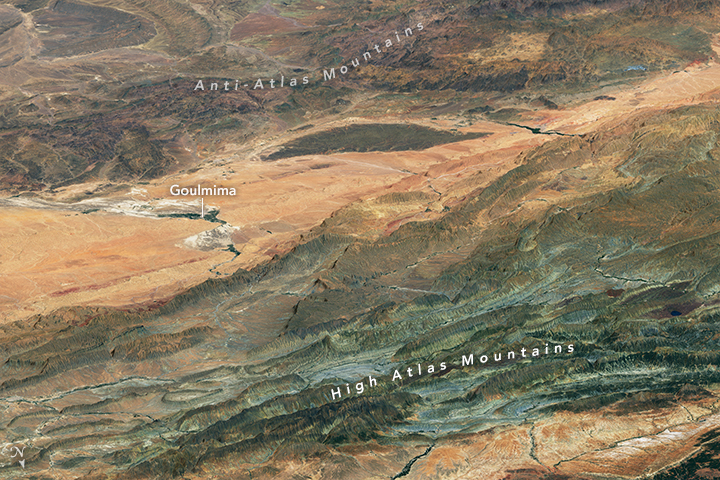
The High Atlas stretches across central Morocco and divides the greener Atlantic and Mediterranean-facing country from the Saharan and pre-Saharan basins to the south. Mineralogically it should be understood as a province, not a point locality. Its specimen-producing sites include basalt-hosted agate and quartz-geode fields, calcite-barite-fluorite veins, carbonate-hosted Pb-Zn-Ba districts, Fe-Mn and Mn deposits, Cu-Pb-Zn oxidation zones, gold-copper-bismuth prospects and older skarn systems tied to Variscan granitic intrusions.
The collector material most often sold simply as “High Atlas, Morocco” commonly comes from the western and central parts of the range, especially the broad Marrakech–Tizi n’Tichka–Ouarzazate route and associated localities such as Amerzgane, Ikiss, Ourika Valley, Asni and Sidi Rahal. In these districts, Triassic to Paleogene volcanic rocks and associated sedimentary units provided cavities, fractures and flow-top voids that later filled with silica. The result is a varied suite of agate, chalcedony, amethyst, rock crystal, smoky quartz, calcite, barite, fluorite, hematite and goethite. At Sidi Rahal, agates occur in Triassic basaltoids as lens-shaped nodules that may reach about 25 cm; their red and red-brown zones are colored by hematite and goethite, while the interiors are dominantly fibrous quartz with minor moganite and, locally, late calcite in voids or microfissures.
At Ikiss, above the small village in the Amerzgane area, the productive horizon is a basalt layer worked by hand for quartz geodes. Documented workings range from shallow pits a few meters deep to short tunnels a few tens of meters long. The quartz ranges from colorless to amethystine, frequently with goethite inclusions; in better geodes the goethite is not merely a stain but forms needles, sprays or, very rarely, prominent balls set on quartz. Barite is less common but occurs in some geodes, usually as blades or clusters associated with quartz and iron oxides. Similar Amerzgane material has been widely traded through roadside sellers near Tizi n’Tichka and through Moroccan dealers supplying European and North American shows.
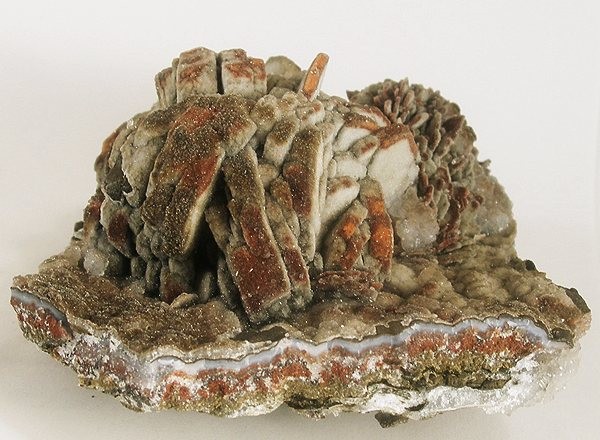
The Ourika Valley suite is particularly important for pseudomorph collectors. Documented specimens include sparkling quartz after barite, quartz after calcite and quartz after fluorite from a coherent find in the Atlas Mountains. These are not ordinary drusy plates: the finest pieces preserve “poker-chip” or parallel-growth shapes inherited from earlier carbonate or sulfate crystals, with later quartz encrusting or replacing the forms and iron oxides giving reddish-brown accents along edges and recesses.
Beyond the geode and vein localities, the High Atlas contains economically significant ore systems. In the Oriental High Atlas, Jbel Bou Dahar is a carbonate-hosted Pb-Zn-Ba district in Early Jurassic reefal limestones. Its paragenesis includes quartz, pyrite or melnikovite, sphalerite, galena, calcite, barite, and locally fluorite and celestine, with barite and calcite in later veins and fractures. Other eastern High Atlas localities, including Jbel Klakh and Bouarfa, preserve supergene copper, lead, zinc, vanadium, iron and manganese mineralization, giving collectors malachite, azurite, smithsonite, cerussite, vanadinite, hematite, goethite and manganese oxides when specimens are saved rather than milled as ore.
The western High Atlas adds a different genetic style at Azegour, a historic Cu-Mo-W skarn related to a Late Hercynian granitic intrusion. Skarns developed where the Azegour granite affected Cambrian carbonate beds, producing garnet, wollastonite, vesuvianite, pyroxene, amphibole, epidote, calcite, quartz, scheelite, molybdenite, chalcopyrite, sphalerite, pyrrhotite and other sulfides. Modern work gives Re-Os molybdenite ages near 276 Ma for Azegour and 267 Ma for Tizgui, tying the mineralization to late Variscan magmatism rather than the younger Atlas uplift that later exposed the deposits.
Mining history in the High Atlas is equally varied. Azegour is one of Morocco’s old modern metal mines, with early twentieth-century work followed by copper, molybdenum, tungsten and minor uranium production before closure in the early 1970s. Published accounts record modern work beginning around 1920, molybdenum production from the 1930s, tungsten discovered around 1950, and mining ceasing by 1971–1972. The Imini manganese mine, on the southern flank of the High Atlas northwest of Ouarzazate, is operated by SACEM; the company was created in 1929, exploitation began in 1938, and the first mine opened in 1946 after delays caused by the Second World War. Barite veins, Pb-Zn-Ba bodies and smaller copper or manganese workings across the province have often been worked intermittently, with artisanal exploitation common in some districts.
Collecting access today is mixed. Active mines such as Imini and active or recently active quarries cannot be assumed open to visitors and require formal permission. Small geode workings in basalt, especially around villages where locals dig by hand, are commonly part of a local mineral economy; buying from the diggers or from established Moroccan dealers is usually more realistic than attempting independent collecting. Roadside mineral selling along the Tizi n’Tichka route is famous, but locality precision is uneven: a specimen labelled “High Atlas” may be genuinely from the range, from the adjacent Anti-Atlas, or from another Moroccan district entirely unless the seller can supply a credible village, mine or collection history.

Quartz is the collector’s signature mineral of the High Atlas, especially in basalt-hosted geodes and agates from Amerzgane, Ikiss, Tizi n’Tichka, Asni, Sidi Rahal and Ourika Valley. It occurs as colorless rock crystal, smoky to brown quartz, amethyst, chalcedony and agate; at Ikiss it lines geodes with clear to amethystine crystals and frequent goethite inclusions, while Ourika pieces may be sparkling quartz pseudomorphs after barite, calcite or fluorite. Cabinet specimens can range from small hand-sized geodes to large open geodes more than 40 cm across, but quality depends less on size than on fresh luster, intact terminations, undamaged geode rims, attractive iron-oxide contrast and whether the piece shows a recognizable habit such as quartz after calcite, quartz after barite, or clean goethite needles suspended inside transparent crystals.
Calcite from the High Atlas appears in several distinct contexts: late carbonate in agate and geode cavities, vein calcite with barite, gangue calcite in Pb-Zn-Ba deposits such as Jbel Bou Dahar, and skarn-related calcite in the Azegour district. Collector pieces from the geode belt are usually white to cream, colorless, or iron-stained, often associated with quartz, barite, goethite and hematite; the most interesting examples are sculptural calcite forms that have been coated or replaced by quartz, preserving upright parallel-growth or “poker-chip” shapes. Good High Atlas calcite is judged by form and association rather than large size alone: sharp crystal geometry, clean contrast with quartz, minimal bruising on exposed edges, and credible locality detail make the difference between a routine Moroccan carbonate and a meaningful Atlas specimen.
Barite is widespread across the High Atlas as both an ore-gangue mineral and a specimen mineral, reported from numerous localities and especially important in Pb-Zn-Ba systems, barite veins and the quartz-geode districts. In the Amerzgane–Ikiss material it is scarcer than quartz and goethite but may occur as blades or clusters in geodes; Ourika Valley specimens include quartz pseudomorphs after barite that preserve platy, poker-chip forms beneath a sparkling silica surface. The best High Atlas barite-related pieces show crisp bladed geometry, translucency where barite is preserved, or especially faithful quartz replacement where it is not; ordinary pieces are commonly iron-stained, incomplete or loosely labelled, so collectors should favor examples with intact blade edges and a specific locality such as Ourika Valley, Ikiss, Anemzi or Bou Dahar.
Goethite gives many High Atlas specimens their character, from rusty inclusions in agate bands to lustrous black-brown needles in quartz geodes. At Ikiss and Amerzgane it occurs as fine inclusions within clear to amethystine quartz, as acicular sprays projecting from quartz-lined cavities, and, in the rarest pieces, as rounded radial balls on a quartz carpet. Fine specimens are prized for lustrous, free-standing needles or coherent sprays that have not been crushed during extraction; common pieces show only muddy brown staining or broken fibrous patches. Association matters here: goethite needles emerging from clear quartz, or black radial balls over bright quartz with minor barite, are far more desirable than massive iron oxide without crystallographic texture.
Other documented High Atlas minerals reflect the province’s breadth. Agate, chalcedony, amethyst and rock crystal dominate the specimen trade, while hematite, manganite, pyrolusite, hollandite, coronadite, braunite and manganese-bearing calcite reflect the iron-manganese districts. Carbonate-hosted and supergene ore systems add sphalerite, galena, cerussite, smithsonite, hydrozincite, malachite, azurite, brochantite, vanadinite, fluorite and celestine. The Azegour skarns contribute andradite-grossular garnet, wollastonite, vesuvianite, diopside or other clinopyroxene, epidote, scheelite, molybdenite, chalcopyrite, sphalerite and accessory apatite, zircon and titanite. Among the rarer modern records, chenguodaite has been reported from the Imourkhssen Cu-Mo-Au-Ag porphyry system in the broader High Atlas/Anti-Atlas transition region; such species are analytical mineralogy rather than normal field-collecting targets.
The main authenticity problem for High Atlas specimens is not that the geology is doubtful, but that the trade labels often are. “Atlas Mountains,” “High Atlas,” “Tizi n’Tichka,” “Ouarzazate” and “Morocco” have all been used loosely in the tourist and wholesale trade. Ask for the most specific locality available: Ikiss, Amerzgane, Ourika Valley, Sidi Rahal, Asni, Anemzi, Jbel Bou Dahar, Imini or Azegour conveys much more value than a broad range name. Be especially cautious with specimens that visually resemble well-known material from Mibladen, Touissit, Bou Azzer or Anti-Atlas districts but are labelled only “High Atlas.”
Artificially colored quartz geodes are a documented and common problem along the Marrakech–Ouarzazate route and in the tourist trade. Natural High Atlas geodes may show amethyst, smoky tones, iron-stained red-brown zones, gray chalcedony, black goethite and white calcite or barite, but neon blue, bright metallic coatings, uniform sprayed purple, painted gold, glittery black “cobalt,” and iridescent “aura” surfaces should be treated as decorative treatments, not natural mineral color. Cut geode halves can be honest display specimens, but look for dye collecting in cracks, saw marks hidden by color, paint over the outer rind, and unnatural color sitting on top of crystal faces rather than within them.
Condition varies by mineral. Quartz geodes often have chipped rims and bruised terminations from splitting; amethystine crystals can be pale and only locally colored. Goethite sprays are delicate and are easily flattened or rubbed, especially when they protrude from geode cavities. Barite cleaves and chips readily; preserved blades with sharp edges deserve careful handling. Calcite scratches and bruises easily and should be kept away from acids, including vinegar or acidic cleaning solutions. Iron-oxide-rich specimens may shed dust from soft limonitic matrix, so avoid aggressive washing unless you are certain the matrix is stable.
Fluorescence is not a primary selling point for most High Atlas specimens, but it can be interesting. Some agates contain organic material that may show long-wave UV response, and manganese-bearing calcite or late calcite in geodes can fluoresce variably. Treat fluorescence as specimen-specific: test gently and do not assume that a glowing area proves locality or natural color.
Market availability is good for small quartz geodes, agate nodules, sliced agates and iron-stained quartz; moderate for attractive goethite-included quartz and quartz-after-calcite or quartz-after-barite pseudomorphs; and much lower for fine free-standing goethite balls, sharp barite in geode association, well-localized Azegour skarn specimens, and credible ore-mineral suites from Bou Dahar or other High Atlas mines. For serious collections, the premium should go to precise locality, natural color, undamaged crystal edges, and specimens that show a mineralogical story rather than merely a Moroccan trade label.
The Tizi n’Tichka road has long been one of the most mineral-saturated roads in Morocco, not because it is lined with formal collecting sites, but because the trade is visible in the open air. Travelers climbing from Marrakech toward Ouarzazate cross the High Atlas at more than 2,000 m, passing villages where mineral sellers display geodes, agates and quartz clusters beside the road. Older field accounts describe the area around Amerzgane as “quartz amethyst country,” with calcite, pyrolusite and barite appearing in the geodes, but also warn that truly good specimens are uncommon among the abundant tourist pieces. That contrast still defines the district: one table may carry dyed geode halves for casual visitors, while a local digger or careful dealer may have, tucked away, a natural quartz geode with goethite needles or a small barite group worth a second look.
Ikiss gives the High Atlas geode trade its working face. In the hills above the village, the productive basalt layer is not mined by large open pits or mechanized benches in the way a quarry collector might imagine. It is dug by hand. Some workings are only a few meters deep; others become short tunnels extending a few tens of meters into the basalt. The reward is unpredictable. Most geodes are modest quartz-lined cavities, sometimes pale amethyst, often iron-stained. Then, rarely, the cavity opens with goethite doing something extraordinary: fine needles inside the quartz, sprays standing above the druse, or a coherent black-brown ball perched on the sparkling floor of a geode.
One museum-quality Amerzgane specimen shows why collectors keep looking through so many ordinary geodes. The piece, now known from the mim Museum collection, measures 11 x 10 x 14 cm and weighs about 1,400 g. Its centerpiece is a shiny 7.1 cm ball of black acicular goethite crystals sitting on a carpet of quartz; some of the quartz crystals themselves contain fine goethite needles. The description of the occurrence is telling: the original deposit is worked mainly for the many quartz geodes sold in Tizi n’Tichka and around the world, but the goethite balls appear only sporadically. Extraction is difficult, and many balls are damaged before they ever reach a collector. That single specimen represents the upper end of a deposit otherwise known mostly for much humbler geodes.
Sidi Rahal tells a quieter, more analytical story. There the attraction is not a glittering pocket but a broad agate field east of Marrakech, with outcrops spread over an area roughly 40–50 km long and about 5 km wide. Polish collectors Jacek Szczerba and Remigiusz Molenda personally gathered agate nodules there in 2010 and 2011 for a gemological study. The studied pieces, 4 to 15 cm wide, revealed landscape, stalactitic and pipe-like internal patterns when cut. Under the microscope and Raman probe, their colors became a chemical history: pink outer rims rich in opal-CT, red-brown zones colored by hematite and goethite, gray-blue interiors of fibrous quartz with minor moganite, and tiny inclusions of pyroxene, plagioclase, titanium phases, copper sulfides and organic material. In the field these nodules may look like plain basaltic pebbles; on the saw they become maps of fluid pulses, iron activity and late silica growth.