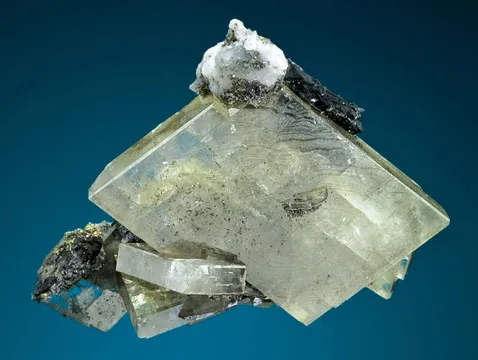
A collector's guide to Souss-Massa Region, Morocco: its geology, mining history and notable minerals, illustrated with the 30 specimens documented from this locality on EarthWonders.
Key facts
Souss-Massa is not a single mine locality in the collector’s sense, but a mineral province: a rugged slice of southwestern Morocco where the High Atlas, Anti-Atlas, Souss Basin, and pre-Saharan plateaus converge, exposing some of the country’s most productive metal-bearing terranes. For collectors, its modern identity rests above all on the western Anti-Atlas copper belt and the Jbel Siroua silver district. Here, Neoproterozoic to Lower Cambrian rocks of the Anti-Atlas host stratabound and vein-style copper-silver mineralization, later overprinted by supergene weathering that produced the bright copper-carbonate specimens that reach the market under locality names such as Tazalaght, Tazalarht, Tizert, Akka, Iourirn, and Zgounder.
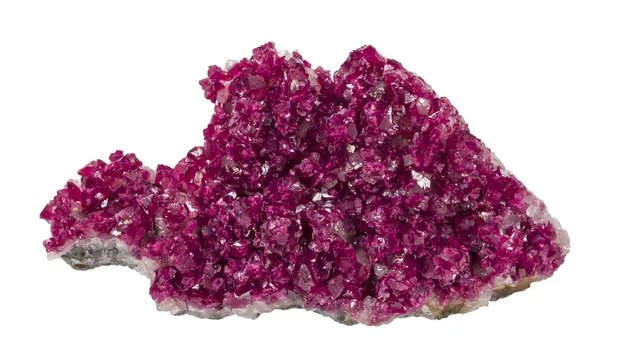
The region’s most collectible hand specimens are the copper-oxide-zone pieces from around Tazalaght: glassy, electric to royal-blue azurite on quartz; malachite coatings and pseudomorphs; pale to smoky quartz crusts; and, in the 2015 material, surprisingly vivid erythrite on phlogopite-rich matrix. The best Tazalaght pieces have a distinct “Moroccan Anti-Atlas” aesthetic—strong color contrasts, iron-stained quartz or limonitic matrix, compact cabinet-scale size, and minerals that record a complicated passage from primary sulfides to secondary sulfides, carbonates, arsenates, and gossan quartz. This is not Bou Azzer erythrite, nor classic Mibladen azurite; the interest lies in the locality-specific associations and the western Anti-Atlas supergene story.
Regional View
Country View
The broader Souss-Massa mineral record is richer than its cabinet specimens alone suggest. Tizert, in Taroudant Province, is a major sediment-hosted Cu-Ag deposit in the Igherm inlier, notable in the literature for its large malachite-rich supergene system, secondary chalcocite and covellite, and rare silver-mercury phases such as eugenite and arquerite. Zgounder, on the northwestern flank of the Siroua Massif, is a high-grade silver operation whose output has given Souss-Massa an outsized role in Morocco’s silver production. And near Tissint in Tata Province, the fall of a Martian meteorite in 2011 added an entirely different mineralogical dimension: shock-metamorphic high-pressure phases, including type-locality minerals, preserved in extraterrestrial rock that happened to land within the region.

Photo: Wikimedia Commons
Search for specimens: View all specimens from Souss-Massa Region, Morocco
The specimens most often marketed simply as “Souss-Massa, Morocco” belong to a regional copper suite centered on Taroudant Province and especially the Tazalaght or Tazalarht area, about 40 km east of Tafraout on the eastern border of the Aït Abdallah inlier. The Tazalaght copper mine is recorded as an open pit at about 1,826 m elevation, developed on a folded NNE–SSW structure roughly 500 m long. Geologically, it belongs to the western Anti-Atlas copper belt, where mineralization occurs both as stratabound copper in the clastic “Série de base” of the Adoudounian carbonate cover and as discordant vein mineralization in underlying Neoproterozoic quartzites.
The Tazalaght ore system records a classic but locally distinctive supergene history. Primary hypogene sulfides include chalcopyrite, bornite, pyrite, tennantite-group minerals, sphalerite, galena, and related phases in quartz-carbonate gangue. Weathering replaced part of that primary assemblage with bornite, chalcocite, covellite, and other secondary copper sulfides in the cementation zone. More oxidizing, near-neutral conditions then produced malachite, azurite, olivenite, chenevixite, and related arsenate-carbonate phases, followed by goethite, hematite, and quartz in the gossan. For specimen collectors, this sequence explains why attractive Tazalaght pieces often combine quartz, azurite, malachite, iron oxides, and less common arsenate or cobalt-arsenate species on a single small matrix.
Mining history at Tazalaght is unusually deep for a Moroccan copper locality. The deposit is described as one of the oldest mines of the western Anti-Atlas, with medieval exploitation attributed to the Almoravids in the 12th century. The scale of the old workings, dumps, and slag heaps—estimated in the mining literature at about 40,000 tonnes—shows that the ancient operation was not casual prospecting. Modern work resumed in the 1930s with shafts and crosscuts by SERMISUD, followed by BRPM exploration and partial reworking of dumps during the 1960s. SODECAT reopened the deposit in 1974, mining by open pit until 1987 and underground until closure in 1992. Published accounts report roughly 915,000 tonnes of ore grading 2.97% Cu and 35 g/t Ag extracted from a reserve estimated at about 1 million tonnes.
Modern Souss-Massa copper development is closely tied to Managem and its subsidiary Akka Gold Mining. The Akka site, southeast of Agadir in the western Anti-Atlas copper belt, began as a gold operation; after new copper resources were identified in the surrounding district, activity shifted increasingly toward copper. Managem has described the Akka mining site as part of a regional copper and silver-byproduct production pole, while Tizert has emerged as the company’s flagship copper project in Taroudant Province. Tizert reached commercial production in 2025, with Managem describing it as a long-life copper-concentrate operation and one of the key assets in its copper strategy.
For collectors, however, the most important production events were not tonnage milestones but specimen finds. Tazalaght azurite on quartz was already reaching international dealers by the late 2000s, with compact pieces of flattened, lustrous blue crystals on quartz matrix. A separate 2015 find near Tazalaght produced erythrite on phlogopite-rich matrix, recognized at the Sainte-Marie-aux-Mines show as a new fine erythrite occurrence far from the famous Bou Azzer cobalt district. In 2021, new Tazalaght-area material brought fresh malachite and azurite-malachite-quartz combinations to the market, including lenticular blue azurite crystals on quartz and malachite coatings.
Collecting access should be treated as restricted. Tazalaght, Tizert, Akka, and Zgounder are mining or exploration districts, not open recreational collecting grounds, and working mines, old shafts, quarries, dumps, and desert prospects in Morocco require permission from the relevant landholders, operators, and authorities. The safest route for most collectors is the specimen market, where older labels may use variant spellings—Tazalaght, Tazalarht, Tazalakht, or Tazalarht Quarry—and may sometimes give only “Taroudant Province,” “Souss-Massa,” or “Morocco.” Good modern labels should preserve the mine or find name, the province, the region, and, where known, the find year.
Quartz from the Souss-Massa collector suite is most important as the pale, sparkling, iron-stained, or locally smoky matrix that carries Tazalaght copper minerals rather than as large standalone crystals. At the Tazalaght copper mine, quartz is tied to the quartzite and quartz-carbonate vein environment of the western Anti-Atlas deposit, and late gossan-stage quartz is part of the supergene sequence that followed sulfide replacement and copper-carbonate formation. The better pieces show sharply crystallized quartz crusts or compact vuggy quartz surfaces carrying saturated blue azurite, green malachite, or, in the 2015 find, erythrite with phlogopite; ordinary pieces are simply massive quartz stained by iron oxides or scattered with thin copper-carbonate smears. Size is usually thumbnail to small-cabinet for aesthetic specimens, with the most desirable examples balancing clean quartz sparkle against strong blue, green, or magenta secondary minerals rather than relying on quartz crystal size alone.
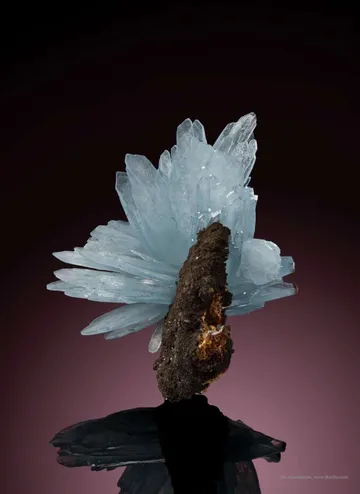
Azurite from Souss-Massa is best known from Tazalaght-area copper workings, where it occurs on quartz matrix as flattened prismatic to lenticular crystals, parallel-growth clusters, small globular aggregates, and, in later material, combinations with malachite and quartz. The color can be excellent—vivid royal to deep blue—and the best pieces stand apart by luster, translucency on crystal edges, clean separation from the matrix, and sharp contrast against white to iron-stained quartz or green malachite. Documented Tazalaght specimens include late-2000s material with flattened azurite crystals on quartz, some coated by analyzed clay-limestone-copper-phosphate mixtures, and 2021 material with azurite groups in which an earlier azurite generation was pseudomorphed by malachite. Crystals are generally small rather than huge, commonly in the millimeter to sub-centimeter range, with reported examples around 0.6 cm and fine 2021 crystals around 0.8 x 0.6 cm; exceptionally showy mixed pieces may display larger blue crystals to a few centimeters, but such examples are scarce.
Malachite is the dominant green face of the Souss-Massa copper suite, especially at Tazalaght and Tizert, where copper sulfides were oxidized and carbonate host rocks neutralized acidic fluids to produce malachite-rich zones. At Tazalaght, collector pieces show malachite as coatings, crusts, acicular silky sprays, irregular but recognizable crystals, and pseudomorphs after azurite, commonly associated with azurite, quartz, goethite, hematite, and other supergene copper minerals. In the Tizert deposit, malachite is so central to the weathering profile that the ore zone has been described in the literature as a green oxide zone, whereas azurite is absent or very rare there; that contrast helps explain why Tazalaght is the more appealing azurite-malachite specimen locality. The best Souss-Massa malachites have saturated deep to vivid green color, crisp texture rather than dull massive coating, and visible paragenetic interest—malachite replacing azurite, lining quartz, or sharing matrix with blue azurite—while ordinary pieces are earthy green copper ore.
Erythrite from Souss-Massa is a highly locality-specific story: a 2015 find near Tazalaght produced fine magenta cobalt arsenate specimens in a phlogopite-rich matrix, in a geological environment distinct from the much more famous Bou Azzer cobalt district roughly hundreds of kilometers away. These Tazalaght erythrites occur as very elongated, lustrous crystals, radial aggregates, and vivid magenta to purple sprays, commonly with phlogopite and locally quartz, with associated chalcocite-djurleite-digenite mixtures reported in the matrix. Published dealer descriptions and show reports emphasize that the crystals differ in habit from classic Bou Azzer erythrite and may reach around 0.8 to 1.5 cm long on hand specimens in the 5–7 cm range. The most desirable pieces show transparent to translucent, sharply defined, intensely colored crystals standing free on contrasting mica-rich matrix; lesser examples are darker, more massive, or reduced to thin pink coatings.
Phlogopite is not a common headline species in Moroccan display mineralogy, but at the Tazalaght erythrite occurrence it is the essential matrix mineral that makes the 2015 Souss-Massa material recognizable. It has been reported from the erythrite occurrence near Tazalaght and identified by Raman spectroscopy, occurring as mica-rich matrix and spheroidal to scaly growths associated with elongated erythrite crystals; some dealer descriptions emphasize phlogopite as analyzed, precisely because it is an unusual and useful label feature for this find. Good specimens are judged less by phlogopite as an isolated mica and more by how its bronze, tan, or greenish micaceous texture sets off the vivid magenta erythrite; the finest pieces have clean erythrite sprays rising from phlogopite-rich surfaces, while ordinary examples show only dull micaceous matrix with sparse pink staining.
Other documented minerals from Souss-Massa include the primary and secondary copper suite at Tazalaght—bornite, chalcopyrite, chalcocite, covellite, cuprite, carrollite, siegenite, sphalerite, tennantite-group minerals, olivenite, rosasite, goethite, dolomite, talc, and rhombohedral carbonates—as well as the broader Tizert assemblage of malachite, chalcocite, covellite, bornite, chalcopyrite, galena, cerussite, chlorargyrite, native silver, arquerite, stromeyerite, eugenite, kaolinite, smectite-group clays, muscovite, feldspar, fluorapatite, rutile, and hematite. The region also contains meteorite minerals from the Tissint Martian meteorite, including type-locality ahrensite, tissintite, and chenmingite, along with high-pressure phases such as ringwoodite, majorite, akimotoite, lingunite, stishovite, bridgmanite, and tuite. These are not conventional collectible display minerals from mines, but they make Souss-Massa unusually important in formal mineralogy.
The main label problem for Souss-Massa specimens is not outright fakery but imprecision. Sellers may label Tazalaght material only as “Morocco,” “Souss-Massa,” “Taroudant,” “Tazalarht Quarry,” or “Tazalaght Mine,” and older labels may use the former administrative language “Souss-Massa-Draâ,” which no longer matches Morocco’s post-2015 regional map. Preserve all variant spellings on old labels, but ask for the most specific locality available. A specimen labeled “Bou Azzer” should not be casually relabeled as Tazalaght just because it carries erythrite, and vice versa: Tazalaght erythrite is distinguished by its 2015 find history, phlogopite-rich association, and different geological setting.
Azurite and malachite pieces require the usual copper-carbonate scrutiny. Some Tazalaght azurite specimens were reported with coatings analyzed as a mixture of clay, limestone powder, and submicrocrystalline copper phosphate on the lower parts of crystals and matrix. That does not necessarily mean artificial enhancement, but it does mean collectors should examine surfaces carefully under magnification and avoid assuming every pale or chalky coating is a named mineral. Look for natural continuity of crystals into the matrix, undisturbed luster, and unpainted contacts. Malachite after azurite is a genuine and desirable feature at Tazalaght-area material, but vague “azurmalachite” labels can obscure whether a piece is crystal, pseudomorph, coating, or massive ore.
Erythrite is arsenate-bearing and should be handled sensibly: do not grind, soak, lick, or clean aggressively, and wash hands after handling friable material. The best Tazalaght erythrites are delicate, with slender crystals that can detach from mica-rich matrix if brushed or vibrated. Color is one of the chief value drivers, so store vivid magenta pieces away from harsh light and heat. The phlogopite matrix may flake, and quartz-bearing pieces can have hidden bruising along crystal tips or pocket edges.
Quartz-rich Tazalaght specimens are often sturdy in the matrix but vulnerable in the displayed minerals. Azurite edges can chip, malachite sprays can abrade to dullness, and iron-oxide matrix can shed dust. Avoid ultrasonic cleaning for mixed copper-carbonate specimens. Gentle air, a soft artist’s brush used sparingly, and a dry display environment are safer than water or chemicals.
Market availability is intermittent. Tazalaght azurite on quartz appeared internationally around the late 2000s, erythrite with phlogopite entered the collector conversation in 2015, and malachite/azurite-malachite-quartz material reappeared in 2021. Fine, well-labeled pieces are much scarcer than generic Moroccan copper specimens. The most desirable examples combine accurate locality data, balanced aesthetics, visible paragenesis, and freshness of crystal surfaces.
Long before Tazalaght became a dealer-label name at European and American mineral shows, it was a working copper place in the old sense: shafts, waste heaps, furnace remains, and slag in the Anti-Atlas sun. The mining literature places the medieval exploitation in the 12th century and associates it with the Almoravids, whose power and trade routes linked the Sahara, the Souss, and the cities to the north. The surviving traces are not subtle. Around the old quarries, the dumps and slag heaps have been estimated at about 40,000 tonnes, a figure that turns “ancient workings” from a romantic label phrase into a physical landscape of broken rock and smelting waste.
The modern mine had a second life in stages. In the 1930s, SERMISUD drove shafts and crosscuts into the old copper ground. In the 1960s, BRPM drilled, cut crosscuts, and re-evaluated the deposit, even partially treating old dumps. SODECAT took over in 1974 and mined the deposit in the open pit until 1987, then underground until 1992. By the time the mine closed, published figures recorded about 915,000 tonnes extracted at nearly 3% copper and 35 g/t silver. For collectors, those numbers matter because they explain why attractive specimens are episodic rather than abundant: the mine was built for copper, not pocket collecting, and the showy pieces are accidental survivors of ore extraction, dump searching, and small pocket discoveries.
The 2015 erythrite find near Tazalaght was a collector’s surprise precisely because Morocco already had a world-famous erythrite name: Bou Azzer. When the Tazalaght pieces appeared at Sainte-Marie-aux-Mines, they invited instant comparison—bright magenta crystals, arsenate color, Moroccan label—but the locality was different, the geology was different, and the association was different. Dealers emphasized that the material came not from the old Tazalaght quarries themselves but from a new shaft or prospect nearby. The matrix carried phlogopite, verified analytically in reported specimens, and dark copper-sulfide mixtures rather than the classic Bou Azzer cobalt-arsenide setting. For collectors who pay attention to labels, that changed the specimens from “another Moroccan erythrite” into a short-lived, sharply defined locality event.
Then there is Tissint, which belongs to Souss-Massa by geography but to Mars by origin. At about 2 a.m. local time on July 18, 2011, witnesses in southern Morocco saw a bright fireball in the sky near Tata and Tissint. The first stones were recovered months later in the Oued Drâa area, in desert country southeast of Tata and southwest of Tissint village. The fragments were coated in glossy black fusion crust and broke to reveal pale gray-green interiors with olivine phenocrysts and black shock glass. Scientists recognized the fall as a Martian shergottite—the first witnessed Martian meteorite fall since Zagami in 1962, and only the fifth Martian meteorite fall observed by people.
Tissint quickly became more than a meteorite trophy. Researchers found high-pressure minerals and shock textures that record violence on a planetary scale: melt pockets hundreds of microns across, ringwoodite grains far larger than those usually seen in Martian meteorites, and pressure-temperature estimates around 25 GPa and roughly 2,000 °C. One study inferred that Tissint may have been launched from Mars by an impact crater on the order of 90 km across, with a large uncertainty but still far larger than the small craters commonly invoked for other shergottites. That makes a small black-crusted stone from the Tata desert one of the region’s most dramatic mineralogical objects: a witness to both a Moroccan night sky and a Martian impact event.