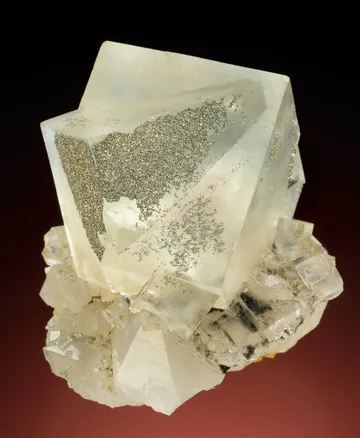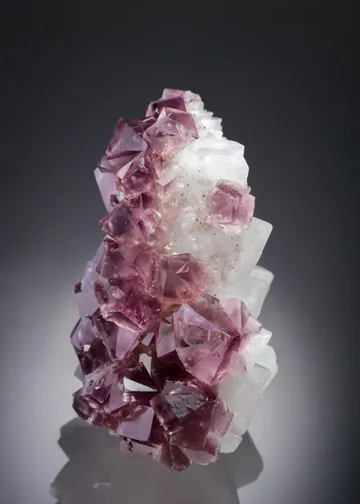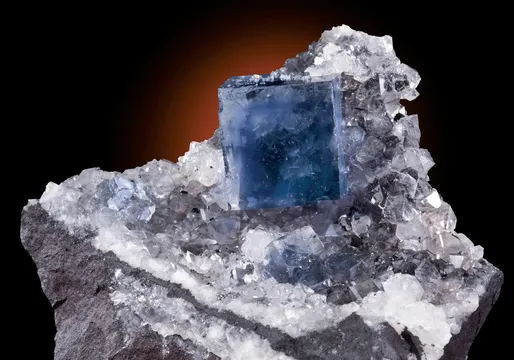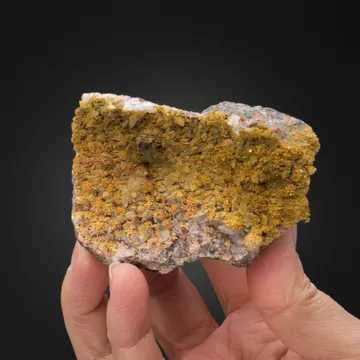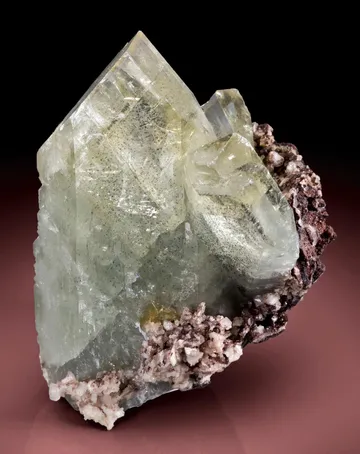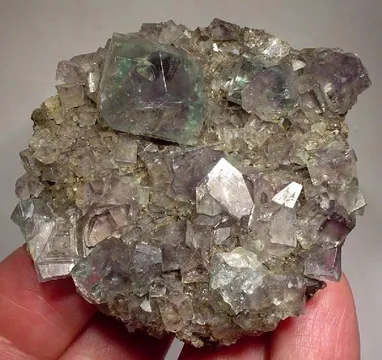
Heights Quarry, UK - premier Weardale fluorite locality known for transparent emerald-green to purple crystals, twinned cubes, and blue daylight fluorescence.
Key facts
Heights Quarry sits on the north side of Weardale between Eastgate and Westgate, County Durham, where a modern limestone quarry has cut into the old ground of Heights Mine. For collectors, the name means one thing above all: highly lustrous Weardale fluorite from the central fluorite zone of the Northern Pennine Orefield. The quarry works the Carboniferous Great Limestone, but the specimens came from a more complicated intersection of old veins and replacement “flats” at the High Flats horizon, principally the Heights North and Heights South veins and the cross-cutting West Cross Vein. Those iron-rich, vuggy flats produced the classic Heights look: transparent to translucent green, purple, colourless, and straw fluorite, commonly twinned, often seated on dark ferruginous limestone or ironstone, with galena, calcite, siderite, aragonite, and quartz as companions.
The best Heights fluorites are instantly attractive but not always instantly easy to separate from other Weardale classics. Fine pieces show interpenetrant cubic twins with glassy faces, intense emerald-green colour, pale purple cores or edge phantoms, and the vivid blue daylight fluorescence that made late 20th-century Weardale fluorite famous among collectors. Heights is especially important historically because it bridged the older mining era and the modern quarrying era: the underground mine was worked in the 19th century for iron ore and some lead, became a collecting haunt in the mid-20th century, and then the quarry periodically re-exposed portions of the same mineralized structures after the old workings were sealed.
Regional View
Country View
Heights is not a single-pocket locality in the way some modern specimen mines are. It is better understood as a mineralized tract where vein fissures, limestone replacement bodies, iron-carbonate alteration, and later oxidation all overlap. The most admired specimens are not large by world standards, but their quality is high: sharp, bright fluorite twins of thumbnail to small-cabinet size; cabinet plates of green fluorite on dark ironstone; galena accents tucked among fluorite; and calcite later than, or overgrowing, fluorite. The locality’s finest material rewards close inspection under daylight, incandescent light, and longwave ultraviolet light, where the strongest green crystals can shift character dramatically.

Photo: Fabre Minerals

Photo: Wikimedia Commons
Search for specimens: View all specimens from Heights Quarry, UK
Heights Quarry is a Carboniferous limestone aggregate quarry developed over and around the old Heights Mine workings at Westgate, Weardale, County Durham. The quarry exposes the Great Limestone Member, described in field-trip literature as a bedded, medium dark grey, fine- to medium-grained biomicrite with a thickness of about 17–18 m at the site. The regional setting is the Alston Block portion of the Northern Pennine Orefield, a classic carbonate-hosted Pb-Zn-F-Ba system in which mineralized faults and replacement flats cut the Carboniferous limestones, sandstones, shales, and associated units. Heights lies in the fluorite-rich central zone, where fluorite and galena dominate the collector assemblage more strongly than the barium minerals that characterize outer parts of the orefield.
The deposit is best described as a vein-and-flat system. The old mine exploited ground developed on three principal structures: the roughly parallel Heights North and Heights South veins, and the intersecting West Cross Vein. Where these veins cut receptive horizons in the Great Limestone, mineralizing fluids spread laterally and replaced limestone to form “flats,” especially at the High Flats horizon. Those flats were important both economically and mineralogically: they contained iron ore, largely limonite produced by oxidation of siderite and/or ankerite, and they also carried vugs lined with fluorite, galena, calcite, aragonite, and related minerals. Quarrying later exposed portions of the Heights South and West Cross veins, allowing further occasional recovery after the original mine workings became inaccessible.
The Northern Pennine mineralization is a low-temperature hydrothermal, Mississippi Valley-type system in broad genetic terms. Published field-trip summaries describe hot, metal-rich saline brines in the central fluorite zone, with mineral precipitation linked to mixing of chloride-dominated metalliferous brines and sulphate-rich brines. At Heights, the collector result of that chemistry is a compact but distinctive suite: fluorite as the show mineral, galena as the main sulphide, calcite and aragonite as late carbonates, quartz locally, siderite and ankerite in the ironstone-alteration story, pyrite in the shale overburden, and goethite/limonite as oxidation products.
Historically, Heights Mine was never simply a fluorite specimen mine. It opened in the mid-19th century and moved between lead and ironstone interests. Lead was worked from the flats by the Beaumont Company in the early 1860s, but the principal commercial work was by the Weardale Iron Company between 1850 and 1868, when the mine served mainly as an iron-ore source. Later records also note Anglo Austral Mines Ltd in connection with the site in 1950. The mine’s specimen reputation, however, rests on the vuggy flats rather than on its economic success: collectors in the second half of the 20th century recovered some of the locality’s finest green fluorites from old underground workings, before those workings were sealed in the late 1970s.
Modern Heights Quarry has been operated as an aggregate quarry, with Aggregate Industries UK Ltd recorded as the operator/leaseholder in planning and locality records. Quarry extraction involves stripping soil and overburden, blasting the limestone, hauling the broken rock to the plant, and crushing and screening it for construction aggregate, concrete aggregate, roadstone, and asphalt-coated stone. Planning documents describe a large established quarry east of Westgate, with permission for continued extraction and restoration timetables extending into the 2040s, and proposals for a north-western extension that would continue extraction to 2046. From a collector’s standpoint, this matters because specimens are tied to active industrial ground, not to a casual public collecting site.
Collecting access today should be treated as closed unless formal permission has been granted by the operator. Heights is a working quarry with blasting, heavy plant, unstable faces, old voids, and backfilled historic workings. The Russell Society’s documented 2016 visit was conducted only with permission, a risk assessment, a safety briefing, and quarry staff guidance. The old mine workings are not a collecting option: they were described as dangerous and were sealed in the late 1970s. Even where mineralized material has appeared in overburden or blast piles, legitimate access is controlled, and any collecting should be through organized visits or explicit operator consent.
The best-documented specimen ground includes the West Cross Vein, the Heights South Vein, and pockets or flats connected to the High Flats horizon in the Great Limestone. Mindat photo records document bluish purple twinned fluorite from the West Cross Vein at the high flat horizon, gemmy green twins from the low flat horizon, straw-coloured fluorite with calcite from the intersection of North Vein and West Cross Vein, and calcite overgrowing fluorite from a West Cross Vein sidewall pocket. Modern field observations also record pyrite nodules up to about 50 mm in shales above the Great Limestone, small non-specimen pieces of purple fluorite in overburden above West Cross Vein, and visible collapse features over old flat workings near the north-west edge of the quarry.
Fluorite is the defining Heights mineral: cubic, commonly penetration-twinned, and most prized where transparent to gemmy with emerald-green colour, purple internal zoning, or pale purple to colourless faces. Classic Heights crystals are typically thumbnail to small-cabinet scale, with fine twinned crystals commonly around 1–4 cm, though larger opaque green crystals from the West Cross Vein have been reported up to about 8–10 cm. The best pieces show high lustre, sharp cube geometry, strong colour contrast, and attractive placement on dark ironstone or ferruginous limestone, especially where accented by galena, siderite, quartz, or later calcite; ordinary pieces tend to be loose, cleaved, frosted, opaque, or too battered by quarry blasting to retain display quality. Documented zones include the West Cross Vein, low and high flat horizons in the Great Limestone, and the North Vein–West Cross Vein intersection, with notable examples including green gemmy twins, bluish purple multiple twins, straw fluorite with white centres and calcite, and colourless to near-colourless cubes with purple phantom edges.
Galena from Heights is usually a companion rather than the dominant display mineral, but it is essential to the locality’s best associations. It occurs as metallic grey cubic to cubo-octahedral crystals, commonly partly altered or tarnished, set in ironstone, quartz, calcite, or fluorite-rich matrix. Fine pieces show sharp, bright galena crystals tucked among transparent green or colourless fluorite, or supporting fluorite crystals in miniature and small-cabinet groups; less desirable examples are massive, oxidized, dull, or broken out of context from their fluorite-bearing matrix. The West Cross and Heights South vein system is the key setting for quarry-era pieces, while older mine material can show more coherent crystal groups from the vuggy flats. Because Heights was a lead-bearing as well as an ironstone and fluorite locality, galena is authentic and expected here, but sharp, well-formed galena crystals are appreciably scarcer than attractive fluorite.
Calcite at Heights is most collectible as an accessory that completes the fluorite association rather than as a stand-alone show species. It occurs as colourless to off-white crystalline crusts, small rounded to prismatic crystals, stepped hexagonal-looking groups, and later overgrowths on fluorite, with documented examples from West Cross Vein pockets where calcite coats or partly overgrows earlier fluorite. Good specimens preserve the paragenetic contrast: glassy green, purple, or straw fluorite below, with crisp, clean calcite arranged lightly enough not to smother the cubes entirely. Calcite-heavy Heights pieces can be attractive when the coating is sparkling and undamaged, but ordinary examples often appear visually chalky, heavily encrusted, or blast-fractured; the most desirable pieces still read first as Heights fluorite specimens, with calcite adding texture, age, and context.
Other documented minerals from Heights Quarry and the associated Heights Mine ground include aragonite, quartz, siderite, ankerite, sphalerite, pyrite, goethite, and limonite. The iron-carbonate story is especially important: siderite and ankerite were altered to limonite/goethite in the flats, producing the dark ferruginous matrices that help give many Heights fluorites their visual weight. Goethite pseudomorphs after cubic pyrite are specifically noted from South Vein workings, while the modern quarry overburden has yielded iridescent pyrite nodules in shale. No type-locality mineral is attached to Heights Quarry itself in the verified locality records; its rarities are not new species, but rather well-contextualized Weardale associations from named veins and flat horizons.
Heights material is desirable but easy to overgeneralize. The strongest authenticity issue is locality attribution within Weardale. Deep green, daylight-fluorescent, twinned fluorite is not unique to Heights: Middlehope Shield, Rogerley, Eastgate, Diana Maria, Blackdene, Boltsburn, and other North Pennine localities can all produce superficially similar fluorite. Old green fluorites from Middlehope Shield have been specifically discussed as having been mislabelled as Heights, partly because collectors recognize Heights more readily as a green fluorite source. Bevelled or softened cube edges alone are not a reliable Heights indicator, because multiple Weardale localities produced twinned fluorites with modified or rounded edges. Matrix, colour zoning, habit, old labels, collection history, and association are all important.
Heights fluorite is most convincing when it has the locality’s full assemblage and fabric: twinned green or purple fluorite on dark ferruginous limestone or ironstone, often with galena, siderite, quartz, or calcite. Transparent emerald-green twins with purple cores or edge zoning are prime; pale purple to colourless pieces can be excellent but need sharper provenance because they overlap visually with other Weardale mines. A specimen labelled “Heights Quarry” may in older collections refer to Heights Mine material, quarry-exposed vein material, or the broader Heights workings; where possible, preserve any more specific notation such as West Cross Vein, Heights South Vein, North Vein, high flat horizon, low flat horizon, or Green Hole.
Condition is a serious issue. Quarry-era specimens often suffered from blasting, crushing, and mechanical handling; look for bruised fluorite edges, cleaved twin halves, flat contacts, hidden repaired corners, and bruised galena. Fluorite from Heights has perfect octahedral cleavage, so even a glassy, undamaged-looking cube may have internal cleaves or back-side damage. Calcite coatings are vulnerable to abrasion and acid cleaning, while galena may be naturally tarnished or slightly altered. Cut bases and trimmed sides are not unusual on displayable Heights specimens and are acceptable when disclosed, especially for ironstone-matrix pieces, but they affect value.
No well-documented modern treatment industry is associated with Heights fluorite, but the ordinary cautions for English fluorite apply: avoid oiling claims that cannot be verified, inspect for glued contacts under UV and magnification, and treat overly bright “wet look” surfaces with skepticism if the lustre appears inconsistent across broken and natural faces. Longwave ultraviolet response and blue daylight fluorescence are a legitimate attraction of fine Heights material, but fluorescence should support—not replace—locality evidence. Fluorite should be kept away from strong heat, thermal shock, and acidic cleaning. Calcite associations obviously preclude acid use, and galena-bearing pieces should be handled with normal lead-mineral hygiene: wash hands after handling and keep dust away from children and food-preparation areas.
Market availability is moderate for representative Heights fluorite and much thinner for top material. Small loose twins, pale green cubes, and damaged quarry pieces appear regularly; fine small-cabinet plates with gemmy, lustrous, undamaged green twins and good galena or calcite association are far less common. Historic pieces with solid old labels, named collection provenance, or a specific vein/pocket attribution command a premium, especially when they preserve the intense green colour and daylight fluorescence associated with the locality’s best output.
In the spring of 1973, long before the old workings were sealed, Heights Mine was one of the first North Pennine localities visited by the artist and collector David Walker Barker. His route into the locality began not in Weardale but in London, in the Geology Museum at South Kensington, where two fluorspar specimens in a glass case caught him: one labelled “Deep Green Fluorite, Heights Mine, Weardale, County Durham,” the other simply “Fluorite, County Durham.” He later described those specimens as “geometrical perfection” in colour and transparency. When he finally reached Heights, the visit became a descent into the real version of what the museum case had promised: a dramatic, claustrophobic first encounter with the “hidden landscape” beneath the Pennine hills.
The collector mythology of Heights also has a lost-ground story. The great regret often repeated by Weardale collectors is not that the quarry failed to expose fluorite, but that industrial quarrying and aggregate use consumed enormous volumes of mineralized ground before specimens could be saved. One informed local account describes the quarry face advancing toward South Vein flats, stopping where the limestone became too contaminated by iron and silica, and then cutting through the South Vein near its junction with West Cross Vein. In that telling, much of the mineralization remained in place or was covered by landscaping, while about 300,000 tonnes of West Cross Vein material went away for sea defences near Sunderland. Whether every tonne of that rock would have held collector fluorite is unknowable, but the image is painful: a classic Weardale vein reduced to armour stone, with only a small fraction of its pockets ever reaching cabinets.
A more recent field note shows how controlled and industrial Heights had become by the 21st century. On 21 May 2016, seven Russell Society members arrived on an overcast but dry day and were met by Assistant Manager Richard Micklethwait, who took them through the risk assessment and safety briefing. The quarry’s northern face, they were told, had been left unstable by historic quarrying methods, requiring larger-than-usual standoff distances. The party inspected overburden east of the plant, where shale above the Great Limestone had yielded iridescent pyrite nodules, some up to 50 mm long, loose or locked in weathered shale blocks. At the north-west edge of the quarry, they could see collapse in the sandstone and shale beds over old flat workings on West Cross Vein. Purple fluorite was present in overburden above the vein, but only as small, non-specimen pieces. It was a collector’s visit to a famous locality, but also a reminder that the great pockets were mostly past tense.
One of the more charming modern Heights moments happened not underground, but in a pub. A 2016 video by Peter Ward shows Charles Clark, a veteran explorer of Weardale mines, with a huge glassy twinned Heights fluorite specimen being unwrapped in the Bluebell pub at St John’s Chapel. The video’s description says the specimen had not been seen for 30 years. For a locality whose finest material often comes with half-remembered adit stories, sealed workings, and rescued old labels, that scene captures the social life of Weardale minerals perfectly: the specimen is important, but so is the provenance, the person who saved it, and the room full of collectors leaning in to see what the old paper finally reveals.
Mindat: Heights Quarry, Westgate, Stanhope, County Durham, England, UK — Primary online locality record for the quarry, including coordinates, mineral list, quarrying notes, operator/planning summary, and references to Dunham and the BMS database.
Mindat: Heights Mine, Westgate, Stanhope, County Durham, England, UK — Essential companion locality record for the old underground mine, the three main veins, High Flats horizon, 19th-century ironstone history, and classic fluorite specimen descriptions.
K. C. Dunham, Geology of the Northern Pennine Orefield, Volume 1: Tyne to Stainmore, 2nd edition, British Geological Survey/HMSO, 1990 — The standard geological memoir for the district and the key published reference behind galena, calcite, and goethite records at Heights.
K. C. Dunham, Iron Ore Deposits of the Northern Pennines, Wartime Pamphlet 14, Geological Survey of Great Britain, 1941 — Important for understanding the ironstone flats and limonite/goethite setting that shaped Heights Mine’s economic history.
K. C. Dunham, Mineral Resources of Great Britain, Volume IV: Fluorspar, Geological Survey of Great Britain, 1952 — Cited in mining databases for the Heights/Heights Pasture area and useful for the wider fluorspar context of Weardale.
R. A. Fairbairn, The Weardale Mines, British Mining No. 56, Northern Mine Research Society, 1996 — A mining-history source cited for the Heights area, especially useful for placing the mine among Weardale’s lead, ironstone, and fluorspar workings.
Extractive Industry Geology 2018 Field Trip: Heights Quarry & Mineralisation in Weardale, Co. Durham — Concise field-trip guide with quarry location, Great Limestone description, Northern Pennine Orefield model, MVT-style mineralization, fluid temperature/salinity summary, and regional production figures.
Steve Warren, “Northern Branch Visit to Heights Quarry, Westgate, Weardale, Co Durham,” Russell Society Newsletter, Issue 69, September 2016 — Field report documenting modern quarry access, safety restrictions, pyrite nodules in shale, West Cross Vein collapse features, and the status of old flat workings.
Jesse Fisher, Ross Lillie, and John Rakovan, “Fluorite in Mississippi Valley–type Deposits,” Rocks & Minerals, 88(1), 2013 — Includes Heights Mine fluorite in the broader treatment of fluorite from Mississippi Valley-type deposits.
R. F. Symes and B. Young, Minerals of Northern England, National Museums Scotland and Natural History Museum, 2008 — A major regional mineralogical reference for Northern England and the North Pennine Orefield collector suite.
Mindat photo records: Helen Wilkinson gallery, Heights Mine and Heights Quarry fluorite/calcite examples — Valuable for specific specimen documentation from West Cross Vein, high and low flat horizons, calcite overgrowths, and North Vein–West Cross Vein material.
Nenthead Mines Conservation Society mineral display collection — Includes catalogued display material from West Cross Vein, Heights Quarry, including green fluorite with calcite.
A magnificent Heights Mine fluorite - huge gemmy twin — Peter Ward — Charles Clark presents a large glassy twinned Heights Quarry fluorite specimen in the Bluebell pub, St John’s Chapel; useful for provenance culture as much as specimen appearance.
Fluorite from West Cross Vein, Heights Quarry — Peanuts Minerals — Dealer media page for a 45 × 50 × 37 mm pale purple zoned fluorite from West Cross Vein, with video link and Greenbank Collection provenance.
Mindat: Heights Quarry, Westgate, Stanhope, County Durham, England, UK — Best starting point for the quarry locality, mineral list, coordinates, operator notes, and specimen-photo links.
Mindat: Heights Mine, Westgate, Stanhope, County Durham, England, UK — Essential for the historic mine, main veins, High Flats horizon, and classic fluorite descriptions.
Steetley Minerals: Weardale — Collector-focused overview of Weardale localities, including Heights Quarry and Mine, fluorite colours, crystal sizes, associations, and comparison with nearby Eastgate and Lady Annabella material.
Extractive Industry Geology 2018 Field Trip: Heights Quarry & Mineralisation in Weardale — Short but authoritative geological field guide to the quarry and the surrounding Weardale mineralization.
Russell Society Newsletter Issue 69, September 2016 — Contains the 2016 Russell Society field report from Heights Quarry, with useful observations on access, safety, overburden, pyrite nodules, and West Cross Vein workings.
GeoGuide: Minerals and mineralogy, County Durham — Regional mineralogical context for County Durham, including the importance of Heights Mine green fluorite.
GeoGuide: Mineral veins, North Pennines — Clear regional background on the North Pennine Orefield, fluorite zoning, and MVT-style mineralization.
BGS Memoir online: Northern Pennine Orefield Volume II—Stainmore to Craven — Broader British Geological Survey context for the Northern Pennine Orefield and its comparison with Mississippi Valley-type deposits.
Wikimedia Commons: Heights Quarry, County Durham — Freely viewable quarry photographs showing the working landscape and exposed rock faces.
Fabre Minerals: Fluorite with Galena from Heights Quarry — High-quality specimen image showing the classic green fluorite and galena association.
MineralAuctions: Fluorite on Galena, Heights Quarry — Useful specimen record for near-colourless fluorite with purple phantom zoning on cubo-octahedral galena and calcite.
Crystal Classics: Fluorite from Heights Mine — Dealer specimen record with history, Green Hole attribution, fluorescence notes, and George Farr collection provenance.