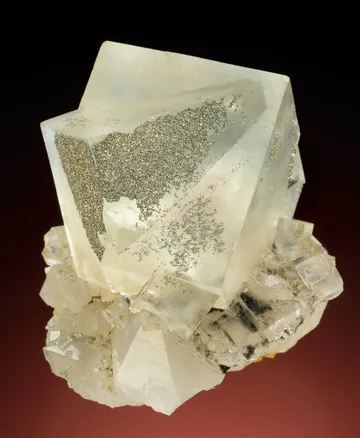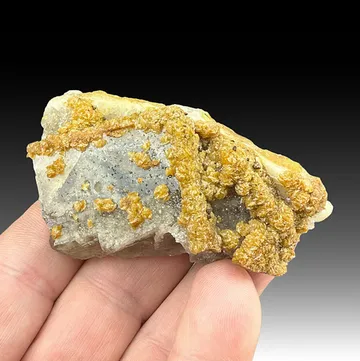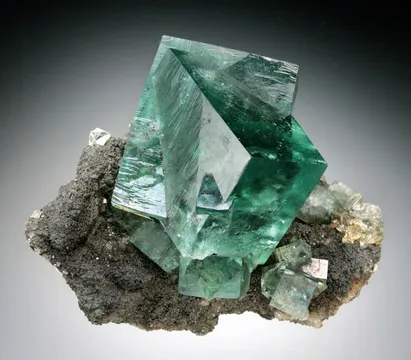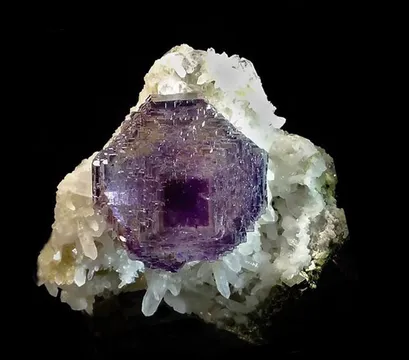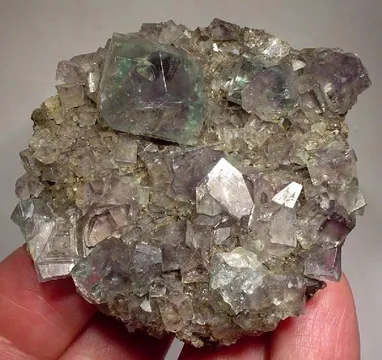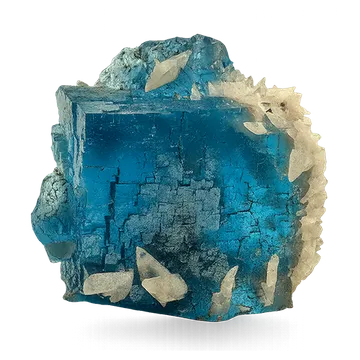
Cambokeels Mine, UK—classic Weardale fluorite with lavender to purple cubes, color-zoned twins, and UV fluorescence; prized for provenance and historic stock.
Key facts
Cambokeels Mine belongs to the classic Weardale fluorite tradition, but its best specimens have a personality quite their own: pale lavender and purple penetration twins, water-clear to turquoise-zoned groups from the zinc flats, pastel green cubes caught under quartz, and, from the lowest workings, unusual deep pink transparent twins on quartz. The finest pieces balance the clean geometry of English cubic fluorite with enough matrix to tell the mine’s story—white quartz druse, small calcite, pyrite dusting, or the late grey-green chamosite coatings that give some Cambokeels specimens a muted, mineralogically rich surface.

Photo: John Gibson / Wikimedia Commons
Geologically, Cambokeels sits in the fluorite-rich heart of the Northern Pennine Orefield, on the Slitt Vein between Eastgate and Westgate in County Durham. This is a carbonate-hosted, vein-and-flat style of mineralisation in the broad Mississippi Valley-type family: fluorite, galena, sphalerite, quartz, calcite, and related sulphides were deposited from mineralising brines along fractures and in replacement “flats” within Carboniferous limestone horizons. Cambokeels is especially interesting because its deeper workings intersected the Whin Sill; the mine is noted not only for fluorite but also for zeolite-type minerals and excellent calcite from levels driven through and below that dolerite body.
For collectors, the locality has two overlapping attractions. First is beauty: sharp, lustrous cubes and twins, often lavender to purple, sometimes colourless, greenish, turquoise, or pink, with classic Weardale fluorescence under ultraviolet light. Second is provenance: Cambokeels was one of the last major commercial fluorspar mines in Weardale, worked into the late twentieth century, and much of the best material in circulation today traces to old mine runs, dealer stocks, and established private collections rather than any continuing production.
Search for specimens: View all fluorite specimens from Cambokeels Mine, UK
Cambokeels Mine is on the north bank of the River Wear, between Eastgate and Westgate, in the Stanhope area of Weardale, County Durham. Historical names include Cammock Isle, Cumnock Isle, Cammock Eals, and the local shortening “Cambo.” The mine was developed on the Slitt Vein, one of the great structural lines of the Northern Pennines, and the abandoned buildings and adit area have long been visible from the A689 road.
The deposit is part of the Northern Pennine Orefield’s central fluorite zone. Mineralisation occurs in steep veins and in replacement flats where reactive limestone beds were invaded by hydrothermal fluids. In broader Weardale terms, the most productive flats are associated with competent Carboniferous limestones, especially the Great Limestone elsewhere in the orefield, but Cambokeels’ later commercial development reached deeper horizons including the Tynebottom Limestone, Jew Limestone, and the Whin Sill. The mine’s position relative to the Whin Sill is important: the lower workings descended below it, and the intersection of vein workings with dolerite produced a suite of analcime, fluorapophyllite-(K), chabazite, pectolite, and related minerals distinct from the main lead-zinc-fluorite mineralisation.
The early history was disappointing from an ore standpoint. Older records place the opening of the mine in the mid-nineteenth century, while the Beaumont Company drove a level from the River Wear bank below the Scar Limestone in the later 1860s for lead. The vein was large, but the lead values were poor, and the venture was abandoned. Parkburn Level was then driven from Park Burn in the 1870s; after about 920 metres of driving it too was given up because the vein failed to provide enough lead.
Fluorspar changed the economics. The mine was reopened for fluorspar in the early twentieth century, with J. Coulthard working Cambokeels from 1906 to 1909 and W. Hird & Co. later working it until 1927. A. Dalton reopened Cambokeels Level in 1935 and worked a stope west of Fleming’s Shaft before abandonment in 1939. Anglo-Austral Mines Ltd., a subsidiary of the Imperial Smelting Corporation, reopened the mine in 1948 and worked it until 1960; estimates for that period record 26,128 tons of fluorspar, 1,203 tons of lead ore, and 51 tons of zinc concentrate.
The modern phase made Cambokeels a major specimen source. In 1969 and the early 1970s, local operators Malcolm Brown and Madison drove new decline workings below the old horse level and found high-grade fluorite ore from the 40-metre level downward. Swiss Aluminium UK, usually abbreviated SAMUK, then developed levels at 200 metres in the Tynebottom Limestone and 240 metres in the Whin Sill and Jew Limestone. Later ownership under Weardale Minerals and the Minworth Group extended the mine to 280, 320, and ultimately 340 metres before closure in 1989.
Cambokeels is no longer a collecting locality in any practical sense. The lower decline workings are flooded, the Beaumont Horse Level has collapsed just inside the entrance, and remaining mine structures are abandoned industrial remains rather than an active specimen site. Underground entry would be extremely dangerous and should not be attempted. Modern Cambokeels fluorite reaches collectors almost entirely through old stocks, estate collections, dealer inventories, and auction dispersals.
Cambokeels fluorite is principally cubic, commonly twinned, and often arranged as interpenetrant twins on quartz or calcite-bearing matrix. The most familiar collector pieces are pale lavender, lilac, purple, or purple-zoned cubes and twins, but the locality is more chromatically varied than a casual glance suggests. Clear to colourless cubes, pastel green fluorite, turquoise-zoned groups from the zinc flats, and pink to deep pink transparent twins from the 340 level are all recorded. Many specimens fluoresce blue to lavender-blue under ultraviolet light, a classic Weardale response prized by collectors, though fluorescence intensity varies from specimen to specimen.
The upper workings are known for pastel-coloured fluorite crystal beds reached through the old horse level entrance. The later decline workings, especially the zinc-flat area around the 325 level, yielded some of the most desirable Cambokeels material: clear to turquoise fluorite groups with strong colour zoning and good lustre, frequently dusted with pyrite or partly coated by sparkling quartz or calcite. These pieces are recognisably Weardale, but the combination of clarity, cool colour, quartz sparkle, and occasional chamosite coating gives them a Cambokeels accent.
Crystal size ranges widely. Small cabinet and miniature specimens with 8 mm to 3 cm cubes or twins are common in the market record. Well-formed twins to about 2.5–3.5 cm are a strong collector size for the locality. Larger specimens are known, including cabinet pieces with fluorite crystals several centimetres across and rare large purple cubes reported to about 10 cm on edge. As with most classic Weardale mines, very large crystals may be less gemmy or more contacted than smaller, sharper groups, so the most valuable specimens are not simply the largest: balance, twinning, transparency, lustre, zoning, and association matter more.
Quartz is the most characteristic matrix mineral. It may occur as white druse, stubby transparent crystals, or a later sparkling overgrowth on fluorite. Calcite is common and important, both as an associated species on fluorite and as a major Cambokeels collectible in its own right. Pyrite is a frequent minor associate, sometimes as an attractive dusting. Chalcopyrite, dolomite, galena, sphalerite, siderite, pyrrhotite, and chlorite-group minerals are recorded from the mine, with chamosite coatings especially notable on some fluorite specimens. The deeper workings also produced British-interest pyrrhotite and a Whin Sill zeolite suite, making Cambokeels a locality where a fluorite specimen can sit naturally alongside a much broader mineralogical story.
Quality factors are straightforward but exacting. Look for undamaged cube corners, bright lustre, visible internal colour zoning, clean penetration twinning, and an undisturbed matrix of quartz or calcite. A good Cambokeels fluorite often has a slightly architectural look: a twin or cluster standing above quartz, with pale-to-purple zoning visible through the body of the crystal. Pieces with a documented level—especially 325 zinc flats, 340 level, 200 metre, 240 metre, or 320 level—carry added interest when the label history is credible.
Cambokeels fluorite is a closed-locality classic. Commercial mining ended in 1989, the workings are flooded or collapsed, and there is no meaningful modern production. That makes provenance important. Old dealer labels, collection labels, mine-level notes, and documented collection histories add real value, particularly for specimens from the zinc flats or 340 level.
No well-established Cambokeels-specific fake or treatment problem is part of the standard collector literature. The more realistic concern is mislocality. Weardale fluorites from Heights, Eastgate Quarry, Blackdene, Frazer’s Hush, West Pasture, Boltsburn, Rogerley, Diana Maria, and Cambokeels can overlap in colour and habit, especially when a specimen has lost its original label. Cambokeels attribution is strongest when the specimen shows a plausible combination of habit and association—lavender or purple twins on quartz, clear to turquoise-zoned zinc-flat material, chamosite-coated fluorite, or pink twinned fluorite from the lower levels—and when backed by old labels or a trusted chain of ownership.
Condition requires careful inspection. Fluorite has perfect octahedral cleavage, and Cambokeels specimens commonly show edge nicks, cleaved corners, small internal bruises, or repaired separations from matrix. Quartz overgrowth can protect some surfaces while concealing contact points or earlier damage. Calcite associates may be cleaved, scuffed, or etched. Chamosite and chlorite-group coatings are natural and locality-appropriate, but they can be mistaken by inexperienced buyers for dirt or alteration; on a genuine Cambokeels piece, such coatings may be part of the specimen’s character rather than a flaw.
Market availability is intermittent. Small to medium Cambokeels fluorites still appear through specialist British dealers, auction houses, and online mineral marketplaces, but truly fine pieces are not abundant. Expect modest specimens with light purple cubes on quartz to be obtainable, while sharply twinned, gemmy, well-zoned, level-documented examples from old collections are much more competitive. Large, lustrous, minimally damaged cabinet pieces with strong aesthetics are genuinely scarce.
Cambokeels’ surface story is as memorable as its minerals. The old mine lies beside the Wear, but its industrial reach climbed the valley side. During the First World War, when limestone demand increased sharply, the Cambo Keels incline was built to improve transport from Heights Quarry. The details are pure industrial Weardale: German prisoners of war built a three-quarter-mile, self-acting, 1-in-8 incline with three tracks, a midway passing loop, and a triangular junction with the Wear Valley Railway at Cambo Keels siding. The line crossed the River Wear on wooden trestles, linking quarry, road, and rail in a piece of wartime engineering that outlasted the immediate crisis before being replaced by an aerial ropeway, itself abandoned in the late 1950s.
Underground, the most collector-famous episode came from the zinc flats below the 325 level. There the mine encountered cavities so frequent that the ground seemed to defeat ordinary mining rhythm. Drill rods were said to vanish into open spaces as the men tried to work the flat. For collectors, that complaint is almost comic in retrospect: those troublesome voids were exactly the kind of cavities that make Weardale legendary, the open pockets where fluorite, quartz, calcite, pyrite, and later coatings could crystallise freely instead of forming massive ore. Mining in the area eventually ended with rich ore still present, checked by working difficulties and a fall in zinc prices.
The deepest levels added a final twist. At most localities, “deeper” simply means more difficult access; at Cambokeels it also means a different mineralogical world. The workings reached below the Whin Sill, and the 320-level engine chamber exposed closely jointed dolerite lined with colourless analcime and fluorapophyllite-(K), with rare chabazite and pectolite. These were not just incidental oddities. They were abundant enough to be described in scientific literature, and the measurements are strikingly precise: analcime crusts up to 30 cm across, typical crystals to 2 mm, rare isolated crystals to 6 mm, and fluorapophyllite-(K) prisms generally a few millimetres long, with some reaching 7 mm. The same mine that supplied purple and turquoise fluorite also preserved a late-stage Whin Sill mineral suite in the quiet surfaces of dolerite joints.
The end of the mine has its own hard edge. By the time Cambokeels closed in 1989, production had reached the 340 level. In 1991 the Minworth Group went bankrupt, and abandoned sites were left in limbo. Later, Sherburn Stone took over mining rights but operated the Grove Rake–Frazer’s Hush complex rather than reviving Cambokeels; Cambokeels was cannibalised to keep Grove Rake running. The machinery went, the winding house and equipment disappeared, and the remaining buildings deteriorated. What survives for collectors is not an active mine but a dispersed archive of specimens, each label carrying part of a vanished industrial landscape.