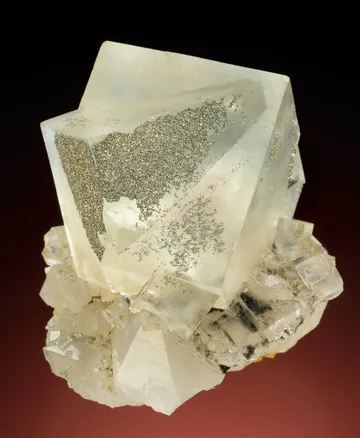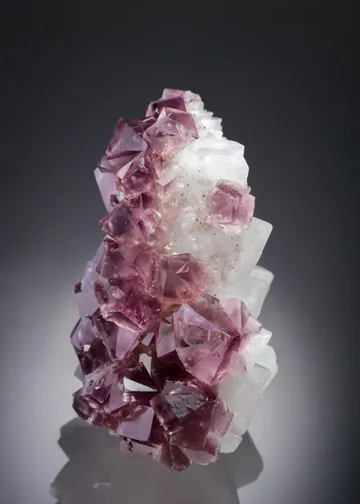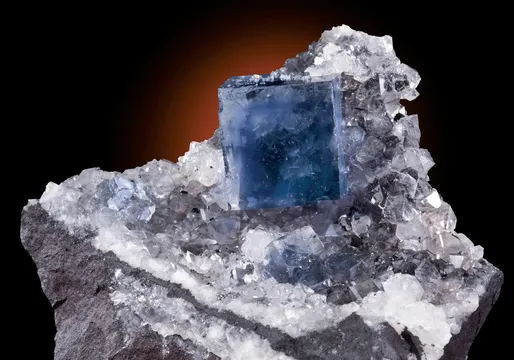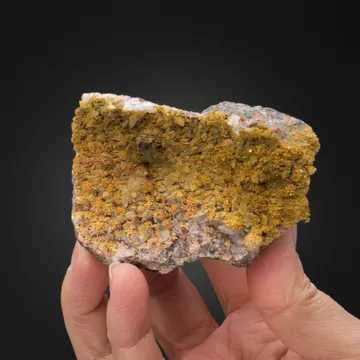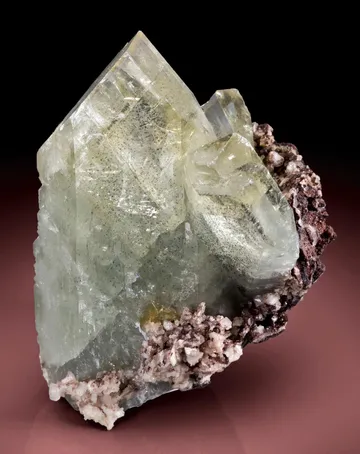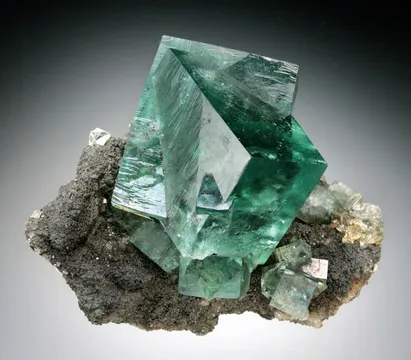
Heights Mine, UK - a classic Weardale fluorite locality famed for glassy green cubic fluorite, strong twinning, and the old-Weardale glow prized by collectors.
Key facts
Heights Mine is one of the classic Weardale fluorite localities: not a modern specimen mine, not a single celebrated pocket, but an old lead-and-ironstone working whose vuggy replacement flats produced some of the most desirable green fluorites in the Northern Pennines. The mine lay north of the River Wear between Eastgate and Westgate, in the fluorite-galena zone of the Northern Pennine Orefield, where mineralized veins cut Carboniferous limestone, sandstone, mudstone, and shale above the concealed Weardale Granite. In collector language, “Heights” means glassy green fluorite first of all: sharp cubic crystals, commonly interpenetrant twins, with an emerald to sea-green body color that can shift toward blue-violet in daylight and glow strongly under ultraviolet light.
Regional View
Country View
The best Heights specimens have an unmistakably old-Weardale look: brilliant, transparent to translucent fluorite twins standing on ironstone or altered limestone matrix, sometimes with little white quartz points, later calcite, aragonite, or subdued grey galena tucked between the cubes. While Weardale as a whole is famous for purple, yellow, colorless, and green fluorite, Heights made its reputation on the bottle-green end of that spectrum. The finest pieces are not merely green; they combine high lustre, open crystal spacing, clean edges, strong twinning lines, and a lively internal glow that rewards handling under changing light.
Historically, the mine sits at an intersection of three collector stories: the nineteenth-century lead and iron industries of upper Weardale, the mid-twentieth-century British specimen-collecting culture that prized accessible old workings, and the later quarrying of the same ground for limestone aggregate. The underground mine is gone from the collector’s practical world, but Heights fluorite still circulates through old collections, dealer stock, and estate material, often with labels from the 1960s, 1970s, and early 1980s. That combination of closed access, distinctive appearance, and long cabinet history is why good Heights pieces command attention well beyond local British-mineral circles.
Search for specimens: View all specimens from Heights Mine, UK
Heights Mine proper consisted of numerous underground workings on three main structures: the roughly parallel Heights North and Heights South veins, cut by the West Cross vein. The productive specimen ground was not simply vein fill in narrow fractures, but the associated flats at the High Flats horizon in the Great Limestone. These flats are lateral replacement bodies developed in the limestone beside the veins, and at Heights they were notably open and vuggy, giving crystals room to form rather than only massive ore.
The geological setting is classic central-zone Northern Pennine Orefield. Mineralizing brines rose through fractures in the Carboniferous sequence above the hidden Weardale Granite, depositing fluorite, galena, carbonates, silica, and iron minerals where structure, wall rock, and temperature were favorable. At Heights the host was the Great Limestone, a thick Carboniferous limestone unit that modern quarrying has worked for aggregate. Iron mineralization in the flats took the form of limonite derived from oxidation of earlier iron carbonates such as ankerite and siderite; that iron-rich matrix is an important visual clue on many old Heights fluorite specimens.
Commercially, Heights was not famous because it was a great ore mine. Some lead was obtained from the flats by the Beaumont Company during the early 1860s, but the mine’s principal nineteenth-century importance was as an ironstone producer. The Weardale Iron Company worked the deposit between about 1850 and 1868, exploiting oxidized iron ores in the flats around the veins. Later documentary records and leases show the broader Heights ground continuing to matter as a source of limestone, fluorspar, lead, silver, ironstone, ganister stone, fireclay, and other minerals in the Stanhope parish estate economy.
The mine opened in the mid-nineteenth century and eventually became much more important to collectors than to accountants. The underground levels were still accessible to collectors well into the twentieth century, and several generations of British collectors knew Heights as a place where hard, uncomfortable work in old workings could occasionally be repaid with first-rate green twins. By the late 1970s the condition of the levels had become dangerous; the old workings were sealed or blasted, and the historic collecting era effectively ended. Modern limestone quarrying at Heights Quarry later exposed parts of the mineralized ground again, especially portions of the South and West Cross vein area, but the locality today is an active industrial site, private land, and not a casual collecting locality.
The named finds that collectors speak about are mostly vein-and-pocket based rather than formally published pocket names. The West Cross Vein at the High Flats horizon produced bluish purple fluorite with calcite, gemmy fluorites with purple edges and pale green centers, and calcite overgrowths on earlier fluorite from pockets along the sidewall between the horse level and adjacent flat ground. The intersection of North Vein and West Cross Vein produced straw-colored fluorite with calcite, including untwinned crystals with gemmy corners and white centers. North Vein specimens are especially prized when the green fluorite carries small, clean, colorless quartz crystals and shows the locality’s characteristic shift toward purple in strong natural light. Dealer and collection records also preserve the “Green Hole” name for a 1970s pocket or find associated with superb emerald-green twinned material.
Fluorite from Heights Mine is the locality’s defining mineral and occurs chiefly as sharp cubic crystals, many of them interpenetrant twins, ranging from thumbnail-size crystals of a few millimetres to fine display crystals around 2 to 4 cm on edge; larger opaque green crystals to about 8 cm are known but are far less desirable than the glassy twins. The classic color is emerald to bottle green, though pale purple, bluish purple, straw-colored, and colorless fluorite are also documented from the North Vein, South Vein, and especially West Cross Vein flats in the Great Limestone. The most collectible pieces combine transparency, wet-looking lustre, clean twin lines, and pleasing association with quartz, calcite, aragonite, galena, or ironstone matrix; ordinary examples are duller, more opaque, heavily chipped, or too crowded on massive matrix to show the distinctive twinned habit.
Galena at Heights Mine is important historically as lead ore but, for collectors, is usually an accessory that sharpens the fluorite composition rather than the main attraction. It occurs as metallic grey crystals and modified crystal groups with fluorite, locally rounded or tarnished and in some specimens partly altered on the surface to pale lead-carbonate material; well-balanced fluorite-galena specimens are valued when the galena sits in open contrast with green fluorite rather than being buried in ironstone or reduced to dull blebs. The best pieces preserve bright to dark silvery galena against transparent green cubes, especially from the vuggy flats on the principal veins, while ordinary examples suffer from oxidation, poor separation from matrix, or broken fluorite around the heavy sulphide.
Calcite from Heights Mine is most familiar as a later carbonate companion to fluorite, appearing as white to colorless crystals, drusy crusts, and overgrowths on earlier fluorite in the West Cross Vein pockets and at vein intersections in the Great Limestone. Good calcite-bearing Heights specimens are not usually judged by the calcite alone, but by how the calcite frames or contrasts with the green, purple, or straw fluorite beneath: a light dusting or sharp secondary growth can add depth and paragenetic interest, whereas thick, opaque coatings may obscure the fluorite and lower the specimen’s display value. Documented pieces include calcite overgrowing fluorite from a pocket in the sidewall between a West Cross Vein flat and the horse level, as well as straw-colored fluorite from the North Vein-West Cross Vein intersection with both larger calcite crystals and later thin crystalline calcite crusts.
Quartz from Heights Mine is a supporting but very characteristic mineral, most often seen as small colorless to milky crystals scattered on or around fluorite, especially on North Vein material and on ironstone or altered limestone matrix. The crystals are generally small rather than cabinet-scale in their own right, but they matter because they give Heights fluorites texture and sparkle, and because quartz can sit as crisp little points on the broad cubic fluorite faces without overwhelming the composition. The best quartz-bearing pieces have clean, transparent green fluorite with discrete quartz crystals positioned as accents; ordinary examples have iron-stained, granular, or damaged quartz that merely roughens the matrix.
Other documented minerals from Heights Mine are few but meaningful: aragonite, calcite, fluorite, galena, limonite, and quartz form the verified list most consistently attached to the mine proper. Aragonite occurs with fluorite and can add creamy white globular or radiating carbonate texture to a specimen, while limonite is both an ore mineral and a matrix-forming product of oxidized iron carbonates in the flats. The locality is not known as a type locality, and its importance rests instead on unusually fine fluorite crystallization within a compact and well-defined Weardale assemblage.
The first authenticity issue with Heights Mine is locality precision. “Heights Mine,” “Heights Quarry,” and “Heights Pasture” have all appeared on labels and dealer descriptions, but they are not always interchangeable. Heights Quarry is the modern quarry developed over or around the former mine ground and has exposed related mineralization; Heights Mine proper refers to the underground workings on the Heights North, Heights South, and West Cross veins. Height’s Pasture or Heights Pasture has also been used in the trade, sometimes for nearby material, and should be checked carefully against the specimen’s vein, matrix, and provenance. A label stating “West Cross Vein,” “North Vein,” “South Vein,” or “High Flats horizon” adds useful credibility.
The second issue is confusion with other Weardale green fluorites. Middlehope Shield, Rogerley, Eastgate, Diana Maria, and other Weardale sources can produce green fluorite with strong fluorescence, and older Middlehope Shield pieces in particular have historically been misattributed to Heights because collectors recognized the Heights name more readily. Heights specimens tend to be judged by the combination of green color, glassy lustre, twinning, ironstone or altered limestone matrix, and association with small quartz, calcite, aragonite, or subordinate galena. A fine green Weardale fluorite should not be accepted as Heights on color alone.
Condition is critical. Fluorite has perfect octahedral cleavage and Heights crystals commonly stand proud on matrix, so edge bruising, cleaved corners, and small chips along twin junctions are common. Cabinet-size plates should be examined with a bright light from multiple angles; small white impact points on cube edges can hide under the strong green body color. Many old specimens have sawn or trimmed bases, which is not automatically a defect if disclosed and if the display face is intact. Repairs are not a widely documented Heights problem, but any high-value fluorite from an old closed locality deserves ultraviolet inspection, magnification, and careful examination for glued crystals, filled cleavages, and modern mounting residues.
Fluorescence is a major part of the locality’s appeal. Fine Heights fluorite can show daylight fluorescence, shifting toward blue, violet, or purple in strong natural light, and can respond vividly under longwave ultraviolet light. The response is not always uniform: zoned crystals may glow internally in patches or bands, revealing growth history that ordinary white-light display misses. Avoid prolonged strong sunlight for display, not because Heights fluorite is known to fade rapidly in normal cabinet conditions, but because heat, dust, and accidental handling do more harm than any display benefit. Use a filtered UV lamp responsibly, protect eyes and skin, and remember that fluorescence photographs often exaggerate what a specimen looks like in person.
Market availability is steady but selective. Lesser Heights fluorites appear regularly in old British collections and online dealer stock, while truly fine, transparent, damage-free emerald twins with documented provenance are much scarcer and command strong prices. Small thumbnails can be affordable if slightly bruised or matrixless; premium miniature and small-cabinet pieces with exceptional color, twinning, and old provenance can reach several thousand dollars. Provenance to recognized British collectors, older dealer labels, or documented 1970s collecting adds real value, especially when the specimen’s appearance matches the label.
In spring 1973, one collector-artist arrived in Weardale already haunted by a museum specimen. The Heights Mine fluorite he had seen in a geology museum had been collected in late Victorian times, and the name sent him north to the dale before he had fully grasped how physical, cold, and claustrophobic the old mining landscape could be. Heights was one of his first underground visits. The old workings were still partly accessible, and the experience was not the comfortable romance of a glass case but a descent into what he later called a “hidden landscape”: hand-driven levels, dark passages, mineralized flats, and the close presence of the men who had cut those voids for ore long before collectors crawled in after green crystals.
By the 1960s and 1970s, Heights occupied a particular place in British collecting culture. Miners and collectors in the North Pennines had long saved crystallized specimens when they could, sometimes to supplement wages and sometimes simply because they knew beauty and rarity when they saw it. A 1964 photograph published by the Russell Society shows Jim Knight and Tim Greenland at Heights Mine, a small historical glimpse of the period when serious field collectors still treated old Weardale workings as living mineral localities rather than only as names on antique labels. That era produced much of the Heights material now moving through collections.
The end of collecting access came in stages and with a certain grim finality. The old mine levels associated with the South Vein and the East and West Cross veins were lost to modern quarry workings, while the level into the North Vein was blown in by the lease owners. It was initially blasted during the 1970s and later dug out, but the second blasting was more decisive: charges were set farther along the roof, and the detonation made reopening impractical without heavy machinery. That detail explains why so many good Heights specimens feel like survivors. They are not from a locality waiting politely for the next collecting trip; they are from workings physically removed, sealed, or collapsed into the industrial afterlife of the quarry.
One of the most memorable late stories centers not underground, but in the Bluebell pub at St John’s Chapel. In 2016, a video by Peter Ward recorded Charles Clark, a veteran explorer of Weardale mines, unwrapping a large glassy twinned Heights fluorite specimen “for all to see for the first time in 30 years.” The setting is pure Weardale collector theatre: an old specimen, a local pub, the Greenlaws mining crew, and the real treasure being not only the crystal but the provenance carried in a miner-explorer’s memory.