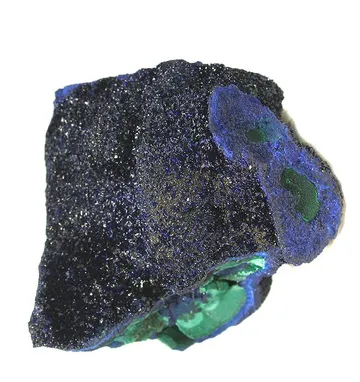
Guichi District, China - famed for Liufengshan azurite over malachite, with vivid color contrasts and rare pocket-wall crystals prized by collectors.
Key facts
Guichi District, now part of Chizhou in southern Anhui Province, is known to mineral collectors above all for the secondary copper suites of the Liufengshan Mine, with the nearby Tongshan copper mine adding a smaller but important supporting note. The district lies in the Anqing–Guichi ore concentration area of the Middle–Lower Yangtze River Metallogenic Belt, one of eastern China’s great Mesozoic iron-copper-polymetallic provinces. In regional terms the ores belong to a belt of skarn, porphyry-skarn, stratabound sulphide, and hydrothermal vein systems developed where Yanshanian intrusions cut carbonate-rich Paleozoic and early Mesozoic sedimentary rocks. In collector terms, however, Guichi is shorthand for a very particular look: black-blue azurite crystals sparkling over velvety to chatoyant green malachite, with limonitic goethite, earthy iron oxides, chalcocite, cuprite, and native copper recording the oxidation of a copper-bearing orebody.
The Liufengshan material became widely visible on the international market around 2002, and it quickly stood apart from the mass of ordinary Chinese azurites. The best pieces are not merely blue crusts; they are pocket-wall sections and vug fragments with rich, lustrous azurite druses, rosettes, blocky crystals, or lenticular crystal groups set against vivid malachite. In fine examples the contrast is almost theatrical: electric or royal blue points of azurite on a fibrous green base, sometimes with the blue and green minerals alternating in layers that reveal repeated shifts in oxidation chemistry during pocket formation. Large individual azurite crystals are unusual here, so specimens with crisp, distinguishable crystals—especially those approaching or exceeding several millimeters and arranged as balanced plates, rosettes, or cavity linings—carry a premium.
Regional View
Country View
Liufengshan is a useful reminder that a specimen locality and an ore-deposit locality are not always identical in emphasis. Geologically the deposit has been described both as a mid- to high-temperature strata-bound skarn copper system and as an unusual leaching-accumulation copper-iron occurrence in Quaternary gravels deposited in erosion cavities of Carboniferous limestone. For collectors, the important intersection is the oxidized, clay-rich, limonitic part of the system: small vugs and firmer goethitic pockets in otherwise sticky red-brown fault gouge and clay. That is where the azurite, malachite, cuprite, and native copper specimens were freed from an orebody whose primary story is chalcopyrite, chalcocite, pyrite, magnetite, hematite, galena, and other sulphide-oxide assemblages.

Search for specimens: View all specimens from Guichi District, China
Guichi District occupies an important position in the Anqing–Guichi mining district along the Middle–Lower Yangtze River Metallogenic Belt. The broader district is underlain by Precambrian metamorphic basement, Paleozoic to early Mesozoic marine sedimentary rocks, and Late Mesozoic volcano-sedimentary units, cut by small Yanshanian stocks and porphyries including diorite, granodiorite, and granite. The dominant mineralization styles in the district are skarn, stratabound massive sulphide, porphyry-related molybdenum-copper, and hydrothermal vein systems, with many deposits hosted by dolostone and limestone. That regional setting explains why Guichi is mineralogically broader than the azurite-malachite specimens suggest: Tongshan is a skarn copper deposit, Matou is recorded as a molybdenum-copper porphyry deposit, Paodaoling is an epithermal gold deposit, and the district also contains manganese, lead-zinc, iron, pyrite, and industrial limestone resources.
Liufengshan is the specimen locality that made Guichi famous. It lies near Lishan, about 20 km south of Chizhou City, and has been described in the collector literature as having an open pit, mine headquarters buildings, shafts, and waste dumps. The mine was originally opened as an open pit in 1970; later accounts describe shaft production beginning in the 1980s and specimen production from three likely interconnected vertical shafts after the open pit had become inactive. Official mineral-resource planning documents for Guichi list the Liufengshan copper mine as a small deposit, with copper as the principal commodity and iron and pyrite as associated resources. Those documents also record the mine as stopped by the 2015 resource-status table, while collector and locality databases preserve the older picture of a township-owned industrial operation with shafts. For collectors this distinction matters less than the practical conclusion: this is not an open collecting site, and any access should be regarded as private, industrial, and permission-only.
The specimen pockets occur in the oxidized and leached parts of the copper system rather than in clean open cavities of hard rock. Reports from buyers who visited the mine describe damp, sticky red-brown gouge and clay in a thick breccia zone, with firmer limonitic-goethitic areas hosting small vugs. Those vugs range from golf-ball scale to basketball scale, and their walls may be coated with velvety green malachite, sparkling medium- to dark-blue azurite druses, and in rarer cases cuprite or native copper. This pocket-wall origin explains the form of many specimens: shallow curved plates, nodular masses with an exposed cavity, geode-like halves, and slices showing alternating blue and green bands.
The greatest collecting period began when azurite-malachite pieces reached international dealers around 2002. Early exports included rich cabinet specimens, large nodular pockets, and azurite-malachite slices; later finds continued to appear as smaller cabinet, miniature, and thumbnail pieces, some with excellent sparkle and very good color but generally modest crystal size. A named “2002” large find is repeatedly noted in auction and collector descriptions as the source of important museum-scale azurites from China, including a large piece later connected with Ken Roberts and Rob Lavinsky and exhibited in the 2013 “Crystalline Treasures of China” display at the University of Arizona during the Tucson Gem & Mineral Show. Later market material, including specimens described from 2018, 2020, and 2022, shows that attractive pieces continued to circulate long after the first wave, though the finest early pocket specimens remain the benchmark.
Tongshan, also in Guichi District, is significant geologically and occasionally for specimens. It is a medium-sized skarn copper deposit in the Anqing–Guichi ore concentration area, with ore bodies occurring in the contact zone between the Tongshan intrusion and carbonate rocks of the Lower Permian Qixia Formation. Azurite is recorded from Tongshan as well, and modern dealer descriptions note sharp, vivid azurite groups from the mine, but Tongshan has not displaced Liufengshan as the district’s classic specimen name.
Azurite from Guichi District is chiefly the Liufengshan style: lustrous deep-blue to black-blue crystals lining pocket walls, commonly as sparkling druses, rosettes, lenticular crystals, tabular-prismatic individuals, and rich semi-spherical vug linings on malachite and limonitic goethite. The typical crystal size is small—individual crystals larger than about 1 cm are considered unusual—so quality is judged less by single-crystal size than by color saturation, luster, undamaged coverage, and the degree to which distinct crystals rise above mere sugary crust. Associations with green malachite are the rule and are central to the locality’s appeal; the best pieces balance blue azurite against chatoyant, fibrous, or botryoidal malachite, while ordinary examples can be duller, more massive, more broken, or simply too drusy to show individual form.
Malachite at Guichi is most familiar as the green structural partner to Liufengshan azurite, forming velvety pocket linings, chatoyant fibrous masses, botryoidal and mounded matrices, acicular sprays, green bands, and partial replacement textures. It may occur as a vivid backdrop under azurite druses, as radiating fan-shaped fibrous growth on the backs of pieces, or as green layers alternating with blue azurite where the pocket chemistry shifted repeatedly. Fine malachite-rich specimens have a saturated grass- to Kelly-green color, silky chatoyance, and an attractive contrast with intact blue azurite; lesser pieces are commonly massive, earthy, abraded on exposed fibers, or visually flat because the azurite is sparse or the malachite lacks sheen.
Cuprite is a scarcer but important Liufengshan mineral, recorded from the same secondary copper environment and most prized when it forms sharp octahedra or deep red lustrous crystals on native copper or with malachite and azurite. Collector pieces range from small specimens of dark, almost black-looking crystals that flash red in strong light to more dramatic copper-cuprite combinations, including aerial arborescent native copper partly coated by sharp red cuprite octahedra. Good Guichi cuprite is judged by crystal sharpness, red internal color, luster, and freedom from bruising on exposed octahedral corners; ordinary examples may be too dark, massive, poorly crystallized, or obscured by malachite crusts and iron oxides.
Native copper from Guichi, especially Liufengshan, is best known in branching, arborescent, and crystalline aggregates associated with cuprite; some examples show lightly iridescent copper frameworks adorned by octahedral cuprite, while fine dealer-described specimens are airy, well-crystallized, and lustrous rather than dense lumps. The color may range from fresh coppery metallic surfaces to darker oxidized tones, and malachite or cuprite can accent the branches. The best pieces have sculptural openness, recognizable copper crystallization, stable surfaces, and sharply perched cuprite; lesser pieces are compact, heavily oxidized, bent or contacted, or lacking the cuprite contrast that gives this locality’s native copper its collector identity.
Beyond the headline copper carbonates, Guichi District has a substantial recorded suite that reflects both oxidized collector pockets and primary ore systems. Liufengshan itself is documented for chalcocite, chalcopyrite, covellite, delafossite, galena, goethite, hematite, limonite, magnetite, pyrite, quartz, tenorite, cuprite, native copper, azurite, and malachite. District-wide records add minerals from other deposits, including molybdenite, sphalerite, arsenopyrite, realgar, stibnite, boulangerite, jamesonite, skutterudite, petzite, native gold, scheelite, rhodochrosite, baryte, fluorite, calcite, dolomite, and skarn silicates such as andradite, grossular, diopside, hedenbergite, vesuvianite, wollastonite, tremolite, epidote, and titanite. Delafossite is one of the more interesting Liufengshan rarities for micromineral and copper-oxide specialists, and a French article specifically treated delafossite from Liufengshan in 2023.
Guichi azurite-malachite is common enough on the market that not every specimen should be assumed rare, but genuinely fine pieces are much less common than the blue-green abundance suggests. The vast majority are small-crystal druses or pocket fragments; specimens with large, distinct, lustrous azurite crystals, complete vug aesthetics, strong azurite-malachite contrast, and minimal damage are the ones that move into serious collection territory. Early Liufengshan pieces from the 2002-era production, well documented ex-collection examples, and large balanced cabinet specimens are especially desirable.
The main authenticity issue is not a well-documented epidemic of locality-specific fakes, but rather misidentification, over-optimistic locality labeling, and the general problem of manufactured or dyed “azurite-malachite” objects in the decorative market. Natural Liufengshan pieces usually show vug-wall geometry, limonitic matrix, true crystal sparkle, layered or intergrown blue-green mineralization, and irregular oxidation textures. Be cautious with polished masses, spheres, bright blue-green composites, resinous surfaces, unnaturally uniform color, or labels that say only “Anhui” or “Guichi copper mine” without a more precise locality. Some genuine specimens are sold under abbreviated or variant spellings such as Liu Feng Shan, Liufengshan, Luifengshan, or Guichi Copper Mine; these can be legitimate, but the label should be evaluated against the specimen style and provenance.
Condition is a central grading point. Azurite crystals are relatively soft and can be bruised, rubbed, or chipped along exposed terminations; the darker crystals make small edge damage visible as lighter blue or matte spots. Malachite fibers and chatoyant surfaces can be flattened, abraded, or dust-filled, and pocket plates often have sawn or broken backs. Cuprite octahedra on copper are also prone to corner contacts. Because many specimens were extracted from sticky clay and iron-oxide gouge, cleaning quality varies: the best pieces are free of smeared clay in the vugs, but aggressive cleaning can dull malachite fibers or expose bruises.
Handling should be conservative. Avoid soaking azurite-malachite specimens for long periods, avoid acids, and do not use ultrasonic cleaning. Keep pieces dry and stable; azurite can alter to malachite over geologic time and may be vulnerable to poor storage conditions, although well-kept specimens are stable in normal display environments. Dust with air or a very soft brush. Malachite and azurite are copper minerals and should not be cut, ground, or polished without proper dust control; for display specimens, the ordinary risk is mechanical damage rather than toxicity.
Market availability remains good for representative miniatures and small cabinet specimens, especially azurite with malachite from Liufengshan. Prices vary widely: modest drusy pieces can be accessible, attractive cabinet pieces with strong sparkle and contrast command more, and large, old, or exceptional pocket specimens occupy a much higher tier. Cuprite and native copper combinations are less frequently encountered and are best bought with careful attention to locality, crystal sharpness, and condition.
The most vivid account of Liufengshan begins underground, away from the polished photographs and show cases. Collector’s Edge buyers who visited the mine described a working copper property with headquarters buildings, an abandoned open pit, waste dumps, and a series of three likely interconnected vertical shafts. The beautiful blue-green specimens did not come from clean, airy alpine-style pockets. They came from a thick breccia zone soaked with what one account called some of the most damp, sticky, red-brown fault gouge and clay imaginable. The productive spots were the firmer patches: limonitic-goethitic zones in which small cavities survived, their walls lined with velvety malachite and sparkling deep-blue azurite. The vugs were not huge caverns; they were commonly the size of a golf ball to a basketball. That is exactly why so many good Liufengshan pieces look like broken windows into small oxidized pockets rather than freestanding crystal groups.
The district’s rise in the collector world was rapid. Azurite and malachite specimens from Liufengshan began reaching the market around 2002, once dealers from Guilin and other Chinese specimen centers recognized the material. At first glance the pieces invited comparison with Bisbee: green malachite, dark blue azurite, limonitic matrix, and pocket-wall forms. But Liufengshan developed its own personality. The crystals were often smaller than Bisbee’s classics, yet the carpets of blue druse could be dazzling, and the contrast with fibrous malachite gave the better specimens a saturated, jewel-box effect. Early observers noted that individual azurite crystals over 1 cm were unusual, making the very best specimens those with exceptional coverage, sparkle, balance, and intact cavity form rather than sheer crystal size.
One large find from 2002 became a landmark in Chinese azurite collecting. A massive nodular specimen from that production—described in auction literature as coming from the most famous larger find of azurite in China—passed through the hands of major mineral figures. Ken Roberts reportedly owned much of the pocket production at one stage, and the specimen later entered Rob Lavinsky’s personal collection. Its prestige grew further when it was shown in the 2013 “Crystalline Treasures of China” exhibit at the University of Arizona during the Tucson Gem & Mineral Show. The same specimen was described as just over 8-1/4 inches, or about 21 cm, long: not merely a colorful Guichi piece, but a museum-scale representative of the locality’s first great market moment.
Later finds kept the locality alive for a new generation of collectors. Dealers documented large cabinet specimens with gemmy electric-blue azurite perched on malachite from 2018, complete floater pieces mined in early 2020, and copper-cuprite specimens sold as 2022 production. The later material did not erase the cachet of the early pockets, but it broadened the locality’s identity. Guichi was no longer only an azurite-malachite name; it also became a source for distinctive native copper with sharp red cuprite, giving collectors a compact suite of secondary copper species from the same district.