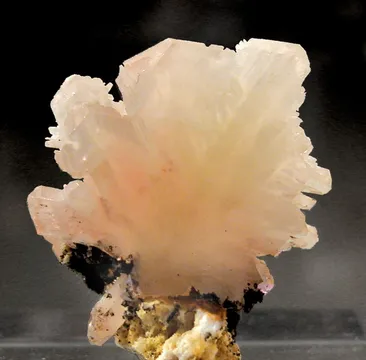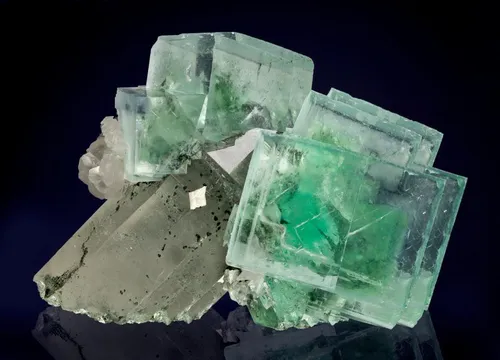
Ganzhou, China — premier collector locality in southern Jiangxi’s tungsten belt, famed for Xiefang barite-on-fluorite with amber barite on green to purple fluo…
Key facts
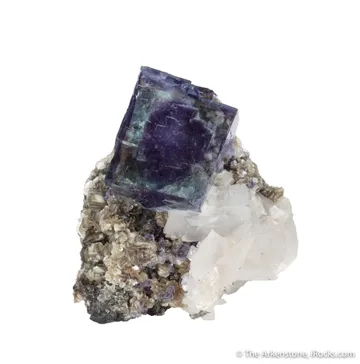
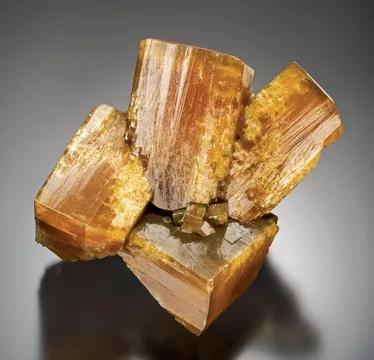
Ganzhou, in southern Jiangxi Province, is not a single mine so much as a collector’s shorthand for one of China’s richest mineral districts: the southern Jiangxi sector of the Nanling metallogenic belt. For economic geology it is classic tungsten country, a landscape of granite-related W-Sn-polymetallic deposits, greisen, quartz veins, skarns, rare-metal mineralization and weathered rare-earth resources. For cabinet collectors, however, the name most often points to the Xiefang Mine at Ruijin, where low-temperature hydrothermal veins produced one of the most recognizable modern Chinese barite-fluorite assemblages: golden to amber BaSO4 crystals perched on green, blue-green, lilac, purple or dark botryoidal fluorite, commonly with quartz and pyrite.
The visual signature is unusually strong. Good Xiefang pieces have thick, glassy, tabular to blocky barite crystals with honey, toffee, amber or yellow-orange color, set in sharp contrast against fluorite that may be cubic, drusy, botryoidal, color-zoned, greenish, blue-green, lilac or deep purple. The best specimens combine transparency, luster, height above matrix, clean spacing, and a three-dimensional “barite-on-fluorite” architecture rather than a flat coating of small blades. Some pieces are more massive large-cabinet plates; others, especially later market offerings, are tight miniatures and small cabinets with the same color contrast in a more displayable scale.
Regional View
Country View
Ganzhou’s collector importance also reaches well beyond the Xiefang barites. Xihuashan, Dajishan, Pangushan, Tieshanlong, Piaotang, Kuimeishan and related mines are part of the historical tungsten-mining identity of southern Jiangxi. These deposits document wolframite, scheelite, cassiterite, molybdenite, bismuth minerals, tellurides, topaz, fluorite, quartz, sulfides and rare-metal oxides. The region also includes the type locality of gananite, BiF3, a rare bismuth fluoride named for Gannan, the historical name of southern Jiangxi.

Photo: Wikimedia Commons / Rob Lavinsky, iRocks.com

Search for specimens: View all specimens from Ganzhou, China
Ganzhou is a prefecture-level region at the headwaters of the Gan River in southern Jiangxi, where the Luoxiao, Nanling and Wuyi mountain systems meet. In mineralogical use, “Ganzhou” covers numerous mines and districts rather than one excavation. The broad geological frame is the eastern Nanling metallogenic belt, one of the great granite-related tungsten-tin provinces of South China. Regional mineralization is tied to Mesozoic magmatism and hydrothermal activity, with tungsten-tin-polymetallic ores concentrated in quartz veins, greisenized granites, skarn systems, vein stockworks and associated altered sedimentary and volcanic rocks.
For the barite and baryte specimens that collectors most often associate with Ganzhou, the important sublocality is the Xiefang Mine, near Xiefang in Ruijin County. Mindat records the locality at Xiefang Mine, Ruijin Co., Ganzhou, Jiangxi, China, with baryte, fluorite, quartz, pyrite, calcite, chalcopyrite, galena, muscovite/sericite, opal and possible aragonite. Published and dealer descriptions consistently describe the collector material as a hydrothermal fluorite-barite vein assemblage, with barite and pyrite crystallizing in cavities and fractures and fluorite forming the principal colored matrix.
The Xiefang ore is best understood as a fluorite-dominant hydrothermal vein deposit with barite as an important gangue and specimen mineral. The specimen pockets exploited by collectors produced several styles: golden barite on blue-green fluorite; honey-brown to amber barite on massive or botryoidal green fluorite; yellow-orange tabular barite on purple fluorite; barite on quartz; fluorite on quartz; pyrite on barite; and rarer calcite/quartz pseudomorph material. The fluorite is locally highly responsive under ultraviolet light, a useful display property that also helps explain the market appeal of combination pieces.
The mining history of the region begins earlier and broader than Xiefang. Ganzhou is officially promoted as the birthplace of China’s tungsten industry, with tungsten discovered at Xihuashan in Dayu in 1907 and major production expanding across Dayu, Chongyi, Quannan, Dingnan, Shangyou, Yudu and Ganxian in the years that followed. By the late 1910s, local tungsten mining was already large enough to put Ganzhou into world-scale production. In 1932 the China Tungsten Ore Company was founded at Yudu, and in the early People’s Republic period the major mines of Dajishan, Xihuashan, Kuimeishan and others were built or expanded as state-operated operations. The government account of Ganzhou’s tungsten industry lists six large tungsten deposits in the prefecture: Xihuashan, Dajishan, Pangushan, Tieshanlong, Piaotang and Huamei’ao, together with numerous medium and small deposits and many smaller tungsten occurrences.
Modern Xiefang is not a casual collecting site. The area is an industrial fluorite district, and Chinese planning documents identify Ruijin-Xiefang as an important fluorite mining area. Public industry lists also record a fluorite mining and processing line of Ruijin Mianjiang Fluorite Mining Co., Ltd. at Huashi Village, Xiefang Town, Ruijin, with a listed single-line scale of 210 tonnes per day. Specimens reaching the collector market therefore come through mine recovery, local mineral trade, exporters and international dealers, not through open hobby collecting.
The most visible specimen-producing period for Xiefang barite-fluorite material spans at least the late 2000s to the present market. Wikimedia-hosted specimens photographed before March 2010 already document golden transparent baryte on blue-green to green fluorite, including a 5.2 cm small cabinet piece and a 20.0 cm large cabinet plate from earlier finds. Mineralogical Record online reports and dealer archives show that large Xiefang barite-on-fluorite pieces appeared repeatedly at major shows in the 2010s and 2020s, often as cabinet and large-cabinet plates. A fresh wave of smaller, more affordable miniatures and small cabinets was noted in 2025, while EarthWonders and dealer listings from 2025–2026 record new or recent finds with amber barite to roughly 2.8–4.0 cm on fluorescent botryoidal fluorite. A distinctive October 2025 style, pyrite on deep yellow baryte, was publicized by Fabre Minerals as a Munich Show 2025 discovery and later appeared in print references.
At Ganzhou, collector-grade barite is overwhelmingly represented by the Xiefang Mine material: thick tabular, blocky, pseudo-cubic or bladed BaSO4 crystals in golden, honey, toffee, amber and yellow-orange tones, most famously on green to purple fluorite and less commonly on quartz or with pyrite. Documented specimen sizes range from thumbnail-to-miniature pieces around 4.5–6.5 cm to large-cabinet plates exceeding 20 cm, with individual barite crystals commonly in the 0.5–4.0 cm range and exceptional isolated crystals reported to about 6 cm. The strongest pieces have bright luster, translucency to gemminess, sharp unbruised edges, saturated amber color, balanced elevation on contrasting fluorite, and minimal cleaving; ordinary pieces tend to be flatter plates with many small, crowded crystals, duller color, or conspicuous edge chipping on the heavy barite crystals.
“Baryte” is the internationally preferred spelling for the same BaSO4 species that many American dealers list as “barite,” and the Ganzhou baryte specimens are the classic Xiefang Mine combinations: transparent to translucent golden-amber crystals, typically tabular to blocky, scattered or clustered over fluorite matrices that may be blue-green, green, lilac, purple or dark botryoidal. Older documented pieces include 5.2 cm and 20.0 cm baryte-fluorite specimens photographed before 2010, while later dealer records show Xiefang baryte continuing to enter the market as cabinet to large-cabinet plates and as newer miniatures. Top examples here are judged less by crystal size alone than by the interplay of color, relief and association: clean amber baryte standing crisply above lustrous fluorite, preferably with visible translucency, intact terminations, and an arrangement that reads as a composed specimen rather than a mined ore fragment.
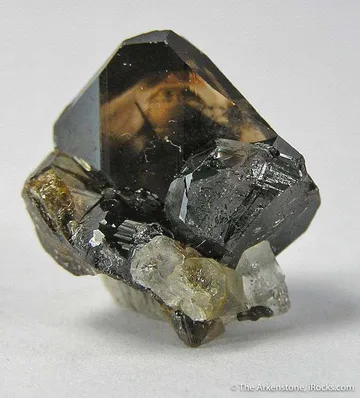
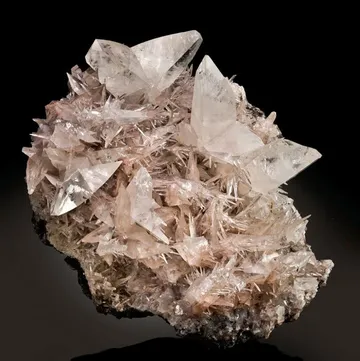
Other minerals documented from the Ganzhou prefecture make the region far richer than a two-species barite locality. Xiefang itself is recorded for fluorite, quartz, pyrite, calcite, chalcopyrite, galena, muscovite/sericite, opal and possible aragonite. The broader Ganzhou mineral list includes classic Nanling tungsten-suite species such as wolframite, scheelite, cassiterite, molybdenite, arsenopyrite, chalcopyrite, sphalerite, galena, topaz, fluorite, muscovite, quartz and bismuth minerals. The Laikeng tungsten mine in the Helong W-Cu deposit is the type locality for gananite, BiF3, described as microscopic brown to black and greenish-black aggregates associated with native bismuth, bismuthinite, chalcopyrite, pyrite, quartz and wolframite. Pangushan is notable for a bismuth-telluride assemblage including ingodite, joséite-A, joséite-B, baksanite, sulphotsumoite and tetradymite, while Dajishan is important for tungsten, tantalum-niobium and complex W-Sn-polymetallic mineralogy.
The first authenticity issue is locality precision. “Ganzhou, China” on a label is usually too broad for serious cataloguing; when a specimen is the familiar golden barite on green or purple fluorite, the likely correct full locality is Xiefang Mine, Ruijin Co., Ganzhou, Jiangxi, China. Conversely, not every Jiangxi fluorite with barite is Xiefang. De’an/Wushan in northern Jiangxi, Shangrao localities, Hunan fluorite mines and other Chinese fluorite districts can produce superficially similar combinations. A strong Xiefang attribution should be supported by the expected habits: amber to golden thick barite, green to purple fluorite, frequent botryoidal or drusy fluorite surfaces, quartz in some pieces, and occasional pyrite.
No well-documented, locality-specific epidemic of manufactured Xiefang barite-fluorite fakes appears in the mineral literature or reputable dealer notes, but mislabelling is a real risk because Chinese fluorite localities are numerous and trade labels are often shortened. Be cautious of vague labels such as “Jiangxi,” “Ganzhou,” “Xie Fang,” or “Ruijin” without mine-level detail, and preserve any older dealer, mine or collection labels that clarify the chain of custody. Also be aware that English spellings vary: Xiefang may appear as Xie Fang, Ruijin as Jui-chin/Ruijing in older or inconsistent labels, and “baryte” may be replaced by “barite” depending on the dealer.
Condition is the major quality filter. Barite is dense and relatively soft compared with quartz; the crystals chip, cleave and abrade along exposed edges, especially on broad plates. Many Xiefang specimens are heavy for their size and have projecting crystals on a brittle fluorite matrix, so inspect crystal edges, corner bruises, back-side trimming and repaired contacts. Minor micro-chipping is common and often noted even on high-end dealer examples; it should be priced accordingly but need not disqualify a large, visually strong piece. Repairs are harder to evaluate from photographs because amber barite can hide glue along contacts, so use side lighting and magnification.
Fluorescence is a positive feature in many Xiefang pieces. Several market records describe fluorite that fluoresces brightly under longwave ultraviolet and in some cases under shortwave as well; EarthWonders listings also note pale gray surface fluorescence and vivid purple fluorescence along broken or parted edges. Because barite and fluorite can respond differently, ultraviolet examination can add display value, but it should not be used as a sole locality test. For handling, avoid acids, ultrasonic cleaning and thermal shock; fluorite has perfect octahedral cleavage and barite’s high specific gravity makes dropped specimens especially vulnerable.
Market availability is active but uneven. Commonest are cabinet and large-cabinet barite-fluorite plates from the 2020s dealer stream, with prices rising steeply for large, saturated, undamaged examples. Smaller pieces from new finds have made the locality more accessible, but miniature specimens with the same color contrast and good aesthetics are still desirable because the classic material was often saved as bulky plates. Pyrite-on-baryte pieces from the 2025 find are much scarcer and should be evaluated as a separate style. Pure barite without fluorite is less immediately recognizable but can be worthwhile when crystals are large, lustrous, deep amber and sharp.
The deepest Ganzhou story begins not in a modern mineral showroom but on Xihuashan, where tungsten first brought the region to national attention. Official accounts credit a German missionary, Wilhelm, with discovering tungsten at Mount Xihua in 1907, opening China’s tungsten-mining history. Early output was small: from 1907 to 1914, annual production was reportedly less than 20 tonnes. Then the discoveries spread. In 1917 tungsten ore was found in Dayu, Chongyi, Quannan, Dingnan and Shangyou, and local people began mining it. By 1918, Ganzhou’s tungsten output was said to exceed 10,000 tonnes, amounting to about 60 percent of world output. The transformation was abrupt: what had been mountain country became a mining rush.
One Chinese historical account of Xihuashan preserves the rush in remarkably vivid terms. In the spring of 1918, after the whole mountain was opened for free mining, people from neighboring provinces and counties “flocked up the mountain” to dig tungsten sand. Within a year, the number of miners reportedly exceeded ten thousand. Temples, forests and wild ground became market space. Merchants from Guangdong and Hong Kong set up dozens of sand-buying firms, competing to buy ore and ship it out. The local price reportedly began at one-tenth of a silver dollar per jin and later rose to four-tenths. The account ends with a striking line about Xihuashan tungsten: it was “not a pearl, yet better than a pearl,” its brilliance spreading across the world.
Ganzhou’s tungsten history also intersects with revolutionary finance. In 1932, the China Tungsten Ore Company was founded in Yudu, and Mao Zemin, then president of the Central Bank in the Jiangxi Soviet period, was appointed general manager. The company supplied 7,890 tonnes of tungsten concentrate and generated a reported RMB 6.2 million in financial income. For collectors, that episode is a reminder that the minerals of southern Jiangxi were never merely pretty crystals; they were strategic material, currency, industry and politics in ore form.
The modern specimen story is quieter but familiar to anyone who watches mineral shows. Xiefang barite-fluorite pieces began to build a reputation because the material was immediately legible across a room: amber barite on green or purple fluorite. Early documented specimens show that by 2010 the combination had already reached international collections, with a 5.2 cm piece carrying blocky transparent golden baryte on blue-green fluorite and a 20 cm plate studded with many amber crystals. Later, for several years, dealers at major shows tended to have only very large examples—impressive, colorful, and often awkwardly heavy. When small 4.5–10 cm pieces appeared in a 2025 dealer update, the shift mattered: it put the same Xiefang look into the miniature and small-cabinet range where serious collectors could more easily display it.
A different Xiefang episode surfaced in 2025 with pyrite on baryte. Instead of the familiar amber-on-fluorite combination, these pieces showed thick, deep yellow baryte crystals carrying metallic gray pyrite in spherical or concretionary growths. Fabre Minerals described the association as unusual for the locality, and one specimen was noted as a Munich Show 2025 discovery, later cited in Mineralogical Record and Paragénesis. For a locality that collectors thought they understood visually, the pyrite-on-baryte pieces were a useful jolt: Xiefang was not just a one-style barite mine, and new pockets could still complicate the picture.