A collector's guide to Anhui, China: its geology, mining history and notable minerals, illustrated with the 100 specimens documented from this locality on EarthWonders.
Key facts
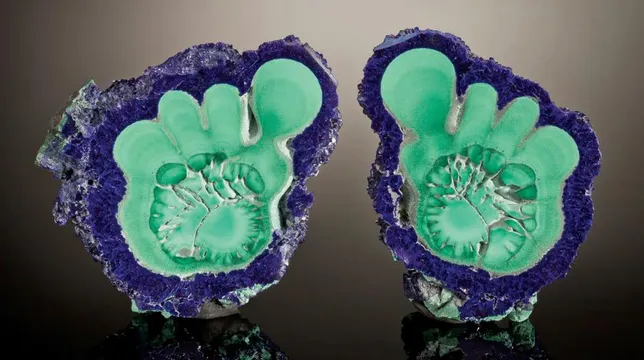
Anhui’s importance to collectors is concentrated in the mineralized belt that follows the middle and lower reaches of the Yangtze River, especially the Anqing–Guichi, Tongling, and Lujiang–Zongyang districts of southern and central Anhui. This is not a single specimen mine in the classic sense, but a province-scale collecting label that covers several very different ore environments: copper-iron skarns and supergene copper deposits around Guichi and Tongling; Ag-Pb-Zn and Cu-Au systems around Lujiang; and younger-looking specimen production from hydrothermal Cu-Au veins such as Jingbian. The collector fame rests above all on Liufengshan azurite and malachite: deep blue, highly lustrous azurite druses and rosettes set in emerald to mint-green malachite, commonly developed in small vugs in iron-rich, limonitic matrix. The best pieces have the visual snap of Bisbee or La Sal copper carbonates but retain their own Chinese signature: sparkling carpets of millimetric azurite, blue-lined cavities, malachite rims, and occasional sculptural nodules that split to reveal dramatic internal color contrast.
Regional View
Country View
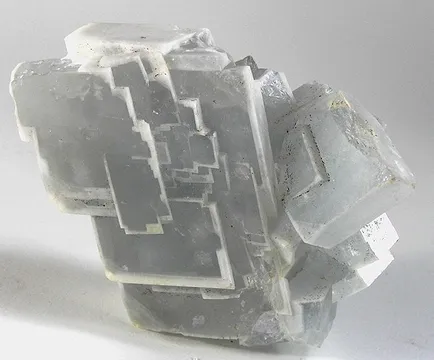
The Anhui label also appears on wire silver from the Lujiang area, particularly Yueshan/Huangtun and Jingwa material, where native silver forms curled, branching wires with acanthite and other silver-bearing phases. A more recent collecting stream is the purple to red-purple fluorite from the Jingbian Cu-Au deposit, typically as lustrous cubic crystals with strong geometric zoning on drusy quartz and locally with calcite. For serious collectors, the value of an Anhui specimen lies in tightening the locality: “Anhui, China” is acceptable as a market shorthand, but “Liufengshan Mine, Guichi District, Chizhou,” “Yueshan Ag-Pb-Zn deposit, Huangtun township, Lujiang County,” or “Jingbian Cu-Au deposit, Lujiang/Zongyang area” is far better.

Photo: Wikimedia Commons
Search for specimens:
Anhui’s specimen-producing deposits sit within the broader Middle-Lower Yangtze River Metallogenic Belt, one of eastern China’s major Mesozoic Fe-Cu-Au-Mo-Pb-Zn-Ag provinces. In collector terms, the province can be understood as a chain of related but distinct districts along the Yangtze corridor: Anqing–Guichi in the southwest, Tongling to the east, and Lujiang–Zongyang farther northeast. Regional studies describe these districts as products of Late Jurassic to Early Cretaceous magmatism interacting with carbonate and clastic sedimentary successions, producing skarn, porphyry, strata-bound hydrothermal, cryptobreccia, and vein-style ore bodies. That metallogenic complexity is exactly why Anhui produces such a varied specimen suite: oxidized copper carbonates, native silver wires, fluorite-bearing hydrothermal pockets, sulfides, oxides, and a growing list of rare-metal minerals from southern Anhui granites.
Liufengshan, in Guichi District near Chizhou, is the collector’s anchor for Anhui azurite and malachite. The mine lies at about 30°35' N, 117°31' E and has been described both as a leaching-accumulation copper-iron deposit hosted in Quaternary gravels occupying erosion caves in Carboniferous limestone, and as a strata-bound skarn-related copper deposit. The apparent contradiction reflects the locality’s unusual history: primary copper-iron mineralization, carbonate host rocks, karstic cavities, breccia, iron oxides, clay, and supergene copper enrichment all matter to the specimens. The classic azurite-malachite pieces came from vugs in firmer limonitic and goethitic zones within otherwise damp, sticky red-brown gouge and clay. The common habit is not the isolated, long-prismatic crystal; it is a vug wall or nodule interior lined with glittering azurite druse, edged or partly replaced by malachite.
Mining at Liufengshan began as an open pit around 1970, with shaft development following in the 1980s. The original pit has long been described as abandoned, while specimen accounts refer to three vertical shafts, probably interconnected, that supplied the better material. Fine mineral specimens entered the international market in quantity around 2002, and for several years Liufengshan became one of the most recognizable Chinese copper-carbonate localities. The best pockets were small by mine standards—roughly from golf-ball size to basketball size—but they could yield complete cavity sections with blue azurite “carpets,” velvety malachite linings, and compact cabinet-size display pieces. Good individual azurite crystals over 1 cm are distinctly less common than drusy aggregates; a specimen with a sharp, lustrous crystal in the 2–3 cm range is exceptional for the mine.
Tongling, long known as one of China’s major copper districts, is a broader mining region rather than a single collecting pocket. Geological literature divides the Tongling ore district into orefields including Tongguanshan, Shizishan, Xinqiao, Fenghuangshan, and Shatanjiao. These deposits include skarn Cu-Au, porphyry Cu-Au, strata-bound Cu-Au-S, vein-type Au-Ag, and Pb-Zn systems. Many Anhui specimens sold simply as “Tongling” are probably imprecise regional labels, but the district is real and mineralogically important. For collectors, the name should invite questions: is the piece from Liufengshan/Guichi, from Lujiang, from Jingbian, or from one of the Tongling orefields? A label reading only “Tongling, Anhui” may be market-usable but is less archival than a mine- or deposit-level label.
Lujiang County is especially important for silver and for several rare or less familiar species. The Yueshan Ag-Pb-Zn deposit at Huangtun township has yielded native silver wires, sometimes with acanthite; Jingwa is another Anhui name long associated with Chinese silver specimens in the literature and trade. These silver pieces are typically far less abundant than the Liufengshan azurite-malachite material. The better examples show upright, curling, branching wires rising from massive silver, acanthite, calcite, quartz, or sulfide matrix; lesser examples are short wires or dark, compact silver-sulfide pieces whose aesthetics depend heavily on contrast and preservation.
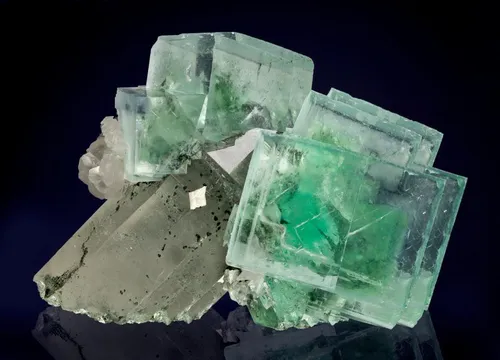
The Jingbian Cu-Au deposit, in the Lujiang–Zongyang/Luzong basin context, supplies the purple to red-purple fluorite seen in the modern specimen market. Geological work describes Jingbian as a medium- to low-temperature hydrothermal Cu-Au deposit in the central Luzong basin, with ore bodies commonly developed as steeply dipping veins controlled by faults and tectonic shatter zones. Specimen fluorite occurs as lustrous cubic crystals on drusy quartz, commonly with geometric purple zoning visible in backlight; calcite may sit on or among the fluorite cubes. Market pieces range from modest hand specimens to broad quartz plates with scattered cubes, and the most attractive examples combine strong saturation, clean translucency, crisp zoning, and minimal edge wear.
Collecting access today should be considered industrial, restricted, and permission-based. Anhui’s important specimen localities are operating or formerly operating mines, not public rockhounding sites. Underground workings, abandoned pits, vertical shafts, clay-rich stopes, and mine dumps all pose serious hazards, and collectors should not assume that older trip reports, dealer visits, or specimen-recovery stories imply present-day access. Most specimens available to collectors now come through Chinese dealers, established international mineral dealers, auction houses, and older collections.
Anhui azurite is best represented by Liufengshan material: lustrous, deep navy to electric-blue crystals lining vugs in limonitic and goethitic copper-iron matrix, commonly with malachite as rims, linings, sprays, or partial replacement. Most pieces are sparkling druses of small crystals rather than large isolated individuals; crystals over 1 cm are unusual, and a sharp, well-formed crystal approaching several centimeters is a serious locality piece. The classic specimens are cavity sections, nodules, and miniature to cabinet-size plates where the azurite forms continuous blue carpets over rounded vug walls, sometimes with gemmy edges in strong light. Ordinary examples are dark, massive, or visually flat; good examples have lively luster, distinct crystal texture, rich blue color that does not black out, and clean contrast against fresh green malachite.
Liufengshan malachite is the green counterpoint that makes Anhui azurite specimens immediately recognizable: velvety, fibrous, acicular, botryoidal, and banded malachite occurs with azurite in small vugs, as green linings beneath blue druse, as rims around blue pockets, and locally as pseudomorphic or partial replacement growth after azurite. The color ranges from minty green to saturated Kelly-green and darker forest tones, with the strongest pieces showing crisp green-blue separation rather than muddy, weathered alteration. Most collectible malachite from Anhui is valued as part of an azurite-malachite association, though sculptural nodules and sawn or naturally broken cavity pieces can be striking when the banding and internal contrast are strong. The best pieces have chatoyant fiber, fresh color, and undamaged edges; lesser pieces are dull, earthy, or dominated by iron-stained matrix.
Native silver from Anhui is most closely tied to the Lujiang area, especially the Yueshan Ag-Pb-Zn deposit at Huangtun township and Jingwa-related material known in the Chinese specimen trade. The attractive pieces are wire silvers: curled, branching, arborescent, or hook-like wires, commonly associated with acanthite and sometimes with calcite, quartz, or sulfide matrix. Documented specimens range from small wires around thumbnail size to miniatures and small cabinets; one recorded Yueshan example is a 5 cm wire about 3 mm thick, curling and branching toward the top, while larger trade specimens have reached cabinet scale. The best Anhui silvers are balanced, three-dimensional, and not overly cleaned; a soft old patina on lustrous wires is often more desirable than a harshly bright, stripped surface.
Anhui fluorite in the collector market is now strongly associated with the Jingbian Cu-Au deposit, where lustrous cubic crystals occur on drusy quartz and, in some specimens, with small calcite crystals. The characteristic look is violet to deep purple, wine-purple, raspberry-magenta, or red-purple fluorite with geometric zoning; backlighting can reveal sharp internal growth lines and color bands that are not apparent in ordinary room light. Crystals are commonly in the millimeter to low-centimeter range, with documented specimens showing cubes to about 1.4–2.8 cm on plates from small cabinet to cabinet size. The better pieces have clean, translucent cubes, distinct zoning, strong separation from the white quartz matrix, and little edge wear; ordinary pieces are darker, more crowded, chipped, or visually confused by too much matrix.
Beyond the four headline species, Anhui has a much deeper mineralogical record. Liufengshan records chalcocite, chalcopyrite, covellite, cuprite, delafossite, galena, goethite, hematite, magnetite, native copper, pyrite, quartz, tenorite, and clay minerals. The Lujiang–Luzong area adds acanthite, stromeyerite, galena, sphalerite, barite, bornite, chalcocite, cobaltite, glaucodot, and rare silver-copper-mercury sulfides such as danielsite from Huangzhuyuan. Southern Anhui’s Huangshan pluton has recently become important for rare-metal mineralogy, with work documenting Nb-Ta-W-Sn oxide minerals such as columbite-(Fe), ferberite, cassiterite, rossovskyite, and qitianlingite, and the newly approved Fe-Ta oxide huangshanite from the Huangshan pluton. Anhui is also the type-region of zhanghengite, CuZn, described from the Boxian meteorite that fell in northern Anhui in 1977.
The first collecting issue with Anhui is locality precision. “Anhui, China” is common on older and dealer labels, but it can hide very different sources: Liufengshan azurite-malachite, Lujiang/Yueshan wire silver, Jingbian fluorite, Tongling-region skarn material, or even imprecisely labeled specimens from elsewhere in China. For important purchases, ask whether the locality is known to mine or deposit level and keep every old label, invoice, auction record, and dealer note with the specimen.
Liufengshan azurite-malachite is widely available, but quality varies enormously. Fine drusy pieces can look superb in photographs because the azurite sparkles under strong light; in hand, the differences are luster, depth of blue, crystal definition, and composition. Watch for broken cavity edges, rubbed high points, clay-filled vugs, and dull surfaces where azurite has begun to alter or has been abraded during cleaning. Larger isolated azurite crystals from Liufengshan are genuinely uncommon relative to the druse material, so unusually large, sharp crystals deserve closer examination and comparison with known examples.
Malachite from Liufengshan should be handled as a delicate fibrous copper carbonate, not as lapidary rough. Acicular and velvety surfaces can mat down, collect dust, or bruise. Avoid ultrasonic cleaning, acids, aggressive soaking, and abrasive brushing. A gentle air bulb or very soft brush is usually safer than water, especially where clay, limonite, or friable goethite supports the crystals. Sawn nodules and “geode” halves are part of the Anhui market; the cutting itself is not automatically a problem, but the collector should distinguish a natural crystal specimen from a decorative cut-and-polished object.
Native silver from Anhui presents different concerns. Wires bend easily, and small branches can snap from vibration or careless packing. Acanthite-rich matrix can be dark and visually subtle, and some silver has been cleaned or brightened; overly shiny, raw-looking wires may lack the soft patina many silver collectors prefer. Store silver away from sulfurous materials, rubber, and fresh cardboard that can accelerate tarnish. Tarnish is normal, but repeated chemical dipping destroys surface character and can reduce collector value.
Jingbian fluorite is tougher than azurite-malachite but still prone to bruised cube edges and cleaves. The strongest specimens depend on transparency and zoning, so inspect them in both reflected light and backlight. Purple Anhui fluorites are also easily confused in the general market with fluorites from Zhejiang, Jiangxi, Hunan, and other Chinese localities; matrix, habit, zoning style, and a credible label matter. Some Jingbian fluorite has been reported as fluorescent under long-wave ultraviolet light, but fluorescence should be treated as a specimen-by-specimen bonus rather than an identifying guarantee.
There is no single notorious fake category unique to Anhui comparable to dyed quartz or assembled “cactus” specimens, but the usual Chinese-market risks apply: vague locality labels, overcleaned copper carbonates, repaired fluorite plates, glued matrix fragments, and decorative sawn nodules marketed as if they were untouched natural pockets. A good Anhui specimen should make mineralogical sense: Liufengshan azurite and malachite in iron-rich vuggy matrix; Lujiang silver with acanthite or silver-bearing sulfide associations; Jingbian fluorite as zoned cubes on quartz, often with calcite.
The Liufengshan story is a lesson in how a specimen classic can come from an ugly place. Underground accounts describe the productive zones not as clean alpine pockets but as a miserable mixture of thick breccia, damp red-brown fault gouge, sticky clay, limonite, and goethite. In that mess, the good pockets were small islands of firmness. A miner breaking into one could open a cavity only the size of a golf ball and find it lined with blue sparkle; a larger vug, the size of a basketball, might produce a cabinet specimen that looked as if it had been painted from within—green malachite around the rim, deep blue azurite druse across the center, and iron oxide matrix holding the whole thing together.
The most memorable Anhui specimen story in the public collecting world is the “feet” nodule. From the outside it was simply a blue azurite nodule from Liufengshan, the sort of rounded piece that might be cut to reveal its internal structure. By luck, the saw passed through exactly the right plane and exposed a malachite core shaped like tiny green feet set in blue azurite. The image circulated widely among collectors under names such as “Baby Feet” and “Happy Feet,” and the piece later appeared in public-facing mineral-show material as a Liufengshan malachite-and-azurite curiosity. It is not a story about size or rarity in the usual sense; it is a story about chance geometry, the hidden architecture of a copper-carbonate nodule, and the strange moment when a serious mineral specimen becomes unforgettable for almost everyone who sees it.