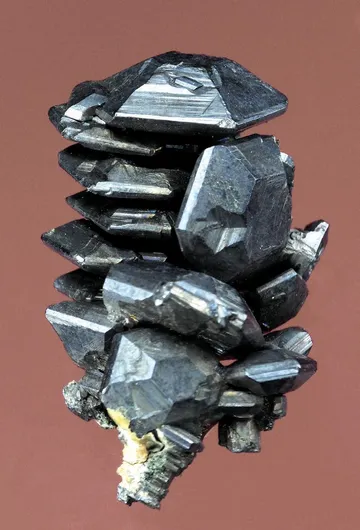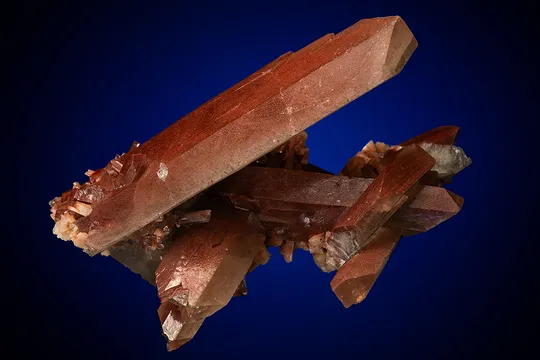
A collector's guide to Frizington Mine, UK: its geology, mining history and notable minerals, illustrated with the 267 specimens documented from this locality on EarthWonders.
Key facts
Frizington belongs to the compact but extraordinarily productive West Cumberland Iron Field of west Cumbria, an orefield whose great hematite bodies lie in and around the Lower Carboniferous limestones between the Cleator Moor–Frizington ground and the Egremont–Beckermet ground farther south. For ore geologists, the district is a classic British example of hematite formed largely by metasomatic replacement of limestone, guided by faults and permeable horizons rather than by simple open fissure veins. For collectors, however, Frizington is famous for something quite different: the cavities in and around those red iron ores yielded some of the most recognizable English baryte specimens ever recovered.
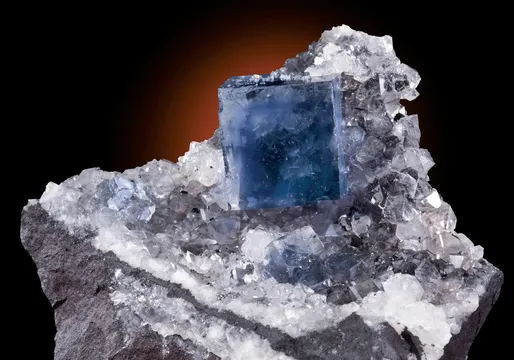
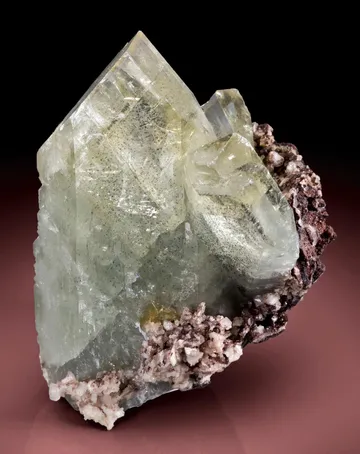
The best Frizington pieces have a visual signature that is difficult to confuse with ordinary baryte. Thick, lustrous, tabular to prismatic crystals—commonly doubly terminated or chisel-ended—rise from pale dolomite, black to reddish hematite, or sparkling calcite. Colours range from water-clear and pale straw to honey, greenish blue, sky blue, grey-blue, and rich reddish or brownish tones produced by hematite and iron-hydroxide inclusions. Fine examples are not just “barite from an iron mine”; they are old British classics in the strict collecting sense, with many labels simply reading “Frizington” because the precise pit—Mowbray, Parkside, Dalmellington, Goose Green, High House, Lonsdale, or another shaft in the cluster—was not always preserved.
Regional View
Country View
The label “Frizington Mine” needs to be handled with collectorly caution. The village and its surrounding mines formed a tight iron-mining district, and older specimen labels often used “Frizington” as a district name rather than a precise shaft name. Modern databases distinguish a Frizington Mine entry, the village-level Frizington locality, and individual mines such as Mowbray and Parkside. The safest reading of many old specimens is therefore “Frizington district, West Cumberland Iron Field” unless an old label, museum number, or documented collection history identifies the exact mine.
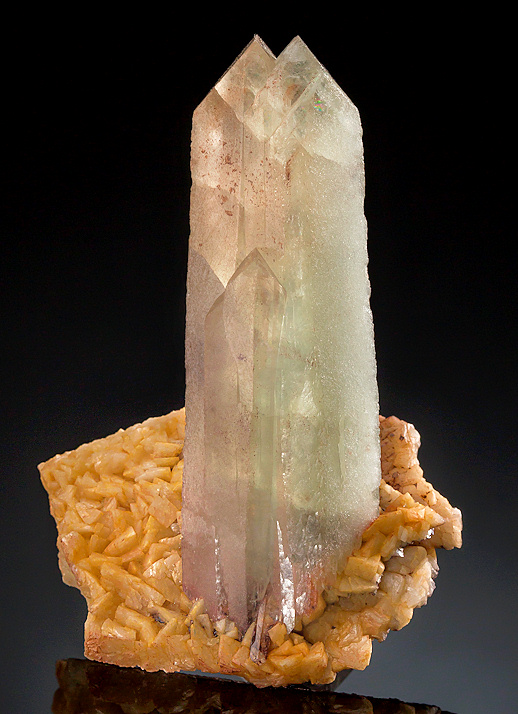
Photo: Exceptional Minerals
Search for specimens: View all specimens from Frizington Mine, UK
Frizington is in the old county of Cumberland, now Cumbria, on the western side of the Lake District. The collecting locality is best understood as part of the Frizington sector of the West Cumberland Iron Field, rather than as a single simple vein mine. This was a district of iron-ore pits and flats developed around Frizington, Cleator Moor, Moor Row, and Egremont, where large hematite ore bodies replaced Carboniferous limestone along favourable structural and stratigraphic positions.
The ore bodies were chiefly high-grade hematite, commonly massive, compact, purplish grey to red-brown, and locally developed as the famous mammillated “kidney ore” and fibrous “pencil ore.” Well-crystallized specular hematite also occurs in small amounts. Gangue minerals were subordinate in the ore field overall, but they are precisely what made the Frizington district so important to collectors: baryte, dolomite, calcite, quartz, aragonite, fluorite, pyrite, chalcopyrite, and minor sulphides occur in cavities, crusts, and matrix associations around the iron ore.
The geology is structurally complex. In the old iron mines near Frizington, two fault sets are especially important: older northeast–southwest “Coal Faults” with northwest downthrow, and later northwest–southeast faults with large throws and hematized downthrow sides. In the Parkside–Frizington ground, some horizontal ore bodies were so large that they were mined through several named properties and many shafts. Parkside, Crossgill, Frizington Parks, Goose Green, and High House all worked the same broad body of ore over a lateral area reported as more than 16 hectares. That shared ore body is one reason old specimen labels can be imprecise: a baryte or hematite specimen may have come from the same mineralized system even when the exact shaft name was lost.
Parkside is one of the key named mines for collectors. It lay about 1 km south of Frizington and about 6 km east-southeast of Whitehaven. The Parkside Mining Company began work there in 1855, and the mine soon became highly successful; in 1873 more than 100,000 tons of ore were raised from a huge flat deposit in the First Limestone. By the mid-1870s output declined, and when the royalty was renewed in 1875 the eastern part of the property was split between the Goose Green Company and the New Parkside Company. In 1877 Parkside opened ore in the Fourth Limestone by sinking No. 19 shaft, and in 1894 it took over Crossgill Mine and the Dalmellington No. 7 pit. By 1913, Crossgill was the only Parkside part still working, and the whole Parkside concern was closed by 1925.
Goose Green, on the east side of the main road through Frizington, was part of the Frizington Parks group. Mining began there in 1855 under the Parkside Mining Company, passed in 1875 to the Goose Green Iron Ore Company, and continued under that company until 1892. The mine was abandoned in 1897, but the Frizington Mining Company later extracted some upper-level ore between 1910 and 1913. Goose Green is documented for baryte and hematite, including kidney ore, and it sits directly within the same specimen-producing Frizington group.
Mowbray is the most important Frizington name attached to fine baryte. Mineralogical literature and old museum material distinguish Mowbray crystals by their wide colour range—colourless, pale yellow, yellow-brown, greenish blue, greenish yellow, and sky blue—and by a usually tabular habit. Mowbray specimens are commonly associated with dolomite, calcite, and hematite, and many of the most desirable “Frizington” barytes in older collections are either from Mowbray or suspected to be from Mowbray when their original mine attribution has been lost.
Dalmellington and Parkside are also important baryte names. Early mineralogical work noted that crystals from Dalmellington and Parkside varied from clear pale yellow to rich chocolate-brown, with tabular or prismatic habits and colour controlled by hematite and iron-hydroxide inclusions. Dalmellington-attributed specimens are especially prized when well documented, because far fewer top-quality examples in private collections carry that precise mine name.
High House and Lonsdale are more important in the collector record for aragonite and calcite associations. High House is the Frizington district locality attached to aragonite in the standard mineral records, and old accounts of Frizington-area dumps mention aragonite and calcite needles alongside hematite, quartz, dolomite, and blue baryte. Lonsdale is documented for calcite, dolomite, quartz, pyrite, chalcopyrite, baryte, and hematite, including kidney ore, and collectors have recorded calcite crystals with hematite inclusions from there.
The historical setting is inseparable from the specimens. Iron ore was worked in the wider West Cumberland area from early times, but systematic exploitation accelerated in the 18th century and expanded dramatically after the development of the Bessemer steel process in 1856. The West Cumberland ores were valued because they were high in iron and very low in phosphorus, making them suitable for steelmaking. By the later 19th century, companies, railways, blast furnaces, leases, royalty boundaries, and mining townships had transformed what had once been scattered farms and houses into the industrial Frizington district.
Collecting today is essentially a matter of old collections, estate material, and the mineral trade. The mines are long closed, many shafts and dumps have been disturbed, landscaped, built over, or are on private land, and underground access is not a collecting option. Any field collecting around old dumps would require explicit landowner and mineral-rights permission, and the remaining hazards of iron-ore workings—shafts, unstable ground, old tips, flooded workings, and concealed voids—make casual searching inappropriate. For serious collectors, the more meaningful hunt is in labels: old British dealer stock, ex-Barstow, ex-Sutcliffe, ex-Greenbank, ex-Alderson, ex-Bosch, ex-Vaux, museum duplicates, and 19th- or early-20th-century cabinet pieces.
Barite from Frizington is the locality’s defining collectible, especially as thick tabular, chisel-ended, prismatic, and doubly terminated crystals from the Frizington iron-mining district, with Mowbray, Parkside, Dalmellington, Goose Green, and unnamed Frizington pits all appearing on old labels. Fine crystals commonly fall in the 4–10 cm range, with outstanding cabinet examples reaching larger display sizes; documented pieces include sharp crystals around 5.5 cm on dolomite and hematite, 7–9 cm doubly terminated crystals, and exceptional show specimens with a main crystal around 13.8 cm. The colour range is central to the appeal: pale straw, honey, amber, chocolate, grey-blue, greenish blue, and sky blue, often modified by red hematite inclusions or surface staining. The best pieces are transparent to translucent at the terminations, highly lustrous, well terminated on both ends, and set cleanly on pale dolomite, dark hematite, or calcite; ordinary pieces tend to be duller, more opaque, broken along edges, or too iron-stained to show the crystal’s internal zoning.
Baryte is the British spelling of the same species, BaSO4, and Frizington baryte is one of the named English classics because it combines size, architecture, colour, and historical age in a way few British localities do. Mowbray material is especially noted for varied colour—from colourless and yellow-brown through greenish-yellow and greenish-blue to sky blue—and for tabular crystals, while Dalmellington and Parkside material includes clear pale-yellow to chocolate-brown crystals with tabular or prismatic habits caused in part by hematite and iron-hydroxide inclusions. Good Frizington baryte often has strong growth zoning, glassy luster, sharp chisel faces, and a sculptural position on tan dolomite or iron ore; the elite pieces show fine transparency, clean edges, old labels, and exact mine names, particularly Mowbray, Parkside, or Dalmellington.
Dolomite from Frizington is most important as the pale carbonate stage that makes the baryte specimens so displayable: biscuit-tan, creamy, pink-tan, pearly white, and saddle-shaped rhombs commonly carpet hematite or massive carbonate matrix and provide the visual base for blue, greenish, honey, or hematite-included baryte. It is recorded from Mowbray, Parkside, Lonsdale, and the broader Frizington district, and fine pieces show sharp, sparkling rhombs or curved rhombic crystals rather than mere massive carbonate. On top-level specimens the dolomite is not just matrix; it frames the baryte, contrasts with dark hematite, and helps prove the West Cumberland iron-field association. Ordinary examples are massive, stained, or visually subordinate, while better ones have clean, pearly crystal coverage, minimal bruising, and a balanced baryte–dolomite composition.
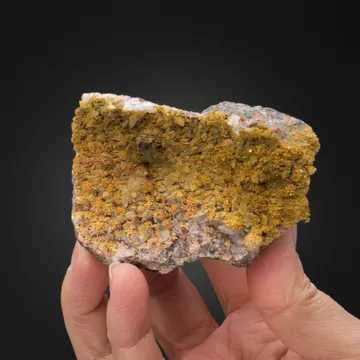
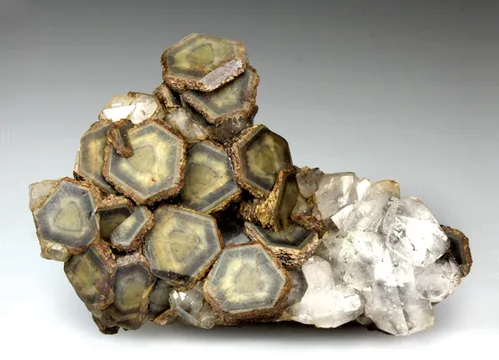
Hematite is the ore mineral of Frizington and the reason the district existed industrially, occurring as massive high-grade ore, lustrous botryoidal kidney ore, fibrous pencil ore, and specularite in cavities and on matrix. Parkside and Goose Green are especially important names for kidney ore, while Parkside is also documented for specularite and quartz-lined vugs in hematite. Good collector hematite from the Frizington ground shows rounded, glossy, rust-brown to black botryoidal surfaces, fibrous texture, or bright specular plates, ideally with small quartz, dolomite, calcite, or baryte accents; common ore lumps are historically interesting but lack the lustre, form, and cavity association that elevate a specimen.
Calcite from Frizington is a secondary classic rather than the headline species, but it is important in the baryte assemblage and in its own right from Parkside, Mowbray, Lonsdale, and the district-level Frizington locality. Documented habits include water-clear prismatic crystals with scalenohedral terminations from Parkside, prismatic trigonal calcites associated with Dalmellington baryte and dolomite, small sparkling colourless calcite covering matrix beneath pale blue-green baryte, and iron-stained or hematite-included calcite from Lonsdale and other Frizington workings. The best calcites have clean crystal form, clarity, and red hematite contrast without being merely stained masses; small, sharp crystals on baryte matrix can be just as desirable as larger isolated calcites when the association and old label are strong.
Quartz from the Frizington district is closely tied to the iron ore, especially at Parkside and Lonsdale, where it occurs as clear to slightly smoky or hematite-reddened crystals on hematite. Old dealer descriptions and modern locality records document doubly terminated, mostly transparent quartz crystals, bipyramidal beds on hematite ore, and bright crystals encrusting botryoidal fibrous hematite with small specularite plates. Fine Frizington quartz is not judged by giant size but by contrast: clear or iron-red points against dark kidney ore or sparkling specular hematite, preferably with exact Parkside or Lonsdale attribution. Ordinary quartz from the district is small and indistinct; better pieces carry the unmistakable West Cumberland red-iron association.
Aragonite is a scarce but documented Frizington species, particularly tied in records to High House Mine and to old Frizington-area material showing needle-like crystals. It occurs as delicate acicular sprays, white to colourless needles, and three-dimensional clusters; recorded examples include small aragonite needles found with calcite, hematite, quartz, dolomite, and blue baryte on old Frizington-area dumps, and older cabinet material with sharp, glassy spikes. The best Frizington aragonite specimens are airy, undamaged, and attributable to High House or a credible old Frizington label; because the crystals are slender and brittle, incomplete sprays, bruised tips, and vague “Cumbria” labels are common limitations.
Other documented minerals from the Frizington district include fluorite from Mowbray, pyrite and chalcopyrite from Lonsdale, and the hematite varieties kidney ore and specularite from several of the iron mines. The broader West Cumberland hematite assemblage also includes subordinate manganese oxides, rare siderite, marcasite, chalcopyrite, galena, and fluorite in some deposits, though not every species can be assigned with confidence to the specimen locality called “Frizington Mine.” No type-locality mineral is central to Frizington collecting; its rank rests instead on world-class baryte and classic British hematite associations.
The main authenticity problem with Frizington specimens is locality precision, not widespread fakery. Many 19th- and early-20th-century labels say only “Frizington,” “Cumberland,” or “West Cumberland,” and some modern marketplace entries reasonably assign such pieces to the Frizington mining district rather than a named shaft. Exact-mine labels—Mowbray, Parkside, Dalmellington, Goose Green, Lonsdale, High House—should be valued, but also scrutinized. A label that names Dalmellington or Mowbray and is supported by older provenance can materially affect desirability.
Repairs are not unusual on large Frizington barytes. Thick crystals can look robust, but their edges, chisel terminations, and contact points are vulnerable, especially after more than a century of handling. Reattached major crystals, repaired terminations, and small edge chips should be expected possibilities and should be disclosed. “Old-time” condition is a sliding scale: a small chip on an 1880s baryte with superb colour, transparency, and pedigree may be acceptable, while a dull, battered, matrixless blade with only a vague label is far less compelling.
Colour deserves special attention. Classic literature records a remarkable colour change in some Mowbray barytes: pale-yellow crystals collected in 1909 and kept in the dark were exposed to bright sunlight in 1928, turning pale greenish within hours, distinctly blue-green the same day, and completely blue within about a week. This does not mean every blue Frizington baryte is artificially treated, but it does mean that Frizington colour can be light-sensitive and historically complex. Store important yellow, greenish, or blue barytes away from prolonged direct sunlight if preserving their documented appearance matters.
Hematite inclusions and iron staining are normal for the locality and often desirable when they create red phantoms, red terminations, or a strong contrast with blue or golden baryte. Heavy staining, however, can obscure luster and transparency. Cleaning should be conservative: Frizington baryte is relatively soft, dolomite and calcite associations are acid-sensitive, and iron oxides can be integral to the specimen’s identity. Avoid aggressive acid treatments unless the mineralogy and desired outcome are fully understood.
Market availability is uneven. Small and moderate Frizington barytes appear regularly from old British and European collections, but truly fine pieces—sharp, lustrous, transparent, undamaged, well balanced, and with exact mine attribution—are scarce and expensive. Baryte on dolomite or hematite is the most liquid category. Parkside kidney ore and quartz-on-hematite specimens are less costly but much less common in top aesthetic condition. Aragonite from the Frizington district is genuinely uncommon, and good attributed examples should not be treated as interchangeable with more available Cumbrian aragonite from other localities.
One of the most memorable Frizington stories belongs not to a miner underground but to a mineralogist watching a crystal change colour in daylight. Jessie M. Sweet, writing on British barytes, noted that Mowbray Mine crystals in the British Museum had been bought from J. Graves of Frizington in 1909 and 1913 as pale-yellow or amber-yellow specimens. By 1928, catalogue work showed that some had become pale green to sky blue. L. J. Spencer supplied comparison crystals that he had collected in 1909 and kept in the dark. At 10:30 a.m. on June 25, 1928, one pale-yellow crystal was put in bright sunlight. At noon there was no appreciable change. By 2:15 p.m. the entire crystal had become pale greenish; by 4:20 p.m. it was distinctly blue-green. Left in the window, it was completely blue by July 2. For collectors, that little experiment is one of the great footnotes in British mineralogy: a classic locality whose most admired colour may, in some specimens, be a history written by light.
The old Frizington mines also had a harder story, told in the language of coroner’s reports and local newspapers. In May 1895, Robert Howell, a 26-year-old married miner living at No. 1, Moor Street, Frizington, was drilling in the forebreast at High House Mines when the ground rushed in without warning. A nearby worker named Hayton was injured but taken home. Twenty men worked to timber the forebreast and clear the debris, and it took six and a half hours before Howell’s body was recovered. The inquest was held at the Yeathouse Hotel, Frizington, with mine plans and sections produced to explain the working where part of an ore pillar was being removed. Specimens from this district sit in cabinets as bright blue baryte and glossy kidney ore, but their setting was an active iron field where beautiful cavities were encountered in the course of dangerous industrial work.
There is also a quieter field-collector story from the late 20th century. On a 1982 evening excursion to the old iron ore mines around Frizington, the Eskett and Eskett Park tips looked unrewarding at first glance, yet the party still found “blue” barytes, aragonite and calcite needles, hematite, quartz, and dolomite. The note is modest, but it captures the appeal of the West Cumberland iron dumps before many were exhausted, landscaped, or made inaccessible: a poor-looking red tip could still yield a small suite of classic minerals, if one knew what to look for.
Jessie M. Sweet, “Notes on British barytes,” Mineralogical Magazine, vol. 22, no. 129, 1930, pp. 257–270. A key paper for Frizington baryte colour, habit, zoning, Mowbray colour change, and Parkside/Dalmellington crystal forms. Read the paper
L. J. Spencer, “A monograph on the mineral barytes,” Mineralogical Magazine, vol. 19, 1921, cited by Sweet for a curved yellowish-green Mowbray baryte crystal in the British Museum collection. Mineralogical Magazine archive context
Bernard Smith, Special Reports on the Mineral Resources of Great Britain, Vol. VIII: The Haematites of West Cumberland, Lancashire and the Lake District, Geological Survey of Great Britain, 1924. A foundational source for the West Cumberland hematite field and cited in modern locality records for Frizington-area mines and minerals. BGS/NORA related geology report citing Smith
British Geological Survey, Geology and land-use planning: Great Broughton–Lamplugh area, Cumbria. Part 1. Geology, WA/92/54. Summarizes the West Cumbrian hematite field, replacement-style mineralization, gangue suite, production scale, and origin models for the ore bodies. Read the report
J. J. Martin, “The Economic Development of the West Cumbrian Iron Ore Fields,” in Proceedings of the Cumberland Geological Society, 1982–83, Part 3. Gives historical context for early iron working, the 19th-century boom, production figures, companies, labour, and decline. Read the proceedings
Cumberland Geological Society excursion notes, “The old iron ore mines near Frizington,” in Proceedings of the Cumberland Geological Society, 1982–83, Part 3. Useful for fault structure, named mines around Frizington, Eskett and Margaret Mine notes, and minerals found on old tips. Read the proceedings
Mindat locality record for Frizington, Arlecdon & Frizington, Cumbria. Useful for the district-level mineral list and sublocality structure, including aragonite, baryte, calcite, dolomite, fluorite, hematite, pyrite, and quartz. View the record
Mindat: Frizington Mine, Cumbria — The specific Frizington Mine entry, including the caution that the exact historical use of the name is disputed.
Mindat: Frizington, Arlecdon & Frizington, Cumbria — Best district-level mineral list and gateway to the named Frizington sublocalities.
Mindat: Parkside Mine, Frizington — Essential for Parkside mining history, ore-body context, and hematite–baryte–quartz–dolomite associations.
Mindat: Goose Green Mine, Frizington — Useful for Goose Green ownership history and documented baryte and hematite.
Mindat: Baryte from Mowbray Mine — Important occurrence record for one of the finest Frizington baryte sources.
Mindat: Baryte from Frizington district — Broad occurrence record showing the scale and association data for Frizington baryte.
British Geological Survey: Great Broughton–Lamplugh geology report — Regional geological context for the West Cumbrian hematite field and its gangue minerals.
Cumberland Geological Society Proceedings 1982–83, Part 3 — Valuable for the old iron ore mines around Frizington and the economic history of the West Cumbrian iron field.
Jessie M. Sweet, “Notes on British barytes” — Classic mineralogical paper documenting Frizington baryte colours, zoning, forms, and Mowbray colour change.
Steetley Minerals: West Cumbria — Collector-oriented overview of West Cumbrian hematite mines and associated specimen minerals.
Albion Fire and Ice: Mowbray Mine — Brief modern locality note for Mowbray and its specimen minerals.
Mindat locality record for Parkside Mine, Frizington. Useful for Parkside coordinates, mining dates, operators, ore-body extent, and the documented mineral list including baryte, calcite, dolomite, hematite, kidney ore, specularite, and quartz. View the record
Mindat occurrence record for baryte from Mowbray Mine. Records Mowbray baryte as an excellent, world-class occurrence with associated calcite, dolomite, and hematite. View the occurrence
Journal of the Russell Society, vol. 23, 2020. Includes a photograph and collecting-history note for an old-time Frizington baryte purchased in the mid-1990s from Don Edwards at Tideswell Dale Rockshop for £79. Read the issue
Mineral Auctions: Dalmellington Mine baryte with calcite and dolomite — Well-documented market example showing the premium for precise Dalmellington attribution and strong provenance.
Mineral Auctions: Parkside kidney ore hematite — Useful market example for Parkside kidney ore condition, size, and provenance.
Exceptional Minerals: Frizington baryte on dolomite — Photographed example of greenish-blue baryte with hematite inclusions on dolomite matrix.
Crystal Classics: Frizington baryte — Dealer description of sky-blue chisel-habit baryte on dolomite and hematite from the Frizington iron-mining district.