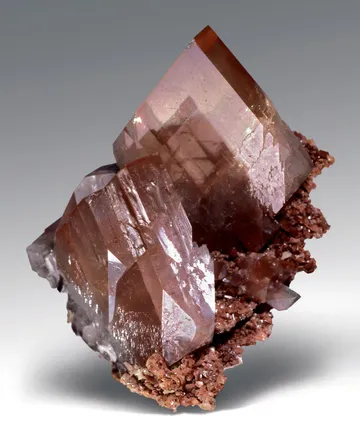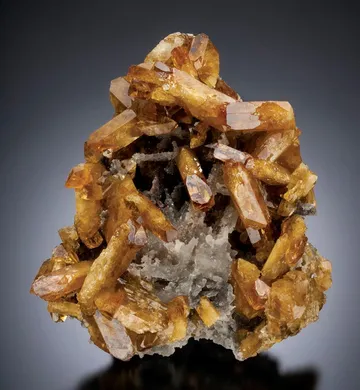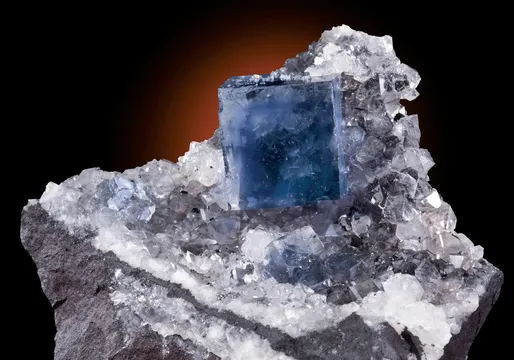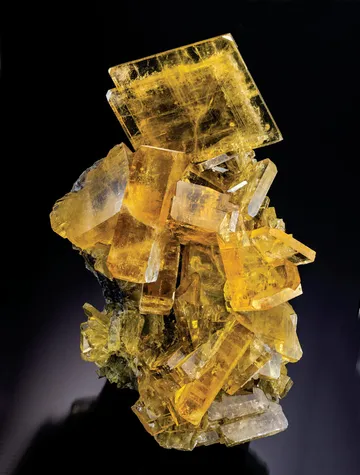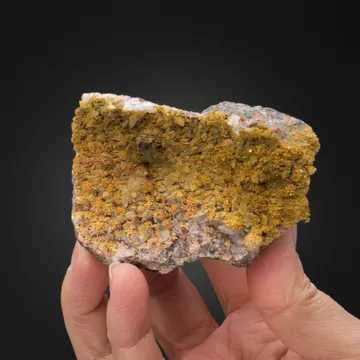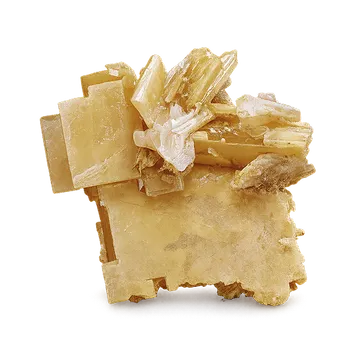
Frizington Barite, Cumbria: pale blue to blue-green tabular crystals, often doubly terminated with hematite; prized for color, form, and historic locality.
Key facts
Frizington barite is one of the classic faces of the West Cumberland Iron Field: glassy, pale blue to blue-green tabular crystals, often sharpened into chisel-like or spear-point forms and set dramatically against red-brown hematite or pale, sparkling dolomite. The best examples have a distinctly “old English” elegance — not huge by modern pocket-mining standards, but superbly proportioned, lustrous, and often doubly terminated, with the red of hematite inclusions or coatings giving the crystals a warm internal blush.

Photo: Wikimedia Commons
The locality name needs a collector’s footnote. “Frizington Mine” appears on modern specimen labels, but Frizington was also a village at the center of a tightly packed iron-mining district. Historic and specimen-producing mines around the village included Mowbray, Parkside, Dalmellington or Holbeck, Frizington Parks, Goose Green, Crossgill, and High House. Many old labels give only “Frizington” or “Cumberland,” and some pieces now sold as “Frizington Mine” are best understood as Frizington-district material unless a specific old label or provenance ties them to Mowbray, Parkside, Dalmellington, or another named working.
Mineralogically, the barite belongs to the same ore-field story as the famous Cumbrian hematites. The orebodies were high-grade red hematite replacements and cavity fills in Carboniferous limestone, with baryte only a minor gangue mineral in the ore but a major prize for collectors. The attractive specimens came from cavities in the iron ore, where barite grew with dolomite, calcite, quartz, fluorite, and hematite in its kidney-ore and specular forms. The best Frizington pieces are not merely “barite from an iron mine”; they are barite crystals visibly shaped by the iron-ore environment — included, dusted, backed, or zoned by hematite.

Photo: Wikimedia Commons
Collectors prize Frizington barite for color and architecture. A fine example may be pale blue-gray, greenish blue, pale yellow, amber, chocolate-brown, or red-tinged by hematite; it may sit on a pearly dolomite matrix or stand almost free as a floater with only a tiny attachment scar. The most desirable specimens combine sharp terminations, high luster, translucency to gemminess, attractive hematite zoning, and a credible old provenance. Because many were mined in the nineteenth and early twentieth centuries, labels from old British, European, or American collections can be as important as the crystal itself.
Search for specimens: View all barite specimens from Frizington Mine, Cumbria, England
Frizington lies in the old West Cumberland iron-mining district, north-west England, among the historic iron-ore centers of Frizington, Cleator Moor, and Egremont. The district’s principal mineral wealth was hematite rather than barite: large, high-grade red hematite orebodies in limestone fed an iron and steel industry of national importance. Barite, by contrast, occurred as a gangue and cavity mineral, but in the Frizington area it reached exceptional specimen quality.
The geological setting is a replacement-style hematite field in Carboniferous limestone. Ore fluids moved along faults and permeable pathways, replacing limestone and filling cavities; where open spaces remained, they allowed late minerals to crystallize freely. In the Frizington-area mines, those cavities produced barite with dolomite, calcite, quartz, hematite, and locally fluorite. The resulting specimens are visually different from the lead-zinc-baryte veins of the North Pennines: they are iron-field barites, often stained, included, or perched on hematite-rich matrix.
The historical mine names matter. Mowbray began in 1864, ultimately involved four pits, absorbed the older Dyke Nook workings, and after 1903 was owned by Cammell Laird & Co., who also worked nearby Frizington Park. Mowbray was finally abandoned in 1921 and is particularly associated with multicolored barites, including colorless, pale yellow, yellow-green, brown, greenish blue, and sky-blue examples. Parkside began in 1855 under the Parkside Mining Company and quickly became a major producer; in 1873 it raised more than 100,000 tons of ore from a huge flat deposit in the First Limestone. Parkside later worked ore in the Fourth Limestone, took in related workings, and closed by 1925. Dalmellington or Holbeck is another old label name strongly associated with flat-topped and spear-shaped barite; the Dalmellington Iron Company opened Holbeck in 1869 and worked it until 1900.
“Frizington Mine” itself is a problematic collector locality. Modern databases list it, and the name appears on specimen labels, but the existence of a single, historically discrete mine of that exact name is disputed. The name may reflect mining-company usage, dealer shorthand, or a district attribution rather than a precise shaft. For serious cataloguing, a label reading “Frizington Mine” should be retained exactly, but it is worth noting “Frizington district, West Cumberland Iron Field” unless the specimen has additional evidence tying it to Mowbray, Parkside, Dalmellington, or another named mine.
Collecting access should be treated as closed and historical unless current permission is explicitly obtained. The old workings are abandoned industrial mine sites, many with unstable ground, flooded levels, hidden shafts, and possible gases. Specimens now on the market overwhelmingly come from old collections, past mine production, and historically collected dump material rather than modern underground collecting.
The classic Frizington habit is tabular to prismatic orthorhombic barite, commonly with chisel or spear-like terminations. Crystals may occur as single dominant blades, stacked or en echelon groups, parallel-growth clusters, cockscomb-like aggregates, and near-floater crystals with minimal matrix attachment. Some specimens show the “open” look prized in old English barite: a transparent or translucent blade poised on a small island of dolomite or hematite rather than buried in massive matrix.
Color is one of the locality’s defining pleasures. Dalmellington and Parkside material was described in the classic literature as ranging from clear pale yellow to rich chocolate-brown, with tabular or prismatic habits. Mowbray material is even more varied: colorless, pale yellow, yellow-brown, greenish blue, greenish yellow, and sky blue all occur in documented specimens. Many crystals carry hematite or iron-oxide inclusions, sometimes distributed through the whole crystal, sometimes concentrated just below the surface, and sometimes localized on particular faces. That selective coloring gives Frizington barite its familiar red-backed, blue-fronted, or zoned appearance.
The blue color deserves special attention. Some yellow Mowbray crystals are documented to change color on exposure to daylight, passing through greenish shades and becoming blue. That means a blue Frizington barite is not automatically suspect; in fact, blue and blue-green tones are part of the locality’s historic character. At the same time, color should be judged together with transparency, zoning, surface quality, and provenance, because the most convincing pieces show the complex color behavior typical of iron-included barite rather than a flat, artificial-looking wash.
Typical individual crystal sizes range from small thumbnails of a few centimeters to miniatures and small-cabinet crystals of 4–9 cm. Larger groups around 10–12 cm across are well documented, and exceptional old specimens can carry crystals approaching or exceeding 10 cm in length. The finest crystals are glassy, translucent to gemmy, sharply terminated, and either undamaged or only lightly worn at exposed edges.
Associated minerals are central to identification and desirability. Pale tan to pearly dolomite is the most attractive matrix association, especially when it forms a sparkling saddle-shaped or drusy carpet beneath a blue or yellow barite crystal. Hematite may appear as red-brown inclusions, coatings, gossan-like matrix, botryoidal or kidney-ore surfaces, or dark lustrous masses. Calcite is a recurring companion, sometimes hematite included; quartz, fluorite, aragonite, and specular hematite are also recorded from the Frizington-area iron mines.
Quality factors are highly locality-specific. A top Frizington specimen should have: a credible old or district-appropriate label; a pale blue, blue-green, yellow, amber, or hematite-zoned color; strong glassy luster; clean chisel or spear terminations; minimal cleaving or edge wear; and ideally a dolomite or hematite matrix that announces the West Cumberland iron-field setting. The best pieces have color contrast — blue or pale yellow barite against red hematite or tan dolomite — and a three-dimensional display angle rather than a flat plate of crystals.
The first authenticity issue is locality precision, not species identity. Barite is straightforward to recognize by habit, density, cleavage, and association, but “Frizington Mine” is often less precise than it sounds. Many old labels used “Frizington,” “Cumberland,” or “West Cumberland” for specimens from several neighboring iron mines. A specimen with no historic label but a Frizington-style appearance should be catalogued cautiously; Mowbray, Parkside, Dalmellington, Goose Green, and other nearby workings produced related but not identical material.
The second issue is color history. Mowbray barite is famous for documented light-related color change from yellow or amber tones toward green and blue. A blue Frizington specimen may therefore be entirely natural in the collector sense, even if its present color developed after mining. Conversely, a yellow old-time specimen kept in the dark may be unusually instructive. Collectors should avoid assuming that blue equals dyed or enhanced, but should still inspect for unnatural surface-only color, color pooled in cracks, or staining inconsistent with hematite zoning.
Condition matters enormously. Barite has perfect cleavage and modest hardness, and the long Frizington blades are easily bruised at tips, edges, and corners. Many otherwise fine pieces show small chips, repaired breaks, or peripheral wear. Repairs are not surprising on old, thin, doubly terminated crystals, but they should be disclosed and priced accordingly. A clean, unrepaired blue Frizington floater or dolomite-mounted crystal is far scarcer than a rubbed cluster.
Documented specimen descriptions frequently mention minor chipping, repaired old pieces, or edge wear; this is normal for the locality and not automatically disqualifying. The important distinction is whether the damage interrupts the main termination, dulls the display face, or compromises an otherwise rare provenance. A small repaired edge on a nineteenth-century blue crystal with old labels may be acceptable; a reglued main crystal without disclosure should be valued much more cautiously.
Market availability is intermittent but real. Small hematite-stained or matrix pieces appear from UK dealers at accessible prices, while well-colored, gemmy, old-time Frizington barites — especially blue crystals on dolomite or hematite with pedigree labels — move into the high hundreds or low thousands of dollars. The best examples are usually recycled from old collections rather than newly found, and competition is strongest for pieces that can be confidently tied to Mowbray, Parkside, Dalmellington, or a respected historic collection.
The most memorable Frizington barite story is not a mine accident or a spectacular pocket, but a crystal changing color in the hands of science. In the British Museum collection, several Mowbray specimens bought from Mr. J. Graves of Frizington in 1909 and 1913 had entered the records as pale yellow or amber-yellow. By the time Jessie M. Sweet was studying the barytes collection for the Museum’s slip catalogue in 1928, those same specimens were no longer yellow: they had shifted to pale green and sky blue.
Sweet and L. J. Spencer then had the ideal comparison material. Spencer had collected pale-yellow crystals from Mowbray in 1909 and kept them in the dark. One was placed in bright sunlight at 10:30 a.m. on June 25, 1928, while another was kept dark as a control. At noon there was no appreciable change. By 2:15 p.m. the exposed crystal had become pale greenish. By 4:20 p.m. it was distinctly blue-green. It was left in the window, and by July 2 it had become completely blue. Sweet could offer no explanation for the change, but she made the crucial observation that, among yellow Cumberland barites, this peculiarity was known only from Mowbray.
The old mines themselves also explain why locality labels are so treacherous. Parkside was not a tidy single-hole operation but part of a network of companies, numbered pits, royalties, and shared ore bodies. The Parkside Company numbered its pits chronologically across different properties, so Pit No. 19 being at Parkside does not mean Parkside had nineteen pits. Crossgill, Parkside, Frizington Parks, Goose Green, and High House all worked the same shallow body of ore, spread laterally over 16 hectares. For a specimen label, that is a nightmare; for a mineral collector, it is a reminder that the crystals came from a geological body larger and stranger than any one mine name.
Mowbray has its own compact history. It started in 1864, sank four pits, absorbed the old Dyke Nook workings, and after 1903 passed into the orbit of Cammell Laird & Co. Its No. 3 and No. 4 pits were extended into the Frizington Park royalty before final abandonment in 1921. From those workings came the color suite that still makes Mowbray a name worth preserving on a label: colorless, pale yellow, yellow-green, brown, greenish blue, and sky-blue barite, with the blue material likely reflecting the daylight alteration that Sweet documented so carefully.