






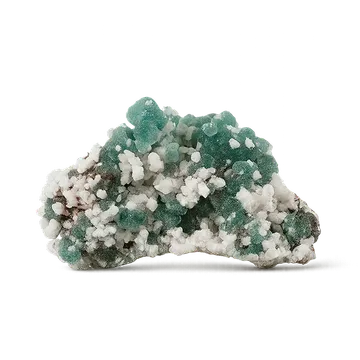
Willemite, Franklin Mining District — renowned for vivid shortwave UV fluorescence, daylight crystal variety, and the classic franklinite–calcite association.
Key facts
Willemite from the Franklin Mining District is one of the great reference materials of fluorescent-mineral collecting: a zinc silicate, Zn2SiO4, that can look modest by daylight and then turn a saturated electric green under shortwave ultraviolet light. In the best Franklin and Sterling Hill pieces, willemite sits with orange-red fluorescent calcite and black, non-fluorescent franklinite, making the classic “Christmas tree ore” contrast that introduced generations of collectors to serious UV mineralogy.

Photo: Wikimedia Commons
The district’s appeal is not only optical. Franklin and Sterling Hill are zinc-iron-manganese deposits enclosed in the Franklin Marble, a Mesoproterozoic carbonate unit that was later folded, deformed, and metamorphosed during Grenvillian mountain building. The ore is dominated by a mineral association that is almost a collecting shorthand for the locality: willemite, franklinite, zincite, and calcite, with an extraordinary halo of rarer manganese, zinc, calcium-silicate, arsenate, borate, and vein minerals. The Franklin-Ogdensburg area is one of the most mineralogically complex districts on Earth, and willemite is both a common ore mineral there and one of its most recognizable collector species.

Photo: Wikimedia Commons
Collectors prize Franklin willemite in several overlapping ways. Fluorescent collectors want strong, even, bright yellowish-green response under shortwave UV, ideally with red-orange calcite and a bold black franklinite framework. Systematic Franklin collectors also value the daylight personalities: apple-green granular masses, reddish or brown “troostitic” material, gemmy yellow to honey crystals, “grape” purple-red willemite, pale seafoam Sterling Hill pieces, and radiating aggregates that may show striking phosphorescence. Crystal collectors look for lustrous, translucent to gemmy crystals rather than ordinary granular ore; locality specialists look for old labels, specific sublocality information, and associations that place the specimen within the Franklin orebody, Trotter workings, Buckwheat material, Sterling Hill veins, or later museum-run collecting piles.
Search for specimens: View all willemite specimens from Franklin Mining District, New Jersey, USA
The Franklin Mining District lies in Sussex County, northwestern New Jersey, about 45 miles northwest of New York City. In collector usage, “Franklin” often means the Franklin Mine and its related pits, shafts, and dumps on the Franklin orebody, while “Sterling Hill” refers to the companion orebody at Ogdensburg, roughly 2.5 miles to the south. In formal mineralogical usage, the Franklin Mining District includes both of these zinc orebodies, the related iron orebodies, Franklin Marble quarries, agricultural-lime and aggregate quarries, and backfill quarries tied to the old New Jersey Zinc Company operations.
Geologically, the district’s willemite belongs to the famous Franklin-Sterling Hill zinc-iron-manganese system. The zinc deposits are stratiform, folded bodies enclosed in Franklin Marble. Their principal ore minerals are franklinite, willemite, and zincite, with calcite and many silicates forming the familiar specimen matrix. Modern interpretations treat the deposits as originally metal-rich layers formed with the marble protolith and later metamorphosed and deformed, rather than as ordinary young replacement veins. That history helps explain why the willemite is not a simple late-stage cavity mineral here: it is part of a deeply metamorphosed, chemically unusual ore system, and it occurs as ore, crystals, veins, coatings, radiating aggregates, and intimate intergrowths with a remarkable range of associated species.
Franklin’s mine workings were ultimately consolidated by the New Jersey Zinc Company around the end of the nineteenth century. The Franklin Mine incorporated earlier pits and shafts, was initially served by the Parker shaft, and later by the Palmer shaft and mill. The Franklin Mine reached about 1,150 feet in depth and closed in the mid-1950s. Sterling Hill followed a longer path: early mining was conducted in open pits, later underground, and the mine eventually reached 2,675 feet deep with about 35 miles of tunnels before closing in 1986. When Sterling Hill closed, it marked the end of New Jersey’s underground zinc-mining era; the property was later purchased by Richard and Robert Hauck and developed as the Sterling Hill Mining Museum.
For collectors today, access is museum-based, controlled, and very different from old mine collecting. The Franklin Mineral Museum operates the Buckwheat Dump, a 3.5-acre collecting area of rock originally dumped by the New Jersey Zinc Company. Visitors descend to a collecting floor about 60 feet below the museum level, and the museum also provides a more accessible upper collecting area. Buckwheat material can include ore and Franklin Marble waste from several Franklin sources, so old-style exact sublocality attribution is often impossible unless a specimen has a reliable older label or was collected from a documented event.
Sterling Hill offers collecting on its Mine Run Dump, including a Local pile of high-grade zinc ore derived from Sterling Hill itself. The museum’s collecting page distinguishes the Local pile from an International pile and notes that much of the local ore is highly fluorescent. A shortwave ultraviolet checking station is available there, an important practical detail because daylight color is a poor guide to the best fluorescent response. As always, current museum rules, hours, fees, age limits, tool policies, and weather closures should be checked before planning a collecting trip.
The district’s notable willemite finds span more than one collecting style. Massive ore specimens with calcite and franklinite are still the classic display material; gemmy Franklin crystals are much scarcer and far more specimen-grade; radiating willemite is a specialized Franklin-Sterling Hill favorite; and seafoam-colored Sterling Hill willemite, “grape” Franklin willemite, and intensely phosphorescent pieces all have distinct followings among locality collectors. Old New Jersey Zinc Company, Franklin Mineral Museum, and well-documented private-collection labels add considerable value when they tie a specimen to the Franklin Mine, Trotter Mine, Buckwheat area, Sterling Hill North Orebody, or another specific part of the district.
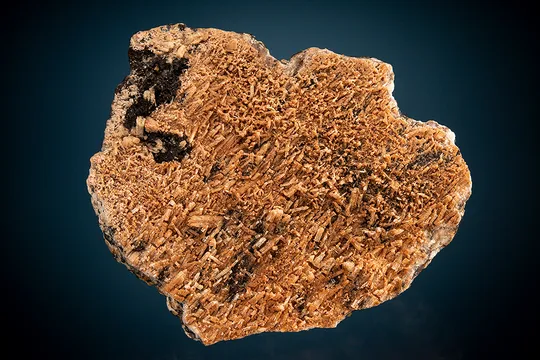
Franklin District willemite is most familiar as granular ore with franklinite and calcite. In hand specimen, willemite grains may be tan, brown, reddish brown, yellow, green, gray, white, blackish, pink, colorless, or bluish, and the daylight color alone is not diagnostic. Under shortwave UV, however, most Franklin and Sterling Hill willemite gives a bright yellowish-green to green response; under longwave it may be weaker, duller green, or absent depending on the specimen. Many pieces also show some phosphorescence, and radiating willemite can be especially memorable for its afterglow.
Crystal habits are more varied than a casual “fluorescent ore” label suggests. Franklin willemite occurs as prismatic crystals with simple rhombohedral terminations and more complex forms, as granular masses, as “shot ore” grains in calcite, as vein material, as coatings, as acicular or fibrous material, and as radiating aggregates. The radiating habit may form flat rosettes in tight fractures or three-dimensional masses in larger openings. Local collectors often call the latter “cones,” a name that refers to habit, not to radioactivity or fluorescence.
The ordinary specimen size range is broad. Thumbnail and miniature pieces of strong fluorescent ore remain common on the market and in museum dump finds. Cabinet specimens of calcite-willemite-franklinite ore are available, especially if collected from modern museum piles, but top cabinet pieces with balanced color under UV, attractive daylight patterning, and old provenance are much more selective. Individual visible crystals are usually small to modest; gemmy crystals and crystal aggregates a few centimeters across are far less common than massive or granular ore. Some documented display pieces, especially fluorescent ore blocks, can be very large, but these are more display rocks than refined mineral specimens.
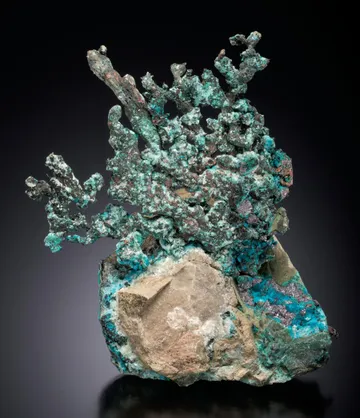
The most frequent associations are calcite and franklinite, followed by zincite in richer ore and, at Franklin, hardystonite, clinohedrite, andradite, esperite, rhodonite, margarosanite, bustamite, tephroite, sphalerite, fluorapatite, microcline, fluorite, native copper, leucophoenicite, glaucochroite, ganophyllite, and many more. Sterling Hill material overlaps strongly but has its own textural and sublocality signatures, including seafoam willemite, black willemite, rich franklinite-willemite-zincite ore, and North Orebody associations.
Quality depends on what kind of specimen is being judged. For fluorescent display, the best pieces have intense green willemite, red to orange-red calcite, sharp color separation, non-fluorescent black franklinite contrast, and good response under a proper shortwave lamp. For daylight cabinet aesthetics, collectors prefer gemminess, translucency, unusual color, visible crystal faces, or attractive associations with red zincite or contrasting black franklinite. For scientific or locality collections, an exact old label can outweigh beauty, especially when it records a sublocality that is no longer accessible.
The first rule with Franklin willemite is to test it under the right light. The classic response is strongest under shortwave ultraviolet, not the inexpensive longwave “blacklight” many beginners own. A piece that looks disappointing under 365 nm longwave may be excellent under 254 nm shortwave; conversely, a longwave glow alone should not be used as an identification. Shortwave lamps require eye and skin protection and, for best results, a filtered mineral lamp rather than an unfiltered germicidal source.
Misidentification is more common than outright fakery. Bright green under shortwave is strongly suggestive of willemite in Franklin ore, especially with calcite and franklinite, but the Franklin-Sterling Hill district contains many fluorescent species and many multi-mineral rocks. Calcite, hardystonite, clinohedrite, esperite, margarosanite, fluorapatite, sphalerite, fluorite, hydrozincite, and other minerals can complicate a specimen. The Franklin Mineral Museum’s own fluorescent checklist warns that fluorescence is a powerful aid but not a complete identification method; serious attributions rely on daylight examination, hardness, cleavage, specific gravity, magnetism, acid reaction where appropriate, associations, and, for rare claims, analytical confirmation.
Locality accuracy is another concern. Franklin Mine, Sterling Mine, Buckwheat Dump, Trotter Mine, Mill Site dump, Parker shaft, Taylor Mine, Hamburg Mine, and generic “Franklin, New Jersey” are not interchangeable labels. Material from modern public collecting areas may genuinely be from the district but not from a single precisely known underground stope. Buckwheat Dump specimens in particular can represent mixed Franklin Mine sources. High-end pieces should be described conservatively unless an older label, collection record, or documented find history supports a more exact locality.
Condition issues are those of a hard, granular ore assembled with softer and more reactive companions. Willemite itself is reasonably durable, but calcite matrix can chip, bruise, cleave, or etch; zincite-rich areas can be brittle; franklinite crystals may sit in granular, fractured rock; and fluorescent surfaces may be less attractive if heavily iron-stained or saw-burned. Many Franklin specimens were historically trimmed with hammers, sawed into slabs, or polished to show the fluorescent pattern. Sawn and polished ore can be desirable as UV display material, but crystal collectors generally prefer natural crystal faces and minimal cutting.
Cleaning should be conservative. Because many desirable pieces depend on calcite, and because the ore can include several sensitive associated minerals, acid cleaning is risky unless the owner understands exactly what is present and what feature is being sacrificed. Mechanical brushing, water, and patient removal of loose dirt are usually safer for mixed ore. For collection storage, keep locality labels with the specimen permanently; a modest willemite with a good Franklin or Sterling Hill label is far more valuable to a future collector than an anonymous green-fluorescing rock.
Market availability remains healthy at the common end. Small calcite-willemite-franklinite pieces, tumbled or sawn fluorescent rocks, and dump-collected fragments are widely traded. Better cabinet specimens with balanced red-green fluorescence are less common but obtainable. Truly fine examples—gemmy Franklin crystals, excellent old-time crystal groups, strong radiating phosphorescent willemite, rare color varieties, or pieces with top associations such as hardystonite-clinohedrite-calcite-willemite from Franklin—are scarcer and command substantial collector interest.
Before the minerals had names, the ore was already confusing people. Early miners at Franklin and Sterling Hill were working strange heavy rock sometime before 1739, but the three minerals that would later define the district—franklinite, willemite, and zincite—were not yet known to science. They were digging into one of the oddest zinc deposits on the planet without the vocabulary to describe it. More than 200 years of research and well over a thousand scientific publications followed, yet the origin of the ore remained debated for generations before a broadly modern picture took hold: metal-rich layers in the Franklin Marble, folded and metamorphosed into the zinc-iron-manganese ore collectors now slice, lamp, and argue over.
Sterling Hill’s underground story is measured in startling dimensions. What began with open-pit mining eventually became a deep underground operation, reaching 2,675 feet below the surface and extending through about 35 miles of tunnels. The mine closed in 1986 after rising production costs and falling zinc prices made the operation untenable. The workings are now flooded below the upper level, and the portion visitors tour is only the level above the water table. In 1989, after Ogdensburg foreclosed on the property for back taxes, Richard and Robert Hauck bought the land at auction and turned the closed zinc mine into a museum. That transformation is why collectors can still stand in a real New Jersey zinc mine, watch willemite flare green in the dark, and then walk outside to collect Sterling Hill ore from a controlled pile.
At Franklin, the Buckwheat Dump has its own, humbler mythology. It is not a romantic underground chamber but a 3.5-acre field of rejected mine rock, a place where the New Jersey Zinc Company put material that was not worth milling. The collecting floor lies about 60 feet below the museum level, reached by an earthen ramp. Thousands of tons have been carried away by collectors over decades, yet the dump continues to reward people willing to crawl, split, wash, and lamp seemingly ordinary rock. The best Buckwheat finds are not usually the grand three- and four-color showpieces that built Franklin’s early legend; they are the pieces a persistent collector earns by screening daylight-gray rubble for a few glowing grains that prove the rock had another life under shortwave ultraviolet.
Bruce T. Mitchell’s long account of collecting the Buckwheat Dump captures the practical truth of the place: daytime collecting means sorting through a great deal of material for “the one or two real gems” worth adding to a collection. He had collected there systematically for about twenty years, with a geology background and a portable ultraviolet lamp, and still framed his observations modestly. Calcite, in his experience, was by far the most abundant fluorescent mineral on the dump. Willemite was also abundant, but the common reddish to red-brown material in gray calcite did not always show the brilliant intensity that made Franklin famous. The brighter willemite, he found, tended to be green in daylight, associated with black franklinite or with franklinite and calcite; cabinet-sized pieces required systematic searching rather than casual picking. He also noted less usual finds such as “grape” willemite and white willemite coatings—small reminders that even a worked-over dump can still produce locality texture.
Radiating willemite has generated its own collector language. Earl Verbeek, one of the district’s best-known modern interpreters, emphasized that “radiating willemite” is a habit term, not a fluorescent term. In tight fractures it can form intergrown, flat rosettes; in larger openings it can grow into three-dimensional radiating masses. Local collectors call those masses “cones.” Many radiating willemites from Franklin and Sterling Hill show bright, prolonged phosphorescence, but not all do—especially where serpentinization has affected the material. That is classic Franklin: a simple-looking label turns into a caution that habit, color, fluorescence, phosphorescence, alteration, and association all have to be read separately.
One of the district’s most charming afterlives is fluorescent concrete. At the Trotter mine dump, collectors have found old concrete from mine-building foundations in which fluorescent mine tailings were used instead of ordinary aggregate. Sawing the concrete with a diamond blade exposed red calcite, green willemite, and blue hardystonite inside the man-made matrix. It is not a natural mineral specimen in the usual sense, but it is unmistakably Franklin: even the discarded rock that went into a foundation could become a glowing geological time capsule.

_2_(31232832761).jpg)