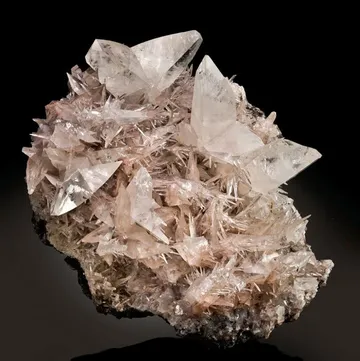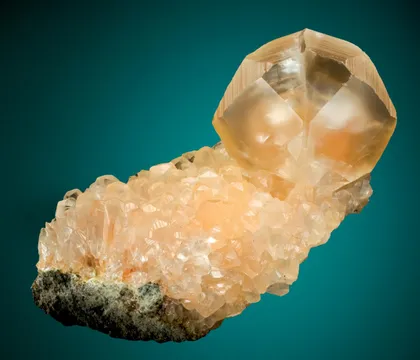
A collector's guide to Fengjiashan Mine, China: its geology, mining history and notable minerals, illustrated with the 178 specimens documented from this locality on EarthWonders.
Key facts
Fengjiashan is one of the great modern Chinese skarn localities: a compact but mineralogically rich iron-copper-wollastonite mine on the outskirts of Daye, Hubei, in the Edong portion of the Middle-Lower Yangtze metallogenic belt. For collectors, its importance rests on a rare combination of serious geology and exceptional cabinet aesthetics. The ore system sits where quartz diorite and related Yanshanian intrusives reacted with Permian carbonate rocks to form garnet-, diopside-, and wollastonite-bearing skarn; later hydrothermal activity filled fractures and cavities with quartz, calcite, pyrite, apophyllite-group minerals, inesite, hubeite, fluorite, analcime, and copper minerals. That succession explains the look of the best Fengjiashan specimens: bright, three-dimensional quartz and calcite matrices carrying metallic pyrite, reddish or salmon-pink inesite, brown hubeite rosettes, pale tabular apophyllite, occasional purple amethyst, and rarer native copper or fluorite.
The locality’s name is inseparable from hubeite, Ca2Mn2+Fe3+Si4O12(OH) · 2H2O, described from the Daye mine near Huangshi and now treated by collectors as the signature type-locality mineral of Fengjiashan. The mine also entered the collector literature through its inesite-hubeite associations and its uncommon Japan-law twin quartz specimens. The latter can be surprisingly sculptural: V-shaped quartz twins, sometimes lightly amethystine or partly coated by iron oxides, set on plates of prismatic quartz and calcite. Fine calcites range from reddish doubly terminated crystals to color-zoned and hematite-tinted groups, while the better pyrite combinations have brassy, sharply striated cubes or modified crystals contrasting against quartz or carbonate.
Regional View
Country View
Although many specimens have been sold under the broader name “Daye,” Fengjiashan is a distinct mine record: the former Daye copper mine, later worked principally for wollastonite as well as copper. Its collector specimens are not the casual by-product of a small surface dig; they came from skarn, marble, and quartz-diorite contact zones in an industrial mine whose geology was repeatedly surveyed, recalculated, and reassessed from the 1950s through modern resource reports. That industrial setting helps explain both the abundance of certain species and the sporadic nature of fine pieces: pockets were encountered during mining, not opened as a specimen quarry.

Photo: Wikimedia Commons

Photo: Wikimedia Commons

Photo: Wikimedia Commons
Search for specimens: View all specimens from Fengjiashan Mine, China
Fengjiashan Mine lies southeast of Daye city in Huangshi, Hubei Province, China. The mine is administratively associated with Dajipu town, only a few kilometres from Daye, in a low-hill landscape south of Daye Lake. Published coordinates for the mine place it near 30°03′N, 114°58′E, while a 2022 mining-rights assessment gives the licensed mining area as about 0.181 square kilometres. The same assessment describes the property as conveniently situated near National Highway 106 and the Wuhan-Jiujiang railway, with the Dajipu station about 2.5 kilometres away.
Geologically, Fengjiashan belongs to the Daye mining district of southeastern Hubei, a classic Cu-Fe skarn province within the Middle-Lower Yangtze River metallogenic belt. The mine occurs in the northwestern part of the Yangxin intrusive complex, on the eastern limb and plunging end of the Fengjiashan overturned anticline. The host sequence includes Lower Permian Maokou limestone and Upper Permian Changxing limestone, locally transformed to marble, along with associated Permian and Lower Triassic strata. Intrusion of quartz diorite, diorite, and later granite produced contact metamorphism and contact-metasomatic skarn. The economic mineralization is controlled by the intrusive contact: iron-copper mineralization is concentrated mainly in the inner contact zone, while wollastonite is developed on the outer side of the contact.
The ore bodies are described as irregular lenses, bed-like lenses, wedges, and thin tabular bodies in the skarn along the contact between carbonate rocks and quartz diorite. A modern resource assessment distinguishes seven wollastonite bodies, numbered Wo-1 through Wo-5 with sub-bodies, and a series of copper bodies. The wollastonite bodies occur in the outer zone of the Fengjiashan overturned anticline’s eastern contact, and some extend hundreds of metres along strike and down dip. The copper ore occurs chiefly in skarn, with subordinate skarnized marble and quartz diorite ore types. The principal copper mineral is chalcopyrite, with bornite, chalcocite, pyrite, molybdenite, and magnetite recorded as subordinate ore minerals. Gangue and skarn minerals include garnet, diopside, wollastonite, calcite, quartz, epidote, tremolite, mica, chlorite, and related alteration minerals.
The mine’s specimen pockets reflect that same layered history. Primary skarn and sulfide assemblages gave Fengjiashan its ore, but collector pieces generally came from open spaces in skarn, skarnized marble, quartz-calcite vein systems, and the margins of wollastonite-rich bodies. Cavities in marble and skarn are reported from centimetre scale to larger vugs, commonly lined with calcite and quartz; later, Mn-bearing and Ca-silicate assemblages introduced inesite, hubeite, apophyllite-group minerals, and analcime in particularly collectible combinations. A noteworthy modern observation from an underground visit in 2019 records hubeite in pockets along the edges of thick wollastonite veins being mined for industrial silicon-bearing material.
Fengjiashan’s mining history is unusually well documented for a mineral-specimen locality. Geological reconnaissance began in 1952-1958, followed by more systematic prospecting by the East China Bureau’s 813 team in September 1958; by July 1959 that work had advanced to exploration, including trenching, drilling, and underground work, and a copper reserve summary report was submitted in 1960. Supplementary exploration followed in 1963 by the Central-South Metallurgical Exploration 603 team, with a report submitted in 1967. The mine itself was established in 1968 as Hubei Huangshi Fengjiashan Copper Mine under the Huangshi Metallurgical Bureau, a state-owned enterprise. In 1990, the Yichang Geological Research Institute of the Central-South Geological Exploration Bureau studied comprehensive utilization of wollastonite. After reserve checks in 2004 and mining-rights valuation work in 2006, the operation was restructured as Huangshi Jintong Wollastonite Mining Development Co.; in 2011 the company name changed to Hubei Fengjiashan Mining Co., Ltd.
Production has shifted over time. Fengjiashan began as a copper-iron mine, but modern assessments emphasize wollastonite and copper, with underground mining licensed from +200 metres to -400 metres elevation and a listed production scale of 130,000 tonnes per year in the 2022 assessment. By the end of March 2019, the assessed No. 1 mining segment had cumulative identified resources of 2.496 million tonnes of wollastonite ore with 1.431 million tonnes of wollastonite mineral content, and 1.483 million tonnes of copper ore averaging 1.44 percent Cu, plus associated silver. Much of the earlier copper and iron ore had already been depleted, while wollastonite remained a significant resource.
Collecting access should be regarded as closed without permission. Fengjiashan is an active or intermittently active industrial mining property, not a public collecting site. The safest and most ethical route for specimens is through established dealers, older collections, and documented ex-collection material. Labels should preserve the full modern locality—Fengjiashan Mine, Daye Co., Huangshi, Hubei, China—because older labels may use “Daye Copper Mine,” “Daye mine,” “Daye County,” or simply “Daye, Hubei,” and because other Daye-area mines, notably Tonglushan and Tieshan, have separate histories and mineral outputs.
The major specimen-producing episodes known to collectors include the early-2000s finds of hubeite, inesite, apophyllite, quartz, and pyrite; the fine calcite finds around 2008; uncommon Japan-law quartz plates; more recent analcime specimens reported since 2016; and small later appearances of chalcopyrite, amethyst, fluorite, native copper, and cuprite combinations. The very best pieces have three virtues at once: a visibly Fengjiashan association, such as hubeite with inesite or pyrite on quartz; crisp undamaged crystals; and an open, sculptural matrix rather than a flat crust.
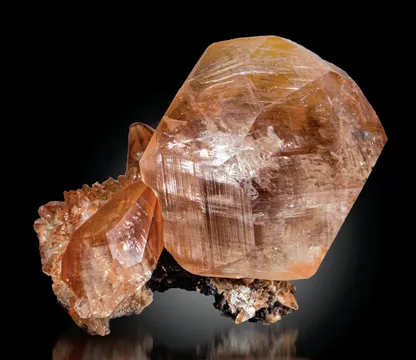
Calcite is one of Fengjiashan’s defining display minerals, occurring as reddish to pale pink, colorless, white, honey, and hematite-tinted crystals on skarn, quartz, and calcite matrix; good pieces include doubly terminated crystals, scalenohedral groups, stepped-growth aggregates, and large isolated crystals that can reach cabinet scale, with a 15 cm crystal illustrated in the China crystalline-treasures literature and a documented 2008 find producing notable 13 cm-class calcites. The color is commonly attributed to iron oxide or hematite inclusions, while some exceptional orange-red material has been described as possibly influenced by trace manganese. Ordinary Fengjiashan calcite is simply another carbonate from a skarn; the desirable pieces show sharp terminations, transparency or saturated red-pink color, attractive contrast with quartz, pyrite, hubeite, inesite, or fluorite, and minimal bruising on exposed tips.
Quartz from Fengjiashan ranges from milky prismatic druses and microcrystalline quartz matrix to clear, iron-stained, lightly smoky, and amethystine crystals, but the mine’s most distinctive quartz specimens are Japan-law twins. These occur as single V-shaped crystals and richer plates with multiple twins, sometimes with calcite remaining in protected areas or iron oxide giving a chocolate-brown to silvery surface; documented examples include twins to about 5 cm across on 9 cm specimens, a cabinet specimen with several twins and a largest twin about 5.2 cm tip-to-tip, and an EarthWonders-listed specimen with three Japan-law twins and a largest 6 cm wingspan. Fine Fengjiashan quartz is judged less by size alone than by exposed, symmetrical twin geometry, three-dimensional placement, intact edges, and association with calcite, pyrite, hubeite, inesite, or amethystic overgrowths.
Fengjiashan inesite is the mine’s great Mn-silicate showpiece: salmon-pink to reddish-pink sprays, sheaves, rosettes, feather-like aggregates, and lath-like crystals set on calcite, quartz, and hubeite-bearing matrix, often with apophyllite dusting or small pyrite. Specimen descriptions from the locality record inesite sprays to about 1.4-1.7 cm on quartz and calcite matrices, including a 5.7 x 5.0 x 5.0 cm specimen with a 1.7 x 1.7 cm spray perched on a 3.4 cm quartz crystal, and larger cabinet plates where numerous sprays are scattered across hubeite and calcite. The best pieces have saturated pink color, separated sprays rather than matted crusts, clean contrast against white quartz or calcite, and visible hubeite association; weak pieces tend to be dull, bruised, or so heavily overgrown by later minerals that the inesite habit is lost.
Fengjiashan amethyst is not a Brazilian-style mass-market amethyst but a locality-specific quartz variety occurring as blush-purple to lightly amethystine crystals, artichoke-habit crystals, and sceptered or Japan-law-twinned quartz associated with calcite, apophyllite, and analcime. A well-documented style from Fengjiashan Shaft I is apophyllite on artichoke-habit amethyst, while material from the Fengjiashan II adit includes amethyst scepters whose stems are commonly hidden by calcite; one recently photographed specimen showed at least ten Japan-law twins to 42 mm wide, with several amethyst-sceptered individuals. Good Fengjiashan amethyst is valued for locality character—scepters, Japan-law twins, artichoke habit, and calcite or analcime associations—more than for deep purple color, which is generally subtle here.
Pyrite at Fengjiashan is a major accessory species and a serious collectible in its own right, occurring as lustrous brassy cubes, modified crystals, interlocking groups, striated crystals, and epitaxial-looking overgrowths on quartz or calcite. The classic association is pyrite with quartz, locally joined by calcite, hubeite, inesite, chalcopyrite, apophyllite, or fluorite; notable specimen records include pyrite-and-quartz groups in the 14-16 cm range and a large multi-mineral hubeite-pyrite-quartz-calcite specimen measuring 310 x 170 x 180 mm. The finest pieces have sharp, reflective, undamaged pyrite sitting prominently on white or milky quartz, sometimes with Japan-law quartz or brown hubeite for locality confirmation; dull massive sulfide or edge-battered cubes are far less desirable.
The apophyllite-group minerals from Fengjiashan are chiefly represented by fluorapophyllite-(K) and fluorapophyllite-(Na), with collectors often encountering older labels that simply say “apophyllite.” The important early-2000s find produced colorless to pale, partly transparent, tabular crystals on calcite-quartz matrix with hubeite; one documented specimen is a 14.5 x 10.8 x 7.0 cm floater with tabular apophyllite crystals to 2.7 cm and scattered dark brown hubeite clusters to 0.6 cm. Fengjiashan apophyllite can also appear frosty or pale yellowish, and it is important as a contrast mineral on hubeite, inesite, quartz, and amethyst; better pieces show bright tabular crystals cleanly perched and not merely a white microcrystalline coating that obscures the rarer silicates beneath.
Analcime is a newer Fengjiashan collectible, reported from the mine since 2016 as clear to water-clear trapezohedral crystals, with crystals documented up to about 2 cm. The best public specimen records show transparent analcime perched on calcite, hematite-tinted calcite, apophyllite-group crystals, and amethystine quartz; one NHM Vienna specimen measures 11 x 8 x 4.5 cm and carries water-clear analcime crystals to 1.5 cm on colorless calcite, while another thumbnail shows a 14 mm analcime trapezohedron on an 18 mm artichoke-habit lightly amethystine quartz crystal. Fine pieces are those in which the analcime is transparent, isolated, and geometrically sharp; small cloudy grains scattered on calcite are much less distinctive and can be confused visually with pale apophyllite or other zeolitic-looking minerals without analysis.
Native copper from Fengjiashan is a minor but attractive supergene or late-stage copper species, best known as arborescent, dendritic, wiry, or crystalline copper associated with cuprite and locally delafossite. Mindat occurrence data tie native copper to the mine and note museum material in the Natural History Museum Vienna, while the cuprite occurrence record lists native copper as a frequent photo-data associate. Desirable Fengjiashan copper specimens show natural branching form, fresh metallic copper color or stable dark patina, and a believable association with cuprite rather than a generic “Daye” label; because native copper is sold from many Chinese and international localities, precise locality documentation matters more here than sheer size.
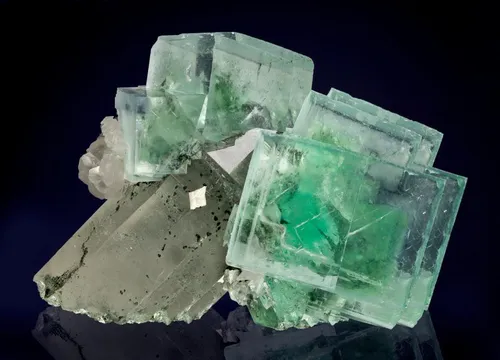
Fluorite is scarce at Fengjiashan compared with calcite, quartz, pyrite, and hubeite, but it is a pleasing accessory when present, recorded with quartz, pyrite, and calcite and represented in the photo record by only a small number of specimens. Collectors should expect isolated cubic to blocky crystals or small clusters rather than the large, saturated plates associated with China’s famous fluorite mines; a published note describes a rare miniature with a blue fluorite crystal about 3 cm across in association with calcite, while other records show fluorite with quartz. The best Fengjiashan fluorites are locality-rich combination specimens—fluorite on quartz or calcite with sulfide context—rather than ordinary purple or green fluorite that could be from dozens of Chinese sources.
Beyond these featured species, Fengjiashan’s mineral list includes bornite, chalcopyrite, cuprite, delafossite, datolite, epidote, galena, goethite, helvine, hematite, ilvaite, magnetite, molybdenite, native silver, stilbite-subgroup minerals, and wollastonite. Hubeite is the key rarity and type-locality mineral, and it deserves special attention even when not the visual centerpiece: brown bladed crystals and rosettes, commonly only millimetres across, can transform a quartz-calcite-inesite specimen from attractive to locality-defining. Some older material labeled “manganbabingtonite” from Fengjiashan proved to be hubeite, so old labels on brown Mn-Fe silicates from the mine should be treated carefully and, for important specimens, analytically checked.
The chief authenticity issue with Fengjiashan material is locality precision, not widespread artificial treatment. Older labels may say “Daye,” “Daye Copper Mine,” “Daye mine,” or “Hubei, China,” and those labels can be legitimate historical shorthand—but the Daye district includes several distinct mines. Tonglushan, Tieshan, and Fengjiashan should not be merged on serious labels. The safest Fengjiashan attributions are pieces with one or more locality-diagnostic associations: hubeite with inesite and quartz, pyrite on quartz from the classic Fengjiashan style, Japan-law quartz from Daye/Fengjiashan, pale apophyllite with hubeite, or analcime on calcite/amethyst from the recent Fengjiashan material.
Condition varies by species. Calcite crystals commonly show edge bruising, contact marks, or small cleaves at exposed terminations. Inesite sprays are delicate and often chipped at the ends; pieces with undamaged, separated sprays command a premium. Hubeite is usually small, brown, and easily overlooked; on rich specimens it can be confused with iron-oxide crusts unless the bladed or rosette habit is visible under magnification. Quartz Japan-law twins should be checked along the thin twin edges, where the most common damage is tiny chipping. Pyrite is generally robust, but dull coatings, bruised cube corners, and repaired matrix contacts reduce value. Apophyllite and analcime can look deceptively similar at a glance on crowded pieces, so labels should be backed by crystal habit, association, and ideally prior analytical confidence for higher-value specimens.
Some Fengjiashan calcite shows attractive fluorescence, with pink long-wave response reported on calcite in quartz-calcite-pyrite specimens. Fluorescence should be treated as a bonus rather than a universal diagnostic feature; absence of fluorescence does not disprove the locality. Native copper should be handled dry and kept away from acidic display environments, while pyrite should be stored in stable humidity even though Fengjiashan pyrite is not especially notorious for pyrite disease.
Market availability is uneven. Calcite, quartz, pyrite, and hubeite-combination pieces appear regularly enough that collectors can be selective, especially for aesthetics and damage. Fine hubeite, large well-composed inesite, clean Japan-law quartz, and transparent analcime are much scarcer. Fluorite, native silver, well-crystallized copper, and strong cuprite-copper-delafossite pieces should be considered uncommon to rare. The best modern Fengjiashan specimens often come with provenance through well-known dealers or collections; those labels are worth preserving because the mine’s output has been sold for decades under several overlapping names.
Fengjiashan’s collector story is a story of an ore mine repeatedly changing what it meant to collectors. It began in the literature and in the field as a copper mine, but the specimens that made it famous were not simply copper ore dressed up for cabinets. In the skarn, the industrial wollastonite bodies and the mineral collector’s pockets were neighbours. Modern accounts from an underground visit in 2019 place hubeite specifically in pockets along the edges of thick wollastonite veins, a memorable image: industrial white wollastonite being taken for silicon-bearing raw material, while along its margins sat brown rosettes of a mineral that would make the mine’s name permanent in systematic collections.
The hubeite discovery changed old assumptions. Brown Mn-Fe silicate material from Fengjiashan had been treated by some collectors as manganbabingtonite, but the Daye specimens eventually yielded a new mineral species. The type description fixed the identity of hubeite as a calcium-manganese-ferric iron hydrated sorosilicate, and the locality became more than another Chinese skarn mine—it became a type locality. The type material itself was not flamboyant in the way of a giant tourmaline or a huge calcite: hubeite commonly forms small radiating aggregates, with individual bladed crystals in the millimetre range. Yet that is precisely why good specimens are so satisfying. On a strong piece, the brown hubeite is not just a crust; it is a field of tiny, deliberate rosettes and blades set among quartz, calcite, pyrite, and salmon-pink inesite.
The mine also produced one of China’s more unexpected quartz styles. Fengjiashan Japan-law twins can be startlingly crisp—thin V-shaped quartz crystals posed on drusy matrix, sometimes with pyrite and calcite, sometimes with amethystine overgrowth. Recent collector documentation has made clear that some amethyst scepters from the Fengjiashan II adit were not obvious at first because their stems were commonly buried in calcite. That is a very Fengjiashan kind of problem: the specimen is not lacking complexity, it has too much of it, with calcite, quartz, apophyllite, hematite staining, and later growth all competing for the collector’s eye.
The 2008 calcite pocket occupies a special place in the mine’s specimen history. Published photographs from the China crystalline-treasures literature show a 15 cm calcite from Fengjiashan with unusually intense color, considered apparently unique and thought possibly to owe that color to trace manganese, along with a 13 cm calcite on calcite from the same period. These are not ordinary “Daye calcites.” They are the kind of pieces that explain why an ore mine known to systematic collectors for hubeite and inesite also became attractive to cabinet collectors who care primarily about color, form, and presence.
Hawthorne, Frank C.; Cooper, Mark A.; Grice, Joel D.; Roberts, Andrew C.; Cook, William R.; and Lauf, Robert J. (2002). “Hubeite, a New Mineral from the Daye Mine near Huangshi, Hubei Province, China.” The Mineralogical Record, 33(6), 465-471. The original hubeite description; essential for the type-locality status, chemistry, morphology, and associated minerals.
Cooper, M. A. and Hawthorne, F. C. (2004). “The crystal structure of hubeite, a novel sorosilicate mineral.” The Canadian Mineralogist, 42, 825-834. Structural data for hubeite, including crystallographic information tied to the type material.
Mindat hubeite species page Records Fengjiashan Mine as the type locality and lists the Canadian Museum of Nature, Ottawa, specimen #83268 as the place of conservation of type material.
Mindat Fengjiashan Mine locality page The most useful single locality summary, with coordinates, alternate names, commodity list, mineral list, and references.
Jiang, Jingye; Tan, Dafang; Hu, Guojun; and Zhang, Lichun (1998). “Characteristics of hydrochemical anomalies and prospecting criteria of the Fengjiashan skarn Fe-Cu deposit.” Geology and Prospecting, 34(6), 5-9. A geological reference for the Fengjiashan skarn Fe-Cu deposit and its ore-mineral record.
Ottens, Berthold (2003). “Inesit, Hubeit und Japanerzwillinge aus Hubei, China.” Lapis, 28(9), 41-47. Early collector-oriented treatment of Fengjiashan inesite, hubeite, and Japan-law quartz.
Ottens, Berthold (2007). “The Fengjiashan mine, Daye district, Ezhou Prefecture, Hubei Province, China.” The Mineralogical Record, 38(1), 33-42. The principal locality article for collectors, although later locality notes correct the administrative wording to Daye County and Huangshi Prefecture.
Tron, Jürgen (2022). “Neu aus China: Lirokonit und Analcim.” Lapis, 47(6), 8-9. Source for the newer analcime occurrence at Fengjiashan, including crystals reported up to 2 cm.
Jin, Jingfang and Jin, Hui (2000). “Apophyllite from Huangshi, Hubei Province, China, and its associated minerals.” Journal of Gems and Gemmology, 2(2), 36-39. Regional apophyllite reference relevant to Huangshi material and associated mineral assemblages.
Xinjiang Tiandiyuan Mineral Resources Appraisal Co. (2022). “Mining-rights transfer income assessment report for Hubei Fengjiashan Mining Co., Ltd. additional resources.” Chinese government-linked assessment with mining history, license data, geology, ore-body descriptions, resource figures, and mining conditions.
Crystalline Treasures: The Mineral Heritage of China supplement, The Mineralogical Record Includes illustrated Fengjiashan calcite and pyrite-quartz specimens and places Daye within China’s long mining and specimen-producing tradition.
Wikimedia Commons: Category “Fengjiashan Mine” A useful image repository with freely licensed photographs of Fengjiashan calcite, inesite, hubeite, apophyllite, fluorite, copper, cuprite, pyrite, quartz, and related specimens.
Mindat: Fengjiashan Mine, Daye Co., Huangshi, Hubei, China — Core locality reference with coordinates, alternate names, commodities, mineral list, and bibliography.
Mindat: Calcite from Fengjiashan Mine — Species-occurrence page with associated-mineral data and gallery access for Fengjiashan calcite.
Mindat: Pyrite from Fengjiashan Mine — Useful for the mine’s pyrite associations and its status as an important pyrite locality.
Mindat: Fluorite from Fengjiashan Mine — Documents the scarcer fluorite occurrence and its quartz-pyrite-calcite associations.
Mindat: Type Locality Report for Fengjiashan Mine — Concise type-locality listing for hubeite.
Mindat: Hubeite mineral data — Mineralogical data, type-locality information, associated minerals, and type-material repository details.
ResearchGate: “A new mineral from the Daye mine near Huangshi, Hubei province, China” — Accessible record of the original hubeite description.
WebMineral: Hubeite Mineral Data — Supplementary crystallographic and physical-property data for hubeite, with Fengjiashan images.
Dakota Matrix Mineralpedia: Hubeite — Dealer-mineralogical summary of hubeite from Fengjiashan, useful for habit and collector appearance.
Wikimedia Commons: Fengjiashan Mine — Freely licensed image category showing the range of Fengjiashan specimen styles.
Huangshi natural resources PDF: Hubei Fengjiashan Mining Co. assessment report — Detailed Chinese-language source for geology, mining history, ore bodies, resources, and license conditions.
The Mineralogical Record: Crystalline Treasures: The Mineral Heritage of China PDF — Published collector context and illustrated Fengjiashan specimens.
Fabre Minerals: Chalcopyrite on Quartz with Arsenopyrite and Calcite, Fengjiashan Mine — Dealer archive documenting a 2022 Fengjiashan sulfide-quartz-carbonate specimen.
EarthWonders specimen record: Quartz from Fengjiashan Mine — Market-facing example of a cabinet specimen with multiple Japan-law twins from the locality.