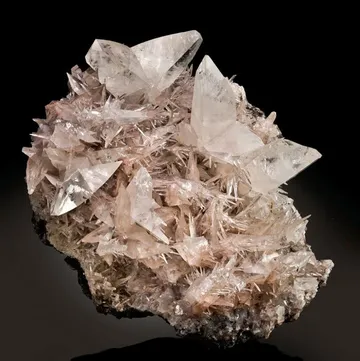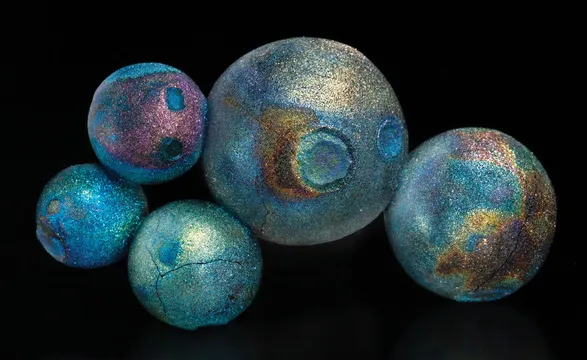
Tonglushan Mine, China — a Cu-Fe-Au skarn locality known for peach to red calcite crystals and iridescent chalcopyrite balls, a top target for collectors.
Key facts
Tonglushan is one of the few mineral localities where a cabinet specimen, an ore-deposit cross section, and a Bronze Age story all belong in the same breath. The mine lies in the Daye ore district of Hubei, at the western end of the Middle–Lower Yangtze River metallogenic belt, where Early Cretaceous quartz monzodiorite to quartz-diorite intrusions invaded Lower Triassic carbonate rocks of the Daye Formation. The result is a major Cu–Fe–Au skarn system: garnet, diopside, epidote, actinolite, phlogopite, chlorite, magnetite, hematite, quartz, calcite, and copper sulfides arranged in a classic but unusually rich intrusion-to-carbonate alteration system.
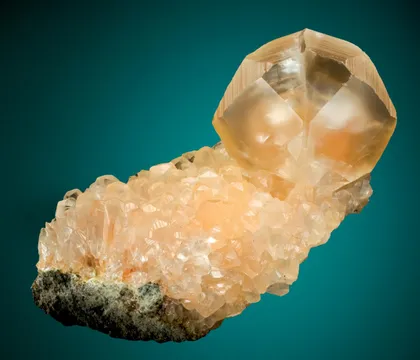
For collectors, Tonglushan is most immediately recognizable for calcite. The best modern pieces are not anonymous white skarn calcites, but sharply crystallized, lustrous, transparent to translucent forms colored peach, orange, red, or smoky gray by iron-oxide inclusions and coatings. Many are doubly terminated scalenohedra or complex flattened crystals, some perched lightly on reddish hematitic matrix, others showing later calcite over earlier microcrystalline sulfide films. Fine pieces have a bright architectural clarity: red internal zoning, glassy faces, delicate terminations, and a distinctly Chinese skarn association rather than the look of a limestone quarry calcite.
The mine also has a second, more controversial collector identity: iridescent rounded chalcopyrite “balls” or “blister copper” clusters attributed to Tonglushan/Daye material. These pieces became famous because they look almost implausible—heavy, metallic, glittering masses of joined bronze, blue-gray, purple, and gold spheroids. Analytical work confirmed chalcopyrite in at least investigated samples, but also revealed unusual internal phases that have kept authenticity and formation questions alive among serious collectors. Tonglushan therefore rewards the knowledgeable buyer: the locality offers beautiful and well-documented calcite, real skarn ore assemblages, and striking copper secondary minerals, but also demands careful attention to labels and provenance.
Regional View
Country View
Tonglushan’s historical weight is exceptional. The ancient mining and smelting complex beside the modern mine preserves shafts, timbering, drainage features, furnaces, tools, slag, ore, and human evidence from a long copper-working tradition that archaeologists connect to China’s Bronze Age. The modern open-pit and underground mine is not a romantic abandoned collecting ground; it is an industrial copper-iron operation in a district where geology, archaeology, and metallurgy overlap more densely than at almost any other specimen locality in China.
Search for specimens: View all specimens from Tonglushan Mine, China
Tonglushan is located at Daye, Huangshi, Hubei Province, and is also seen in the literature and specimen trade as Tonglüshan or Tonglvshan. Geologically, the deposit belongs to the Edong/Daye district in the Middle–Lower Yangtze River metallogenic belt, one of eastern China’s major Cu–Au–Fe–Mo skarn and porphyry provinces. The ore system is centered on an Early Cretaceous quartz monzodiorite to quartz-diorite intrusive body emplaced into Lower Triassic limestones and dolomitic limestones of the Daye Formation. Contact metamorphism changed the carbonate rocks to marble and dolomitic marble, and hydrothermal metasomatism produced endoskarn in the intrusive rocks and exoskarn in the carbonate wall rocks.
The mine is best understood as a porphyry-skarn copper-iron-gold system with a strong spatial zoning. Proximal porphyry-style mineralization in the intrusive rocks is associated with K-feldspar, biotite, magnetite, and weak Cu–Fe sulfides, and it accounts for much of the molybdenum component. The main skarn ores, especially exoskarn bodies, contain the bulk of the iron and much of the copper-gold mineralization. More distal carbonate-replacement and vein-type ores carry Cu–Pb–Zn sulfides with calcite-dolomite gangue. Published models divide the alteration-mineralization history into early skarn-potassic alteration, retrograde Fe-oxide mineralization, quartz-sulfide Cu–Au mineralization, late carbonate alteration, and supergene alteration.
The orebodies are structurally controlled as well as lithologically controlled. They occur along contacts, faults, fractures, and marble rafts around the Tonglushan intrusive center, with larger bodies developed where fractures cut favorable contact zones. Mineralogical studies describe garnet-dominated and diopside-bearing skarns, retrograde alteration with epidote, actinolite, phlogopite, chlorite, serpentine and tremolite, and later quartz-sulfide assemblages carrying chalcopyrite, bornite, pyrite, pyrrhotite, sphalerite, galena, molybdenite, covellite, and digenite. Carbonate veins, dominated by calcite with minor pyrite and marcasite, cut earlier assemblages and are particularly relevant to specimen formation.
From an economic standpoint, Tonglushan is a substantial mine, not a small specimen dig. Published reserve and resource figures vary by date, reporting standard, and whether the whole deposit or active project is being summarized, but the broad picture is consistent: Tonglushan is a major copper-iron-gold skarn with tens of millions of tonnes of ore, significant copper grade, substantial magnetite/iron, recoverable gold and silver, molybdenum, and locally recognized cobalt potential hosted mainly in sulfide-rich skarn-center assemblages. Company reports describe both open-pit and underground mining, and recent corporate disclosures still treat Tonglvshan as an operating project of China Daye Non-Ferrous Metals Mining Limited and associated Daye Non-ferrous Metals operations.
The mining history is far older than the modern company structure. Ancient workings at Tonglushan were uncovered during modern opencast mining in the 1970s. Archaeological excavations from 1974 into the mid-1980s revealed ancient shafts, timbered workings, drainage systems, furnaces, tools, slag, and ore-processing evidence. The ancient mine complex is associated with copper mining and smelting from the Western Zhou through the Han period, with later excavations revealing additional sites, miners’ tombs, and physical traces of work activity. The protected archaeological site and museum stand beside the modern mining landscape, making Tonglushan one of the clearest examples of a mineral deposit exploited in both antiquity and the modern industrial era.
Specimen access today should be considered indirect. Tonglushan is an active industrial mine and a protected archaeological locality, so casual collecting is not appropriate. Collector pieces have reached the market through mine-related recoveries, Chinese dealers, and international dealers, especially in several identifiable waves: older malachite and azurite pieces from the oxidized copper zone; the distinctive chalcopyrite-ball material attributed to Tonglushan/Daye; and the major 2021–2023 calcite finds that supplied many glassy, iron-included calcites ranging from thumbnails to large cabinet specimens. Good labels matter here because “Daye,” “Tonglushan,” “Tonglüshan,” “Tonglvshan,” “Daye Mine,” and nearby Edong district mines can be confused or used loosely in the trade.
Calcite is the defining display mineral from Tonglushan in the present collector market, especially from the 2021–2023 finds that produced glassy, transparent to translucent crystals with reddish, orange, peach, or smoky-gray iron-oxide and hematite inclusions. The finest pieces are doubly terminated scalenohedra, complex multifaced crystals, flattened lenticular groups, and two-stage growths in which later clearer calcite partially reveals earlier sulfide-coated faces beneath “windows.” Sizes range from sharp thumbnails around 3 cm to cabinet specimens over 10 cm, with documented individual crystals around 5–6.5 cm and groups to roughly 15–18 cm. Associations include hematite and iron oxides, pyrite, chalcopyrite microcrystals, goethite, and reddish skarn matrix. Good Tonglushan calcite is separated from ordinary material by transparency, undamaged terminations, high luster, attractive red internal zoning rather than muddy staining, and an airy composition in which the crystals appear to float over the matrix rather than sit as a crowded crust.
Chalcopyrite at Tonglushan occurs both as a genuine ore mineral in the quartz-sulfide stage of the skarn system and as a collector novelty in two main specimen styles: brassy to iridescent microcrystalline coatings on calcite, and rounded “blister copper” or ball-like aggregates attributed to Tonglushan/Daye. In calcite association it may glitter along edges, corners, earlier scalenohedra, or buried growth surfaces visible through later translucent calcite, where it acts almost like metallic outlining on the carbonate architecture. The chalcopyrite-ball material ranges from single spheres to clusters several centimeters across and larger matrix pieces, with surfaces in bronze, gold, blue-gray, purple, and peacock iridescence; some labeled examples are associated with chalcocite, djurleite, calcite, pyrite, quartz, and dark sulfide-rich matrix. The best pieces are visually complete, naturally coherent, and well documented, but this is also the Tonglushan mineral most requiring caution because analytical studies and public locality notes have raised serious questions about the origin and internal make-up of some spherical specimens.
Chalcocite from Tonglushan is principally a copper-sulfide specimen mineral of the supergene and sulfide-rich parts of the system rather than the locality’s abundant show species. Collector pieces are typically dark steel-gray to black, metallic, massive to granular or microcrystalline, and commonly associated with chalcopyrite and djurleite; documented Tonglushan examples include sizable mixed chalcocite-chalcopyrite-djurleite specimens and smaller chalcocite pieces partly coated or accented by brighter chalcopyrite. The mineral’s importance here is contextual: it records the copper-rich sulfide assemblage that made the deposit economically attractive and ties the modern specimen suite to the oxidized and enriched copper zones exploited by ancient miners. Good specimens are those in which chalcocite is clearly identifiable, lustrous, and compositionally interesting rather than just an anonymous black ore mass, especially where it contrasts with brassy chalcopyrite or accompanies labeled djurleite.
Malachite from Tonglushan comes from the oxidized copper environment that also gave the ancient miners their green ore guide, and the best collector pieces are distinctly different from the velvety sprays and huge stalactites of central Africa. Documented specimens include bottle-green botryoidal slabs, sculptural stalactitic and finger-like forms, hollow or pinholed stalactites, banded sections, malachite after azurite, and dendritic or acicular malachite over older malachite and azurite. Sizes range from small cabinet pieces around 6 cm to larger cabinet stalactites and sculptural groups exceeding 10 cm, with some reported Tonglushan stalactitic pieces around 15 cm long. The best pieces combine rich dark to emerald green color, silky or chatoyant luster, complete stalactite terminations or aesthetically broken banded sections, and a convincing Chinese copper-skarn label; ordinary pieces are dull green coatings, massive fragments, or mislabeled material from more common Chinese malachite localities.
Azurite is less common than malachite in the Tonglushan specimen suite, but it is an important companion mineral in the oxidized copper zone. Tonglushan examples are typically deep blue crystalline to microcrystalline crusts, patches, or relics associated with malachite, including dark blue crystals in malachite-rich pieces and malachite pseudomorphs after azurite. The strongest specimens are not usually large freestanding azurite crystal clusters in the style of Milpillas or Tsumeb; rather, they are mixed copper-carbonate pieces where azurite supplies sharp blue contrast against botryoidal, stalactitic, or dendritic green malachite. Quality depends on saturated blue color, visible crystal sparkle or texture, lack of muddy alteration, and clear association with Tonglushan’s oxidized copper assemblage, while labels deserve scrutiny because Chinese azurite-malachite from Anhui and other localities has often circulated more widely than true Tonglushan material.
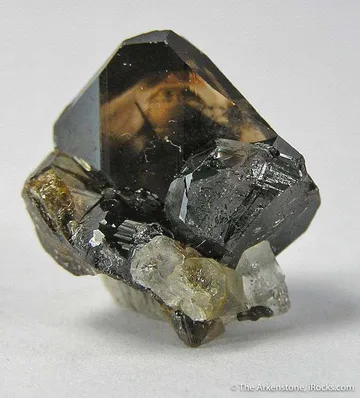
Quartz at Tonglushan is both a gangue mineral in the quartz-sulfide Cu–Au stage and a specimen associate, most often appearing with calcite, amethyst, goethite, sulfides, and altered skarn matrix. In the ore system, quartz belongs to the productive stage that followed skarn formation and retrograde Fe-oxide deposition, so even modest quartz on matrix can be meaningful when it carries chalcopyrite, bornite, pyrite, or other sulfides. Collector-grade quartz is less abundant than calcite and usually gains interest through association: clear to pale crystals with calcite overgrowths, sulfide accents, iron-oxide staining, or transition into amethyst. Good pieces show clean crystal definition and undamaged points, but the most desirable Tonglushan quartz specimens are those that tell the paragenetic story—quartz in direct contact with copper sulfides or later calcite—rather than ordinary milky quartz fragments from skarn rubble.
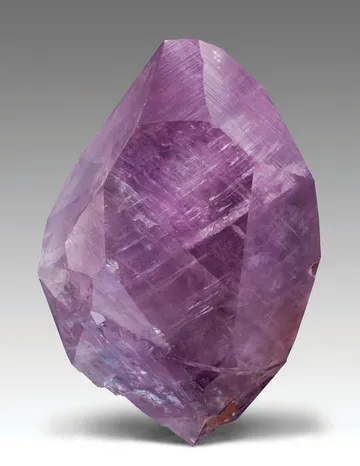
Amethyst from Tonglushan is a scarce and attractive quartz variety, best documented as purple quartz crystals partly overgrown by lustrous calcite and accompanied in some pieces by tiny botryoidal goethite. Known collector examples are generally small cabinet or miniature specimens rather than major amethyst plates; a reported amethyst crystal around 4.5 cm partly covered with calcite is representative of the scale and style. The color tends to be the appeal—purple quartz set off by pale calcite and dark goethite or iron oxide—rather than large crystal size. Fine pieces should show an unmistakable purple quartz crystal, attractive calcite placement that enhances rather than hides it, and minimal bruising on exposed tips; ordinary examples may be visually swallowed by calcite or confused with generic Daye-area quartz unless well labeled.
Djurleite at Tonglushan is a specialized copper-sulfide species known to collectors mainly in mixed sulfide specimens with chalcocite and chalcopyrite. It is not a showy, easily recognized hand-specimen mineral here; visually it may appear as dark gray to black metallic copper sulfide, massive to fine-grained, and its presence is typically label- or analysis-dependent. The mineral fits the secondary/enriched copper-sulfide environment associated with chalcocite, bornite, digenite, covellite, and chalcopyrite, and Tonglushan specimens carrying djurleite are valuable because they preserve a more complex ore assemblage than a simple brassy chalcopyrite piece. Good examples are those with reliable provenance, visible contrast among sulfide phases, and enough surface quality or association to make the specimen collectible rather than merely analytical ore.
Hematite is central to the visual identity of Tonglushan calcite and to the Fe-oxide stage of the deposit, even though it is less often collected as a standalone species. In ore and skarn, hematite occurs with magnetite, calcite, quartz, chlorite, and later sulfides, replacing or overprinting garnet-rich skarn in Fe-mineralized zones. In display specimens, hematite and related iron oxides are most familiar as red to orange inclusions, internal zoning, dusty coatings, or matrix color that turns calcite from ordinary clear crystals into the prized peach-red Tonglushan style. The best hematite-bearing pieces show clean, geometric color placement inside or on calcite, not dull limonitic crusts; when present as matrix or ore, hematite gains interest by association with magnetite, chalcopyrite, pyrite, and sharply crystallized calcite.
Beyond these collector-facing species, Tonglushan’s documented mineralogy is that of a complex Cu–Fe–Au porphyry-skarn system: magnetite, pyrite, pyrrhotite, bornite, covellite, digenite, sphalerite, galena, molybdenite, marcasite, native copper, atacamite, garnet, diopside, epidote, actinolite, phlogopite, chlorite, serpentine, tremolite, feldspar, mica, and clay-group alteration minerals have all been recorded or described in the locality literature. The research interest has recently expanded beyond classic Cu–Fe–Au to cobalt, tellurium, and selenium behavior, with cobalt shown to reside chiefly in pyrite, sphalerite, and magnetite in sulfide-rich skarn-center assemblages. For collectors, those phases are usually supporting characters, but they explain why Tonglushan specimens often look mineralogically “busy”: red iron oxides, brassy sulfides, dark copper sulfides, green copper carbonates, and multiple generations of calcite and quartz are natural expressions of a long, overprinted ore-forming history.
Tonglushan labels deserve more attention than usual. The name appears as Tonglushan, Tonglüshan, Tonglvshan, Daye, Daye Mine, Edong, and sometimes simply “Hubei, China.” Nearby Daye-district mines, especially Fengjiashan, Tongshankou, and broader “Daye mining area” material, have also produced collectible calcite, copper minerals, and skarn specimens, so a vague Daye label should not automatically be upgraded to Tonglushan. For serious pieces, keep old dealer labels, auction records, MinID information, and any notes tying the specimen to a specific find year.
The most serious authenticity issue is the iridescent chalcopyrite-ball material. Smithsonian analytical work on a specimen acquired at the 2019 Tucson Gem and Mineral Show confirmed copper iron sulfide and chalcopyrite-related material, but also found porous rims, internal spherules, calcium sulfate, and calcium sulfide; Mindat’s locality note now explicitly warns that doubts have been raised. That does not mean every rounded chalcopyrite-labeled specimen should be dismissed out of hand, but it does mean that high-priced examples should be bought as a debated collector subcategory unless accompanied by strong documentation and, ideally, independent analytical or provenance support. Be wary of perfect-looking isolated balls, overly uniform glued-looking clusters, surfaces with artificial-looking iridescence, or listings that lean on the phrase “rare natural peacock chalcopyrite” without locality history.
Calcite from Tonglushan is much safer territory, but condition is still decisive. The crystals are often perched, acute, and transparent, so small bruises, cleaves, and repaired tips are easy to miss under show lighting. Check points, edges, back-side contacts, and the base. Some pieces have sawn bases from extraction or preparation; that is not necessarily a defect if disclosed, but it should affect price and display expectations. Strong red fluorescence has been reported for some calcites, and other examples show long- and short-wave UV response, but fluorescence should be treated as a bonus rather than an identifying requirement.
Malachite and azurite pieces should be examined for polish, stabilization, and locality confusion. Tonglushan malachite can show natural banding and stalactitic growth; lightly polished blemished areas or cut sections may reveal internal banding and are sometimes honestly described in auction listings. Completely polished decorative malachite, however, is a different collecting category and may not retain specimen value unless the form and label are compelling. Azurite-malachite from China is frequently attributed to better-known Anhui localities, so true Tonglushan examples should have documentation or a style consistent with the oxidized Daye copper-skarn suite.
In the current market, Tonglushan calcite is available but no longer simply a flood of cheap new material. Excellent miniatures and small cabinets remain obtainable, while large, transparent, undamaged, deeply iron-included groups command stronger prices. Fine malachite, azurite, chalcocite-djurleite combinations, and well-documented chalcopyrite-ball specimens are much scarcer. The best Tonglushan cabinet is not necessarily the largest one; it is the specimen that combines unmistakable locality style, clean condition, credible provenance, and a mineralogical connection to the mine’s skarn-and-copper story.
The first great Tonglushan story begins not with a collector but with a question left hanging over Chinese archaeology. In 1928, excavations at Yinxu in Anyang produced a vast corpus of bronze artifacts, including the enormous Simuwu/stepmother-wu type bronze vessel weighing 832.84 kg. The bronzes proved extraordinary metallurgical capacity, but they also sharpened a mystery: where had the copper come from? For decades, the source of raw material for China’s Bronze Age remained debated.
The breakthrough came in 1973 at Daye, when modern mining exposed ancient copper-mining remains. Archaeologists found copper axes, including a large example reported at 16.3 kg, and the buried industrial landscape of Tonglushan began to emerge. Wu Hongtang, one of the archaeologists involved in the first excavations in the 1970s, later described the discovery as the answer to the “long-sought” source of raw materials for Chinese bronze artifacts. For mineral collectors, this matters because the green and blue copper minerals in our display cases were not merely decorative colors to ancient miners. Malachite itself was part of the prospecting language of the hill.
The preserved old workings have the drama of a mine plan made by hand and timber rather than steel. In the museum, the original excavation is preserved beneath a protective hall 36 meters long and 30 meters wide. Looking down, visitors see a maze of vertical shafts, inclined passages, horizontal tunnels, blind shafts, drainage channels, and timber structures. Earlier museum descriptions record 70 vertical shafts, 66 flat lanes, one blind shaft, and one inclined shaft visible in a 400-square-meter archaeological exposure, with wooden frameworks joined by tenons still showing how the Spring and Autumn period miners supported the ground.
A later excavation added something more intimate than shafts and slag: footprints. In 2012, Chen Shuxiang of the Hubei Provincial Institute of Cultural Relics and Archaeology and colleagues uncovered 35 barefoot impressions left by ancient miners. The longest intact print measured 26 cm. Their depth and setting suggested people moving across wet ground while carrying heavy loads. In a mine famous for furnaces, copper axes, and ore, the footprints brought the workers themselves briefly back into view.
The engineering was not crude. Some ancient shafts reached 60 to 80 meters deep, and reports note that no human remains have been found inside the shafts, a striking point given the scale and duration of underground work. Timbering, drainage, ventilation by pressure differences between shaft openings, and underground water management made the site more than a hole in the ground; it was an organized industrial system. Archaeologists estimate roughly 400,000 metric tons of ancient slag at the mining area and 80,000 to 120,000 tons of crude copper produced. Copper ingots could exceed 93 percent copper, and slag copper content has been reported around 0.7 percent, close enough to modern efficiency to impress even contemporary commentators.
The Sifangtang cemetery changed the story again. Archaeologists discovered tombs associated with the mining site, with some burials thought to belong to managers or supervisors and others to miners or technicians. One summary records an excavation area of 2,275 square meters, 135 tombs, and more than 170 bronze, pottery, and jade artifacts. Some tombs contained weapons; others contained malachite and iron ore. Chen Shuxiang later explained that the second round of excavation helped solve the problem of seeing “things but not people” at mining and smelting sites.
In June 2023, a new museum building opened at Tonglushan. Its exterior was described as resembling six giant mining work sheds, and the new space was connected with the older 1984 museum. The building gave modern form to a very old chain of actions: finding copper, cutting ore, dressing it, smelting it, transporting metal, and turning green-stained rock into the bronze material of states. For a collector holding a Tonglushan calcite, malachite, azurite, or copper sulfide, the label therefore carries more than locality prestige. It points to a hill where ore minerals became both specimens and civilization.