A collector's guide to Daye Co., China: its geology, mining history and notable minerals, illustrated with the 132 specimens documented from this locality on EarthWonders.
Key facts
Daye Co., in southeastern Hubei, is one of China’s great mineral districts in two very different senses. To the economic geologist it is part of the Edong mining district at the western end of the Middle–Lower Yangtze River metallogenic belt, where Early Cretaceous quartz diorite, granodiorite, and related porphyritic stocks intruded Lower Triassic carbonate rocks and generated large Cu-Fe-Au skarn systems. To the mineral collector it is the name attached to a distinctive suite of modern Chinese specimens: red-included calcites, iridescent chalcopyrite on calcite, pyrite and quartz combinations, apophyllite-rich skarn cavities, and the rare manganiferous silicate hubeite from Fengjiashan, its type locality.
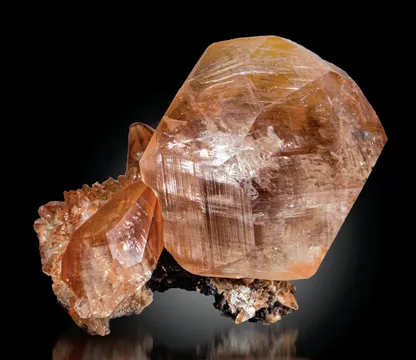
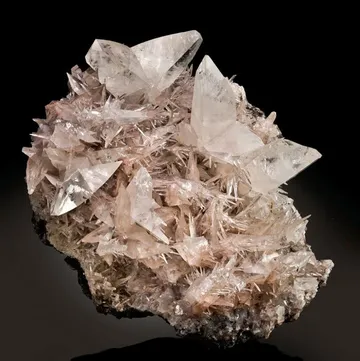
The collector identity of “Daye” is broader than a single mine. Tonglushan is the best-known modern source for calcite and chalcopyrite specimens; Fengjiashan, also long called the Daye copper mine in the specimen trade, is famous for inesite, hubeite, apophyllite, quartz, and calcite; while other Daye-area iron and copper deposits add magnetite, hematite, garnet, diopside, epidote, phlogopite, and other skarn minerals to the district inventory. The visual signature is unmistakable when the material is good: glassy scalenohedral or stacked calcite, commonly flushed red by hematite or iron-oxide inclusions; metallic chalcopyrite that can be brassy, blue-purple, or rainbow-iridescent; and, from Fengjiashan, dark brown hubeite rosettes and blades set among pink inesite, colorless apophyllite, milky quartz, pyrite, and pale calcite.
Daye also carries unusual historical weight. The Tonglushan ancient copper mine, beside the modern open pit, preserves an archaeological record of mining and smelting that reaches back into China’s bronze-making past. Ancient shafts, drifts, drainage works, furnaces, wooden mine supports, tools, ore samples, and slag heaps show that Daye was not simply a modern industrial district later discovered by collectors; it was a copper landscape worked for millennia before the first cabinet specimens entered Western collections.
Regional View
Country View
The district’s specimen quality is tied directly to late hydrothermal overprinting of the skarn. Early prograde garnet-diopside assemblages made the ore architecture; later retrograde and quartz-sulfide stages introduced magnetite, hematite, chalcopyrite, pyrite, pyrrhotite, bornite, quartz, and alteration minerals; still later carbonate-rich fluids produced calcite veinlets, pocket linings, and replacement textures. This succession helps explain why many Daye specimens combine ore-mineral drama with open-space aesthetics: calcite and quartz grew late enough to preserve lustrous crystal faces, while copper and iron minerals supplied the inclusions, coatings, and metallic contrast that make the pieces recognizable across a room.

Photo: Wikimedia Commons
Search for specimens: View all specimens from Daye Co., China
Daye Co. is treated in mineralogical databases as a county-level locality within Huangshi, Hubei, but in modern administrative terms Daye is a county-level city. The mineral localities fall within the Edong mining district, a dense Cu-Fe-Au-Mo-W skarn and porphyry district near the southwestern bank of the Yangtze River. The regional framework is the Middle–Lower Yangtze River metallogenic belt, one of China’s principal iron and copper provinces. In Daye, the critical recipe was the intrusion of Yanshanian igneous rocks into carbonate-dominated sedimentary sequences, especially the Lower Triassic Daye Formation.
The dominant deposit type is skarn. The Daye Formation limestones and dolomitic limestones were intruded by quartz diorite, granodiorite, monzodiorite, quartz monzonite, and related stocks. Contact metamorphism converted carbonates to marble and dolomitic marble; metasomatism then produced calcic, magnesian, and transitional skarns depending on the local wall rock. In the collector-producing systems, garnet, diopside, phlogopite, epidote, amphibole, chlorite, quartz, calcite, magnetite, hematite, pyrite, pyrrhotite, bornite, chalcopyrite, and molybdenite are not random companions but parts of a coherent skarn-to-hydrothermal paragenesis.
Tonglushan, the most familiar Daye name in the calcite and chalcopyrite market, is an active open-cast Cu-Fe deposit near Daye city. It lies at the northern end of the Majiao–Tonglushan anticline and is associated with an Early Yanshanian hornblende quartz monzodiorite to quartz-diorite intrusive center related to the Yangxin batholith. Published studies describe the Tonglushan system as a large Cu-Fe skarn deposit with multiple ore zones and orebodies developed along contacts, fractures, and marble enclaves within the intrusive complex. The orebody geometry is typically lenticular and structurally controlled, with copper-iron ore bodies concentrated close to the intrusion and additional Cu-Au and Mo mineralization developed farther into exoskarn.
The ore mineralogy of Tonglushan explains the specimen palette. Magnetite and hematite dominate much of the Fe-rich ore, while chalcopyrite, pyrite, pyrrhotite, bornite, and locally molybdenite occur with garnet, pyroxene, plagioclase, phlogopite, epidote, chlorite, amphibole, quartz, and calcite. Later quartz-sulfide mineralization was especially important for copper deposition, and the youngest carbonate stage introduced calcite veinlets and pocket growths that cut earlier skarn and sulfide assemblages. Collector calcites from Tonglushan are therefore late-stage products superimposed on a deeply iron- and copper-rich system, which is why hematite or iron-oxide inclusions, chalcopyrite crusts, and sulfide-rich matrices are so characteristic.
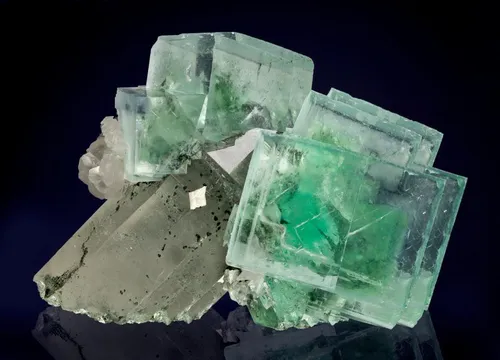
Fengjiashan, another key Daye locality, is a skarn-type iron-copper deposit historically known in the trade as the Daye copper mine. It is the type locality for hubeite and one of the world’s best sources of crystallized inesite. The mine has also yielded apophyllite-group minerals, quartz, calcite, pyrite, hematite, chalcopyrite, helvine, fluorite, galena, native copper, wollastonite, and analcime. Modern notes indicate that the former government-owned copper mine later became privately held and worked for wollastonite, with hubeite-bearing pockets occurring near thick wollastonite veins. Analcime crystals to about 2 cm have also been reported from the mine since 2016.
Other Daye mines and deposits contribute to the broader locality name used by collectors and databases. Jinshandian and its Zhangfushan Fe deposit, Daguangshan, Tongshankou, Yehuaxiang, Jiguanzui, Taohuazui, Xiasifang, Liujiafan, and related Edong localities record the same regional theme: iron, copper, gold, molybdenum, and tungsten mineralization controlled by intrusive contacts, skarn development, fractures, and carbonate host rocks. Not every mine is a major specimen producer, and not every specimen labeled simply “Daye” can be confidently placed without an older label, but the locality designation is mineralogically meaningful because the mines share a common district-scale metallogenic setting.
Mining at Daye is both ancient and modern. At Tonglushan, archaeological mining and smelting are documented from the Western Zhou through Han periods, with later discoveries and excavations revealing shafts, drifts, furnaces, wood-supported workings, tools, ore-processing remains, and vast slag accumulations. Modern industrial mining resumed and expanded in the twentieth century, and the Tonglushan open pit remains associated with China Daye Non-Ferrous Metals Mining and the China Nonferrous Metal Mining Group. Huangshi National Mining Park preserves the former Daye Iron Mine, another emblem of the region’s iron-mining history, while the ancient Tonglushan site museum preserves part of the older copper workings below and beside the modern mining landscape.
Collecting access today should be regarded as restricted. Tonglushan is an active industrial mine and Fengjiashan is a privately controlled working locality; permission, mine safety rules, and local legal requirements are essential. Most specimens available to collectors have reached the market through mine workers, local dealers, Chinese mineral networks, international dealers, and older collections rather than through casual field collecting. For serious buyers, the important label distinctions are “Tonglushan Mine” for most of the modern red-included calcite and chalcopyrite sphere material, “Fengjiashan Mine” for hubeite-inesite-apophyllite-quartz-calcite combinations, and “Daye Co.” or “Daye Mine” for older or less specific material that may require closer scrutiny.
The most important collector finds in recent decades include the Fengjiashan hubeite-inesite-apophyllite pockets around the early 2000s, later pink and red-included calcite from Fengjiashan and Tonglushan, iridescent chalcopyrite-on-calcite combinations that became widely recognized in the 2010s and early 2020s, and the unusual rounded chalcopyrite sphere clusters from Tonglushan that appeared prominently on the market in 2019. Recent dealer and museum records also document Tonglushan calcite crystals with hematite inclusions, calcite with fluorite, calcite with chalcopyrite, chalcocite and djurleite coated by chalcopyrite, quartz-bearing combinations, and high-end large-cabinet calcite specimens.
Calcite is the Daye collector mineral of widest appeal, especially from Tonglushan and Fengjiashan, where late carbonate-stage fluids produced sharp scalenohedra, nail-head rhombs, stacked “pagoda” forms, tabular or bladed-looking aggregates, doubly terminated floaters, and complex multi-generation groups. The best Tonglushan examples are transparent to translucent, colorless, honey, pale cream, peach, pink, or deep reddish brown from hematite or iron-oxide inclusions that may concentrate along edges, vertices, growth zones, or phantom-like internal layers; documented specimens range from small miniatures to cabinet pieces over 15 cm, with individual crystals reported from a few centimeters to at least about 6 cm on dealer-described pieces. Common associations include hematite, goethite or other iron oxides, chalcopyrite, pyrite, quartz, fluorite, chlorite, chalcocite, djurleite, apophyllite, and hubeite depending on the mine and pocket. Fine pieces are judged by undamaged terminations, bright glassy luster, distinct red internal zoning rather than muddy staining, sculptural spacing between crystals, visible sulfide contrast, and a specific mine attribution; ordinary pieces tend to be bruised, cloudy, heavily iron-stained without transparency, or labeled only generically as “Hubei calcite.”
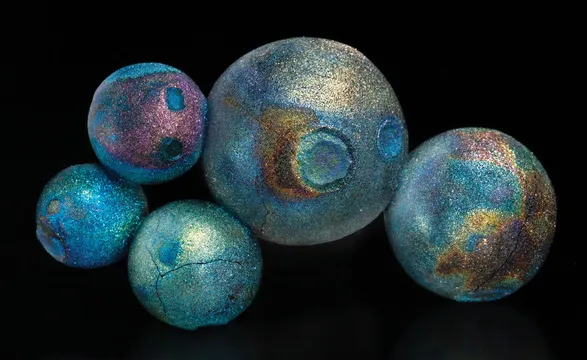
Chalcopyrite from Daye is both an ore mineral and a specimen mineral, occurring in the Cu-rich skarn assemblage at Tonglushan and as an earlier copper ore mineral at Fengjiashan. Collector pieces usually fall into two looks: brassy to iridescent microcrystalline coatings and crystal aggregates on calcite, and the celebrated Tonglushan rounded sphere clusters that appeared on the market in 2019. The calcite-associated material may show small tetrahedral, pseudo-cubic, granular, or botryoidal chalcopyrite groups selectively coating earlier calcite or sulfide-rich matrix, with colors ranging from brass-yellow to blue, purple, bronze, and rainbow iridescence; the sphere clusters are heavy, compact, metallic, and composed of glittering rounded balls that can exceed 2 cm across in major examples. Associations include calcite, pyrite, pyrrhotite, bornite, chalcocite, djurleite, quartz, anhydrite, and skarn gangue. The best chalcopyrite pieces have crisp metallic sparkle, attractive natural iridescence, undamaged rounded forms or sharp microcrystal surfaces, and convincing Tonglushan provenance; altered, acid-brightened, overly rainbow “peacock ore” surfaces, or vague “Daye pyrite” labels deserve caution.
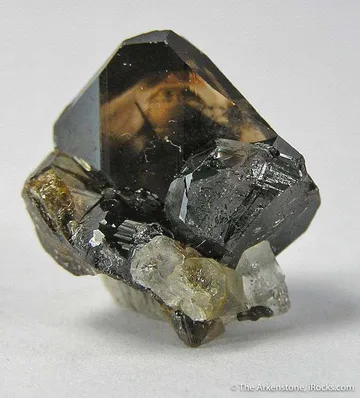
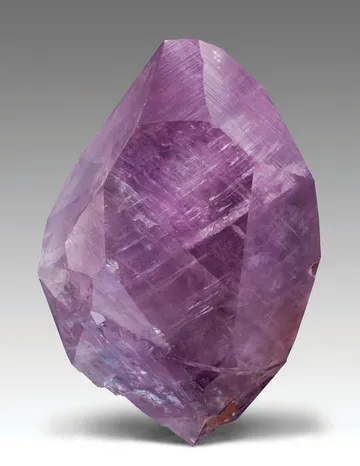
Quartz at Daye is not the headline species by volume, but it is structurally important in the specimen assemblage because it appears in the quartz-sulfide stage of the skarn system and in the Fengjiashan hubeite-inesite-apophyllite pockets. Fengjiashan specimens may show milky to colorless quartz points, jackstraw sprays, or drusy quartz matrices partly covered by brown hubeite, pink to tan inesite, colorless apophyllite, pyrite, and calcite; some older reports and collection notes mention amethystine or smoky-looking quartz associations as well. At Tonglushan, quartz occurs with calcite, fluorite, chalcopyrite, pyrite, chlorite, and copper sulfides, but tends to serve as matrix or accent rather than as the dominant display mineral. Good Daye quartz specimens are those in which quartz provides clean architecture for rarer minerals, especially hubeite and inesite, or sharp contrast with calcite and sulfides; isolated quartz crystals from the district are usually of lesser collector interest unless the form, association, or label is exceptional.
Hematite is fundamental to Daye’s iron-rich skarn ores and is also the coloring agent behind many of the district’s most desirable calcites. At Tonglushan, hematite occurs as an ore mineral with magnetite and other Fe-Cu sulfides, and as fine inclusions or red internal dustings in calcite; at Fengjiashan, hematite is documented in the skarn assemblage and in hematite-tinted calcite specimens, including nail-head and scalenohedral calcite groups. Collector hematite from Daye is rarely sought as isolated mirror-bright blades or “iron rose” specimens; its value is usually relational, producing red phantoms, reddish brown translucency, specks, coatings, or matrix contrast in calcite and quartz-sulfide pieces. The best hematite-related Daye specimens show inclusions that are internal and growth-controlled rather than simple surface dirt, with strong luster on the enclosing calcite; pieces with dull iron staining, friable oxide crusts, or ambiguous “hematite” labels should be considered lower grade.
Beyond these four species, Daye is especially important for hubeite, Ca2Mn2+Fe3+Si4O12(OH)·2H2O, described from Fengjiashan and preserved as type material at the Canadian Museum of Nature. Hubeite occurs in manganiferous skarn as radiating aggregates and small blades or rosettes, typically dark brown to pale brown, associated with inesite, apophyllite-group minerals, quartz, pyrite, and calcite. Fengjiashan also produces some of the district’s finest inesite, usually in pink to orange-pink sprays, sheaves, or bladed groups, along with fluorapophyllite-(K), fluorapophyllite-(Na), hydroxyapophyllite-(K), wollastonite, helvine, fluorite, native copper, galena, analcime, and skarn silicates. Across Daye Co. the documented mineral list expands to more than a hundred valid species, including magnetite, bornite, chalcocite, djurleite, molybdenite, arsenopyrite, sphalerite, pyrrhotite, garnet-group minerals, diopside, epidote, phlogopite, actinolite, chlorite, titanite, zircon, baryte, malachite, azurite, and other copper, iron, and alteration minerals.
The most important authenticity issue at Daye concerns chalcopyrite. The rounded Tonglushan sphere clusters that appeared in 2019 were so unusual that many collectors questioned whether they were artificial, treated, or mislabeled. Analytical work on a Smithsonian specimen confirmed copper iron sulfide consistent with chalcopyrite, with pyrrhotite also reported by X-ray diffraction in preliminary work by outside analysts; polished sections revealed porous chalcopyrite rims, internal concentric regions of tiny copper-iron sulfide spherules, and interstitial anhydrite and calcium sulfide. That does not mean every iridescent “Daye chalcopyrite” on the market is automatically natural or untreated. Brightly colored chalcopyrite and bornite are routinely enhanced in the souvenir trade, and Daye pieces with unnaturally uniform rainbow colors, acid-cleaned brightness, or no credible provenance should be treated carefully.
Mislabelling is common because “Daye,” “Daye Mine,” “Daye Copper Mine,” “Tonglushan,” “Tonglüshan,” “Tonglvshan,” “Fengjiashan,” and occasionally “Baisha” have all circulated on labels. Fengjiashan is often the correct mine for hubeite, inesite, apophyllite, and many older Daye copper-mine silicate combinations; Tonglushan is usually the correct source for the modern hematite-included calcite and chalcopyrite sphere clusters. Older labels may use “Daye Mine” loosely, and some dealers have historically conflated Daye County, Daye District, Ezhou Prefecture, and Huangshi Prefecture. For valuable specimens, preserve every old label and note whether the piece is a district label or a specific mine label.
Condition is a serious grading factor. Daye calcite is soft, easily cleaved, and often occurs as projecting scalenohedral or stacked crystals with exposed tips and edges. Bruised points, rehealed-looking chips, dinged rhomb faces, and broken secondary crystals are common. Red-included calcite should be examined under strong light: the best material has internal hematite or iron-oxide zoning and high luster, while lower-grade pieces are merely surface-stained. Many calcites show minor fluorescence under longwave or shortwave UV, but fluorescence is not the main value driver and varies from specimen to specimen.
Hubeite and inesite combinations require different handling. Hubeite occurs as small, brittle, radiating to bladed crystals and can be damaged by careless dusting. Inesite sprays and apophyllite plates are also vulnerable on exposed matrix. These specimens should be handled by the matrix, kept away from repeated washing, and stored where tiny crystals will not abrade against box lids or mounts. Native copper, chalcopyrite, and other sulfides should be kept dry and stable; avoid aggressive chemical cleaning, which can alter natural tarnish, remove delicate coatings, or create misleading color.
Market availability is uneven. Tonglushan calcite remains available in small to cabinet sizes, with prices driven by clarity, red inclusions, form, condition, and association with chalcopyrite or fluorite. Ordinary Daye calcites can be modestly priced, while large, transparent, strongly included, undamaged examples command much higher prices. Chalcopyrite-on-calcite pieces are less common and more sensitive to aesthetics; rounded chalcopyrite sphere clusters are distinctive and collectible, but provenance and surface naturalness matter. Hubeite is genuinely rare, and rich Fengjiashan hubeite with inesite, apophyllite, and quartz is a specialty-mineral piece rather than a casual locality example.
At Tonglushan, the modern mine and the ancient mine occupy the same mineralized hill in a way that few collecting districts can match. Archaeological work began after ancient workings were discovered during mining activity in the early 1970s. Between 1974 and 1985, rescue excavations exposed a mining and smelting landscape that changed the study of Chinese metallurgical archaeology: roughly 4,923 square meters were excavated; hundreds of vertical and blind shafts, more than a hundred level or inclined drifts, and a dozen furnaces were recorded; and more than a thousand mining tools, smelting tools, ore specimens, and metallurgical samples were recovered. The preserved remains included bronze axes and adzes, iron axes and hammers, wooden and bamboo implements, stone tools, mine timbers, and ore-processing debris.
The museum at the ancient Tonglushan site preserves the most vivid part of that story. In a hall built over the excavation itself, visitors look down on a Spring and Autumn Period mining system where squared timber frameworks, joined with wooden tenons, still mark the ancient shaft structure. The display area preserves about 400 square meters of excavated workings, including 70 vertical shafts, 66 level passages, one blind shaft, and one inclined shaft. Drainage works wind through the workings layer by layer. The effect is not of isolated artifacts in glass cases but of an old mine arrested in place, with the tools displayed close to where they were used and the geological section reconstructed around the base of the hall.
The ancient miners were not simply scraping green copper stain from the surface. Studies of Tonglushan describe open-pit extraction followed by deep underground mining, with shafts, winzes, horizontal and inclined passageways, drainage, ventilation, and lifting systems capable of working ore tens of meters below surface. One technical account describes facilities for water discharge, ventilation, and a well pulley that allowed miners to work 40 to 50 meters underground and hoist raw ore back up. Wooden shovels, hammers, and bamboo baskets found in the tunnels turn the archaeology into a recognizable work scene: timbered passages, ore sorted below ground, low-grade material packed into voids, and selected ore raised toward furnaces at surface.
The scale is astonishing. Archaeological and archaeometallurgical sources describe Tonglushan as a roughly 2-square-kilometer mining and smelting complex with numerous slag heaps concentrated in the central region, estimated in one recent study at around 400,000 tons. Ancient mining traces have been found across most of the ore bodies, and remains of open-pit mining occur on several of them. The site preserves evidence for a long technological sequence from Western Zhou beginnings through Eastern Zhou and Han activity, including both direct treatment of oxidized copper ore and more complex processing of sulfide ore through matte-like intermediate products.
There is a later collector story, quieter but just as memorable for mineral people. Around 2019, clusters of iridescent metallic spheres labeled from Tonglushan entered the mineral market and immediately looked suspicious to many experienced eyes. They were too rounded, too sparkly, too unlike normal chalcopyrite. The Smithsonian acquired one at the 2019 Tucson Gem and Mineral Show and began investigating it. Early analytical work confirmed a copper iron sulfide composition; later polished sections showed porous chalcopyrite rims and internal regions packed with 10–100 micron copper-iron sulfide spherules. The investigation even found calcium sulfide, a phase better known to mineralogists as oldhamite and usually associated with meteorites or unusual terrestrial conditions. What began as a “surely this cannot be natural” market oddity became one of the more interesting modern analytical puzzles attached to a Chinese mineral specimen.