






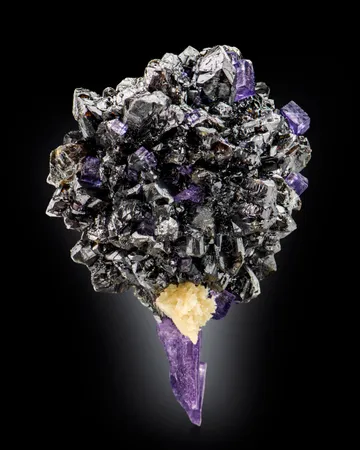
Elmwood Mine, USA - premier Tennessee locality renowned for dark sphalerite, purple fluorite, amber calcite, and white barite, prized by collectors.
Key facts
Elmwood is one of the defining American mineral localities of the late twentieth and early twenty-first centuries: an industrial zinc mine whose finest pockets yielded specimens with the scale, contrast, and sculptural presence normally associated with the great classic districts of Europe. The mine lies near Carthage in Smith County, Tennessee, within the Central Tennessee Ba-F-Pb-Zn district, a Mississippi Valley-type system hosted in carbonate rocks of the Knox Group. Its collector fame rests on a compact but unforgettable assemblage: wine-red to jet-black sphalerite, purple to colorless fluorite, amber scalenohedral calcite, white spherical barite or baryte, subordinate galena, quartz, dolomite, pyrite, marcasite, celestine, and bituminous residues.
The geological reason Elmwood specimens look the way they do is that the ore was not merely fine-grained replacement zinc. Much of the collector-grade material formed in open dissolution cavities and collapse-breccia voids, where sphalerite, fluorite, barite, calcite, quartz, and lesser sulfides had physical room to grow. The best pieces are not simply “large”; they are architecturally alive—dark, resinous sphalerite crystals flashing ruby at thin edges; translucent purple fluorite cubes with etched or zoned surfaces; ivory barite balls perched like snowdrifts; and honey-orange calcite spears, twins, and complex scalenohedrons that can look almost internally lit.
Regional View
Country View
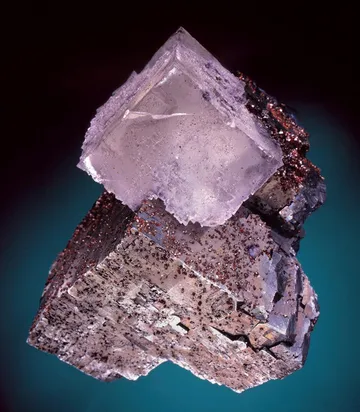
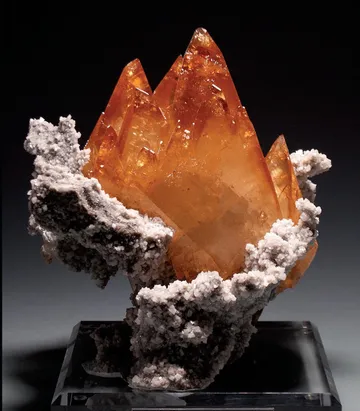
Elmwood’s finest aesthetic style is instantly recognizable: purple fluorite and amber calcite set against black or deep reddish-brown sphalerite, often with white barite or pale dolomite giving the composition a high-contrast “Tennessee classic” look. The mine also produced stranger fluorite forms—etched cubes, stepped faces, hollowed crystals, “Carthage Corner” forms, and internally patterned crystals—that have become a sub-specialty among advanced fluorite collectors.
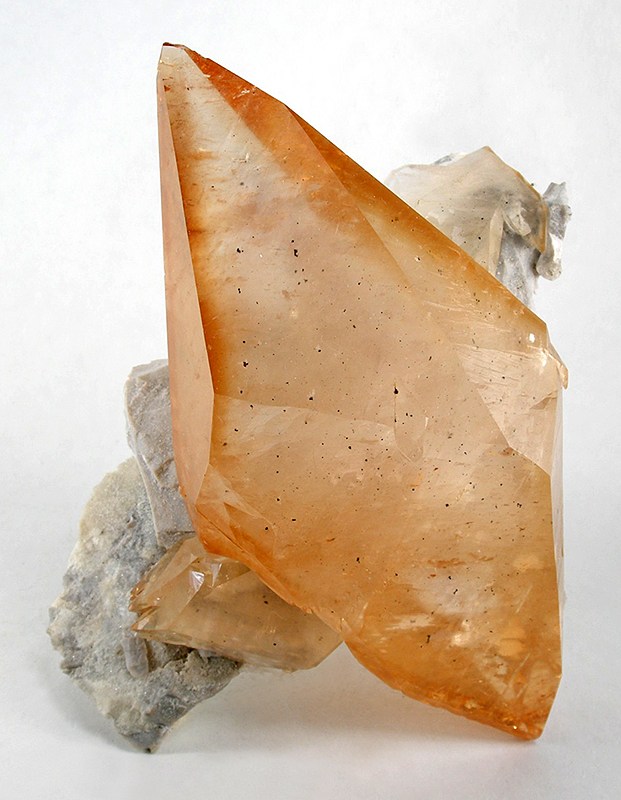
Photo: Wikimedia Commons

Photo:

Photo: Wikimedia Commons
Search for specimens: View all specimens from Elmwood Mine, USA
Elmwood is part of the Middle Tennessee zinc mining complex near Gordonsville, Carthage, Elmwood, and Cumberland in Smith County, Tennessee, roughly 50 miles east of Nashville. The deposit is a classic Mississippi Valley-type zinc system, with mineralization localized in stratabound collapse breccias and dissolution cavities in the Mascot Dolomite of the Knox Group. In the Elmwood mine specifically, much of the ore occurs in the Elmwood upper and lower limestone members. The host sequence belongs to the broad Cambro-Ordovician carbonate package of the Nashville Dome–Cincinnati Arch region, where limestones and dolostones were fractured, dissolved, brecciated, dolomitized, silicified, and then mineralized by low-temperature basinal brines.
The mine’s specimen-producing zones were not isolated geodes in the amateur-collecting sense, but open cavities and breccia voids encountered during zinc mining. Sphalerite was the principal ore mineral. It formed massive breccia-fill material, disseminated grains, and vug-filling crystals. Collector specimens came from the vuggy part of the system, where dark brown to black sphalerite developed large, lustrous crystals with ruby-red internal reflections. Fluorite commonly formed clear to purple rinds and cubes over sphalerite in dissolution cavities, and later open space could be filled or partly lined by calcite and barite. Calcite is the dominant gangue mineral and occurs in more than one generation; the late orange calcite generation is the one most collectors picture when they think of Elmwood.
The discovery story begins with New Jersey Zinc Company exploration in Middle Tennessee. Exploration drilling started in the 1960s, and economic zinc mineralization near Elmwood was identified after a long drilling campaign. A decisive diamond-drill intercept confirmed a high-grade zinc interval, and the company defined a major orebody around the discovery. The Elmwood mill was built in 1973–1974, and full production began in 1975 under Jersey Miniere Zinc Company, a joint venture involving New Jersey Zinc interests and Union Minière. The mine and related Middle Tennessee operations then passed through a sequence of operators and owners, including Union Zinc, Savage Zinc, Pasminco, Mossy Creek Mining, Strategic Resource Acquisition, and Nyrstar.
By the early 2000s Elmwood had already become an international collector classic, and by the 2003 closure it had produced more than 11 million tons of ore at an average grade a little above 3% Zn. Operations were later rehabilitated, and Nyrstar acquired the Middle Tennessee Mines in 2009. Ore from Elmwood was again hoisted through the Gordonsville No. 3 shaft and incline in 2010. The modern mining complex used underground methods including random room-and-pillar mining and, later, longhole open stoping. Production was paused in late 2023, and Nyrstar subsequently sold its U.S. mining and smelting assets, including the Middle Tennessee complex, to Korea Zinc in 2026.
Collecting access today should be treated as closed to the public. Elmwood was an active industrial underground mine, not a fee-dig locality, and worthwhile specimens reached the market through mine-related recovery, commercial specimen arrangements, miners, old collections, and later dealer dispersals. The famous finds came from pockets and breccia cavities exposed by mining, including older Elmwood workings, the north end or OMZ area, and interconnected parts of the Elmwood-Gordonsville-Cumberland complex. Labels sometimes blur those adjacent operations, so the most valuable Elmwood pieces are those with strong provenance, old labels, recognizable style, or documented recovery history.
Elmwood fluorite is famous for purple cubes, lavender to blue-purple crystals, colorless to pale yellow interiors, stepped or etched faces, and the locality’s distinctive dissolution forms; ordinary examples are translucent purple cubes on sphalerite, barite, dolomite, or calcite, while the best pieces show sharp isolation, attractive zoning, gemmy corners, deep purple phantoms, balanced placement on contrasting black sphalerite or white barite, and minimal edge wear. The “Carthage Corner” style—where corners remain glassier or more resistant while faces are etched or hollowed—has become one of Elmwood’s signature fluorite oddities, and advanced collectors also prize rare colorless, blue, very dark “black” purple, hollow, or internally patterned crystals. Fluorite commonly followed sphalerite in the mineral sequence, often coating or rimming it in dissolution cavities before late calcite or barite completed the pocket.
Elmwood sphalerite is the mine’s economic heart and one of its great collector minerals: dark reddish-brown to black, highly lustrous, resinous to almost metallic-looking crystals that often reveal wine-red or ruby internal reflections along thin edges or under strong backlighting. It occurs as massive breccia-fill ore, disseminated grains, and vug-fill crystals; the vug crystals are the collector prizes, especially when they form sharp, complete, isolated crystals or sparkling plates that support fluorite cubes, amber calcite, or white barite. Good pieces are judged by luster, crystal definition, lack of cleaved or bruised faces, red translucency, and the quality of contrast with associated minerals; ordinary ore-like pieces may be historically interesting, but top Elmwood sphalerite has a saturated, “ruby-jack” presence that few other U.S. zinc districts match.
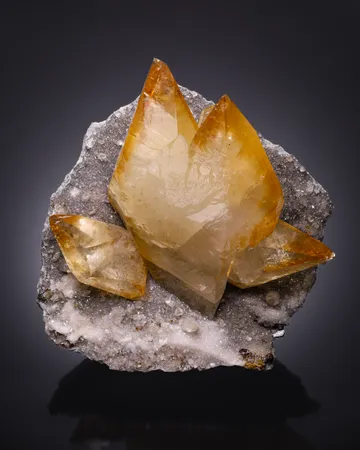
Elmwood calcite is among the locality’s most celebrated products, occurring as amber, golden, orange, tan, milky, and occasionally gray-violet-centered crystals, most famously as large complex scalenohedrons, penetration twins, and doubly terminated crystals on sphalerite, fluorite, barite, dolomite, or limestone breccia fragments. Late-stage orange calcites can exceed 18 inches, and the best cabinet specimens combine transparency, saturated cognac color, sharp undamaged terminations, attractive twinning, and a natural perch on dark sphalerite or purple fluorite. Many lesser calcites are contacted, cleaved, rubbed, or detached from matrix; top Elmwood examples are valued not only for size but for whether the crystal “floats” visually, whether both terminations are complete, and whether the matrix association proves the specimen’s pocket origin rather than looking like a loose crystal placed on ore.
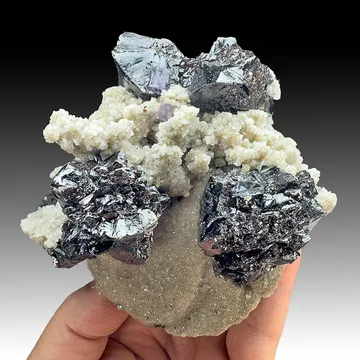
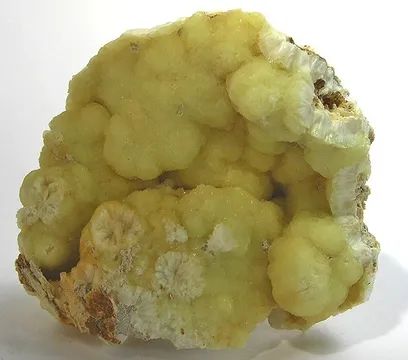
Elmwood barite, commonly encountered on labels using the American spelling, is famous for white to ivory mound-like, hemispherical, spherical, rosette-like, or “snowball” aggregates that sit on sphalerite, fluorite, dolomite, quartz, or calcite-bearing matrix. The classic form is not a transparent bladed barite in the usual sense, but a rounded aggregate that can range from small accents to impressive masses exceeding 10 cm, with fine examples showing clean white color, rounded sculptural form, pleasing contrast against black sphalerite, and no gray handling grime in the surface texture. Good barite pieces from Elmwood are especially attractive when the barite balances rather than smothers the composition—one white mound beside a purple fluorite cube and a dark sphalerite cluster is far more desirable than a shapeless, bruised barite mass.
Baryte is the same mineral species as barite, but Elmwood labels, European dealers, museums, and databases often use the international spelling, so serious collectors should recognize both names when tracing provenance. At Elmwood, baryte is best known as cream-white to ivory ball-like or botryoidal-looking aggregates, sugary druses, and compact rosette masses associated with purple fluorite, black to reddish sphalerite, amber calcite, and quartz-dolomite matrix. Top baryte combinations are judged by architecture: a clean baryte “ball” tucked under a fluorite cube, a calcite twin emerging from white baryte, or a sphalerite cluster rising through baryte has much more collector appeal than massive white material alone; the finest examples retain crisp surface sparkle and natural pocket texture without staining, crushing, or obvious trimming scars.
Elmwood dolomite is usually an association and matrix mineral rather than the star, but it is crucial to the look of many good specimens: pale tan, white, cream, or grayish rhombs and druses lining silicified limestone or breccia fragments, commonly beneath sphalerite, fluorite, calcite, and barite. In the Smith County part of the district, dolomite is not a major breccia cement compared with calcite, but early dolomite crystals and groups occur on quartz and provide attractive sparkling bases for dark sphalerite or purple fluorite. The best dolomite-bearing specimens show fresh, lustrous rhombs, clean contrast, and undisturbed relationships with the other minerals; ordinary examples are simply dolomite-coated matrix, while superior pieces use the dolomite as a visual stage for Elmwood’s main species.
Elmwood galena is much less common than sphalerite, calcite, fluorite, or barite, but it is an important accessory in the district’s Pb-Zn mineralization and a desirable addition when well crystallized. It occurs locally as crystalline masses and large cubes attached to sphalerite or breccia fragments, apparently later than much of the sphalerite and before the end of fluorite deposition. Collector-grade galena from Elmwood is usually valued as part of a rich association rather than as a standalone galena specimen: bright metallic cubic faces, minimal dulling, and a natural position with sphalerite, fluorite, barite, or calcite separate good pieces from ordinary lead-gray masses. Because galena is heavy and can bruise or detach from matrix, intact, sharp cubes on convincing Elmwood matrix are notably scarcer than the mine’s common sphalerite-calcite combinations.
Elmwood quartz is generally understated: drusy quartz and silicified surfaces line breccia cavities, coat fragments, and provide early pocket linings beneath later dolomite, sphalerite, fluorite, calcite, or barite. It is common in the geological sense but seldom collected as the central display species; its value rises when the quartz is bright, clean, and visibly part of the paragenetic story, especially where it forms a sparkling base for sphalerite crystals or supports later fluorite and calcite. Ordinary quartz druse from Elmwood is easy to overlook, but on refined specimens it gives texture to the matrix and helps distinguish natural breccia-cavity pieces from trimmed ore blocks or reassembled combinations.
Other minerals documented from Elmwood include celestine, barium-bearing celestine, strontium-bearing baryte, pyrite, marcasite, bitumen or petroleum residue, silica, and reported vaterite; technical descriptions of the Middle Tennessee deposits also note local celestite in dissolution cavities and bituminous material associated with both ore and gangue minerals. Barium-bearing celestine is one of the locality’s more interesting rarities, described as fibrous white material and sometimes associated with unusual fluorite. Marcasite and pyrite are typically small accessories, with marcasite reported on dolomite and within rims of early calcite. These minor minerals rarely drive the value of a specimen, but they matter because they record the full low-temperature brine system that made Elmwood’s great pockets possible.
Elmwood is heavily collected, well known, and still actively traded, but the mine should not be approached as a collecting site. It is an industrial underground mine within a modern mining complex, and public field collecting is not a realistic or safe expectation. The marketplace supply is a mixture of old-stock material, specimens recovered during earlier mining periods, pieces dispersed from private collections, and material that entered the trade during the Nyrstar-era revival.
The biggest authenticity issue is not an epidemic of completely fabricated Elmwood specimens; it is attribution, repair, and restoration. Nearby Middle Tennessee mines—Gordonsville, Cumberland, Carthage, Stonewall, and related workings—share mineralogy and are sometimes folded into “Elmwood” in dealer shorthand. That may be innocent, but serious buyers should distinguish “Elmwood Mine” from “Middle Tennessee” or “Elmwood-Gordonsville-Cumberland complex” when the label matters. Strong provenance, old collection labels, mine-pocket information, and consistency of mineral habit are especially important on high-value pieces.
Repairs are common enough to check for carefully. Fluorite cleaves cleanly and can be reattached; calcite tips and twins are vulnerable; sphalerite clusters can break away from matrix; and barite balls may detach along weak contacts. Examine suspicious junctions under magnification and side lighting. Look for glossy glue lines, dust-filled seams, mismatched luster, unnatural contact geometry, or matrix grains bridging across a break. Some repaired specimens are acceptable if disclosed, especially large cabinet pieces that could hardly have survived mining and shipping intact, but undisclosed repair is a major value issue.
Calcite condition is critical. Elmwood calcite commonly has contacts, cleaves, bruises, and tiny chips on the sharp terminations. A small tip chip on an otherwise transparent amber twin can change both the visual impact and price dramatically. Acid-dulled or chemically altered calcite surfaces should be treated with caution; natural Elmwood calcite has crisp faces, good luster, and characteristic growth textures, not a uniformly melted or frosted look unless the specimen history clearly explains it.
Fluorite deserves the same scrutiny. Natural etched surfaces, stepped faces, dissolution pits, and “Carthage Corner” forms are part of Elmwood’s appeal, but these features should not be confused with damage, polishing, oiling, or coating. A good Elmwood fluorite can be rough-faced and still excellent if the form is natural and the corners are intact. Backlighting is useful: many dark purple crystals reveal zoning, phantoms, or surprising internal color only when lit from behind.
White barite and pale dolomite show dirt and handling quickly. Avoid aggressive cleaning unless you know exactly what you are doing; calcite is vulnerable to acids, fluorite has perfect cleavage, and sphalerite can detach from weak contacts. A gentle dusting and careful display usually do more good than chemical intervention. Large Elmwood specimens can also be heavy, unbalanced, and brittle along breccia contacts, so custom bases and vibration-free display shelves are not luxuries—they are preservation.
Market availability remains healthy because Elmwood produced substantial quantities of specimen material and because many collections contain examples, but top pieces are increasingly selective purchases. Common small sphalerite-calcite or fluorite-sphalerite specimens remain obtainable. Fine large calcite twins, balanced fluorite-barite-sphalerite combinations, unusual fluorite oddities, clean barite balls, and documented old-pocket specimens command a significant premium.
The discovery of Elmwood reads like a patient geologist’s wager finally paying off. New Jersey Zinc’s Middle Tennessee exploration did not begin with a glittering pocket or a lucky prospector’s outcrop; it began with subsurface clues from oil and gas test holes, broad regional thinking, and years of drilling. Company geologists spread holes across the country rock on what later reports called the “Random Walk” of exploratory drilling. The 79th drill hole finally cut major economic zinc mineralization near Elmwood, but the decisive confirmation came with the 106th diamond-drill hole, numbered 4-43-9: 5.1 meters running 18.5% Zn. After that, the work became a campaign. A 3,000-meter grid was laid out around the discovery, 100 holes were drilled on 300-meter centers, and the original press release estimate announced a 45-million-ton deposit. At one stage, New Jersey Zinc had 21 drill rigs working the district.
Collectors were watching almost from the beginning. In 1969, when news of the Tennessee zinc discovery first reached mineral-club readers in New Jersey, the hope was simple: perhaps the new deposits would be well crystallized. By early 1977 that hope had become reality. The Picking Table reported that Elmwood’s first shaft had reached 1,300 feet, two more shafts were down, and an inclined tunnel was being driven so large equipment could enter without being disassembled. Then came the line that must have made every collector sit up: the cavities were “some larger than an adult collector,” lined with calcite, sphalerite, barite, galena, and fluorite. The report added that arrangements had been made with a commercial collector to recover the newly discovered specimens—and, with charming realism, that the miners would help.
By December 1984, Elmwood material was already creating the sort of private-room memory that becomes hobby folklore. A collector traveling with Dalton and Consie Prince described going to a miner’s house near Elmwood, where the Princes bought “a whole room full” of choice specimens laid out on the floor. The group flew in through Nashville and shipped the minerals out afterward. The remembered scene is wonderfully concrete: not a museum case, not a dealer booth, but an entire room in a Tennessee house carpeted with golden calcite, purple fluorite, dark sphalerite, and pale barite from a mine then in its prime.
A later chapter belongs to the professional specimen crews. In 1996, Top Gem Minerals received a contract from Savage Zinc to collect specimens from the Elmwood complex, including Elmwood, Gordonsville, and Cumberland. Mark Kielbaso recalled working with Brian “Big B” Stefanec, Bryon “Medium B” Brookmyer, and Brian “Little B” Huntsman—the “killer B’s”—over three years in the workings. Their experience links Elmwood to a broader tradition of contract collecting in operating mines: dirty, logistical, time-limited work in places where the ore came first and specimens had to be recovered when mining exposed them.
One of the best visual records of that era is the Road Train Pocket footage from 1997, filmed in the north end or OMZ area of Elmwood while Savage Zinc owned the complex. In the video, Joe Kielbaso shows large Elmwood specimens being extracted from a major pocket: barite, calcite, fluorite, and sphalerite coming out not as abstract “mineral specimens,” but as fragile pocket architecture that had to be separated from an active mine environment. That is the essential Elmwood paradox. Its specimens look composed and elegant in cabinets, yet many were born in breccia voids deep underground and rescued from an orebody whose normal destiny was crushing, concentration, and smelting.

_2_(33750777303).jpg)
